
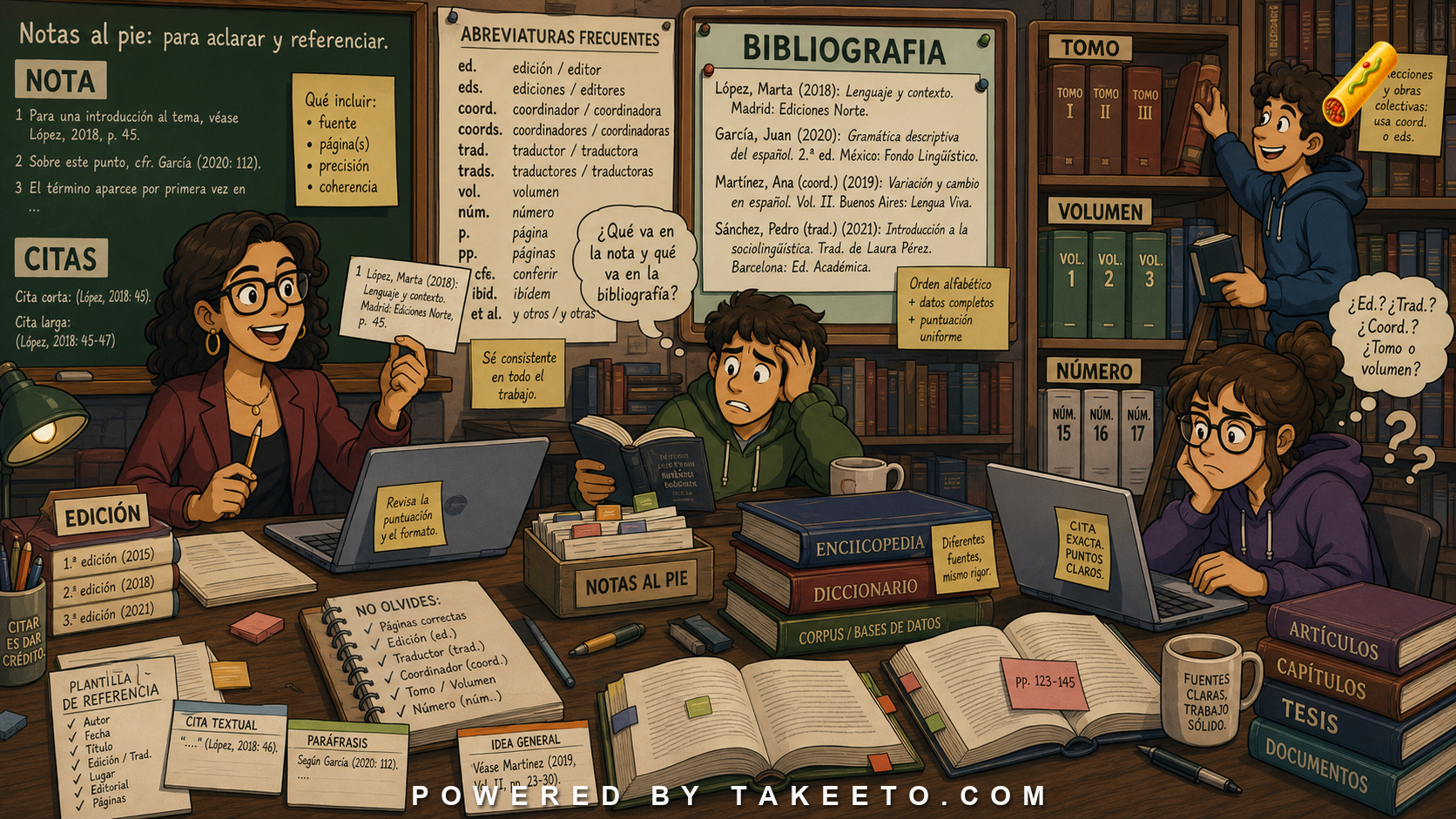
Citations are a language system
Spanish academic texts do not only cite sources; they use a specialized vocabulary for editions, pages, volumes, translators, editors, footnotes, archival references, and bibliographies. A learner may understand the main prose but get lost in the apparatus: the notes, abbreviations, references, and bibliographic labels that tell you where knowledge comes from.
The key principle is:
Footnotes and bibliographies are structured Spanish data, not decorative academic clutter.
If you learn to read them, you gain access to source type, edition history, authorship, translation, and scholarly reliability.
Nota, nota al pie, nota final
Nota is a note. In academic writing it may be explanatory, bibliographic, archival, or argumentative.
nota al pie — footnote
nota final — endnote
llamada de nota — note marker/callout
aparato crítico — critical apparatus
Examples:
Véase la nota 12.
See note 12.
En nota al pie, la autora aclara el uso del término.
In a footnote, the author clarifies the use of the term.
Footnotes can do different jobs:
- Give a source.
- Add a qualification.
- Define a term.
- Point to related literature.
- Explain a translation choice.
- Provide archival information.
- Carry a side argument.
Learners should not skip notes automatically. In history, law, literary studies, and philology, notes may contain essential information.
Bibliografía, referencias, obras citadas
Spanish texts may label the source list in several ways.
bibliografía — bibliography
referencias — references
obras citadas — works cited
fuentes — sources
fuentes primarias — primary sources
fuentes secundarias — secondary sources
Bibliografía may include works consulted, not only works cited, depending on style. Referencias usually implies cited references. Obras citadas is closer to “works cited.”
Example:
La bibliografía distingue entre fuentes primarias y estudios críticos.
The bibliography distinguishes between primary sources and critical studies.
A serious reader asks:
Is this list only cited works, or broader reading? Does it separate primary sources from secondary scholarship?
Author, editor, coordinator, translator
Bibliographic entries encode roles.
Common labels and abbreviations:
autor / autora — author
editor / editora — editor
ed. — editor, edition, or edited by depending on context
coord. — coordinator/editor of a collective volume
comps. — compilers/editors
trad. — translator
pról. — prologue/preface by
introd. — introduction by
The abbreviation ed. is tricky. It may mean editor, edición, or editado por depending on position.
Examples:
Juan Pérez, ed.
Juan Pérez, editor.
2.ª ed.
second edition.
ed. crítica
critical edition.
Coord. is common in Spanish-language edited volumes:
María López (coord.), Lenguaje y sociedad.
María López, coordinator/editor of the volume.
Do not translate coordinador literally as someone who merely scheduled meetings. In publishing, it often means volume editor.
Edition vocabulary: edición, reedición, edición crítica
Edición may refer to an edition, publishing instance, or editorial preparation.
Terms:
primera edición — first edition
segunda edición — second edition
edición revisada — revised edition
edición aumentada — expanded edition
reedición — reissue/new edition
edición crítica — critical edition
edición facsimilar — facsimile edition
Example:
Se cita la edición crítica de 1998.
The 1998 critical edition is cited.
A critical edition may include textual variants, notes, introduction, and editorial decisions. It is not merely a “critical” review.
Volume, issue, pages
Journal and book references use compact labels.
volumen / vol. — volume
número / núm. / n.º — issue/number
tomo — volume/tome, often in multi-volume works
páginas / pp. — pages
capítulo — chapter
apartado — section/subsection
Example:
Revista de Lingüística, vol. 12, núm. 2, pp. 45–67.
Journal of Linguistics, volume 12, issue 2, pages 45–67.
Tomo appears often in older scholarship, encyclopedias, legal compilations, and multi-volume works.
tomo III
volume III
Cross-reference phrases
Footnotes often use compressed reference language.
véase — see
véase también — see also
cfr. / cf. — compare, consult
ibid. / ibídem — in the same place/source
op. cit. — in the work cited
loc. cit. — in the place cited
Modern styles often avoid some Latin abbreviations, but older or humanities texts may use them.
Example:
Véase también González, 2016.
See also González, 2016.
Cfr. does not always mean “this source says exactly the same thing.” It may mean compare or consult.
Citation styles differ
Spanish academic writing may follow APA, Chicago, MLA, ISO, journal-specific guidelines, legal citation conventions, or national academic styles. Humanities texts may use footnotes heavily; social sciences may use parenthetical author-date references; law may have dense legal references; history may cite archives.
Do not assume one universal Spanish citation system.
A learner should identify the style before interpreting abbreviations.
Questions to ask:
Are sources cited in footnotes or parenthetically?
Does the bibliography include URLs or DOIs?
Are archival documents cited separately?
Are editions or translations named?
Are page numbers required for quotations?
Source type encoded in the reference
Bibliographic entries can tell you whether a source is a book, chapter, article, thesis, archival document, legal text, web page, or edited volume.
Clues:
En — in, often before edited volume or journal
tesis doctoral — doctoral dissertation
artículo — article
capítulo — chapter
actas — proceedings
manuscrito — manuscript
archivo — archive
disponible en — available at
Example:
En M. López (coord.), Estudios de pragmática, pp. 101–122.
In M. López (ed.), Studies in Pragmatics, pages 101–122.
The En tells you the cited work is a chapter inside a larger work.
Example bank walkthrough
nota
Academic note.
Learner action: determine whether it gives a source, explanation, or argument.
bibliografía
Bibliography/source list.
Learner action: check whether it includes all consulted works or only cited works.
edición
Edition.
Learner action: distinguish edition number from editor role.
tomo
Volume in a multi-volume work.
Learner action: watch for Roman numerals.
volumen
Volume, especially journals and books.
Learner action: pair with número and páginas.
número
Issue/number.
Learner action: not always a page number.
páginas
Pages.
Learner action: recognize pp. and p.
coord.
Coordinator/editor of a collective volume.
Learner action: treat as publication role, not general office coordinator.
trad.
Translator.
Learner action: note when you are reading a translation, not the original language.
ed.
Editor or edition.
Learner action: interpret by position in the entry.
Citation-reading workflow
When decoding a Spanish reference:
- Find the author or responsible person.
- Identify the year.
- Identify title of article/chapter/book.
- Look for En to see whether it is inside another work.
- Identify editor/coordinator/translator roles.
- Read volume, issue, and page labels.
- Check edition information.
- Note source type: book, article, chapter, thesis, archive, web.
- Treat abbreviations contextually.
- Use notes to understand scholarly positioning.
Remediation: a citation is not just a name in parentheses
Footnotes, endnotes, and bibliographies encode source type, scholarly relationship, and editorial responsibility. Learners often treat them as visual clutter. That is a mistake. A citation can tell you whether the text cites a book, article, chapter, edited volume, translation, critical edition, archive item, or digital resource. It can also tell you whether a person wrote, edited, translated, coordinated, compiled, or introduced the work.
The first remediation habit is to label roles:
autor/a — wrote the work.
editor/a — prepared or edited a volume or edition.
coord. — coordinator of an edited collection.
trad. — translator.
comp. — compiler.
pról. — prologue/introduction author in some entries.
dir. — director, editor, or dissertation director depending on context.
Do not assume ed. always means “edition” or always means “editor.” Context and style determine it. In Spanish bibliographic practice, abbreviations are efficient but dangerous when read mechanically.
Anatomy of a bibliographic entry
Consider:
Paredes, Ana. La ciudad escrita. 2.ª ed., Madrid, Fondo Sur, 2018.
Possible labels:
Paredes, Ana = author
La ciudad escrita = title
2.ª ed. = second edition
Madrid = place of publication
Fondo Sur = publisher
2018 = year
Now compare:
Ramos, Julia, coord. Lecturas de archivo. Bogotá, Umbral, 2020.
Here coord. indicates that Julia Ramos coordinated an edited volume. She may not have written every chapter. If a chapter inside that volume is cited, the entry may include both chapter author and volume coordinator.
A learner should not translate citation entries before identifying their parts. Citation literacy is structured data reading.
Footnotes as argument, not storage
Footnotes can serve different functions:
source citation, explanation, qualification, counterargument, archive reference, translation note, edition note, historiographic aside.
A footnote that begins Véase often directs the reader to another source. Cfr. invites comparison. Ibíd. points to the immediately preceding source in some note systems. op. cit. refers back to a previously cited work, though many modern styles avoid it. s. f. means no date. s. l. means no place. núm. is number/issue. pp. pages. t. may be tomo.
Learners should ask:
Is this note supporting the claim, adding context, limiting the claim, or pointing me elsewhere?
Not every footnote is equally important for comprehension. Some are essential evidence; others are bibliographic maintenance.
Mini-workshop: decode a citation note
Read this note:
Véase también M. Salazar, “Prensa y nación en el siglo XIX”, en R. Molina (coord.), Historia cultural de la lectura, vol. 2, núm. 4, pp. 115–139.
Decode:
Véase también = see also, additional support.
M. Salazar = author of the chapter/article.
“Prensa y nación en el siglo XIX” = article/chapter title.
en R. Molina (coord.) = inside a coordinated/edited volume.
Historia cultural de la lectura = container title.
vol. 2, núm. 4 = volume and issue/number depending on publication type.
pp. 115–139 = page range.
The note tells you not only what source exists, but how the source is nested.
Style systems and local variation
Spanish academic writing does not have one universal citation system. Humanities disciplines may use footnotes heavily. Social sciences may prefer author-date systems. Journals impose local styles. Spain and Latin America share many conventions but differ in institutional habits, punctuation preferences, capitalization, and abbreviation frequency.
A good learner does not ask, “What is the Spanish citation rule?” Instead ask:
Which discipline? Which journal? Which style guide? Which country? Which source type?
For Takeeto purposes, the goal is not to memorize every style. The goal is to read citations well enough to recover source type, role, date, and location. That is enough to prevent most beginner and intermediate confusion.
Remediation drill: distinguish source, container, and location
Many citation mistakes come from confusing three things: the source itself, the container where it appears, and the location within that container.
For a chapter:
source = chapter
container = edited book
location = page range
For a journal article:
source = article
container = journal issue
location = volume, issue, pages
For an archival document:
source = document
container = collection/fonds/box/file
location = folio, image number, or reference code
Spanish labels help you identify these layers:
en often introduces the container
coords. or eds. identify editorial responsibility
pp. gives page range
fol. / ff. may identify folio(s)
sign. / signatura may identify shelfmark
Mini-practice:
López, Marta. “La memoria oral.” En Archivos y nación, coord. Luis Vera, 55–78. Bogotá: Norte, 2019.
Decode:
Marta López wrote the chapter. Archivos y nación is the book. Luis Vera coordinated the volume. The chapter appears on pages 55–78.
This prevents the common error of attributing the chapter to the coordinator.
Suggested interactive module: citation label decoder
A strong tool for this article would parse bibliographic entries into fields.
Suggested functions:
- Abbreviation decoder: coord., trad., ed., vol., núm., pp.
- Source-type classifier: book, article, chapter, thesis, archive.
- Role map: author, editor, translator, coordinator.
- Edition warning: ed. as editor vs edition.
- Footnote function tagger: source, explanation, cross-reference, qualification.
- Style comparison: footnote style vs author-date style.
Final rule
Spanish citations are not noise at the bottom of the page.
They encode authority, source type, edition, translation, page location, and scholarly relationship. Learn nota, bibliografía, edición, volumen, número, coord., trad., and ed. as part of academic Spanish. When you can read the apparatus, you can judge the text more intelligently.