
Spanish becomes clearer when you have the right tools
A serious learner eventually notices that ordinary grammar labels are not enough. Why does b sound different in un beso and la boca? Why can se mean so many things? Why is usted formal in one place and intimate in another? Why can aunque venga and aunque viene both exist with different stance?
You do not need a graduate degree to ask these questions well. You do need a minimal toolkit.
The key principle:
Linguistic categories do not replace Spanish examples; they make Spanish examples easier to analyze.
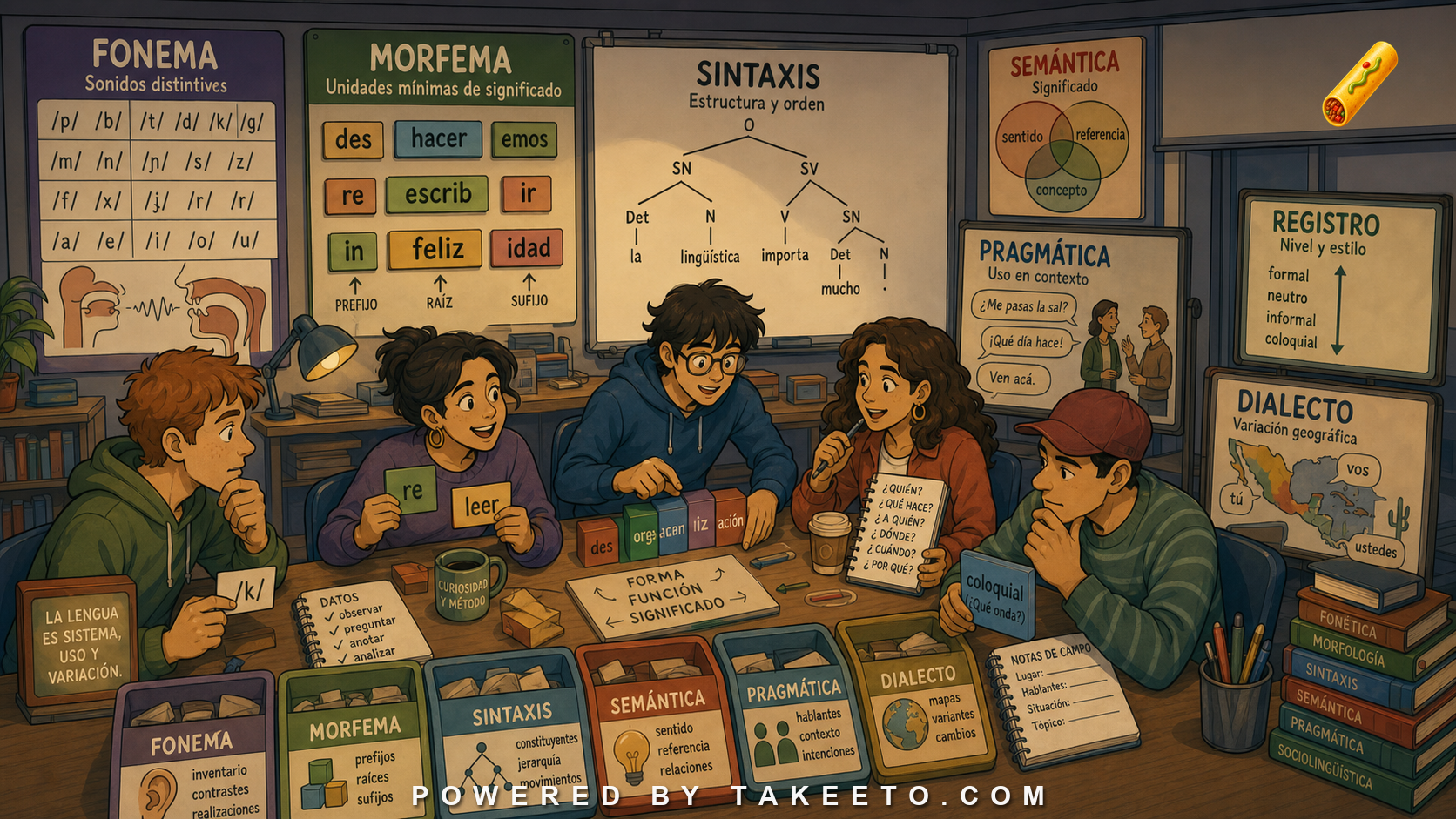
This article gives the smallest useful set: phoneme, allophone, morpheme, syntax, semantics, pragmatics, dialect, and register.
Phoneme: sound contrast in the language system
A fonema is a sound category that can distinguish words in a language.
In Spanish, /p/ and /b/ contrast:
pala
bala
The difference matters. A speaker cannot freely swap them without changing meaning.
The tap and trill r contrast in many positions:
pero
perro
The written forms show different meanings, but the key fact is spoken: the tap and trill can distinguish words.
Learner action: learn which sound differences Spanish uses to distinguish words and which differences are contextual variants.
Allophone: predictable pronunciation variant
An allophone is a variant of a phoneme that appears in certain contexts.
Spanish b, d, and g often have stop-like pronunciations after a pause or nasal and softer approximant pronunciations between vowels.
Compare:
un beso
la boca
The written b is the same letter, but the sound can differ by context. This is not sloppiness. It is Spanish phonetics.
Learner action: do not pronounce every written letter with the same English-like value. Learn contextual pronunciation.
Morpheme: meaningful form piece
A morpheme is a meaningful unit of form.
In hablábamos, several pieces carry information:
habl-
verb root
-ába-
imperfect marker
-mos
first-person plural
In niñas, the ending marks feminine and plural:
niñ-
lexical root
-a-
feminine
-s
plural
Morpheme analysis helps learners see that Spanish words are built, not memorized as opaque blocks.
Syntax: how words combine
Syntax studies how words form phrases and clauses.
Spanish syntax explains why these are different:
Me gusta el café.
I like coffee.
Me gustan los libros.
I like books.
The English translation has I as subject. The Spanish subject is el café or los libros. The verb agrees with the thing liked.
Syntax also helps with word order:
Juan compró el libro.
El libro lo compró Juan.
Both can be grammatical, but the second changes information structure and emphasis.
Semantics: meaning inside the system
Semantics studies meaning.
It helps explain why two translations are not identical:
saber
know a fact / know how
conocer
know a person/place/work / be familiar with
It also helps with verbs of change:
ponerse nervioso
become nervous
hacerse médico
become a doctor
volverse difícil
become difficult
All may translate as “become,” but Spanish divides change by state, identity, agency, duration, and result.
Pragmatics: meaning in use
Pragmatics studies what language does in context.
Compare:
¿Puedes cerrar la ventana?
Can you close the window?
Literally it asks about ability. Pragmatically it is often a request.
Compare:
Disculpe.
Perdón.
Lo siento.
All can relate to apology or repair, but they do different social work depending on context: attention-getting, interruption, sympathy, mistake repair, or formal address.
Pragmatics explains why correct grammar can still sound rude, distant, overly familiar, or strange.
Dialect and register are not mistakes
A dialect is a regional or social variety of a language. A register is a style suited to a situation.
Dialect examples:
vos tenés
tú tienes
usted tiene
Register examples:
dame el documento
¿podrías enviarme el documento?
le agradecería que me remitiera la documentación
A linguistics student must separate three questions:
- Is this grammatical in some Spanish variety?
- Is it appropriate in this register?
- Is it a good production target for this learner?
Those are not the same question.
Minimal toolkit does not mean minimal seriousness
The categories in this toolkit are small enough to start using immediately, but they are not shallow. Each one prevents a common learner mistake. Fonema prevents spelling-based pronunciation myths. Morfema prevents treating every conjugated form as a separate word. Sintaxis prevents English word order from dominating analysis. Semántica prevents one-word translation traps. Pragmática prevents socially inappropriate but grammatical Spanish. Dialecto prevents lazy judgments about regional speech. Registro prevents the belief that one form is always best.
The habit is simple: when you meet a Spanish problem, classify what kind of problem it is. Is it a sound problem, a word-building problem, a sentence-structure problem, a meaning problem, a social-use problem, a regional variation problem, or a style problem? That classification often points directly to the next resource you need.
Example bank walkthrough
fonema
Contrastive sound category.
Learner action: study minimal pairs like pero/perro.
morfema
Meaningful form unit.
Learner action: break verbs and nouns into meaningful pieces.
sintaxis
Sentence structure.
Learner action: analyze subjects, objects, complements, and clause relations.
semántica
Meaning.
Learner action: distinguish near-synonyms by meaning domain.
pragmática
Meaning in social context.
Learner action: ask what the sentence is doing, not only what it says.
dialecto
Language variety.
Learner action: describe variation before judging it.
registro
Situation-based style.
Learner action: choose forms according to audience, medium, and purpose.
Description before correction
A linguistics toolkit also trains intellectual discipline. Before deciding whether something is “wrong,” describe what is happening.
Example:
A Juan le vi ayer.
A quick correction might say that standard production should use lo vi in many learner targets. A better analysis asks: Is this leísmo? Where is it used? Is the object masculine, singular, and personal? Is the context Spain, formal writing, or a learner exam? What target variety is being taught?
Description does not eliminate norms. It makes correction more accurate. For serious Spanish study, the order should often be: observe, classify, locate, compare, then decide on a production target.
Remediation notes: linguistic labels should sharpen observation, not become weapons
The main repair is to stop presenting linguistic terminology as prestige vocabulary. Terms such as fonema, morfema, sintaxis, semántica, pragmática, dialecto, and registro are useful only when they help the learner observe Spanish more accurately. A label that does not improve analysis is decoration.
A minimal toolkit should train evidence discipline. Before saying a form is wrong, the student should ask: What data do I have? Who produced it? In what region? In what register? Is it speech, writing, literature, official language, casual texting, or learner Spanish? Is the issue pronunciation, morphology, syntax, meaning, politeness, or spelling? This prevents the common novice move of turning one classroom target into a universal judgment.
The article should also clarify descriptive and prescriptive work. Descriptive analysis asks what speakers do and how the system works. Prescriptive guidance asks what form is expected in a particular standard, exam, publication, or institution. Both are legitimate. The mistake is to pretend they are the same. For example, le vi can be described as leísmo in some varieties. A learner may still choose lo vi as the safest international production target in many contexts. Good analysis makes the production choice more precise.
The toolkit also needs example size. One sentence rarely proves a rule. A student who sees se venden casas, se vive bien, se me cayó, and se lo di must not conclude that se has one meaning. The right move is to build categories and compare. Linguistics is not a magic label machine; it is a habit of controlled comparison.
Production target: for every confusing example, write five tags: sound/spelling, form, sentence structure, meaning, and social use. Then decide whether the issue is a learner production target, a regional variant, a register difference, or a true misunderstanding. The toolkit earns its place only when it makes correction more careful.
Suggested interactive module: linguistics concept map with Spanish examples
A strong tool for this article would connect terms to live Spanish data.
Suggested functions:
- Term cards: phoneme, allophone, morpheme, syntax, semantics, pragmatics, dialect, register.
- Spanish examples: each term illustrated with real sentence pairs.
- Analysis mode: user labels what kind of issue a sentence shows.
- Dialect/register toggle: compare grammar, appropriateness, and learner target.
- Minimal-pair audio: phoneme practice.
- Morpheme splitter: verb and noun forms.
- Pragmatics scenarios: request, apology, greeting, disagreement.
Final rule
A small linguistics toolkit makes Spanish less mysterious.
Use phoneme and allophone for sound, morpheme for word structure, syntax for sentence structure, semantics for meaning, pragmatics for use, dialect for variety, and register for situation. The terms matter because they sharpen what you notice.