Contact vocabulary carries history
Spanish in the Americas did not enter empty land. It entered territories with established languages, names, foods, political systems, trade networks, ecological knowledge, and cultural categories. Spanish speakers adopted many Indigenous words because they needed names for plants, animals, foods, tools, places, social roles, and realities that European Spanish did not already name.
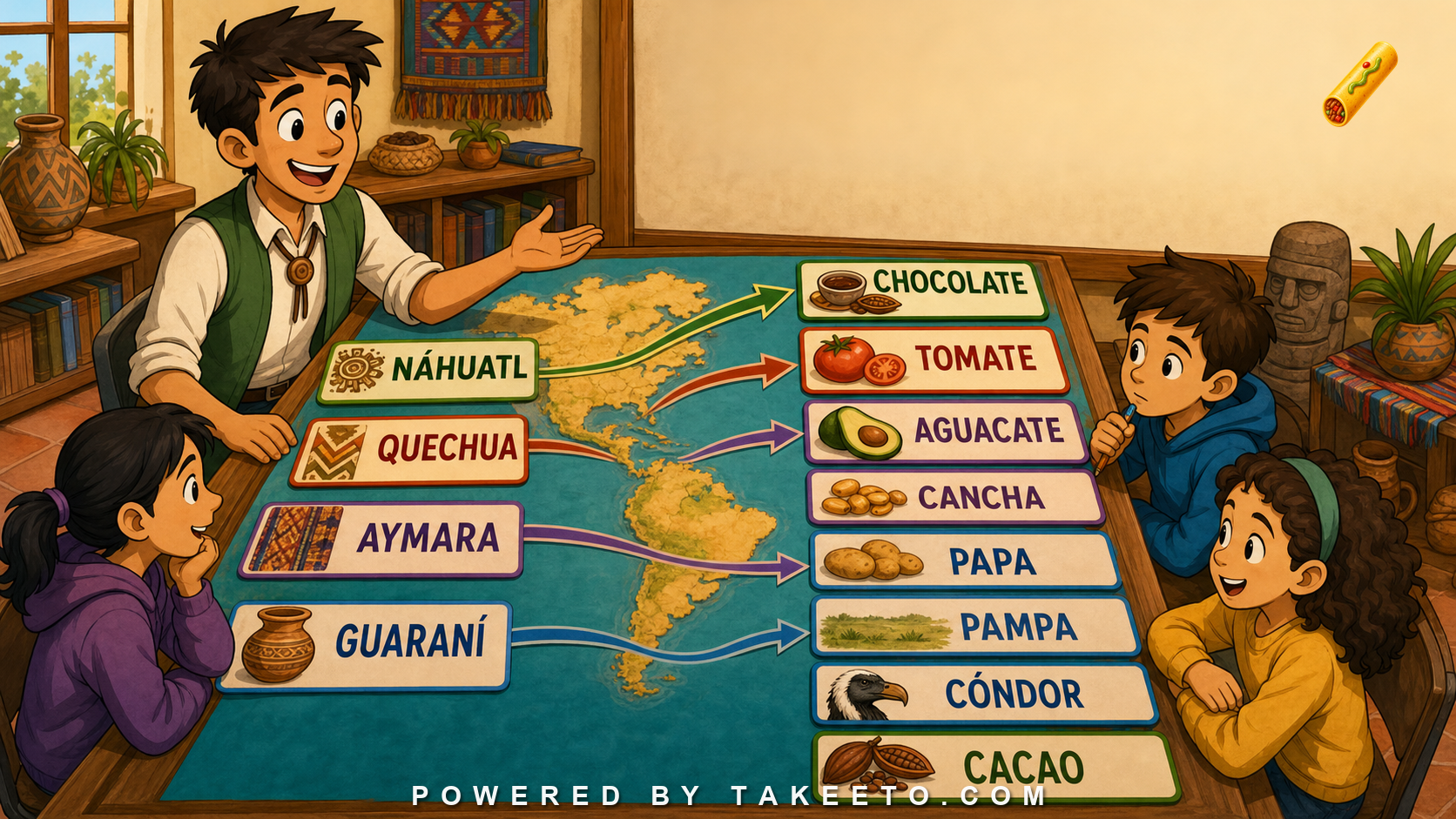
The result is visible every day:
chocolate
tomate
aguacate
cacao
papa
cancha
cóndor
pampa
These words are not decorative cultural trivia. They are evidence that American Spanish was built through contact.
The key principle is:
Indigenous influence on Spanish is strongest and easiest to document in vocabulary, while structural influence must be discussed carefully and with evidence.
This article teaches contact literacy without romantic exaggeration.
Nahuatl and Mesoamerican loans
Many familiar Spanish words come from Nahuatl or other Mesoamerican language contexts, sometimes through complex transmission.
Examples:
chocolate
cacao-based drink/product
tomate
tomato
aguacate
avocado
cacao
cacao
chile
chili pepper
coyote
coyote
These words spread far beyond their original regions. A speaker in Spain or Argentina may use chocolate without thinking of Nahuatl. That is how successful loanwords work: they become ordinary.
Learner action: when a food word looks “international,” check whether it may have moved from an Indigenous American language into Spanish and then outward.
Quechua, Aymara, and Andean loans
Andean contact contributed many words, especially in geography, food, agriculture, animals, and regional life.
Examples:
papa
potato
cancha
field, court, toasted corn in some regions
cóndor
condor
pampa
plain/open land
llama
llama
Some words remain regional. Others become pan-Hispanic or international. Papa is widely used for potato in much of the Americas, while patata is common in Spain and some contexts. Cancha can mean a sports field, court, arena, or a food item depending on region.
Learner action: do not assume an Indigenous-origin word has the same meaning everywhere.
Guaraní and regional ecology
Guaraní influence is especially important in Paraguay and surrounding regions, and Guaraní itself remains a major living language. Contact vocabulary includes words for animals, plants, foods, and regional cultural life. Some terms remain local; others circulate more widely.
The important point is not simply that Spanish “borrowed words.” In some regions, bilingualism and long contact created deep interaction between Spanish and Indigenous languages. That contact can affect discourse patterns, address, pragmatic particles, and local identity.
Learner action: treat living Indigenous languages as present, not only historical sources of old words.
Place names preserve older maps
Toponyms often preserve Indigenous language history. Names of cities, rivers, mountains, regions, and countries may come from Indigenous languages, sometimes filtered through Spanish spelling and colonial administration.
A place name may be Indigenous in origin but fully integrated into Spanish grammar:
Guatemala
Bogotá
México
Oaxaca
Cuzco / Cusco
Paraguay
Learners should avoid folk etymologies. Place-name origins can be debated, layered, or uncertain. The responsible move is to say “often analyzed as,” “traditionally derived from,” or “of Indigenous origin” when evidence supports it, and to avoid invented stories.
Structural influence: be careful
Vocabulary loans are visible. Structural influence is harder. Scholars have debated Indigenous-language effects on Andean Spanish, Paraguayan Spanish, Mexican Spanish, and other varieties. Possible areas include evidentiality, object pronouns, word order, diminutives, aspect, discourse markers, and phonology. But influence claims require evidence.
A learner should not say “Andean Spanish uses X because of Quechua” unless a reliable source supports that specific claim. Contact does not automatically explain every difference. Some features may arise internally, from Spanish dialect history, from bilingual transfer, from sociolinguistic leveling, or from multiple causes.
The responsible formula is:
Indigenous contact may help explain this feature, but the claim needs regional and historical evidence.
Loanwords move and change
A borrowed word can change sound, spelling, meaning, and social status. Aguacate and English avocado are related historically, but they are not the same word in modern usage. Cancha may mean a sports field in one place and toasted corn in another. Papa may be ordinary in one country and contrast with patata elsewhere.
Borrowed words also enter metaphor. Cancha can produce expressions about experience or skill. Pampa can become a literary or national landscape term. Contact vocabulary becomes part of the symbolic life of Spanish.
Example bank walkthrough
chocolate
A major Mesoamerican-origin word that became international.
Learner action: recognize how food vocabulary carries contact history.
tomate
Another widely spread American plant word.
Learner action: note that global familiarity can hide Indigenous origin.
aguacate
A Nahuatl-origin word in Spanish, with different international descendants.
Learner action: compare Spanish forms with English avocado cautiously.
cancha
Often linked to Quechua; meanings vary by region.
Learner action: check whether it means court, field, arena, or food.
papa
Potato in much of American Spanish.
Learner action: contrast with patata in Spain and certain registers.
pampa
Open plain/landscape word associated with South America.
Learner action: read geographic words as cultural terms, not just dictionary entries.
guaraní
A language, people, and identity term; also the name of Paraguay’s currency.
Learner action: remember that Indigenous languages are living languages.
cóndor
Andean bird name that entered broader Spanish and international vocabulary.
Learner action: connect vocabulary to ecology.
cacao
Food/agricultural word with global reach.
Learner action: study food words as historical contact evidence.
Remediation notes: Indigenous languages are living sources, not decorative origins
The main repair is to avoid treating Indigenous influence as a museum label. Nahuatl, Quechua, Aymara, Guaraní, Maya languages, and many other Indigenous languages are not just “where some Spanish words came from.” Many are living languages with speakers, institutions, literatures, politics, and ongoing contact with Spanish. An article about their influence should not reduce them to food-word trivia.
Etymology needs evidence. Tomate, chocolate, aguacate, and cacao are associated with Mesoamerican language histories, but their exact transmission paths and forms can be complex. Papa, pampa, cancha, and cóndor point learners toward Andean contact, but each word has its own history and regional distribution. Guaraní can name a language, a people, a currency, and a broader cultural reference depending on context. A serious learner says “this is widely described as coming from X” only when the source supports that specific claim.
The article should also sharpen the difference between lexical and structural influence. Loanwords are easy to show. Structural influence is harder. A pronunciation pattern, word order, evidential nuance, diminutive habit, or object-pronoun pattern may be attributed to Indigenous-language contact in a region, but the explanation must be demonstrated, not guessed. Spanish dialect history, rural/urban leveling, education, bilingualism, and internal change may all interact.
Respectful naming matters. “Mayan” is common in English as a language-family label, but in Spanish the usual plural is lenguas mayas. Quechua is not one simple uniform code everywhere; neither is maya a single everyday language name for all speakers in Mesoamerica. Use specific names when you have them.
Production target: learn common loanwords, but attach three labels: source if known, region of use, and modern meaning. Cancha in one country may be a sports field; elsewhere it may connect to food or a different local use. Origin does not replace present-day usage.
Suggested interactive module: loanword origin map
A strong tool for this article would map vocabulary to language source, semantic field, and region.
Suggested functions:
- Language-source layer: Nahuatl, Quechua, Aymara, Guaraní, Mayan languages, others.
- Semantic fields: food, plants, animals, geography, social life, administration.
- Spread map: local, regional, pan-Hispanic, international.
- Meaning-change notes: original meaning, Spanish meaning, English descendant if relevant.
- Evidence labels: well established, debated, uncertain, folk etymology warning.
- Living-language note: current speaker communities and caution against treating sources as extinct.
Final rule
Indigenous influence on American Spanish is real, deep, and easiest to see in vocabulary. It is also easy to exaggerate badly.
Learn the loanwords. Respect the living languages. Be cautious with structural claims. Contact history deserves precision, not mythology.