
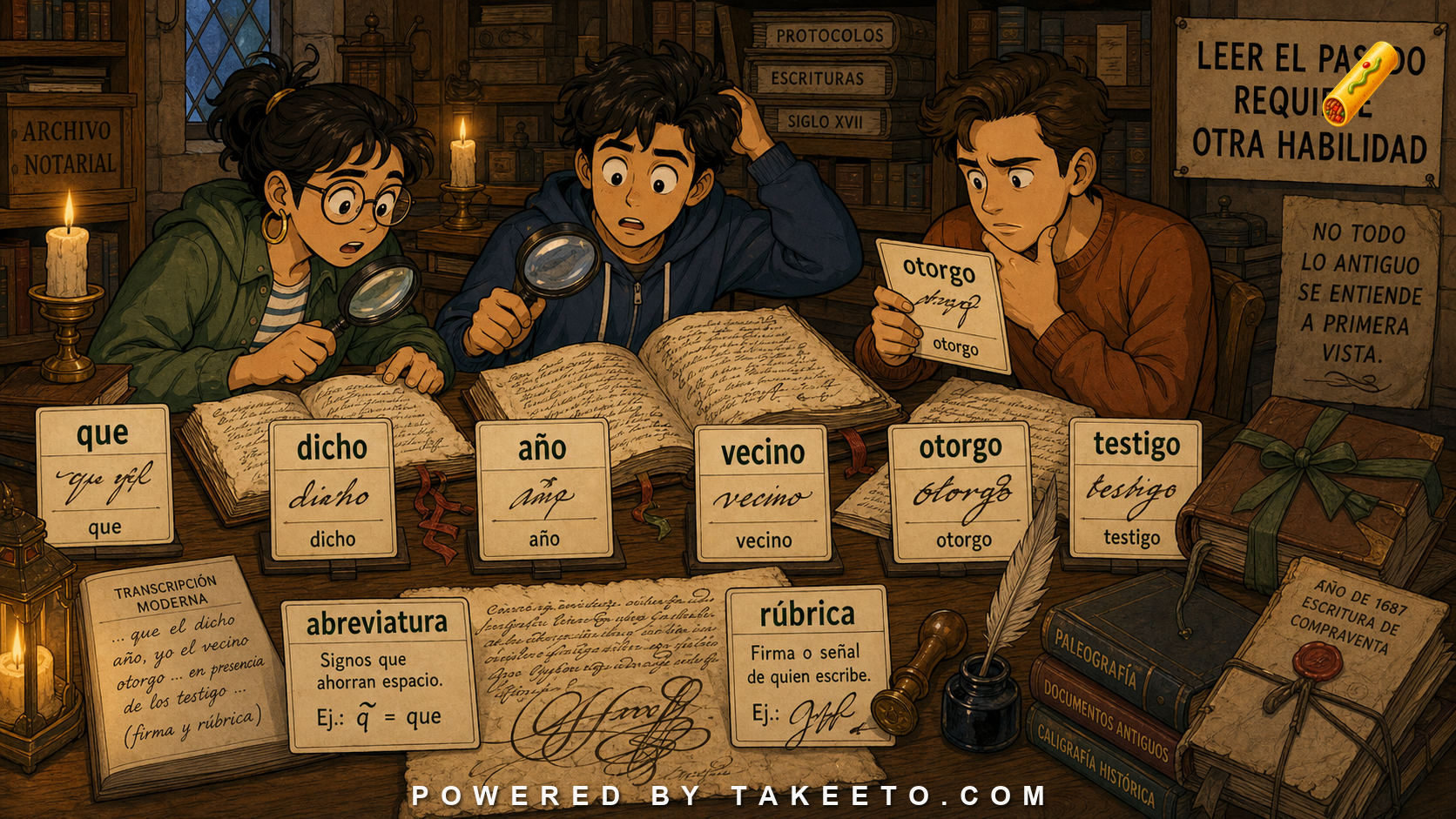
Handwriting is a separate reading problem
A learner may know modern Spanish well and still be unable to read an older handwritten document. That does not mean the learner’s Spanish is weak. It means paleography is a separate skill: the study and practice of reading old handwriting, abbreviations, scripts, and document conventions.
The key principle is:
Historical handwriting is not just messy Spanish. It is a different visual system attached to older spelling and formulaic genres.
To read it, you need patience, pattern recognition, comparison, and humility.
Script styles change
Older Spanish documents may use handwriting styles that differ sharply from modern cursive or print. Letter shapes can vary by century, region, scribe, document type, and speed of writing.
Common difficulties:
long or looped letters
similar-looking letters
connected strokes
flourishes
inconsistent spacing
ink bleed
page damage
abbreviations
superscript marks
unusual capitalization
A modern reader expects clear separation between words. Historical documents may not give that comfort.
Learn repeated words first
Paleography improves when you learn recurring forms.
Useful target words:
que
dicho
año
vecino
otorgo
testigo
ante mí
escribano
fecha
ciudad
Why these words? Because they appear repeatedly in legal, administrative, and genealogical records. Once you identify them in one hand, they help you decode the rest.
A good method:
- Find a repeated word.
- Compare every occurrence.
- Build the scribe’s letter shapes from known words.
- Use those shapes to test unknown words.
Do not begin with the hardest word on the page.
Abbreviations are everywhere
Older documents often abbreviate common words. A small mark may represent omitted letters.
Examples of abbreviation-prone words:
que
dicho
nuestro
vuestra merced
señor
escribano
testigo
pesos
reales
Abbreviations may use:
superscript letters
horizontal lines
special marks
omitted endings
conventional signs
A learner must not silently expand abbreviations without marking uncertainty. In transcription, expansions may be shown using brackets or editorial conventions depending on project rules.
Spelling variation and handwriting interact
You may see a word that looks unfamiliar because both spelling and handwriting differ from modern norms.
Example possibilities:
año may appear with an old-style ñ or abbreviation mark.
dicho may be abbreviated.
vecino may have letterforms that obscure c/i/n.
que may be represented by a compact abbreviation.
Do not decide too quickly that the word is unknown. Ask:
Could this be a common formula word?
Does the context expect date, witness, place, or role?
Does the same shape appear elsewhere?
The importance of formulae
Paleography is easier when you know document formulae. If a line begins:
En la ciudad de...
you can predict that a place name may follow. If a line says:
ante mí...
you may expect an official or scribe. If a clause says:
fueron testigos...
names may follow.
Formula does not solve every problem, but it narrows possibilities.
Reading old handwriting is partly linguistic and partly probabilistic:
What letters do I see?
What words are possible?
What does this document type usually say here?
Does another line confirm it?
Rúbrica and signature marks
Rúbrica can refer to a signature flourish or mark, not just a “rubric” in the modern classroom sense.
In historical documents, signatures may be followed by elaborate marks. Some people signed; others used marks; a scribe might sign for someone; witnesses may sign; an official may certify.
Terms:
firma — signature
rúbrica — flourish/signature mark
signo — sign/mark
no firmó por no saber — did not sign because he/she did not know how
a ruego — at the request of
Example:
Firmó a ruego del otorgante por no saber éste escribir.
He signed at the request of the grantor because the latter did not know how to write.
This kind of phrase gives social and procedural information.
Transcription is not copying blindly
A transcription represents handwritten text in readable form. But transcription involves decisions:
Do you preserve original spelling?
Do you expand abbreviations?
Do you preserve line breaks?
Do you mark uncertain letters?
Do you modernize punctuation?
Do you distinguish u/v or i/j as written?
Different projects use different rules. A genealogist, historian, editor, and archivist may transcribe differently depending on purpose.
A learner should always state transcription policy when producing serious work.
Mark uncertainty honestly
Bad paleography guesses confidently. Good paleography marks uncertainty.
Common notation:
[palabra] — supplied or expanded word, depending on convention
[?] — uncertain reading
ilegible — illegible
sic — as written
[...] — omission or unreadable passage, depending on convention
Do not hide uncertainty. An honest uncertain transcription is more useful than a polished false one.
Practice principles
Practice should be slow and comparative.
Good exercises:
- Transcribe one line, not a whole page.
- Create an alphabet from known words.
- Compare repeated names.
- Identify formula phrases.
- Mark uncertain letters.
- Check against a published transcription if available.
- Revisit the line later.
Poor exercise:
Try to read an entire damaged legal document with no context and no reference.
That produces frustration, not skill.
Example bank walkthrough
que
Very common word and abbreviation target.
Learner action: learn its shape in each hand.
dicho
Formulaic reference word.
Learner action: use repeated occurrences to build recognition.
año
Date word.
Learner action: watch ñ and abbreviation-like marks.
vecino
Resident/status term.
Learner action: recognize in identity formulas.
otorgo
Legal action verb.
Learner action: expect in deeds and wills.
testigo
Witness.
Learner action: names often follow.
abreviatura
Abbreviation.
Learner action: expand cautiously and mark policy.
rúbrica
Signature flourish/mark.
Learner action: do not confuse with modern classroom rubric.
Paleography practice workflow
- Identify document type and period if possible.
- Locate clear repeated words.
- Build a letterform chart from known words.
- Mark abbreviations without expanding too quickly.
- Use formulaic context.
- Transcribe line by line.
- Mark uncertain readings.
- Compare names and dates across the page.
- Consult reference alphabets and examples.
- Do not modernize unless your transcription policy says so.
Remediation: paleography is visual grammar
Older handwriting is not just “messy Spanish.” It is a visual system. Letters connect differently, abbreviations compress predictable words, and scribes repeat formulae that become easier once recognized. Learners fail when they try to read each letter as if it were modern print.
The better approach is pattern-based:
identify repeated words,
compare letterforms inside the same hand,
build a local alphabet,
use formulae to predict likely words,
mark uncertainty instead of guessing.
If a document repeats dicho, que, vecino, testigo, otorgo, and año, those words become anchors. Once you know how that scribe writes d, q, v, t, and g, new words become less mysterious.
Build a local alphabet
A paleography exercise should not begin with an abstract chart only. It should begin with the document you actually have.
Make a table:
| Letter or cluster | Example word in the document | Notes |
|---|---|---|
| q | que | abbreviation or flourish? |
| d | dicho | initial and medial forms differ |
| s | testigo | long or short form? |
| v/u | vecino | shape may overlap |
| r | otorgo | check final flourish |
This table is local because each hand differs. A printed paleography chart helps, but the document’s own repeated forms are more valuable.
Abbreviations are not decoration
Historical Spanish handwriting often abbreviates frequent words. que, dicho, señor, merced, don, fray, licenciado, testigo, and administrative formulas may be shortened. Marks above letters can signal omitted nasal consonants or conventional abbreviation, depending on period and hand.
Do not expand abbreviations silently in serious notes. Use a consistent convention:
q̃ = que, if that is your transcription standard.
q[ue] = expanded abbreviation.
d[ic]ho = expansion with omitted letters supplied.
[?] = uncertain reading.
Different projects use different systems. The key is to distinguish what is visible from what you supplied.
Mini-workshop: anchor-word reading
Suppose a page contains five lines, and you can confidently identify only these words:
En ... ciudad ... ante mí ... compareció ... vecino ... dijo ... testigos ... fecha.
That is already a structure:
place → official setting → appearance → residence/status → declaration → witnesses → date.
Now use the structure to predict likely missing categories. After compareció, expect a name. After vecino de, expect a place. After dijo que, expect a declaration or legal action. Before testigos, expect names or a closing formula.
This does not mean inventing text. It means using genre knowledge to focus attention. Paleography is partly reading letters and partly knowing what kinds of words documents tend to contain.
Uncertainty discipline
Bad paleography produces confident nonsense. Good paleography preserves doubt.
Use levels:
certain reading, probable reading, possible reading, illegible.
Example notes:
García — certain.
Garc[í]a — accent supplied or unclear.
Garc?a — one uncertain letter.
[García?] — likely but uncertain.
[ilegible] — cannot read.
Never force a name because it helps your research. Names are exactly where uncertainty matters most.
Practice principles
A serious beginner routine:
- Choose a short, high-quality image.
- Identify document type.
- Mark line breaks.
- Circle repeated words.
- Build a local alphabet from known words.
- Transcribe literally.
- Expand abbreviations separately.
- Normalize spelling only after transcription.
- Compare with another reader if possible.
- Record uncertainty.
The goal is not speed. The goal is traceable reading. A Takeeto paleography module should reward correct uncertainty, not just correct answers. In historical documents, “I cannot read this yet” is often the most honest expert move.
Remediation drill: use context without letting it bully the letters
Context is essential in paleography, but it can also trick you. If you expect a word, you may see it even when the letters do not support it.
Use a two-column note:
What the context predicts
What the letterforms support
Example:
Context predicts a month name after a date formula. The letters look like mayo, not marzo, because the third letter descends/does not descend according to the scribe's pattern.
Or:
Context predicts a surname, but the final letters are uncertain. Do not force a known family name unless the strokes match.
Controlled expansion
When expanding abbreviations, keep a record of what you changed.
Possible convention:
q̃ = que
dho = dicho
vᵒ = vecino
Mᵈ = merced
Your transcription note might say:
Abbreviations have been expanded in brackets; uncertain readings are marked with [?].
This makes your work auditable.
Practice habit
Read across the page, not only down one line. If a name appears three times, the clearest instance can solve the unclear one. If a month appears in a standardized date formula, compare it with other month names in the same volume. Paleography is cumulative; each solved letter improves the next line.
Suggested interactive module: paleography letterform comparison chart
A strong tool for this article would help learners build a script-specific alphabet.
Suggested functions:
- Known-word tagging: que, dicho, año, testigo.
- Letterform extraction: collect examples of a, e, s, r, n.
- Abbreviation catalog: mark and expand with confidence levels.
- Formula predictor: common phrases by document type.
- Uncertainty notation tools: brackets, question marks, illegible markers.
- Side-by-side view: image, diplomatic transcription, normalized reading.
- Name tracker: compare repeated personal names.
Final rule
Paleography is not a test of whether you “really know Spanish.”
Older handwriting requires its own training: script styles, abbreviations, spelling variation, formulae, and transcription conventions. Work from repeated words, mark uncertainty, and read the document as a visual artifact. Confidence comes from comparison, not guessing.