
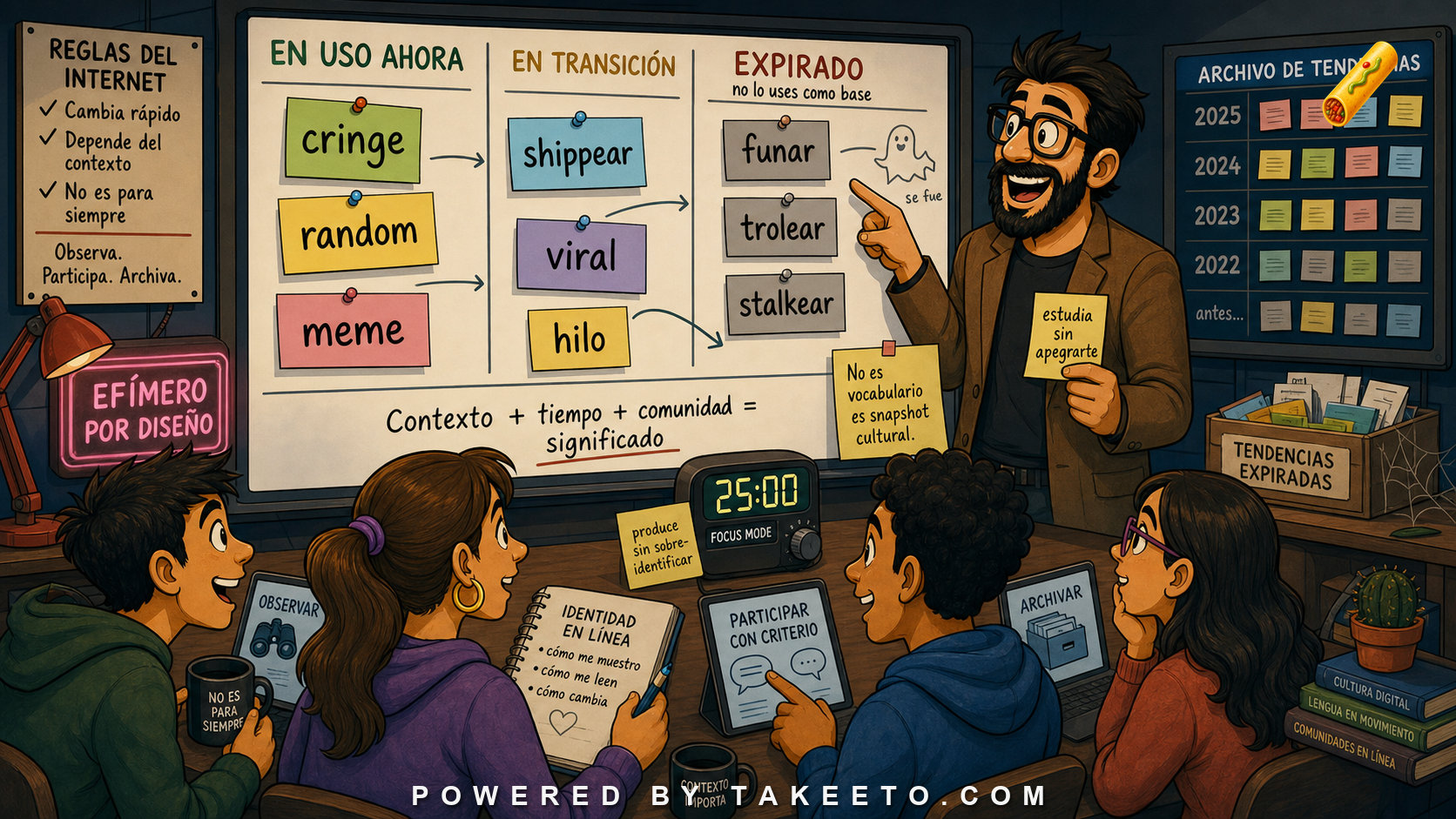
Internet slang moves faster than textbooks
Spanish internet slang changes quickly. A word can feel fresh, then mainstream, then embarrassing. It can be playful in one community and hostile in another. Learners often want a list of slang to “sound native,” but slang is risky because it carries age, platform, region, identity, and timing.
The key principle is:
Internet slang is better recognized widely than produced recklessly.
Borrowing and adaptation
Spanish digital speech borrows heavily from English:
cringe
random
meme
viral
fan
streamer
spoiler
Some borrowed words stay close to English. Others adapt to Spanish morphology:
shippear
trolear
stalkear
likear
banear
spoilear
The ending -ear is productive. It turns borrowed stems into Spanish verbs that can conjugate:
shippeo
troleaste
lo banearon
me spoilearon el final
This is not random. It is Spanish grammar absorbing digital English.
Meme and viral language
Important terms:
meme
viral
hilo
tendencia
trend
plantilla
formato
contenido
algoritmo
Hilo means thread in social platforms. Viral means widely circulated. Plantilla can mean template. Formato refers to the meme/content format.
Abro hilo.
This means “I’m starting a thread.” It became a recognizable platform phrase.
Funar and public accusation
Funar is a strong example of regional and political digital vocabulary. In many contexts it means publicly denounce, expose, call out, or socially sanction someone. It has roots and usage patterns that vary, especially in Latin American contexts.
Lo funaron en redes.
This does not simply mean “they criticized him.” It may imply public exposure and social backlash. The seriousness depends on context.
Learners should use caution. Some slang terms are socially charged.
Identity and community
Internet slang marks belonging:
fandom
shippear
stan
otaku
gamer
streamer
comunidad
cringe
A fandom term may be normal inside a community and strange outside it. Shippear means support or imagine a romantic pairing between characters or people. It belongs strongly to fandom discourse.
Todos shippean a esos dos personajes.
This is not general business Spanish.
Irony and unstable meaning
Words like random, cringe, literal, and basado can shift by speaker and generation. Some are ironic. Some are borrowed through meme culture. Some become mainstream enough to lose edge.
Cringe can be used as adjective-like evaluation:
Ese video da cringe.
This means the video is embarrassing or awkward to watch.
Random may mean unexpected, weird, arbitrary, or unrelated:
Fue súper random.
It was very random/weird/out of nowhere.
Youth, gaming, fandom, professional internet
Different communities use different slang:
- Youth comments use fast-changing reaction slang.
- Gaming uses verbs like farmear, lootear, rushear.
- Fandom uses shippear, canon, fanfic.
- Professional internet uses engagement, algoritmo, contenido, métricas.
A learner should not merge all internet Spanish into one “cool” register.
What to recognize versus produce
Good learner strategy:
- Recognize common slang for comprehension.
- Produce only terms you have heard repeatedly in similar context.
- Avoid slang in formal, professional, legal, academic, or intergenerational communication.
- Be extra cautious with insults, identity terms, and public accusation language.
Slang competence includes restraint.
Example bank walkthrough
Cringe: embarrassing/awkward; borrowed evaluation.
Random: unexpected/weird/unrelated.
Shippear: support a pairing; fandom.
Funar: publicly denounce/expose; socially charged.
Trolear: troll.
Stalkear: stalk/check someone online; register-sensitive.
Meme: meme.
Viral: widely circulated.
Hilo: thread.
Internet slang study workflow
- Identify platform and community.
- Identify country/region if possible.
- Decide whether term is borrowed, adapted, or native.
- Check whether it takes Spanish morphology.
- Observe tone: playful, hostile, ironic, affectionate.
- Note age and community marking.
- Save examples, not isolated translations.
- Avoid producing terms after one exposure.
- Re-check meaning over time.
- Retire slang that feels outdated or risky.
Before/after revision drill
Weak reading:
They stalked him.
Source Spanish:
Lo stalkearon en redes y luego lo funaron.
Better reading:
People looked him up or monitored him on social media and then publicly called him out/exposed him.
This translation preserves the digital context and the public-social force of funar. Not all internet verbs should be translated with their nearest dictionary equivalent.
Remediation: slang is productive, but not stable
Spanish internet slang changes quickly because it is driven by platforms, youth speech, gaming, fandom, English contact, regional humor, political conflict, and meme cycles. The learner’s job is not to memorize every new term. The job is to understand how slang is formed, where it circulates, and when not to use it.
Many internet terms are productive:
-ear borrowed verbs: stalkear, shippear, trolear, farmear, lootear, banear.
re- intensification in some regions: re bueno, re random.
English adjective insertions: cringe, random, fake, cute.
Platform nouns: hilo, post, story, reel, live, stream.
Community actions: funar, cancelar, viralizar, etiquetar.
Productive does not mean universal. A term can be normal in one platform community and absurd in a formal email.
Recognition versus production
A serious learner should divide slang into three categories:
recognize only — risky, vulgar, highly regional, identity-loaded, or ephemeral.
safe casual comprehension — common online terms you understand but use sparingly.
active production — terms you can use naturally with the right people.
For many learners, cringe, meme, viral, hilo, and trolear may be useful to recognize. Terms like funar, shippear, or highly regional insults require more context before production.
Mini-workshop: borrowed verb grammar
Spanish adapts many borrowed internet verbs with -ear:
stalkear → stalkeo, stalkeas, stalkeó, stalkeando
shippear → shippeo, shippeas, shippearon
trolear → troleo, troleaste, troleando
banear → banearon, baneado
These forms are not random English. They are integrated into Spanish morphology. They take Spanish endings, tense, person, and participles. A learner can analyze them grammatically even if the word is informal.
Sentence:
Me banearon por trolear en el chat.
Parsing:
me banearon = they banned me.
por trolear = for trolling.
en el chat = platform/community location.
Slang life cycle
A term may move through stages:
- niche community use;
- platform spread;
- ironic overuse;
- mainstream recognition;
- brand imitation;
- decline or parody.
By the time a company uses a youth slang term in advertising, the original community may already find it stale. This is why “latest slang” lists age badly. Teach formation and register instead of chasing every token.
Before/after: de-slanging for clarity
Slang comment:
Ese hilo está re random pero terminó funando a medio mundo.
Plain Spanish:
That thread is very random/disorganized, but it ended up publicly calling out or denouncing many people.
English translation depends on context. Funar can mean publicly denounce, call out, expose, or socially condemn online. It can be serious activism language, internet pile-on language, or casual exaggeration. Do not translate it as one fixed word without context.
Risk terms and identity
Some slang touches identity, harassment, sexuality, politics, or public accusation. The fact that a word is common online does not make it safe. Cancelar, funar, stalkear, hate, toxicidad, red flag, and similar terms can involve real people and reputational harm.
A learner writing publicly should prefer clarity over imitation:
La comunidad criticó públicamente al creador.
may be safer than:
Lo funaron.
unless the register and meaning are exactly intended.
Slang-study workflow
For each term, record:
- Form: spelling variants and morphology.
- Source: English, regional Spanish, platform, meme.
- Meaning: literal, pragmatic, ironic.
- Register: playful, vulgar, hostile, neutral online.
- Community: gaming, fandom, politics, youth, professional.
- Longevity: stable, trending, already stale.
- Production safety: recognize, limited use, active use.
Internet slang is not a replacement for Spanish. It is a moving layer on top of Spanish.
Additional remediation drill: slow the document down
If this article still feels like vocabulary, turn one authentic-looking sentence into a four-line analysis before translating it. Write the original sentence. Then list the actor, the action, the object, and the condition or consequence. Only after that, produce a plain-language paraphrase.
This drill matters because domain Spanish often compresses too much into noun phrases. The learner sees familiar words and moves too quickly. Slowing the sentence down reveals whether the reader understands the document logic or only recognizes terms. For article 279, the safest practice is to treat each key term as a field in a larger system: who is acting, what status is changing, what evidence or condition controls the action, and what the reader should do with the information.
A useful production rule is: do not write a polished sentence until you can write a plain one. Plain Spanish is not inferior; it is the diagnostic layer that proves comprehension.
Suggested interactive module: slang lifecycle tracker
A useful tool would treat slang as unstable data.
Suggested functions:
- Term card: meaning, platform, region, register.
- Morphology tracker: -ear verbs and conjugations.
- Community labels: gaming, fandom, youth, professional.
- Risk meter: safe recognition, cautious production, avoid.
- Lifecycle notes: emerging, mainstream, outdated, ironic.
Mini-workshop: recognizing borrowed Spanish morphology
Take stalkear.
It is borrowed from English “stalk,” but Spanish treats it like an -ear verb:
yo stalkeo
tú stalkeas
me stalkeó
estaban stalkeando
The same pattern works with trolear, banear, shippear, and spoilear. The spelling may vary, but the grammar is Spanish.
This shows why internet slang is not merely English inserted into Spanish. Borrowing becomes productive when speakers adapt it to Spanish morphology.
Common learner mistakes
One mistake is trying to sound current by producing slang too early. Slang marks age, community, region, and attitude. If you use it in the wrong space, the effect can be awkward. Another is treating slang as permanent vocabulary. Some terms fade quickly or become ironic.
A third mistake is underestimating social risk. Words like funar can involve public accusation and community conflict. Learn the context before using loaded terms.
Applied study drill: decide whether to recognize or produce
When you meet a slang item like funar, shippear, or stalkear, do not immediately add it to your active speaking deck. First classify it:
- Is it widely recognized or community-specific?
- Is it current or already dated?
- Is it neutral, playful, vulgar, political, or risky?
- Is there a standard alternative?
- Would you sound natural using it?
For example, postear may be relatively safe in casual digital contexts, though publicar is more neutral. Funar is socially and politically loaded; it should be recognized before it is imitated. Shippear belongs strongly to fandom contexts. Stalkear may sound casual online but can refer to invasive behavior.
A mature learner has three vocabulary zones: active formal Spanish, active casual Spanish, and passive recognition. Most internet slang should enter passive recognition first. Moving it into active production requires repeated exposure, clear community fit, and awareness of tone.
Final rule
Internet slang is real Spanish, but it is not stable core Spanish. Recognize broadly, produce cautiously, and remember that sounding current is less important than sounding appropriate.