
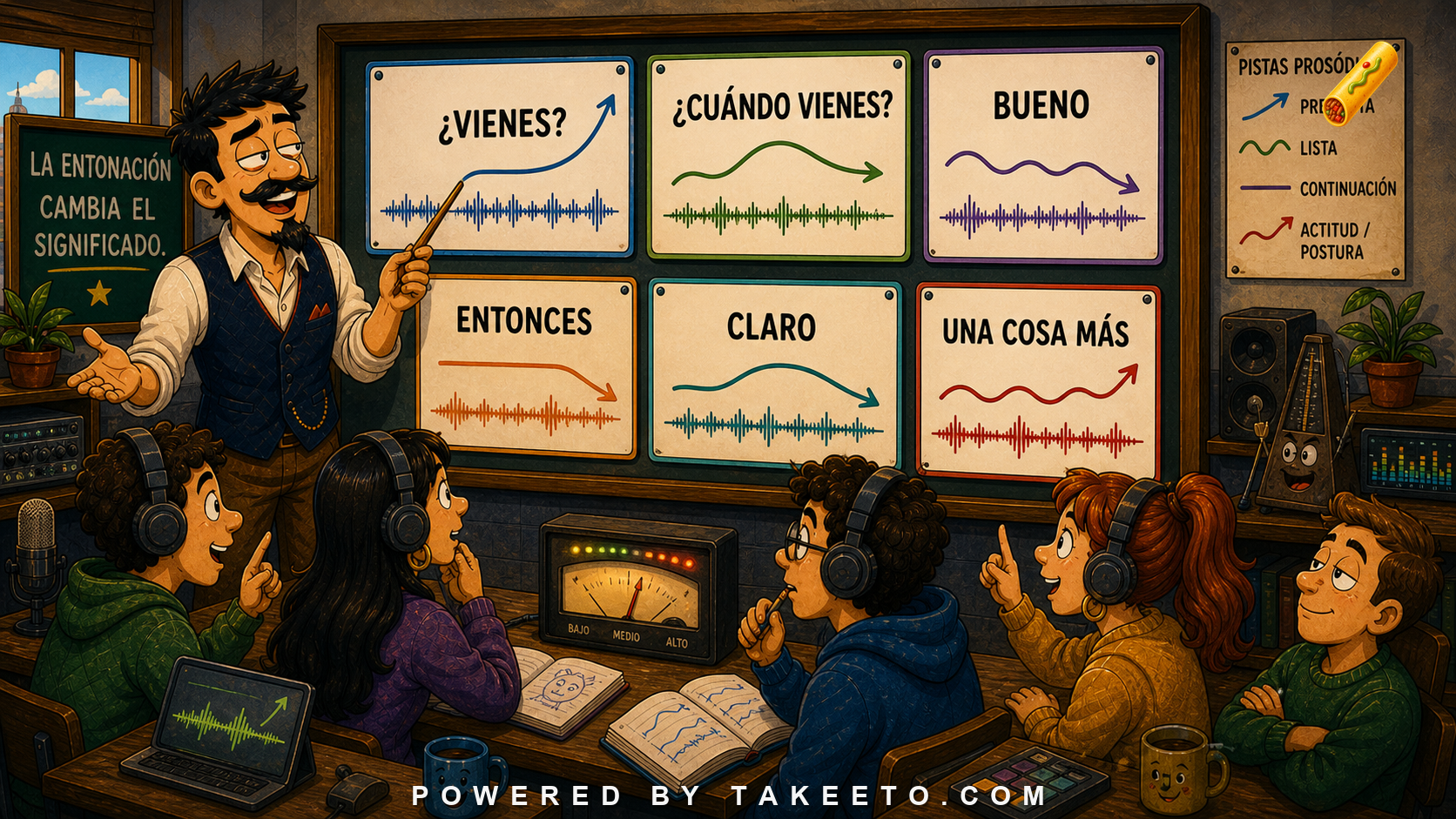
Spanish intonation changes what the sentence is doing
Learners often treat pronunciation as individual sounds: vowels, r, d, s. But conversation depends on prosody: pitch, rhythm, pauses, and intonation. A sentence can be grammatically correct and still sound doubtful, impatient, unfinished, surprised, or rude because of intonation.
The key principle is:
Intonation is not decoration. It is part of meaning.
Spanish intonation varies by region, but all varieties use pitch movement to organize questions, lists, continuation, finality, politeness, and stance.
Yes/no questions
A yes/no question often has a contour that signals openness or confirmation:
¿Vienes?
Depending on region and context, the contour may rise, fall-rise, or show other local patterns. The important point is that the pitch tells the listener that a response is expected.
Compare:
Vienes.
¿Vienes?
Vienes, ¿no?
Same basic verb, different interaction. Statement, question, confirmation request.
Learner action: do not rely only on word order. In Spanish, written punctuation marks questions, but spoken language uses intonation.
Wh-questions
Wh-questions:
¿Cuándo vienes?
¿Dónde está?
¿Por qué lo hicieron?
They do not always have the same contour as yes/no questions. The question word already signals information seeking. Intonation still adds stance: neutral, impatient, surprised, skeptical, warm, or formal.
Compare:
¿Cuándo vienes?
¿Cuándo vienes? ¡Te estamos esperando!
The second version may sound more urgent depending on pitch and stress.
Lists and continuation
In lists, intonation often signals that more is coming:
Necesito pan, leche, huevos y café.
Items before the final one may have a continuation contour. The final item closes the list.
If every item has finality, the list sounds choppy. If no item closes, the listener may wait for more.
Practice with:
Primero revisamos el texto, luego corregimos los ejemplos y finalmente grabamos el audio.
Each segment should guide the listener through structure.
Continuation after discourse markers
Words such as bueno, entonces, claro, and una cosa más often depend on intonation.
Bueno...
May mean:
- I am starting a response.
- I am hesitating.
- I am softening disagreement.
- I am closing a topic.
- I am reluctantly accepting.
Entonces...
May introduce a conclusion, a next step, or a narrative continuation.
Claro.
Can mean obvious agreement, polite acknowledgment, impatience, or “of course,” depending on delivery.
Learner action: learn discourse markers with pitch and context, not just dictionary meanings.
Finality
Finality tells the listener that a thought is complete.
Example:
Eso es todo.
A clear falling or closing contour signals completion. If the pitch remains suspended, the listener may expect another clause.
This matters in presentations, meetings, and formal explanations:
En resumen, los resultados no permiten confirmar la hipótesis.
The final phrase must land. Otherwise the sentence sounds unfinished.
Stance: politeness, doubt, insistence, surprise
Intonation can make the same words warmer or sharper.
¿Me ayudas?
Can sound friendly, needy, irritated, or demanding.
Claro.
Can sound generous, obvious, annoyed, or dismissive.
Bueno.
Can sound neutral, hesitant, or resigned.
A learner who uses correct words with mismatched intonation may create unintended social meaning.
Regional intonation
Spanish intonation varies widely. Some Caribbean, Mexican, Andean, Rioplatense, Central American, and Peninsular patterns are recognizable even when segmental pronunciation is similar. Regional intonation is part of identity.
Learners do not need to master every pattern. They do need passive awareness:
- A contour that sounds “exaggerated” to one listener may be ordinary in another region.
- A learner should not mock or caricature regional melody.
- A primary model helps production; broad exposure helps comprehension.
Example bank walkthrough
¿Vienes?
Yes/no question.
Learner action: compare with the statement Vienes.
¿Cuándo vienes?
Wh-question.
Learner action: listen for stance: neutral, urgent, surprised, impatient.
bueno
Discourse marker with many intonational meanings.
Learner action: classify function by following sentence and pitch.
entonces
Transition or conclusion marker.
Learner action: notice whether it moves narrative forward or draws inference.
claro
Agreement, acknowledgment, or stance marker.
Learner action: do not treat all claro as identical.
una cosa más
Continuation marker.
Learner action: pause after it to create a clean new point.
Listening exercises with pitch contours
A practical routine:
- Choose three short clips with transcripts.
- Mark questions, lists, and discourse markers.
- Draw arrows for pitch movement: rising, falling, suspended, final.
- Shadow only the contour, not the whole accent.
- Record yourself asking the same question neutrally, warmly, and impatiently.
- Compare how pitch changes stance.
Common learner failure: reading punctuation instead of hearing stance
Written Spanish gives question marks, commas, and periods. Spoken Spanish gives pitch, timing, and voice quality. A learner who relies only on punctuation may miss what the speaker is doing socially.
For example:
Claro.
This can be generous, impatient, obvious, sarcastic, or merely confirming. The word does not decide alone. Intonation, timing, facial expression, and previous context decide.
The same is true of bueno and entonces. These words are often discourse handles. They do not become meaningful until the contour and continuation are known.
Mini-workshop: five versions of one word
Record yourself saying claro in five contexts:
- Warm agreement.
- Impatient “obviously.”
- Polite acknowledgment.
- Surprise followed by acceptance.
- Reluctant concession.
Then write the following sentence that would naturally come after each one. This forces you to connect intonation to discourse function, not just emotion. Advanced prosody is not about sounding dramatic. It is about making the listener hear the intended relationship.
Common failure mode: treating intonation as emotional flavor
Learners often hear intonation only when it is dramatic: surprise, anger, excitement. But most intonation work is quieter. It tells the listener that a list is continuing, a clause is unfinished, a question is genuine, or a transition word is opening a new section. Missing these subtle contours makes speech sound either flat or constantly uncertain.
A second mistake is applying one question melody to every Spanish question. ¿Vienes? and ¿Cuándo vienes? do not have to behave alike, and regional patterns matter. The repair is to compare sentence types inside one target variety before generalizing.
Remediation pass: train intonation as meaning, not melody
Intonation is often treated as the last decorative layer of pronunciation, something learners can add once grammar is stable. That is backwards for advanced listening. Intonation tells the listener whether a phrase is complete, whether a list is continuing, whether a question expects confirmation, whether the speaker is surprised, and whether a statement is being offered firmly or tentatively.
The remediation move is to attach every pitch contour to a discourse function. A rising movement is not just “up.” It may signal continuation, questionhood, surprise, incompleteness, or invitation for response. A falling movement is not just “down.” It may signal finality, certainty, closure, resignation, or low emotional energy. The learner should stop drawing arrows as musical decoration and start labeling what the contour does in interaction.
Spanish intonation also varies by region. A yes/no question in one variety may not match the pattern a learner expects from another variety. That does not make one pattern wrong. It means the learner must hear intonation as a system of local possibilities, not as a universal classroom tune.
Before/after repair: the same words, different stance
Consider:
¿Vienes?
Depending on intonation, this can function as a neutral question, a surprised confirmation, an impatient check, or a soft invitation. The words alone do not decide the stance.
Weak learner note:
“Questions go up.”
Stronger learner note:
Yes/no questions often involve pitch movement that marks the utterance as non-final or response-seeking, but the exact contour varies. Listen for whether the speaker is asking neutrally, confirming something expected, expressing surprise, or pressuring for an answer.
Now consider:
Bueno.
This can mean acceptance, hesitation, transition, resignation, disagreement-softening, or simple acknowledgment. Intonation and timing decide the function. A flat bueno after a proposal may feel unenthusiastic. A bright bueno can open a new topic. A lengthened bueeeno can signal reluctance.
Mini-workshop: contour-function cards
Create cards that do not ask “What does this word mean?” but “What is the speaker doing with this intonation?” Use short clips containing:
- ¿Vienes? as neutral question and surprised confirmation,
- ¿Cuándo vienes? as information request and impatient follow-up,
- bueno as transition and reluctance,
- claro as agreement and skeptical response,
- entonces as continuation and conclusion,
- list intonation where the final item closes the sequence.
The answer side should include function labels: question, confirmation, continuation, finality, doubt, insistence, surprise, politeness, or stance shift. This transforms intonation from vague listening into a repeatable diagnostic exercise.
Intonation and punctuation are not the same thing
Written Spanish gives helpful signals, especially with opening question and exclamation marks. But punctuation cannot represent the full spoken contour. A transcript may show ¿Vienes?, but it cannot fully show whether the speaker sounds delighted, annoyed, skeptical, or worried. Learners who depend only on punctuation miss stance.
The reverse is also true: spoken intonation can signal sentence boundaries that are not obvious to a learner hearing fast speech. A speaker may pause and reset pitch before entonces, pero, or ahora bien, making the discourse structure audible. Listening for these resets helps comprehension.
Production guidance: use fewer contours well
Learners do not need to master every regional contour before speaking. A practical production target is simpler: make questions sound like questions, lists sound unfinished until the final item, continuations sound open, and final statements sound complete. Then add stance gradually.
For example, practice a three-item list:
Necesitamos revisar el presupuesto, el calendario y los materiales.
The first two items should not sound final. The last item should close the list. This one exercise does more for intelligibility than memorizing abstract pitch descriptions.
Editorial quality checks for this article
The article should avoid reducing intonation to “raise your voice at the end.” It should include questions, lists, continuation, and stance because these are the places where intonation changes interpretation. It should also warn against overgeneralizing one country’s pattern as Spanish itself. The reader should finish with a listening task: identify what the speaker is doing, not merely where the pitch rises or falls.
Extended remediation: practice contours in communicative pairs
Intonation cannot be mastered from isolated sentence diagrams. It has to be heard in communicative pairs: question and answer, list and completion, continuation and finality, doubt and confirmation. A learner should practice how bueno, entonces, claro, and una cosa más sound when they open a turn, delay a point, soften disagreement, or return to the main topic. These small contour choices decide whether speech sounds fluent or oddly flat.
Contrast set
- flat connector: Bueno pronounced the same whether it means agreement, hesitation, or topic shift.
- function-marked connector: Bueno... with a delay before disagreement; bueno briskly to resume; bueno, entonces as a transition into the next step.
The contrast set should be read aloud or rewritten, not merely admired. Advanced learners often understand a correction when they see it, then fail to reproduce it when the task changes. The repair is to make the contrast portable: identify the decision, name the cue, and apply the same decision to a new sentence, clip, paragraph, or writing task.
Real-use transfer drill
- Take five short discourse markers: bueno, entonces, claro, pues, una cosa más.
- Assign two functions to each marker.
- Find audio examples or create dialogues where the function is clear.
- Record the same words with different contours.
- Check whether the listener could infer the function without an English explanation.
The useful output is a contour notebook: phrase, function, context, observed pitch movement, and learner recording note. This is more durable than memorizing that questions “go up” or “go down.”
Avoid exaggerating intonation because you are trying to prove you learned it. Spanish prosody can be expressive, but theatrical contour practice may sound less natural than a controlled, regionally consistent model.
A good remediation pass ends with a usable artifact: a marked paragraph, a recording comparison, a collocation card, a frame note, a stance map, a change-claim table, or a revision pair. Without an artifact, the learner may feel enlightened but have nothing to review. With an artifact, the explanation becomes part of a study system.
Depth reinforcement: punctuation is not prosody
A final remediation point for intonation is that punctuation can guide the learner, but it cannot replace listening. The inverted question mark tells the reader that a question is coming; it does not prescribe one universal contour. A comma may mark a pause in writing; it does not tell the speaker how long the pause should be or whether the pitch should remain suspended. A period may mark completion; it does not guarantee that the spoken contour will sound final if the speaker keeps the pitch too open.
For that reason, intonation practice should always include audio and imitation, not only written examples. Learners should collect short formulae such as entonces, bueno, claro, una cosa más, and por último, then study how speakers use them to hold the floor, close a point, show stance, or invite response. These words are small, but they carry discourse timing. When intonation improves, Spanish stops sounding like translated sentences and starts sounding like connected speech.
Applied drill: stance from one-word responses
Use one-word or short responses to train intonation as stance. Record the following words three ways: neutral, surprised, and reluctant.
claro
bueno
entonces
¿sí?
ya
For claro, a bright contour can mean easy agreement; a flatter or lengthened contour can suggest skepticism or impatience. For bueno, a clean falling contour may accept closure, while a lengthened opening may prepare disagreement. For entonces, rising continuation can keep a story moving, while falling finality can mark conclusion.
After recording, write a context for each version. Do not ask only whether your pitch went up or down. Ask what social action the pitch performed. This is the step that turns intonation practice into discourse practice.
A useful Takeeto-style exercise would play the same word with different contours and ask the learner to choose the most likely continuation: agreement, objection, transition, surprise, or closing. The answer should reveal the next sentence, because intonation is confirmed by what follows.
Suggested interactive module: pitch-contour viewer
A strong tool for this article would display intonation visually.
Suggested functions:
- Sentence-type selector: statement, yes/no question, wh-question, list, continuation.
- Pitch display: simple contour line over transcript.
- Regional model toggle: multiple speakers from different regions.
- Stance quiz: Learner identifies doubt, surprise, insistence, politeness.
- Recording comparison: Learner contour versus model contour.
- Discourse marker mode: bueno, entonces, claro in context.
Final rule
Spanish intonation tells listeners how to interpret your words.
Train questions, lists, continuation, and finality. Listen for stance. Respect regional patterns. Good pronunciation is not only accurate sounds; it is controlled meaning over time.