
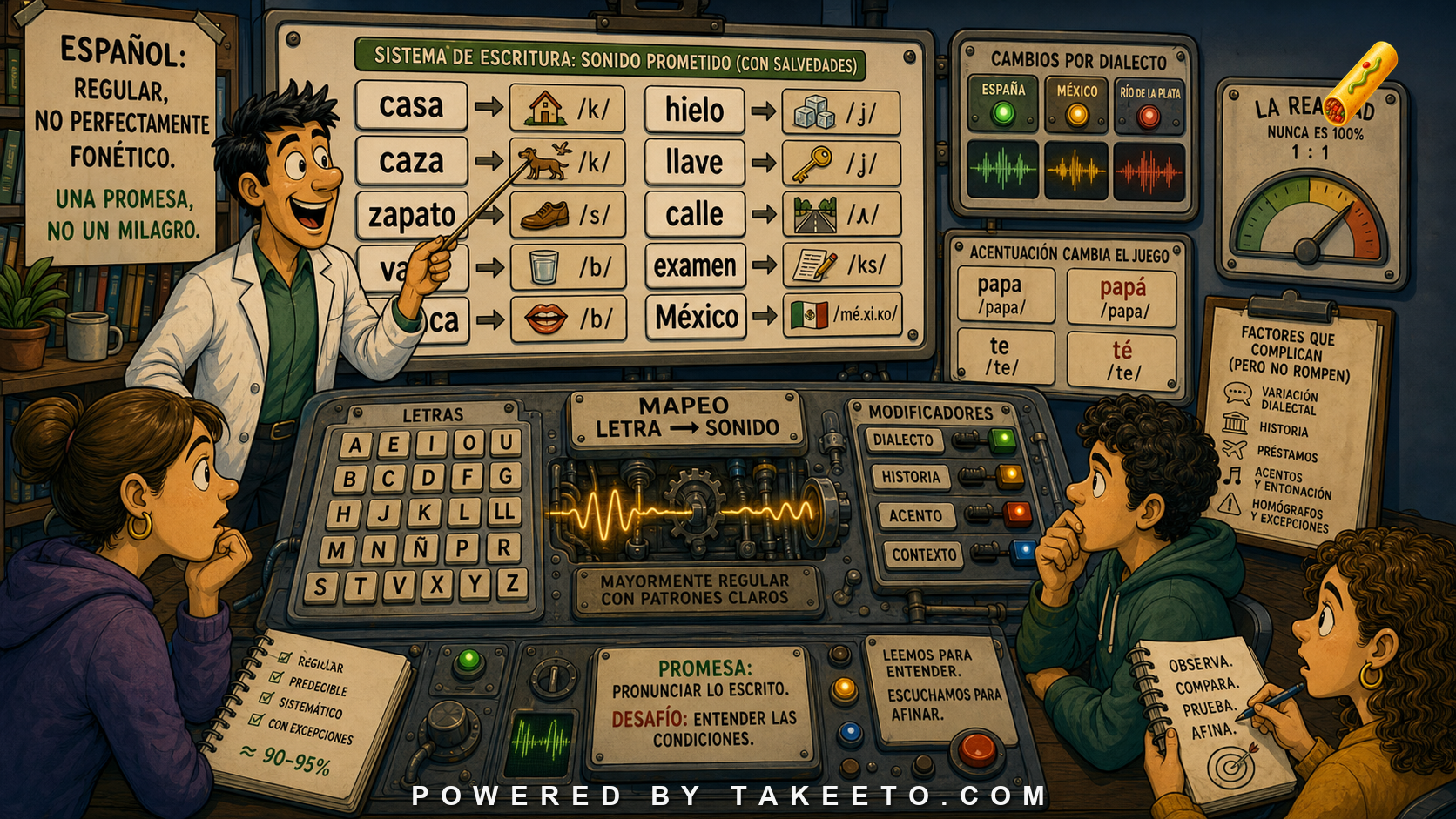
The myth is useful until it starts lying to you
Spanish is often advertised to learners as a phonetic language.
That claim has a good intention. Compared with English, Spanish spelling is wonderfully regular. If you know how the letters work, you can usually pronounce an unfamiliar written word well enough to be understood. If you hear a word clearly, you can often spell it with high confidence. The writing system is not a maze of spellings like though, through, cough, and bough.
But “Spanish is phonetic” is not quite true.
A phonetic spelling system would record actual speech sounds directly. Spanish does not do that. Spanish spelling is better understood as a mostly phonemic and morphological spelling system. It represents meaningful sound contrasts in the language, preserves many historical distinctions, gives information about stress, and maintains word-family relationships. It does not transcribe every regional accent, every weakened consonant, every local pronunciation of ll or y, or every difference between careful and casual speech.
A better first rule is this:
Spanish spelling is regular, but it is not a recording of anyone’s mouth.
That distinction matters because learners who believe Spanish is purely phonetic become confused when real Spanish refuses to behave that way. Why do b and v sound the same? Why do casa and caza sound alike in many regions but not in others? Why is hielo written with h if the h is silent? Why does México have an x but sound like Méjico? Why can examen have one sound for x while México has another?
The answer is not that Spanish spelling is chaotic. It is that the spelling system promises less, and more, than beginners think.
Phonetic, phonemic, and orthographic are not the same
Start with three ideas.
A phonetic transcription tries to show the actual sounds produced in a specific pronunciation. If a speaker weakens a final d, a phonetic transcription can show that. If one dialect pronounces j with strong velar friction and another pronounces it more like an aspiration, a phonetic transcription can show that too.
A phonemic spelling represents contrastive sound categories. It cares about differences that distinguish words in a language. In many Spanish varieties, /p/ and /b/ distinguish words, so the spelling must represent them. But the exact sound of /b/ varies by context: a stronger stop-like sound in some positions, a softer approximant between vowels. Ordinary spelling does not mark that difference.
An orthography is a social writing system. It represents sound, but also history, morphology, standard conventions, etymology, prestige, identity, and practical readability.
Spanish orthography is close enough to pronunciation to be friendly, but it is still an orthography.
Consider these words:
| Word | What spelling helps with | What spelling does not fully show |
|---|---|---|
| casa | likely pronunciation, stress, syllable shape | regional accent details |
| caza | spelling distinction from casa | whether your dialect pronounces it differently from casa |
| vaso | written b/v distinction | no separate /v/ sound in most varieties |
| hielo | word family and historical spelling | the h is not pronounced |
| calle | written ll | whether ll sounds like y in your dialect |
| México | conventional national spelling | x is not pronounced /ks/ here |
If you expect Spanish spelling to be a machine that converts letters into the exact same sounds everywhere, you will be disappointed. If you expect it to give a stable map of word structure, pronunciation categories, and standard spelling, it works extremely well.
Where the spelling promise holds strongly
Spanish vowels are one of the system’s great gifts to learners.
The five vowel letters usually correspond to five stable vowel phonemes:
| Letter | Typical value | Example |
|---|---|---|
| a | /a/ | casa |
| e | /e/ | mesa |
| i | /i/ | piso |
| o | /o/ | poco |
| u | /u/ | puro |
This does not mean every speaker produces identical acoustic vowels. No language works that way. But Spanish does not reduce unstressed vowels the way English often does. The written vowels are dependable.
Many consonant spellings are also straightforward once the rules are known:
- p, t, f, m, n, l are usually reliable.
- ca, co, cu represent /k/: casa, cosa, curva.
- que, qui represent /ke, ki/: queso, quizá.
- ga, go, gu represent /g/: gato, goma, gusto.
- gue, gui keep hard /g/ before e/i: guerra, guitarra.
- j and g before e/i often represent the same broad j-like sound: jamón, gente, girar.
Stress marks are another powerful part of the promise. Spanish written accents are not decoration. They tell the reader that the word’s stress does not follow the default pattern, or that a vowel sequence must be read as hiatus rather than a diphthong, or that one grammatical word must be distinguished from another.
Compare:
| Word | Stress/meaning cue |
|---|---|
| examen | default penultimate stress: e-XA-men |
| exámenes | written accent because the plural is esdrújula: e-XÁ-me-nes |
| café | final stress marked because final vowel would otherwise suggest penultimate stress in many comparable forms |
| país | accent breaks the expected vowel grouping: pa-ÍS |
| tu / tú | grammatical contrast: possessive vs subject pronoun |
This is the part learners should trust: Spanish spelling gives a strong structural reading of the word.
Where the system depends on dialect
The spelling caza is not pronounced the same way by all Spanish speakers.
In much of Spain, especially in north-central Peninsular Spanish, caza and casa are distinct. The z and c before e/i are pronounced with a dental fricative, while s is pronounced differently.
In most of the Spanish-speaking world, caza and casa are pronounced alike. This is seseo, a normal, prestigious, standard feature across the Americas, the Canary Islands, and many Andalusian areas.
The spelling preserves a distinction that many speakers do not pronounce.
| Spelling pair | In seseo regions | In distinción regions |
|---|---|---|
| casa / caza | same pronunciation | different pronunciation |
| cocer / coser | same pronunciation | different pronunciation |
| ves / vez | same pronunciation | different pronunciation |
| siento / ciento | same pronunciation | different pronunciation |
The same issue appears with ll and y. In many Spanish varieties, calle and cayó share the same consonant sound. In others, a distinction survives. In Argentina and Uruguay, the sound associated with ll/y may be pronounced with a strong “sh” or “zh”-like quality, depending on region and speaker.
A spelling system can represent a contrast even when many speakers no longer pronounce it.
This is not a defect. It is one way a broad international language keeps a shared written standard across many accents.
Historical letters are not useless letters
The silent h frustrates learners because it looks like spelling waste.
But h often carries historical and word-family information. It appears in words such as:
- hablar
- hacer
- hijo
- humo
- historia
- prohibir
- zanahoria
Most of the time, the h is not pronounced. It also does not generally prevent vowels from interacting across syllable boundaries. In prohibir, for example, the written h does not act like a spoken consonant.
Learners should not pronounce the h in ordinary Spanish words. But they should not think of it as random. It is part of the standard written identity of many words.
The letter x is another historical trap. In examen, x is commonly pronounced like /ks/ or, depending on region and context, somewhat softened. But in México, Oaxaca, and Texas, the x preserves an older spelling convention and represents a j-like sound in standard Spanish pronunciation.
| Word | Common standard pronunciation value of x |
|---|---|
| examen | /ks/ or reduced variants depending on accent and context |
| extranjero | /ks/ or related cluster behavior in learned spelling |
| México | j-like sound |
| Oaxaca | j-like sound in the relevant position |
| Texas | j-like sound in Spanish |
So the spelling-to-sound rule for x is not “x always equals ks.” It depends on word history and convention.
Spanish spelling also represents morphology
Spanish orthography often keeps related word forms visually connected.
Consider plural formation:
- lápiz → lápices
- feliz → felices
- nación → naciones
- joven → jóvenes
- examen → exámenes
The spelling changes are not arbitrary. They preserve pronunciation, stress, or word-family structure. The written accent in exámenes appears because the plural has a different stress category from examen. The z changes to c before e in lápices because standard Spanish spelling does not normally write ze/zi in that environment for the same sound in most words.
A purely phonetic spelling might rewrite forms more aggressively. Spanish orthography instead balances sound, word families, and standard conventions.
Loanwords and proper names can bend the system
Loanwords are where spelling systems reveal their social side.
Spanish adapts many foreign words:
- fútbol
- líder
- escáner
- güisqui or whisky, depending on treatment and context
- wifi / Wi-Fi in many contemporary uses
Some words are fully adapted; others remain visibly foreign; some exist in competition with Spanish alternatives. Technical, brand, academic, and youth-register vocabulary often moves faster than spelling norms.
Proper names are also special. A person, place, brand, or institution may preserve a spelling that ordinary rules would not predict. Spanish speakers can adapt pronunciation while keeping the official written form.
A learner should treat proper names as identity-bearing forms, not as ordinary vocabulary to “correct.”
Practical framework for learners
Use Spanish spelling with confidence, but use the right kind of confidence.
1. Trust vowels first
In most words, the written vowel letters are reliable. Do not turn Spanish vowels into English-style moving targets. Casa, peso, piso, poco, puro all reward steady vowel quality.
2. Learn consonants as rule families
Do not memorize each word separately when a spelling rule explains the pattern:
- c + a/o/u = /k/
- qu + e/i = /k/
- g + a/o/u = /g/
- gu + e/i = /g/
- j and g + e/i = j-like sound
3. Separate spelling from dialect
If your teacher pronounces caza like casa, that is not sloppy Spanish. If another speaker distinguishes them, that is also normal. Learn which variety you are hearing.
4. Respect written accents
Accent marks tell you stress, vowel grouping, or grammar. They are part of the word’s written identity.
5. Do not invent pronunciation distinctions from spelling
Most Spanish speakers do not contrast b and v. Trying to pronounce v as English /v/ will not make your Spanish more correct; it will often make it sound foreign.
6. Store spelling families
Learn hacer, hecho, deshacer together. Learn hijo, hija together. Learn lápiz, lápices together. Orthography becomes easier when word families are visible.
Suggested interactive module: spelling-to-sound map
A useful tool for this article would let users type a Spanish word and choose a pronunciation variety.
Suggested toggles:
- Seseo / distinción: show whether casa and caza merge.
- Yeísmo / lleísmo: show whether calló and cayó merge.
- Regional j strength: show stronger velar friction vs softer aspiration.
- Final consonant weakening: model careful vs casual Caribbean or Andalusian-style weakening without treating it as “wrong.”
- Stress overlay: mark the stressed syllable and explain any written accent.
- Historical spelling alerts: flag words like hielo, México, Oaxaca, and hombre.
Example input:
México
Possible output:
- Stress: MÉ-xi-co
- Written accent: marks non-default stress
- x value: historical spelling, j-like pronunciation
- Not pronounced like English “Mexico” in Spanish
Final rule
Spanish is not phonetic in the naive sense. It does not write every sound exactly as every speaker produces it.
But Spanish spelling is highly systematic. It gives stable vowels, predictable consonant families, stress information, grammatical distinctions, historical continuity, and a shared written standard across many accents.
The serious learner should not say “Spanish is phonetic” and stop thinking. Say this instead:
Spanish spelling is a regular map of the language, not a live audio recording.
That map is one of the learner’s best tools. Use it carefully, and it will carry you far.