
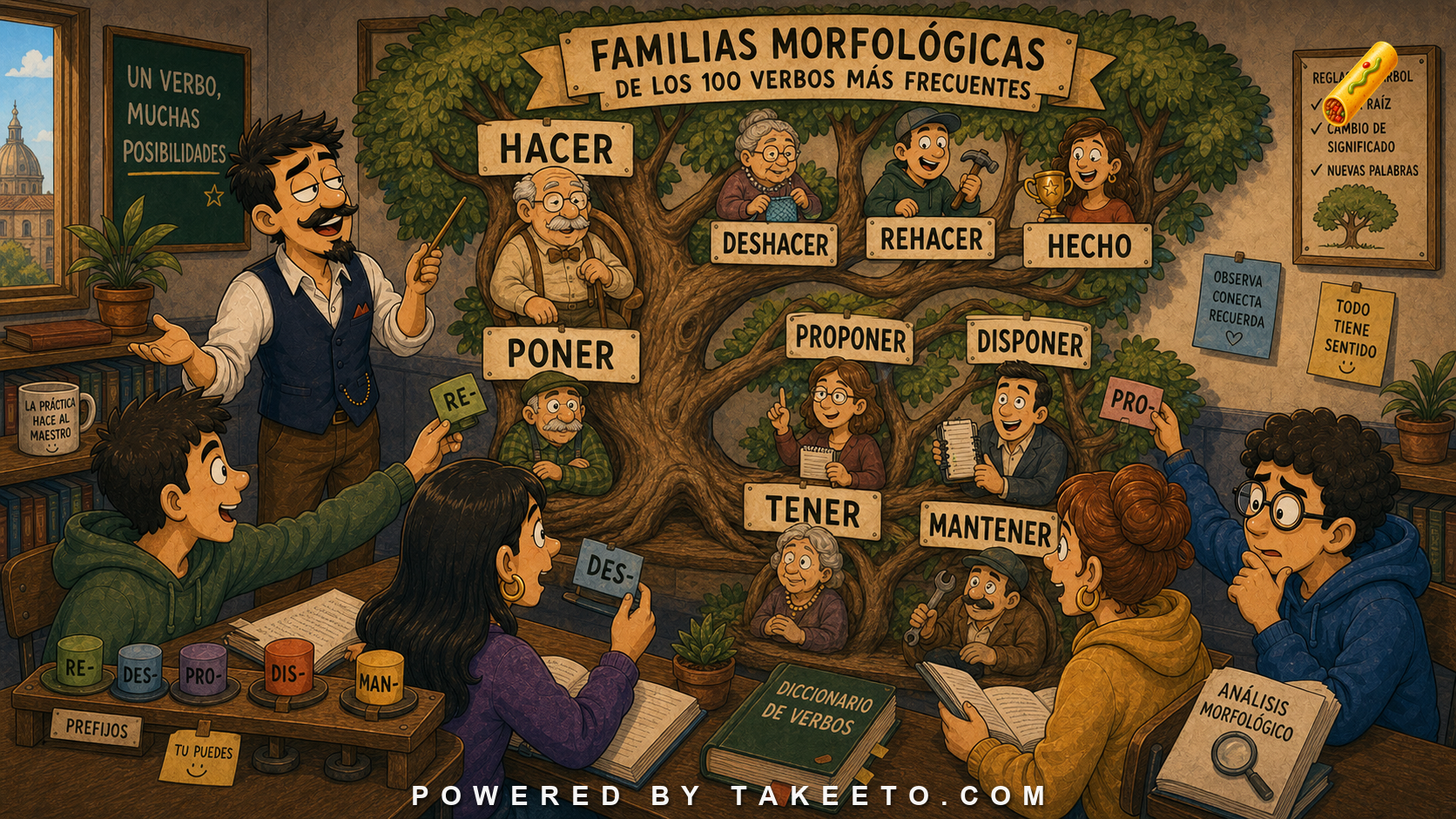
Common verbs are vocabulary engines
Learners often study verbs as conjugation problems. That is necessary but incomplete. High-frequency Spanish verbs are also roots for large families of nouns, adjectives, prefixed verbs, participles, idioms, and formal vocabulary.
Take poner:
poner
proponer
componer
disponer
exponer
imponer
suponer
posponer
propuesta
exposición
disposición
A learner who knows only poner = put misses the architecture.
The key principle:
High-frequency verbs are not isolated items. They are hubs in a morphological network.
Hacer: action, creation, undoing, fact
The family around hacer is enormous:
hacer
to do/make
deshacer
to undo
rehacer
to redo/remake
satisfacer
to satisfy
hecho
fact / done
factura
invoice, historically related through making/doing field but not transparent in everyday learning
efecto
effect, from Latin family rather than simple modern derivation
Learners should be careful: word families can include transparent modern prefixes, inherited forms, learned borrowings, and historical relatives. Do not pretend every connection is equally obvious.
Practical use:
Hay que rehacer el informe.
We need to redo the report.
El hecho principal es este.
The main fact is this.
Poner: placement to argument
Poner begins with placement but expands into abstract arrangement:
poner la mesa
set the table
ponerse nervioso
become nervous
proponer una solución
propose a solution
exponer un argumento
present/expose an argument
imponer una condición
impose a condition
disponer de recursos
have resources available
The prefixes matter:
- pro-: forward, proposal,
- ex-: outward, exposition,
- im-: onto/against, imposition,
- dis-: arrangement/distribution.
A family view helps academic Spanish. Propuesta, exposición, disposición, and supuesto appear constantly in formal texts.
Tener: possession, maintenance, containment
The tener family includes:
tener
to have
mantener
to maintain
obtener
to obtain
sostener
to sustain/hold/argue
contener
to contain
detener
to stop/detain
retener
to retain
tenencia
possession/holding
contenido
content
Formal prose loves this family:
El informe sostiene que la medida no mantiene el equilibrio necesario.
The report argues that the measure does not maintain the necessary balance.
Here sostiene is not physically holding. It means “maintains/argues.”
Venir: movement into event structure
Venir generates useful forms:
venir
to come
intervenir
to intervene
convenir
to be suitable / agree
prevenir
to prevent
provenir
to come from
devenir
to become, in formal/literary language
porvenir
future
These verbs often appear in academic, legal, and public language:
La propuesta proviene de una comisión independiente.
The proposal comes from an independent commission.
Es necesario prevenir nuevos riesgos.
It is necessary to prevent new risks.
Decir, ver, llevar
Other high-frequency hubs:
Decir:
decir, contradecir, predecir, maldecir, bendecir, dicho, predicción
Ver:
ver, prever, revisar, visión, visible, invisible, evidencia, entrevista
Llevar:
llevar, llevarse, conllevar, sobrellevar, llevar a cabo, llevado
These families are not all equally transparent, but they give the learner a map. When a formal text says:
esta medida conlleva riesgos
it helps to connect conllevar with “carry along with it,” not memorize it as a random word.
How to study verb families
Do not make a giant family tree and memorize everything. Use layered review:
- Start with the core verb.
- Add three transparent prefixed verbs.
- Add one noun and one adjective.
- Read sentences from formal and everyday contexts.
- Mark false transparency.
- Revisit the family through passages.
Example poner deck:
poner una fecha
proponer una idea
exponer un problema
imponer una regla
la propuesta
la exposición
This is more useful than isolated vocabulary cards.
Families need boundaries
Word-family study can become reckless if every Latin-looking resemblance is treated as a modern Spanish relationship. Learners should mark the strength of a connection. Poner and proponer are transparently connected for modern learners. Hacer and satisfacer are connected historically and morphologically but less obvious in everyday form. Ver, visión, and supervisar are useful as a visual-root family, but the learner should not pretend they are all simple prefix forms of ver.
A practical family notebook can use labels: transparent, semi-transparent, learned/Latin, idiomatic, collocation-only. This keeps the method honest. The purpose is not to create fake etymology. The purpose is to help learners recognize formal vocabulary, remember related meanings, and notice recurring roots.
Good family study connects words. Bad family study invents connections the learner cannot trust.
Example bank walkthrough
hacer
Core do/make verb.
Learner action: connect to deshacer, rehacer, hecho.
deshacer
Undo.
Learner action: learn prefix des- as reversal in many verbs.
rehacer
Redo/remake.
Learner action: use re- for repetition/restoration patterns.
hecho
Fact or done thing.
Learner action: separate hecho from English “fact” only; it also belongs to participle/event language.
poner
Put/place.
Learner action: expand to proponer, exponer, imponer, disponer.
proponer
Propose.
Learner action: connect verb proponer to noun propuesta.
disponer
Arrange/have available.
Learner action: learn disponer de as a formal pattern.
tener / mantener
Have/maintain.
Learner action: connect tener to mantener, obtener, contener, sostener.
Transparent families and historical families
Verb-family study must distinguish modern transparency from historical relationship. Deshacer and rehacer are transparent for learners because the prefixes attach clearly to hacer. Satisfacer is related but behaves less transparently in everyday learning. Efecto and factura may belong to broader Latin-root networks, but they are not simple modern derivatives a learner should guess from hacer.
This distinction prevents fake certainty. A family graph should say:
- transparent modern prefix,
- common prefixed verb,
- related noun,
- learned/Latin-family item,
- historical connection, not a production rule.
The learner gains the benefit of structure without inventing false derivations.
Remediation notes: word-family graphs need evidence labels
The repair for morphological families is to avoid fake transparency. Spanish verb families are powerful, but not every related-looking word should be taught as if it were a simple modern derivative. Hacer, deshacer, and rehacer are transparent for learners. Satisfacer is related but less obvious and has its own conjugational behavior. Poner, proponer, componer, disponer, imponer, and suponer are useful as a family, but each verb has specialized meanings and collocations. A family graph should not suggest that prefixes mechanically predict full meaning.
A serious word-family tool should mark at least four relationship types: transparent modern derivative, prefix family with meaning shift, learned Latin-root relation, and idiom/collocation. For tener, mantener, retener, obtener, and sostener belong in a useful network, but tener que, tener lugar, tener en cuenta, and tener ganas de are constructional patterns, not ordinary derivatives. Learners need both morphology and phrase architecture.
Frequency also matters. The top 100 verbs generate enormous networks, but some derivatives are rare, technical, regional, or formal. Poner and ponerse should come before yuxtaponer for most learners. Ver, vista, visible, revisar, prever, and supervisar are useful, but their meanings must be learned through real examples. Word families are maps, not licenses to invent words.
The article should also warn about false friends inside families. Realizar does not usually mean “realize” in the English mental-discovery sense; actualizar does not mean “actualize” in ordinary English; asistir does not usually mean “assist” in many contexts. Morphological recognition helps reading, but direct English transfer can still mislead.
Production target: for each high-frequency verb, build a family card with three zones: core verb, productive derivatives, and fixed expressions. Add register labels and one real sentence per item. The learner should be able to say which links are obvious, which are historical, and which must simply be memorized as usage.
Suggested interactive module: verb-family graph
A strong tool for this article would show high-frequency verbs as lexical hubs.
Suggested functions:
- Core verb node: hacer, poner, tener, venir, decir, ver, llevar.
- Prefix branches: des-, re-, pro-, ex-, im-, con-, pre-, re-.
- Noun/adjective links: propuesta, exposición, contenido, visible.
- Transparency labels: transparent, semi-transparent, historical/learned.
- Register tags: everyday, academic, legal, administrative.
- Sentence examples: one everyday and one formal per item.
- Review mode: build decks by family.
Final rule
High-frequency Spanish verbs are vocabulary engines.
Study hacer, poner, tener, venir, decir, ver, and llevar not only as verbs to conjugate, but as roots of families. Vocabulary grows faster when forms are connected instead of stored as isolated fragments.