
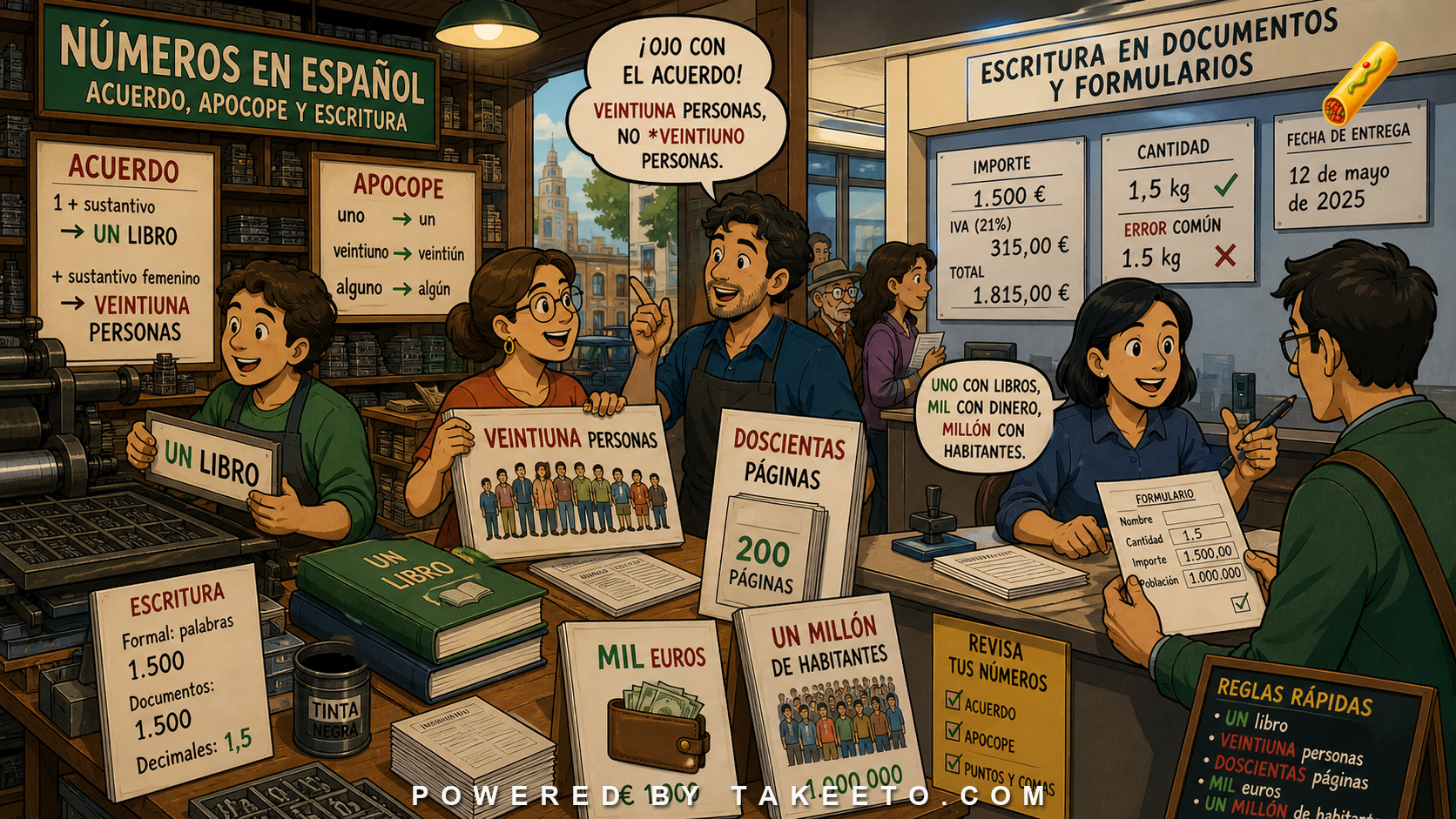
Numbers are grammar, not just counting
A learner may think numbers are easy because they are memorized as a list:
uno, dos, tres, cuatro...
But numbers in Spanish interact with gender, noun agreement, apocope, compound spelling, mil/millón, dates, prices, decimals, and regional writing conventions. The number itself may be simple. Its grammar may not be.
Compare:
uno
one
un libro
one/a book
una mesa
one/a table
veintiún libros
twenty-one books
veintiuna personas
twenty-one people
The number changes because it appears before a noun and agrees or shortens in specific ways.
The first serious rule:
Cardinal numbers are not all invariable labels. Some behave like adjectives or determiners and respond to the noun that follows.
Uno, un, una
The number uno changes before nouns.
Before a masculine singular noun:
un libro
one book / a book
Before a feminine singular noun:
una casa
one house / a house
Standing alone:
uno
one
Examples:
Tengo un problema.
I have one problem.
Tengo una pregunta.
I have one question.
Solo necesito uno.
I only need one.
This shortening is called apocope. Uno becomes un before a masculine singular noun.
The same occurs in compound numbers ending in uno before masculine nouns:
veintiún libros
twenty-one books
treinta y un días
thirty-one days
Before feminine nouns:
veintiuna personas
twenty-one people
treinta y una páginas
thirty-one pages
Agreement with hundreds
Hundreds from 200 onward agree in gender with the noun:
doscientos libros
two hundred books
doscientas páginas
two hundred pages
trescientos habitantes
three hundred inhabitants
trescientas casas
three hundred houses
The agreement appears because these forms behave adjectivally.
| Masculine | Feminine |
|---|---|
| doscientos | doscientas |
| trescientos | trescientas |
| cuatrocientos | cuatrocientas |
| quinientos | quinientas |
| seiscientos | seiscientas |
| setecientos | setecientas |
| ochocientos | ochocientas |
| novecientos | novecientas |
Examples:
quinientos euros
five hundred euros
quinientas libras
five hundred pounds
setecientos alumnos
seven hundred students
setecientas alumnas
seven hundred female students
Cien and ciento
Cien is used before nouns and before mil/millones when it means exactly one hundred:
cien personas
one hundred people
cien euros
one hundred euros
cien mil habitantes
one hundred thousand inhabitants
Use ciento in numbers from 101 to 199:
ciento un libros
one hundred and one books
ciento una páginas
one hundred and one pages
ciento veinte estudiantes
one hundred twenty students
Ciento also appears as a standalone noun in some contexts, but learners should first master this practical contrast:
exactly 100 before a noun → cien
101–199 → ciento...
Mil is invariable; millón is a noun
Mil is invariable:
mil euros
one thousand euros
dos mil personas
two thousand people
treinta mil habitantes
thirty thousand inhabitants
Do not say:
dos miles personas
But millón behaves as a noun. It uses un and forms a plural millones:
un millón de habitantes
one million inhabitants
dos millones de euros
two million euros
Notice the de before the counted noun:
un millón de personas
dos millones de dólares
The same applies to larger noun-like quantity words:
mil millones de euros
a billion euros in the common Spanish long expression, depending on region and context
Learners should be careful with billón, because Spanish and English number naming can differ by region and system. In general Spanish, billón traditionally means a million million, not necessarily English “billion.” In international finance and translation, verify the intended scale.
Compound number spelling
Modern Spanish writes the numbers from 16 to 29 as one word:
dieciséis
diecisiete
dieciocho
diecinueve
veinte
veintiuno
veintidós
veintitrés
veintiséis
From 31 upward, tens and units are usually written with y:
treinta y uno
cuarenta y dos
cincuenta y seis
noventa y nueve
Before nouns, apply apocope and agreement:
veintiún días
treinta y un días
veintiuna páginas
treinta y una páginas
Accent marks appear in forms such as dieciséis, veintidós, veintitrés, veintiséis according to stress rules.
Numbers in dates, addresses, and documents
In many formal and everyday contexts, Spanish uses digits rather than words:
27 de mayo de 2026
calle Mayor, 15
3.º piso
1.200 euros
But conventions vary by country and institution. Forms, passports, academic documents, invoices, and journalism may impose their own formats.
Learners should distinguish grammar from formatting:
veintiuna personas is grammar.
21 personas is formatting.
Both can represent the same quantity, but written context determines which is better.
Decimal and thousands separators
Spanish-speaking countries do not all use separators the same way, and international standards complicate the picture. Traditionally, many Spanish contexts use a comma as the decimal separator:
1,5
one point five
Thousands may appear with a point, a space, or other conventions depending on country and style:
1.500
1 500
In U.S.-influenced or international digital contexts, English-style formats also appear:
1,500
1.5
This can create serious ambiguity. In a bilingual document, 1.500 may mean one thousand five hundred in many Spanish contexts, but one point five in some English-style systems.
The safe rule for learners and translators:
Do not assume number punctuation is universal. Check the country, document type, and institutional style.
Numbers and gender traps
Some nouns have unexpected gender, and numbers must follow the noun’s grammar.
veintiún problemas
twenty-one problems
Problema is masculine, so veintiún.
veintiuna manos
twenty-one hands
Mano is feminine, so veintiuna.
doscientas personas
two hundred people
Persona is feminine, even if the group includes men.
doscientos individuos
two hundred individuals
Individuo is masculine.
Agreement follows the noun, not biological sex or real-world group composition.
Approximate numbers
Spanish can express approximation in several ways:
unas veinte personas
about twenty people
alrededor de veinte personas
around twenty people
aproximadamente veinte personas
approximately twenty people
veinte personas más o menos
twenty people more or less
Unos/unas before a number is common:
unos diez minutos
about ten minutes
unas cien personas
about one hundred people
The form unos/unas agrees with the noun:
unos días
unas horas
Common learner errors
Error 1: Using uno before masculine nouns
uno libro
Correct:
un libro
Error 2: Forgetting feminine forms before feminine nouns
veintiún personas
Correct:
veintiuna personas
Error 3: Forgetting hundred agreement
doscientos páginas
Correct:
doscientas páginas
Error 4: Treating mil like a plural noun
tres miles personas
Correct:
tres mil personas
Error 5: Omitting de after millón
un millón personas
Correct:
un millón de personas
Error 6: Misreading separators
A price written as 1,50 € is not the same as 1.500 €. Region and format matter.
Diagnostic workflow: convert digits into a noun phrase, not just a number word
When converting a number into Spanish words, do not start by translating the digits alone. Start with the noun phrase.
Input:
21 books
The noun is libros, masculine plural. Therefore:
veintiún libros
Input:
21 pages
The noun is páginas, feminine plural. Therefore:
veintiuna páginas
Input:
300 students
If the noun is alumnos, use:
trescientos alumnos
If the noun is personas, use:
trescientas personas
This workflow also clarifies long numbers. For 1,001 books:
mil un libros
For 1,001 pages:
mil una páginas
In practice, many long exact quantities are clearer as digits in ordinary documents:
1001 páginas
But the grammatical principle remains: uno/un/una and hundreds respond to the noun when written out.
For millions, change the structure:
2,000,000 inhabitants → dos millones de habitantes
Here millones is a noun, so it takes de before the counted noun. The counted noun no longer directly follows the number the way it does after mil.
A good editing checklist for numbers:
- Does the number end in uno before a noun? Check un/una.
- Is there a hundred from 200 to 900? Check gender agreement.
- Is the number exactly 100? Use cien before nouns.
- Is it 101–199? Use ciento....
- Is millón/millones present? Add de before the counted noun.
- Could separators be misread internationally? Spell out the month or use unambiguous formatting.
For example, in a report, 1.500 may be read differently by different audiences. If confusion is possible, write 1500, 1 500, or mil quinientos according to the document’s style rules.
Document-risk checklist for numbers
Numbers cause expensive mistakes because they appear in forms, invoices, deadlines, travel documents, prescriptions, and contracts. A learner should develop a document-reading checklist rather than trusting recognition alone.
First, check whether the number is a quantity, an identifier, or a code. A passport number, postal code, apartment number, bus route, and phone number are not processed like normal cardinal quantities. They may be read digit by digit:
habitación 204
room 204
autobús 27
bus 27
Second, check whether punctuation is decimal or thousands notation. In one document, 1.500 may mean one thousand five hundred; in another internationalized context, 1.500 may be read as a decimal form. Institutional style matters.
Third, check whether a noun after the number requires gender agreement in the word form:
31 personas → treinta y una personas
31 alumnos → treinta y un alumnos
Fourth, check whether the number is part of an approximation:
unos veinte minutos
unas cien personas
Here unos/unas does not simply mean “some” in a vague plural sense. It signals approximate quantity.
Fifth, check whether the expression uses millón/millones, which require de before the counted noun:
tres millones de habitantes
These checks are slow at first, but they are exactly what prevents real misunderstandings. Numbers look universal; their grammar and notation are not.
Leading zeros, codes, and spoken reading
Not every written digit sequence is a number to be grammatically expanded. Phone numbers, postal codes, flight numbers, classroom numbers, and document IDs are often read digit by digit or in local groupings. A leading zero is especially a sign that you may be dealing with a code rather than an ordinary quantity.
código 08015
cero ocho cero quince / local grouping varies
vuelo 302
vuelo tres cero dos or trescientos dos, depending on convention
For quantities, grammar matters: doscientas páginas. For identifiers, convention matters: página 200 may be read as a label rather than a counted noun phrase. Treat forms, tickets, and IDs as document systems, not just arithmetic.
Contrast lab: exact, approximate, and labeled numbers
Spanish uses numbers differently depending on whether a quantity is exact, approximate, or merely a label.
Exact quantity:
veintiuna personas
twenty-one people
Approximate quantity:
unas veinte personas
about twenty people
Label:
habitación 21
room 21
The grammar changes because the number’s job changes. In veintiuna personas, the number modifies a feminine noun and agrees. In unas veinte personas, unas marks approximation. In habitación 21, the number is a label; it is normally read as a cardinal identifier, not as an agreeing adjective phrase.
This also matters with addresses and forms:
calle 21
página 21
pregunta 21
These labels do not become veintiuna just because calle, página, or pregunta is feminine. Agreement is strongest when the number is a quantity before the noun, not when it is a label after the noun.
V2 remediation refinement: numbers become noun phrases in real Spanish
A number by itself is easy. A number inside a noun phrase is where Spanish grammar appears. The repair is to stop converting digits into isolated words and start converting them into full noun phrases.
Digit only:
21 = veintiuno
Before a masculine noun:
21 libros = veintiún libros
Before a feminine noun:
21 páginas = veintiuna páginas
With a masculine noun ending in -a:
21 problemas = veintiún problemas
With hundreds:
200 páginas = doscientas páginas
200 problemas = doscientos problemas
With millón, the structure changes because millón is a noun:
un millón de habitantes
dos millones de euros
Not:
un millón habitantes
For very large numbers, the de after millón/millones remains when the following noun is quantified by the million expression:
tres millones de personas
But if the number continues immediately, no de appears before the counted noun until the full numeral is complete:
un millón doscientas mil personas
Writing conventions add another layer. Decimal and thousands separators vary by country and document type. A learner writing for international audiences should not rely on one visual habit. In prose, reduce risk by using words when ambiguity matters and by following the target publication’s style for figures.
The editing checklist is:
- Is the number alone or before a noun?
- What is the noun’s gender and number?
- Does uno/veintiuno/treinta y uno need apocope?
- Do hundreds agree?
- Is millón/millones acting as a noun requiring de?
That checklist catches the errors that pure counting practice misses.
Suggested interactive module: number-to-words converter
A useful tool would convert between digits and Spanish words while explaining grammar.
Suggested functions:
- Gender-aware conversion: 21 libros → veintiún libros, 21 personas → veintiuna personas.
- Hundreds agreement: 300 páginas → trescientas páginas.
- Mil/millón logic: 2,000 → dos mil, 2,000,000 → dos millones de.
- Separator warning: decimal/thousands interpretation by region.
- Document register: words vs digits for essays, checks, forms, and formal documents.
Example input:
501 pages
Output:
quinientas una páginas is the full written form, because páginas is feminine. In many practical documents, however, 501 páginas is clearer and more natural than writing the whole number out.
This kind of tool should flag not only correctness but naturalness.
Final rule
Numbers in Spanish are grammatical. Uno becomes un before masculine nouns and una before feminine nouns. Hundreds agree: doscientos libros, doscientas páginas. Mil is invariable. Millón is a noun and takes de before the counted noun.
Do not treat numbers as isolated vocabulary. In real Spanish, they live inside noun phrases, forms, prices, dates, and regional writing conventions.