
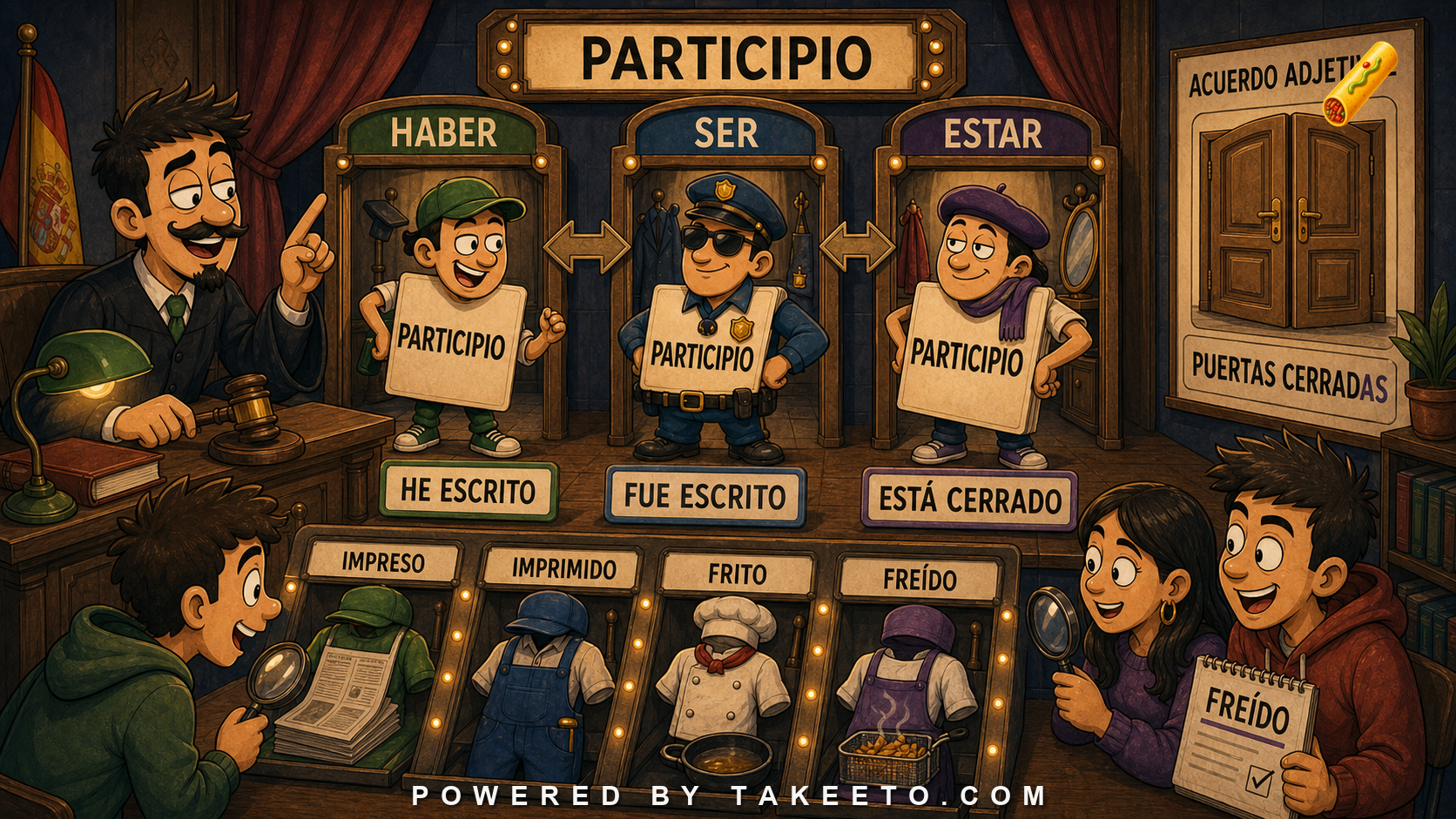
The participle is not one thing doing one job
The Spanish past participle looks deceptively simple. A learner sees hablado, comido, vivido, then meets escrito, hecho, visto, roto, and concludes that the main task is memorizing a few irregular forms.
That is only the first layer.
The deeper issue is that Spanish participles live in several grammatical environments. In one place they are part of a perfect tense. In another place they help build a passive clause. In another place they behave like adjectives. In another, they are so lexicalized that they feel more like ordinary descriptive words than verb forms.
The same visible form can therefore behave differently:
He cerrado la puerta.
I have closed the door.
La puerta fue cerrada por el guardia.
The door was closed by the guard.
La puerta está cerrada.
The door is closed.
Las puertas cerradas impiden el paso.
The closed doors block passage.
The participle cerrado/cerrada/cerradas is related to the verb cerrar, but the grammar around it changes its job. The first sentence is a perfect tense. The second is an event passive. The third is a resultative state. The fourth is an adjective modifying a noun.
A durable rule is this:
Do not ask only what the participle means. Ask what construction it belongs to.
Regular participles: the basic morphology
Regular Spanish past participles are built from the verb stem plus a participial ending.
| Verb class | Infinitive | Stem | Participle |
|---|---|---|---|
| -ar | hablar | habl- | hablado |
| -er | comer | com- | comido |
| -ir | vivir | viv- | vivido |
The regular pattern is stable and highly productive:
- estudiar → estudiado
- terminar → terminado
- vender → vendido
- aprender → aprendido
- recibir → recibido
- salir → salido
But verbs whose stems end in vowels often need a written accent in the participle to preserve the pronunciation:
| Infinitive | Participle | Why the accent appears |
|---|---|---|
| leer | leído | marks hiatus: le-í-do |
| creer | creído | marks hiatus: cre-í-do |
| oír | oído | marks hiatus: o-í-do |
| traer | traído | marks hiatus: tra-í-do |
| caer | caído | marks hiatus: ca-í-do |
These accents are not decorative. They show that the i is a separate syllable rather than part of a diphthong.
Common irregular participles
Many high-frequency verbs have irregular participles. These are not marginal curiosities; they appear constantly in reading and conversation.
| Infinitive | Participle | Example |
|---|---|---|
| abrir | abierto | Han abierto la tienda. |
| decir | dicho | Lo he dicho varias veces. |
| escribir | escrito | Ha escrito una carta. |
| hacer | hecho | Hemos hecho el trabajo. |
| morir | muerto | El perro ha muerto. |
| poner | puesto | Han puesto la mesa. |
| resolver | resuelto | El caso está resuelto. |
| romper | roto | Se ha roto el vaso. |
| ver | visto | No lo he visto. |
| volver | vuelto | Ya han vuelto. |
| cubrir | cubierto | La mesa está cubierta. |
Many compounds inherit the irregular participle of the base verb:
| Base | Compound | Participle |
|---|---|---|
| poner | componer | compuesto |
| poner | proponer | propuesto |
| escribir | describir | descrito |
| cubrir | descubrir | descubierto |
| volver | devolver | devuelto |
| hacer | deshacer | deshecho |
This is one reason participles are vocabulary items, not just forms. If you learn poner → puesto, it becomes much easier to recognize compuesto, propuesto, supuesto, and expuesto.
Haber + participle: invariant participle
In compound tenses with haber, the participle does not agree with the subject or object in modern standard Spanish.
He escrito la carta.
I have written the letter.
Hemos escrito las cartas.
We have written the letters.
María ha escrito los informes.
María has written the reports.
The participle remains escrito. It does not become escrita, escritos, or escritas because the participle is part of the verb tense, not an adjective agreeing with a noun.
This is a common learner trap:
| Intended meaning | Better Spanish | Bad learner pattern |
|---|---|---|
| I have written the letter. | He escrito la carta. | He escrita la carta. |
| We have closed the windows. | Hemos cerrado las ventanas. | Hemos cerradas las ventanas. |
| She has seen the photos. | Ha visto las fotos. | Ha vistas las fotos. |
The rule is simple but powerful:
With haber + participle, the participle is frozen in the masculine singular form.
This applies across perfect tenses:
- he visto
- había visto
- habré visto
- habría visto
- haya visto
- hubiera visto
The auxiliary changes. The participle does not agree.
Ser + participle: event passive with agreement
In the passive voice with ser, the participle agrees with the patient subject in gender and number.
El libro fue escrito en 1998.
The book was written in 1998.
La carta fue escrita ayer.
The letter was written yesterday.
Los informes fueron escritos por el comité.
The reports were written by the committee.
Las reglas fueron escritas con cuidado.
The rules were written carefully.
Here escrito behaves adjectivally enough to agree, even though it is part of a passive construction. The subject is not the doer; it is the thing affected by the event.
A por phrase can identify the agent:
La ley fue aprobada por el Congreso.
The law was approved by Congress.
But Spanish does not use this event passive as freely as English. A Spanish writer often prefers an active clause or a se construction:
El Congreso aprobó la ley.
Congress approved the law.
Se aprobó la ley.
The law was passed / They passed the law.
The ser + participle passive is most natural when the agent matters, the register is formal, or the text wants to frame the patient as the topic.
Estar + participle: state or result
With estar + participle, the participle also agrees, but the construction usually describes a state or result rather than the event itself.
La puerta está cerrada.
The door is closed.
Los documentos están firmados.
The documents are signed.
Las ventanas están abiertas.
The windows are open.
The sentence does not primarily report who closed, signed, or opened something. It describes the current condition.
Compare:
| Event passive | Resultative state |
|---|---|
| La puerta fue cerrada a las ocho. | La puerta está cerrada. |
| El contrato fue firmado por Ana. | El contrato está firmado. |
| Las ventanas fueron abiertas durante la inspección. | Las ventanas están abiertas. |
This distinction matters because English often uses be + participle for both. Spanish forces you to choose between event and state.
Participles as adjectives
Participles can also modify nouns directly:
puertas cerradas
closed doors
una carta escrita a mano
a handwritten letter
un hombre cansado
a tired man
una respuesta equivocada
a mistaken answer
In this use, they behave like adjectives: they agree with the noun.
| Masculine singular | Feminine singular | Masculine plural | Feminine plural |
|---|---|---|---|
| cerrado | cerrada | cerrados | cerradas |
| escrito | escrita | escritos | escritas |
| cansado | cansada | cansados | cansadas |
Some participles become strongly lexicalized as adjectives. Cansado, aburrido, conocido, perdido, complicado, preocupado, and interesado are often learned as adjectives as much as verb forms.
That does not make their verbal origin irrelevant. It helps explain why they can pair with estar, why they agree, and why they often imply a resulting condition.
Double participles: imprimido/impreso, freído/frito, proveído/provisto
Spanish has a small set of verbs whose participial behavior deserves special attention.
The safest high-frequency trio is:
| Infinitive | Regular participle | Irregular participle |
|---|---|---|
| imprimir | imprimido | impreso |
| freír | freído | frito |
| proveer | proveído | provisto |
Both forms are accepted in compound tenses and passive constructions, though usage preferences differ by verb, region, register, and construction.
He imprimido el documento.
He impreso el documento.
Han freído el pescado.
Han frito el pescado.
La empresa ha proveído los materiales.
La empresa ha provisto los materiales.
In adjectival use, the irregular form is often the more natural one:
documentos impresos
printed documents
pescado frito
fried fish
recursos provistos
provided resources
Be careful not to generalize too far. Words like electo, preso, and confuso are related historically or semantically to verbal families, but they do not all behave like ordinary alternate participles in every compound tense. El presidente electo is normal. Han elegido al presidente is normal. But han electo is not the standard ordinary perfect form for “they have elected.”
A good learner strategy is to memorize double-participle verbs as lexical facts rather than inventing a broad rule.
A diagnostic table
When you see a participle, run this test:
| Construction | Agreement? | Main question |
|---|---|---|
| haber + participle | No | Is this a compound tense? |
| ser + participle | Yes | Is this an event passive? |
| estar + participle | Yes | Is this a resulting state? |
| noun + participle adjective | Yes | Is it modifying a noun? |
Apply it:
Hemos cerrado las puertas.
cerrado does not agree because this is haber + participle.
Las puertas fueron cerradas.
cerradas agrees because this is passive ser + participle.
Las puertas están cerradas.
cerradas agrees because this is estar + participle describing a state.
Las puertas cerradas bloquean la salida.
cerradas agrees because it is an adjective.
Diagnostic workflow: identify the participle before you correct it
The most reliable way to handle participles is to pause before editing agreement. Many learner mistakes come from seeing a feminine or plural noun nearby and automatically changing the participle. That is correct in some constructions and wrong in others.
Use this four-step workflow.
1. Find the auxiliary or support verb
Look immediately to the left of the participle. If you see a form of haber, you are almost certainly in a compound tense:
Ana ha cerrado las ventanas.
Ana has closed the windows.
The participle stays cerrado even though ventanas is feminine plural. The tense is ha cerrado, not an adjective phrase.
If you see ser, you may be in an event passive:
Las ventanas fueron cerradas por el guardia.
Now cerradas agrees with ventanas.
If you see estar, you are often describing a state:
Las ventanas estaban cerradas.
Again, agreement appears because the participle is functioning adjectivally in a state description.
2. Ask whether the participle is inside a verb tense
In he visto, habíamos terminado, and habrán llegado, the participle is part of a compound tense. It does not describe a noun directly.
Hemos visto las fotos.
not hemos vistas las fotos
This is especially important when the object comes before the verb:
Las fotos las hemos visto.
We have seen the photos.
Even though las fotos is in front, visto remains invariant because it belongs to hemos visto.
3. Ask whether the participle describes a noun
If the participle answers “what kind?” or “in what state?” for a noun, agreement belongs there.
documentos firmados
signed documents
una puerta abierta
an open door
las tareas terminadas
the finished tasks
This includes predicate adjectives after estar:
Los documentos están firmados.
The participle describes the condition of los documentos, so it agrees.
4. Watch for lexicalized adjective meanings
Some participles have meanings that feel partly independent from the original verb.
una persona interesada
an interested person
un tema complicado
a complicated topic
una respuesta equivocada
a mistaken answer
These still agree like adjectives. The fact that they come historically from verbs does not make them invariant.
A practical editing rule is this: never correct a participle only because a nearby noun is feminine or plural. First identify the construction. Agreement is construction-sensitive, not proximity-sensitive.
Diagnostic refinement: participle agreement is constructional, not visual
The most important remediation point for this article is that participle agreement cannot be edited by looking for the nearest feminine or plural noun. Agreement depends on the construction.
Compare four sentences with the same noun phrase:
| Sentence | Construction | What agrees? |
|---|---|---|
| Hemos revisado las solicitudes. | haber + participle | revisado does not agree |
| Las solicitudes fueron revisadas. | event passive | revisadas agrees with the patient subject |
| Las solicitudes están revisadas. | result state | revisadas agrees as a state/adjective |
| Las solicitudes revisadas pasan a la segunda fase. | noun modifier | revisadas agrees as an adjective |
The learner error is predictable: las solicitudes is feminine plural, so the hand wants to write hemos revisadas. But hemos revisado is a compound tense. The participle belongs to haber, not to the noun.
A stronger editing sequence is:
- Find the word immediately governing the participle.
- If it is haber, keep the participle invariant: he visto, habíamos enviado, habrán recibido.
- If it is ser in a passive clause, make the participle agree with the patient subject: la ley fue aprobada, los informes fueron aprobados.
- If it is estar, ask whether the phrase describes a resulting condition: la puerta está cerrada, los documentos están firmados.
- If the participle directly modifies a noun, treat it like an adjective: puertas cerradas, formularios impresos.
Double participles deserve the same constructional treatment. He imprimido and he impreso are both possible in the perfect; fue imprimido and fue impreso are both possible in the passive, though usage preferences differ. As adjectives, however, impreso, frito, and provisto are usually the more natural choices: documentos impresos, huevos fritos, una sala provista de cámaras.
Finally, do not invent double participles by analogy. Electo, confuso, correcto, preso, and similar forms may be adjective-like words related historically to verbs, but they do not automatically replace the modern verbal participles in compound tenses. Write han elegido, not ordinary learner han electo; ha confundido, not ha confuso.
The working rule is blunt: participles look like one category, but Spanish sorts them by construction. Agreement follows the construction, not the noun that happens to be nearby.
Suggested interactive module: participle role tagger
A useful tool for this article would let readers paste a sentence and identify the role of each participle.
Suggested functions:
- Construction detection: marks haber, ser, estar, and noun-modifying participles.
- Agreement warning: flags participles that should or should not agree.
- Irregular lookup: maps visto, hecho, roto, puesto, dicho, escrito to their infinitives.
- Double participle note: explains imprimido/impreso, freído/frito, and proveído/provisto with register and construction labels.
- Rewrite mode: changes fue cerrado into está cerrado, se cerró, or an active sentence, explaining the difference.
Example input:
Los documentos han sido revisados y ya están firmados.
Possible output:
- han sido revisados: compound passive; revisados agrees with documentos.
- están firmados: resultative state; firmados agrees with documentos.
Final rule
A Spanish participle is not automatically an adjective, and it is not automatically an invariant verb form. Its behavior depends on the construction.
With haber, the participle is invariant: he escrito, hemos escrito, han escrito las cartas. With ser and estar, it agrees: fue escrita, están cerradas. When it directly modifies a noun, it agrees like an adjective: puertas cerradas.
The form may look the same, but the grammar around it tells you its job. Read the construction first. Then decide whether agreement belongs there.