
Possession in Spanish is grammar plus perspective
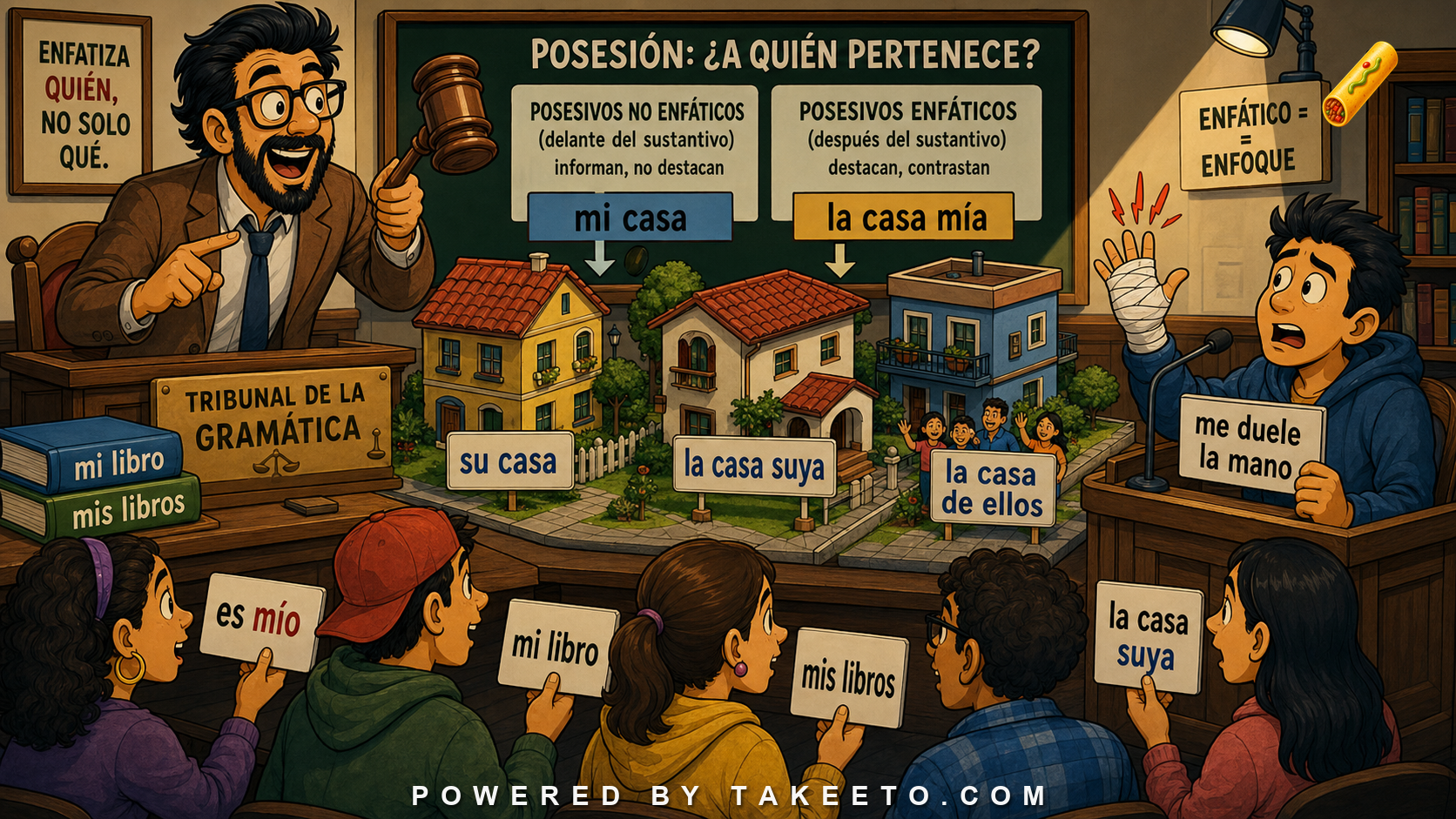
English possessives look simple: my, your, his, her, our, their. Spanish has a richer system because it separates short unstressed possessives before nouns from long stressed possessives after nouns or after ser.
mi casa
my house
la casa mía
my house, with emphasis or contrast
Es mía.
It is mine.
The difference is not just word order. It is information structure. Mi casa normally identifies possession neutrally. La casa mía can sound contrastive, expressive, regional, literary, or emphatic depending on context.
The practical rule:
Short possessives before nouns are the normal default. Long possessives after nouns or after ser add stress, contrast, or pronominal force.
Short possessives before nouns
The short possessives appear before the noun:
| Person | Singular possessed noun | Plural possessed noun |
|---|---|---|
| yo | mi | mis |
| tú | tu | tus |
| él/ella/usted/ellos/ellas/ustedes | su | sus |
| nosotros/as | nuestro/nuestra | nuestros/nuestras |
| vosotros/as | vuestro/vuestra | vuestros/vuestras |
Examples:
mi libro
my book
mis libros
my books
tu idea
your idea
tus ideas
your ideas
su casa
his/her/your/their house
nuestras preguntas
our questions
The agreement is with the possessed thing, not with the owner.
mi casa
my house
mis casas
my houses
The speaker did not become plural. The houses did.
Nuestro and vuestro agree more visibly
Unlike mi, tu, su, the forms nuestro and vuestro show gender and number:
nuestro libro
our book
nuestra casa
our house
nuestros libros
our books
nuestras casas
our houses
The agreement is still with the possessed noun.
In Latin America, vosotros/vuestro is generally not part of the everyday address system, though it remains important for reading Peninsular Spanish, literature, religious language, and some formal or regional contexts. Many learners can recognize vuestro before they need to actively use it.
Su is powerful and ambiguous
The possessive su/sus can mean many things:
su libro
his book, her book, its book, your formal book, their book, your plural book
Context often resolves the ambiguity. But when it does not, Spanish uses de phrases:
el libro de Ana
Ana’s book
la casa de ellos
their house
el coche de usted
your car, formal
Compare:
Juan llamó a Marta porque su coche no arrancaba.
Whose car? Juan’s or Marta’s? Context may say. If not, write:
Juan llamó a Marta porque el coche de él no arrancaba.
Juan called Marta because his car would not start.
or:
Juan llamó a Marta porque el coche de ella no arrancaba.
Juan called Marta because her car would not start.
In careful writing, do not let su create avoidable ambiguity.
Long possessives after nouns
The long possessives are:
| Owner | Masculine singular | Feminine singular | Masculine plural | Feminine plural |
|---|---|---|---|---|
| yo | mío | mía | míos | mías |
| tú | tuyo | tuya | tuyos | tuyas |
| él/ella/usted/etc. | suyo | suya | suyos | suyas |
| nosotros/as | nuestro | nuestra | nuestros | nuestras |
| vosotros/as | vuestro | vuestra | vuestros | vuestras |
They appear after nouns, usually with an article or other determiner:
un amigo mío
a friend of mine
una idea tuya
an idea of yours
la casa suya
his/her/your/their house, with emphasis or clarification depending on context
unos colegas nuestros
some colleagues of ours
The long possessive agrees with the possessed noun:
un amigo mío
una amiga mía
unos amigos míos
unas amigas mías
Not with the speaker.
Possessives after ser
Long possessives are also used after ser:
El libro es mío.
The book is mine.
La casa es nuestra.
The house is ours.
Las llaves son tuyas.
The keys are yours.
Again, agreement is with the possessed item:
El problema es nuestro.
The problem is ours.
La responsabilidad es nuestra.
The responsibility is ours.
Los errores son nuestros.
The mistakes are ours.
This construction often asserts ownership, responsibility, authorship, or belonging.
Un amigo mío vs mi amigo
These are not always equivalent.
mi amigo
my friend, often a specific friend identifiable in context
un amigo mío
a friend of mine, one member of my friend set
Compare:
Mi amigo vive en Quito.
My friend lives in Quito.
Un amigo mío vive en Quito.
A friend of mine lives in Quito.
The second does not identify him as “my main friend”; it introduces one friend among others.
Similarly:
mi profesor
my teacher
un profesor mío
a teacher of mine, one teacher I had/have
This distinction is useful in storytelling and introductions.
Body parts and Spanish articles
English often uses possessives with body parts:
my head hurts
wash your hands
Spanish often uses definite articles when possession is obvious from the person affected:
Me duele la cabeza.
My head hurts.
Lávate las manos.
Wash your hands.
Se rompió la pierna.
He/she broke his/her leg.
The owner is expressed by an indirect/reflexive pronoun or context, not by a possessive adjective.
Do not overtranslate:
Me duele mi cabeza.
This is not impossible in every context, but it is not the neutral pattern. Use:
Me duele la cabeza.
Possession in Spanish often appears through affected-person grammar rather than possessive determiners.
Family nouns and article variation
Spanish often uses possessives with family members:
mi madre
my mother
tu hermano
your brother
nuestros hijos
our children
But articles and possessives vary by region, register, and context. Some varieties use definite articles with names or family references in ways that others do not. Learners should not try to build one universal emotional rule. Instead, learn local patterns from exposure.
One important contrast remains clear:
mi madre
my mother
la madre de Ana
Ana’s mother
una amiga de mi madre
a friend of my mother’s
Possession can be expressed by possessives or de phrases depending on clarity and structure.
Possession beyond ownership
Possessives do not only mark ownership.
mi país
my country, not necessarily owned
mi clase
my class, as student or teacher
mi problema
my problem, responsibility or concern
nuestro tiempo
our time, shared historical or available time
Possession can mean association, responsibility, authorship, relationship, part-whole, origin, control, or emotional connection.
That is why la casa mía is not merely “the house that belongs to me.” It can also mean “my house, not yours,” “that house of mine,” or an emotionally colored phrase depending on context.
Common learner errors
Error 1: Making mi agree with gender
mia casa before a noun
Correct:
mi casa
Use mía after a noun or after ser:
la casa mía
la casa es mía
Error 2: Forgetting plural agreement in short possessives
mi libros
Correct:
mis libros
Error 3: Letting su stay ambiguous when clarity matters
Marta habló con Ana sobre su proyecto.
Whose project? If unclear:
el proyecto de Marta
el proyecto de Ana
el proyecto de ella
Error 4: Overusing possessives with body parts
Lava tus manos.
In many ordinary contexts:
Lávate las manos.
Error 5: Treating un amigo mío as identical to mi amigo
They overlap, but un amigo mío means “a friend of mine,” often one among several.
Diagnostic workflow: owner, possessed item, and discourse effect
To choose a possessive, separate three questions.
First, what is possessed? This determines agreement.
mi libro / mis libros
nuestra casa / nuestros problemas
el libro mío / la casa mía
Second, who is the owner? This determines the possessive family:
yo → mi / mío
tú → tu / tuyo
él, ella, usted, ellos, ustedes → su / suyo
nosotros → nuestro
Third, what discourse effect do you need?
Neutral before-noun possession:
mi casa
su proyecto
nuestras ideas
One-of-many introduction:
un amigo mío
una profesora nuestra
Predicative ownership or responsibility:
La culpa no es mía.
El problema es nuestro.
Contrast or emphasis:
Esa decisión fue tuya, no mía.
This workflow prevents two common mistakes. Learners often make the possessive agree with the owner instead of the possessed noun. But a male speaker still says mi casa and la casa mía, because casa is feminine. A group of owners still says nuestro problema if the possessed noun is singular masculine.
The second mistake is leaving su ambiguous. In a sentence with multiple possible owners, do not rely on context if the stakes are high:
Laura llamó a Marta porque su hija estaba enferma.
Whose daughter? If unclear, write la hija de Laura or la hija de Marta. Possessive grammar is not only about correctness; it is about reference management.
Finally, remember that Spanish often avoids possessives with body parts when the affected person is already marked:
Me duele la espalda.
Se lavó las manos.
This is not less possessive than English. It is possession expressed through the participant structure of the sentence.
Possessor, possessed object, and affected participant
Spanish possessive grammar becomes clearer when you separate three roles: the possessor, the possessed object, and the affected participant. English often packages all three with a possessive adjective, but Spanish may distribute them across articles, pronouns, and de phrases.
English says:
I broke my arm.
Spanish commonly says:
Me rompí el brazo.
The possessed object is el brazo. The affected participant is me. Spanish does not need mi brazo because the reflexive/indirect pronoun already identifies whose body is affected.
Now compare:
Rompí mi taza.
I broke my cup.
Here mi taza is natural because the cup is not an inalienable body part and the possessive distinguishes it from other cups.
The same logic applies to clothing and personal objects, though Spanish varies by context:
Se puso la chaqueta.
He/she put on the jacket, often understood as his/her own.
Se puso mi chaqueta.
He/she put on my jacket.
Possessives become necessary when ownership is contrastive or not inferable.
Use this diagnostic:
- Is the possessed item a body part or something closely associated with the subject?
- Is the possessor already clear from a reflexive or indirect object pronoun?
- Is there a contrast between possessors?
- Would su be ambiguous?
If the possessor is obvious, Spanish often prefers the article. If the possessor must be distinguished, use a possessive or a de phrase. This is why me duele la cabeza is more natural than mi cabeza duele, while mi computadora no funciona is perfectly normal.
Contrast lab: possession, authorship, and responsibility
Possessives often mark more than ownership:
mi libro
the book I own, wrote, use, or was assigned, depending on context
mi error
the mistake I made or accept responsibility for
nuestro país
the country we belong to, not a country we own
su decisión
the decision made by him/her/you/them, or associated with that person/group
This matters in translation. Mi médico is not a doctor owned by me; it is the doctor who treats me. Mi clase may mean the class I teach or the class I attend. Context decides the relation. When the relation is not obvious, Spanish can use a de phrase or a fuller noun: la clase que doy, la clase a la que asisto.
V2 remediation refinement: possession competes with affected-participant grammar
English often marks possession with possessive adjectives: my hand, her head, his mother, our house. Spanish does have possessives, but it frequently uses articles plus an indirect-object or contextual possessor when the possession is obvious, bodily, or personally affected.
Body part:
Me duele la mano.
My hand hurts.
Not the default:
Mi mano duele.
Clothing or body-care event:
Se puso la chaqueta.
He/she put on the jacket.
Me lavé las manos.
I washed my hands.
The article la/las marks the body part or item, while me/se marks the person affected or involved. This is not a lack of possession; it is a different grammatical strategy.
Use possessives when they are needed for contrast, ownership, or emphasis:
Mi chaqueta está en la silla; la tuya está en el coche.
My jacket is on the chair; yours is in the car.
Esa es mi responsabilidad.
That is my responsibility.
The su problem needs a second repair. Su casa can mean his, her, your formal, their, or your plural formal house. When ambiguity matters, Spanish clarifies with de phrases:
la casa de ella
la casa de ellos
la casa de usted
Do not assume the long possessive always solves ambiguity:
la casa suya
This is emphatic or contrastive, but it may still be ambiguous without context. For clarity, de + pronoun/name is often better.
The production rule is blunt: do not import English possessives automatically. Ask whether Spanish would mark the possessor as owner, affected participant, contrastive topic, or simply leave it to context.
Suggested interactive module: possessive ambiguity resolver
A strong tool would help learners choose possessive structures based on clarity and emphasis.
Suggested functions:
- Short vs long possessive selector: neutral before noun vs stressed/pronominal.
- Agreement checker: possessed noun controls form.
- Su ambiguity warning: suggests de él, de ella, de usted, de ellos.
- Body-part pattern correction: mi cabeza duele → me duele la cabeza.
- Discourse effect labels: neutral possession, contrast, one-of-many, responsibility.
Example input:
a friend of mine
Output:
un amigo mío or una amiga mía, depending on the friend’s gender.
Final rule
Use short possessives before nouns for ordinary possession: mi casa, tus libros, su idea. Use long possessives after nouns or after ser for emphasis, contrast, or pronominal possession: un amigo mío, la casa es nuestra.
Remember that possessives agree with the thing possessed, not the owner. And when su is ambiguous, do not force the reader to guess. Use a de phrase.