
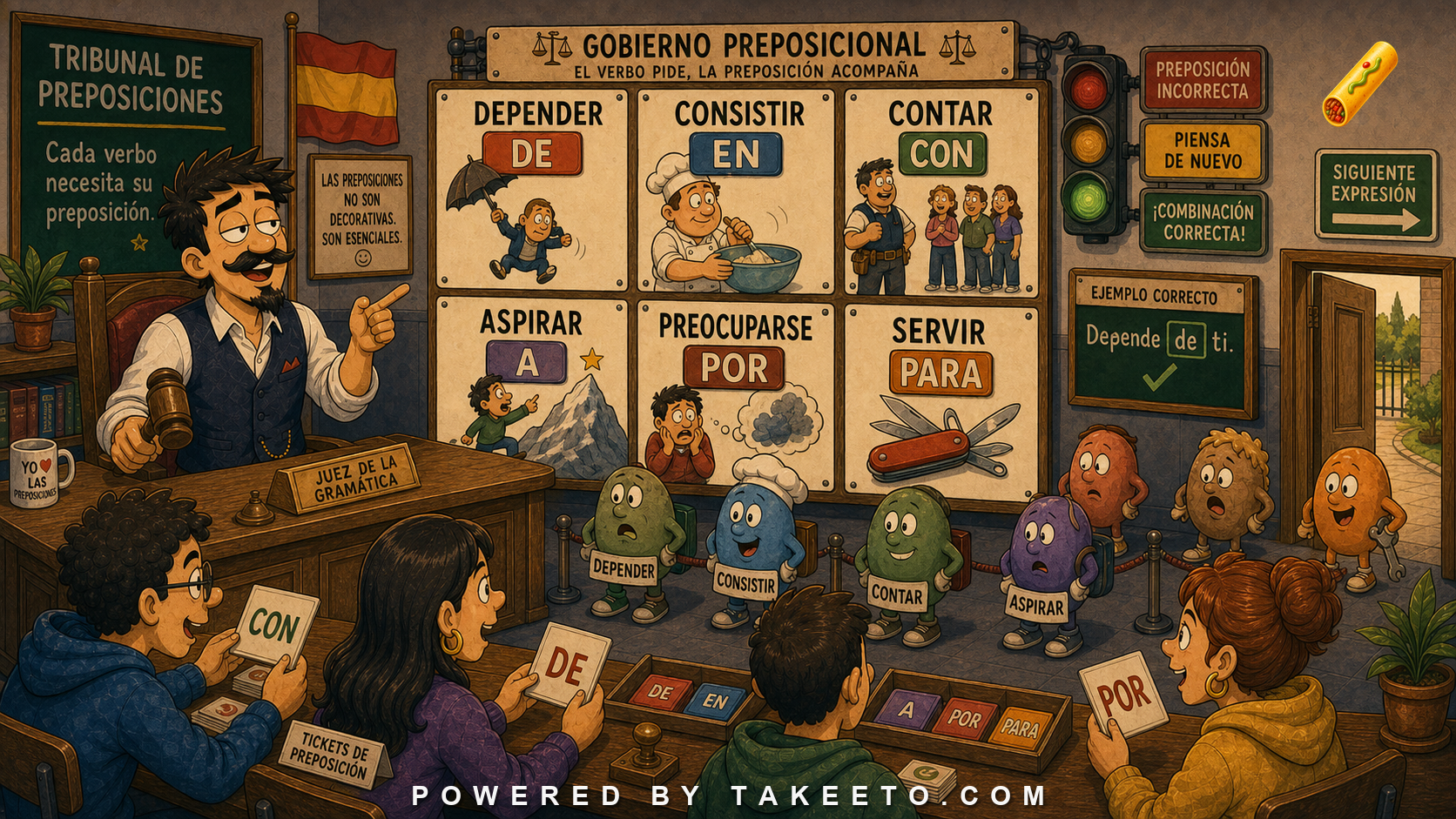
The preposition is part of the verb pattern
Spanish learners often treat prepositions as small interchangeable words. That fails at advanced levels. Many verbs require or strongly prefer a particular preposition before their complement. The pattern is not always predictable from English.
depender de
consistir en
contar con
aspirar a
preocuparse por
servir para
A learner who knows depender but not depender de does not fully know the verb. A learner who knows consistir but says consistir de under English influence is carrying English grammar into Spanish.
The key principle is:
Verb-preposition patterns are vocabulary, not optional grammar afterthoughts.
Learn the preposition with the verb.
Depender de
Depender de means to depend on.
El resultado depende de varios factores.
English uses “on.” Spanish uses de. This is why direct translation is dangerous.
Related patterns:
depender de una decisión
depender de los datos
depender de la situación
In formal prose, dependencia de also appears:
la dependencia de recursos externos
The noun keeps the same de relationship.
Consistir en
Consistir en means to consist of or consist in.
El problema consiste en la falta de datos.
Learners often produce consistir de because English says “consist of.” In Spanish, the standard pattern is consistir en.
The phrase is especially useful for definitions:
La estrategia consiste en reducir los costos sin afectar la calidad.
Learner action: treat consistir en as a fixed explanatory frame.
Contar con
Contar con means to have, possess, rely on, or count on depending on context.
El proyecto cuenta con financiación pública.
This is not the same as simple tener, though it may translate that way. Contar con often sounds formal or institutional and emphasizes available resources, support, or features.
contar con experiencia
contar con apoyo
contar con los recursos necesarios
It can also mean rely on:
Cuento contigo.
Aspirar a
Aspirar a means to aspire to or aim for.
El programa aspira a mejorar el acceso a la educación.
The complement may be a noun or infinitive:
aspirar a un puesto
aspirar a convertirse en líder
The English-like temptation may be to use para because the meaning involves purpose. Spanish uses a with aspirar.
Preocuparse por
Preocuparse por means to worry about or care about.
Se preocupa por sus estudiantes.
The preposition por fits concern, cause, and care. But Spanish also has related forms:
estar preocupado por
preocupación por
preocuparse de, in some varieties/contexts, can occur with taking care of something
Learners should note that regional and semantic variation exists, but preocuparse por is a core pattern.
Servir para
Servir para means to be used for or serve to.
Esta herramienta sirve para analizar textos.
Servir de also exists:
El documento sirve de prueba.
The preposition changes the relationship. Servir para points to function or purpose. Servir de points to role.
This is why memorizing only “servir = serve” is weak. The preposition determines the structure.
Meaning shifts with different prepositions
Some verbs combine with more than one preposition, and the meaning changes.
pensar en
think about
pensar de
have an opinion about, in some contexts
acabar de + infinitive
have just done
acabar con
put an end to
tratar de
try to / be about, depending on structure
tratar con
deal with people/entities
Advanced learners should not ask “Which preposition does this English verb take?” They should ask “Which Spanish verb pattern expresses this meaning?”
Prepositional government in nouns and adjectives
Verb patterns often create noun and adjective patterns:
depender de → dependencia de
consistir en → consistente en, in some formal uses
preocuparse por → preocupación por
aspirar a → aspiración a
This means learning the verb-preposition pattern helps reading noun-heavy formal Spanish.
Example bank walkthrough
depender de
Depend on.
Learner action: do not transfer English “on.”
consistir en
Consist of/in.
Learner action: use for definitions and explanations.
contar con
Have, possess, rely on, count on.
Learner action: recognize institutional resource language.
aspirar a
Aspire to or aim for.
Learner action: pair with noun or infinitive.
preocuparse por
Worry/care about.
Learner action: note relation to preocupación por.
servir para
Be useful for, serve to.
Learner action: distinguish from servir de.
Verb-preposition learning workflow
- Record the verb with its preposition.
- Add an example sentence.
- Add the English temptation if dangerous.
- Add noun/adjective relatives.
- Note alternate prepositions with meaning shifts.
- Review in cloze format: depender ___.
- Practice production with real complements.
- Check dictionaries for patterns, not just definitions.
- Use corpora for phrase confirmation.
- Group patterns by preposition and by meaning.
Mini-workshop: repair preposition transfer
Fix these:
*depende en la situación
*consiste de tres partes
*aspira para ser médico
*sirve por analizar datos
Better:
depende de la situación
consiste en tres partes
aspira a ser médico
sirve para analizar datos
The correction is not about style. The preposition is part of the lexical pattern.
Common learner failure: memorizing preposition lists without meaning
Lists such as “verbs with de” can help, but they can also create mechanical errors. The preposition is not only a memorized particle; it belongs to a construction with meaning.
For example:
tratar de resolver el problema
means try to solve the problem.
tratar sobre el problema
means be about the problem.
The same verb with another preposition creates another construction. A list is only useful if it includes example sentences and meaning distinctions.
Mini-workshop: construction cards
Make cards in this format:
Front:
depender ___ varios factores
Back:
depender de varios factores
Meaning: depend on several factors
Example: El resultado depende de varios factores.
For verbs with multiple constructions, make separate cards. Do not put all meanings on one crowded card. Retrieval should train the exact construction you need.
Common failure mode: choosing prepositions by English
Prepositional government is where English transfer quietly damages otherwise strong Spanish. Depender en, consistir de, and aspirar para are understandable to many listeners, but they reveal that the learner is choosing prepositions after translating from English. The repair is not a longer rule list. It is treating the verb and preposition as one lexical unit.
Flashcards should test the pattern, not only the meaning: depender ___, consistir ___, servir ___. Production must retrieve the preposition automatically, because in real writing there is no time to reason from first principles every time.
Remediation pass: store the preposition inside the lexical item
Prepositional government is frustrating because it resists logic imported from English. Learners ask why Spanish says depender de, consistir en, contar con, aspirar a, preocuparse por, and servir para. Sometimes there are historical or semantic explanations, but in production the useful answer is simpler: the preposition belongs to the pattern.
The remediation move is to stop storing verbs alone. Do not make a card for depender = to depend. Make a card for depender de algo/alguien. Do not store consistir = to consist. Store consistir en. The retrieval target must include the preposition because that is what fails under pressure.
A second repair is to study meaning shifts. Some verbs take different prepositions with different meanings. If learners treat prepositions as interchangeable particles, they miss these distinctions.
Before/after repair: preposition retrieval cards
Weak card:
Front: depender
Back: to depend
Stronger card:
Front: depender ___ la situación
Back: depender de la situación
Even stronger:
Sentence: El resultado depende ___ varios factores.
Answer: de.
Note: depender de + noun/pronoun/infinitive-like idea.
Weak learner sentence:
El proyecto consiste de tres fases.
Standard repair:
El proyecto consiste en tres fases.
Weak learner sentence:
Contamos de suficiente información.
Repair:
Contamos con suficiente información.
Mini-workshop: preposition sorting by verb frame
Create six columns: de, en, con, a, por, para. Add verbs with their complements:
- de: depender de, carecer de, acordarse de, tratar de in one sense.
- en: consistir en, confiar en, insistir en, fijarse en.
- con: contar con, soñar con, cumplir con in some contexts, relacionarse con.
- a: aspirar a, contribuir a, atreverse a, oponerse a.
- por: preocuparse por, optar por, luchar por, preguntar por.
- para: servir para, prepararse para, estar listo para.
Then write one sentence per verb. Sorting is useful, but production requires sentence context.
Meaning shifts and false security
Some verbs change meaning with the preposition:
tratar de = try to / be about, depending on structure.
tratar con = deal with people or matters.
contar con = rely on / have available.
contar de can appear in other structures with “tell about,” but it is not the same pattern.
pensar en = think about.
pensar de = have an opinion about, often in questions like ¿Qué piensas de...?
A finished article should include this because learners otherwise overgeneralize one frame.
Production routine: forced retrieval before writing
Before writing a formal paragraph, list the verbs you plan to use that require prepositions. Fill in the preposition before drafting. This sounds mechanical, but it prevents errors in high-stakes writing.
Example planning list:
depender de
consistir en
contribuir a
contar con
preocuparse por
Then draft. After drafting, audit every preposition. Advanced writing improves when prepositions become part of vocabulary review, not last-minute proofreading.
Editorial quality checks for this article
The article should resist the temptation to provide a giant list with no method. It should teach verb-preposition pairs as lexical frames, show meaning shifts, and include retrieval exercises. It should also acknowledge variation and domain preference where appropriate without making the learner think anything goes. The final reader should stop asking “which Spanish preposition equals English ‘for’?” and start asking “what frame does this Spanish verb require?”
Extended remediation: move preposition patterns from recognition to automatic production
Verb-preposition knowledge has to become fast. In reading, the learner can often infer the intended meaning even if they would choose the wrong preposition. In writing and speaking, hesitation exposes the gap. The cure is repeated retrieval of the frame, especially with conjugated forms: depende de, consiste en, cuenta con, aspira a, se preocupa por, sirve para.
Contrast set
- dictionary knowledge: consistir means to consist.
- production-ready knowledge: El problema consiste en que...; La propuesta consiste en tres medidas. Prompt: consistir ___ → en.
The contrast set should be read aloud or rewritten, not merely admired. Advanced learners often understand a correction when they see it, then fail to reproduce it when the task changes. The repair is to make the contrast portable: identify the decision, name the cue, and apply the same decision to a new sentence, clip, paragraph, or writing task.
Real-use transfer drill
- Make cloze prompts where only the preposition is missing.
- Conjugate the verb across several subjects or tenses.
- Add one noun phrase and one clause complement if the verb allows both.
- Write a short paragraph using six target frames.
- Audit the paragraph without looking at English.
The deliverable is an automaticity score: which frames can you produce instantly, which require checking, and which still attract English transfer?
Some verbs permit multiple prepositions with different meanings. Do not “fix” every variant to one form without checking meaning. The goal is pattern knowledge, not oversimplification.
A good remediation pass ends with a usable artifact: a marked paragraph, a recording comparison, a collocation card, a frame note, a stance map, a change-claim table, or a revision pair. Without an artifact, the learner may feel enlightened but have nothing to review. With an artifact, the explanation becomes part of a study system.
Depth reinforcement: preposition patterns need examples, not slogans
Learners often want a grand explanation for every preposition, but prepositional government is partly lexical. There are tendencies, but the safest learning unit is still the example. Depender de la situación, consistir en un análisis, contar con recursos, aspirar a un cargo, preocuparse por el resultado, and servir para medir should be stored as full mini-patterns.
This does not mean reasoning is useless. It means reasoning should follow examples. After collecting examples, the learner can notice that para often marks function in servir para, that de often appears with dependence or source, and that con marks resources or support in contar con. But production should rely on retrieved patterns, not improvised translation.
Applied drill: preposition cloze under time pressure
Prepositions often fail because learners can recognize them slowly but cannot retrieve them while writing or speaking. Use timed cloze drills with full sentences.
El resultado depende ___ varios factores.
El proyecto consiste ___ tres fases.
Contamos ___ el apoyo del equipo.
Aspira ___ obtener una beca.
Se preocupa ___ la falta de datos.
Esta herramienta sirve ___ analizar textos.
Answer quickly, then explain slowly. The quick answer trains retrieval; the explanation trains understanding. Both matter.
For advanced practice, add distractor sentences where English would suggest the wrong choice. Example: insistir en, not “insist on” translated mechanically every time but a Spanish frame that must be retrieved. The point is not to memorize a rule for each preposition. The point is to attach the preposition to the verb so strongly that it arrives as part of the phrase.
Suggested interactive module: verb-preposition concordance viewer
A strong tool for this article would teach patterns through examples.
Suggested functions:
- Verb lookup: show required/common prepositions.
- Pattern examples: noun complement, infinitive complement, clause complement.
- Meaning-shift alerts: servir para vs servir de.
- English-transfer warning: common learner errors.
- Cloze drills: choose the missing preposition.
- Corpus snippets: authentic-style usage.
- Notebook export: verb + preposition + example + register.
Final rule
In Spanish, many verbs bring their prepositions with them.
Learn depender de, consistir en, contar con, aspirar a, preocuparse por, and servir para as complete patterns. The preposition is not a little word to guess later. It is part of knowing the verb.