
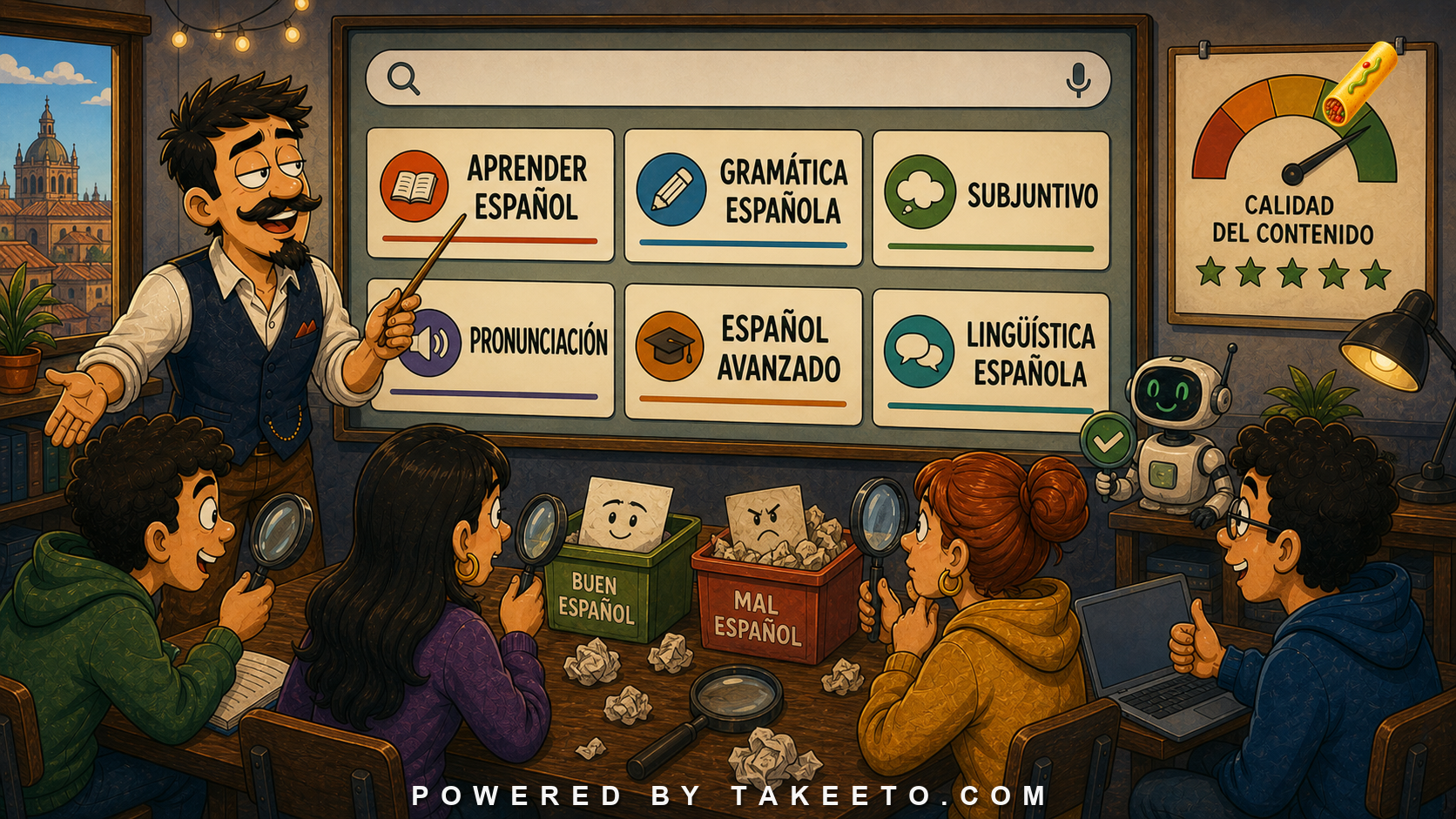
Search visibility is not permission to write badly
Spanish SEO often fails in two opposite ways.
One version ignores search behavior and writes elegant prose nobody finds. The other version chases keywords so aggressively that the Spanish becomes fragmented, repetitive, and untrustworthy.
Example of bad keyword stuffing:
Aprende español gramática española subjuntivo pronunciación español avanzado con mejores ejercicios español.
A reader sees that and immediately loses confidence.
The key principle is:
Good Spanish SEO satisfies search intent while still sounding like competent Spanish.
Search engines matter. Readers matter more. A page that attracts clicks and then feels cheap has failed.
Start with intent, not keywords
A keyword is not a topic. It is a clue about what the user wants.
Keyword:
subjuntivo
Possible intents:
- What is the subjunctive?
- When do I use it?
- What are the conjugations?
- Why does Spanish use it after aunque?
- I need exercises.
- I need advanced nuance.
- I need a quick exam review.
A strong page chooses one intent or organizes several clearly.
Better title:
Spanish Subjunctive: When It Appears and What It Does
For a Spanish-language page:
El subjuntivo en español: cuándo aparece y qué función cumple
The keyword is present, but the title is a real sentence fragment with a clear promise.
Headings should guide, not stuff
Bad headings repeat keywords mechanically:
Gramática española subjuntivo español avanzado
Ejercicios subjuntivo gramática española
Pronunciación español subjuntivo
Better headings answer reader questions:
Qué expresa el subjuntivo
Por qué no basta traducir it depends
Subjuntivo después de expresiones de duda
Errores comunes de estudiantes avanzados
Headings should be scan-friendly. They should also form a logical outline. SEO is stronger when the page structure matches the user’s learning path.
Snippets need natural compression
Search snippets and meta descriptions should be short, but not robotic.
Bad:
Aprende español gramática española subjuntivo pronunciación español avanzado ejercicios ejemplos.
Better:
Una explicación clara del subjuntivo en español, con ejemplos, contrastes de significado y ejercicios para estudiantes intermedios y avanzados.
This includes important terms, but it reads like Spanish.
Translationese damages SEO quality
Spanish SEO written from English often carries translationese:
Hacer progreso rápido en español
Aplicar para nuestro curso
Actualmente, aprenderás...
La app ayuda a construir tu vocabulario
Better:
Avanzar rápido en español
Inscribirte en nuestro curso / solicitar una plaza
En esta lección aprenderás...
La app te ayuda a ampliar tu vocabulario
Search engines may bring readers in, but translationese tells them the site is not built from inside Spanish.
Regional keywords without broken prose
Spanish SEO must often choose between regional forms.
Examples:
- ordenador / computadora,
- móvil / celular,
- coche / carro / auto,
- vosotros / ustedes,
- pronunciación / acento / entonación depending on topic.
Bad strategy:
Aprende español en computadora ordenador celular móvil con ejercicios.
Better strategy:
Use one natural term in the main prose and include regional variants where useful.
Example:
Puedes estudiar desde el teléfono, la computadora o la tableta. En España, es común ver móvil y ordenador para estos mismos conceptos.
This teaches and captures variants without deforming the sentence.
Educational Spanish needs extra trust
If the page teaches grammar, pronunciation, or translation, bad Spanish is self-defeating. A learner may not notice every issue, but teachers, advanced learners, and native speakers will.
For language-learning SEO, the page must demonstrate the standard it teaches.
Weak claim:
Habla fluido en 30 días con nuestro método.
More credible:
Construye una base sólida de lectura, gramática y vocabulario con práctica guiada.
SEO does not require exaggeration. Serious learners often respond better to precision than hype.
Keyword placement that respects prose
Useful locations for keywords:
- title,
- URL slug,
- first paragraph,
- headings where natural,
- image alt text where relevant,
- glossary entries,
- FAQ questions,
- internal links,
- summary sections.
Bad location:
- every sentence.
A page about pronunciación can use pronunciación, sonidos, ritmo, acento, entonación, vocales, consonantes, fluidez, and escucha. Variation is not weakness. It is natural semantic coverage.
Example bank walkthrough
aprender español
Broad keyword with many intents.
Learner action: specify level, skill, or method: aprender español leyendo, aprender español desde cero, aprender español avanzado.
gramática española
Formal and broad.
Learner action: use when discussing grammar as a system, not every small rule.
subjuntivo
High-intent grammar topic.
Learner action: match content to learner question: form, use, contrast, exercises, advanced nuance.
pronunciación
Can include sounds, stress, intonation, rhythm, and accent.
Learner action: clarify whether the page teaches articulation, listening, or speaking practice.
español avanzado
Often signals plateau, nuance, register, and serious study.
Learner action: avoid beginner content under an advanced label.
lingüística española
More academic than “Spanish learning.”
Learner action: use when the content really involves linguistic analysis.
Editorial SEO checklist
Before publishing a Spanish learning article:
- Intent: What exact problem does the searcher have?
- Title: Is it searchable and natural?
- Opening: Does it answer the core need quickly?
- Headings: Do they form a learning path?
- Keywords: Are they present without stuffing?
- Spanish quality: Any translationese, false friends, or awkward collocations?
- Regional policy: Neutral, Spain-specific, Latin America-specific, or explicitly comparative?
- Examples: Are they correct, annotated, and useful?
- Trust: Are claims honest?
- Next action: Does the page guide the reader to practice, review, or a related article?
Search-visible Spanish needs editorial architecture
Good SEO is not sprinkling keywords into Spanish paragraphs. It is building a page whose structure matches what readers are trying to do. The headings, examples, definitions, and internal links should answer a real search intent in readable Spanish.
For an article about the subjunctive, weak SEO Spanish looks like this:
Subjuntivo español aprender subjuntivo ejemplos subjuntivo ejercicios subjuntivo para estudiantes.
This is visible to search engines only in the worst sense. It destroys trust.
A better structure:
Qué es el subjuntivo en español
Cuándo se usa el subjuntivo
Indicativo vs. subjuntivo: ejemplos mínimos
Errores comunes de estudiantes avanzados
Ejercicios para practicar el subjuntivo en contexto
The keywords appear because the page is organized around the reader’s questions. That is the difference between optimization and stuffing.
Headings are promises
A Spanish heading should tell the reader what the section will do. It should not be a pile of search terms.
Weak:
Gramática española subjuntivo avanzado ejemplos
Better:
Cómo reconocer el subjuntivo en textos avanzados
Weak:
Pronunciación español palabras difíciles
Better:
Palabras difíciles de pronunciar en español: ritmo, acento y sílabas
The better heading is still search-visible. It is also readable.
Regional keywords without prose damage
A page may need to capture regional terms. The correct method is to teach the variation, not cram variants unnaturally.
Bad:
Aprende español con móvil celular teléfono para vocabulario España México Latinoamérica.
Better:
En España suele decirse móvil; en gran parte de América Latina, celular. En una interfaz internacional, teléfono puede ser la opción más neutral si el contexto lo permite.
This version respects the reader. It also gives search engines meaningful semantic context: Spain, Latin America, mobile phone, vocabulary, neutral interface.
Translationese is an SEO liability
Machine-translated SEO pages often repeat structures like:
Cómo aprender español rápido y fácil con nuestros consejos comprensivos.
The problem is not only style. It signals low editorial care. Spanish readers quickly detect pages written for algorithms instead of people. For educational content, that is especially damaging because the page is asking the reader to trust its language explanations.
Better:
Cómo estudiar español con un plan realista: lectura, escucha, gramática y repaso
This title is less sensational and more credible. It also contains useful terms.
Serious editorial checklist for Spanish educational SEO
Before publishing, check:
- Does the article answer one clear search intent?
- Does the title use natural Spanish?
- Do headings form a logical outline?
- Are keywords integrated through explanation, not repetition?
- Are accents, punctuation, and capitalization correct?
- Are regional terms identified instead of mixed randomly?
- Does every example teach something?
- Does the page avoid exaggerated promises such as fluidez en una semana?
- Does the Spanish sound like a knowledgeable teacher wrote it?
- Would the article still be useful if search engines did not exist?
That last question is severe but necessary. If the page would be worthless without search traffic, the Spanish is probably not good enough.
Takeeto-specific content principle
A grammar article should not chase visibility by becoming shallow. It should earn visibility by being the clearest page on the problem. That means examples, contrasts, annotated mistakes, practice routines, and honest limits.
For Takeeto-style content, the strongest SEO signal is not keyword density. It is durable usefulness: a page that readers save, teachers assign, and learners return to when the quick answer was not enough.
Example: keyword to paragraph
Keyword cluster:
aprender español, gramática española, subjuntivo, ejercicios
Bad SEO paragraph:
Aprende español gramática española subjuntivo con ejercicios para aprender español rápido.
Article-ready paragraph:
Para aprender el subjuntivo, no basta con memorizar una lista de “activadores”. El estudiante necesita ver cómo cambia la postura del hablante: afirmación, duda, deseo, valoración o finalidad. Por eso, los ejercicios de gramática española deben incluir frases completas y contextos reales, no solo huecos aislados.
The good paragraph still contains the important terms. But each term earns its place by doing explanatory work. That is the editorial standard: keywords should appear because the paragraph needs them, not because a search tool demanded them.
A warning about translated keyword plans
English SEO briefs often arrive with keyword phrases that cannot be inserted naturally into Spanish. A writer should translate intent, not blindly obey phrase order. If the required phrase is unnatural, negotiate a Spanish heading, glossary note, or contextual sentence that preserves search value without damaging prose. Bad Spanish may create traffic once; it will not create trust.
Suggested interactive module: SEO draft auditor
A strong tool for this article would score both search fit and Spanish quality.
Suggested functions:
- Keyword intent classifier: informational, grammar, comparison, product, local.
- Heading analyzer: natural Spanish vs keyword stuffing.
- Translationese detector: calques, false friends, English word order.
- Regional vocabulary checker: Spain/Latin America/global.
- Snippet generator: concise, grammatical meta description.
- Claim-risk flag: fluency, speed, guaranteed results.
- Reader-trust score: clarity, evidence, examples, tone.
Final rule
Spanish SEO should make good Spanish easier to find, not make Spanish worse.
Use search data to understand the reader’s intent. Then write clear headings, natural sentences, honest claims, and region-aware examples. Visibility gets the click. Language quality earns the reader.
Search engines do not excuse ugly Spanish.