
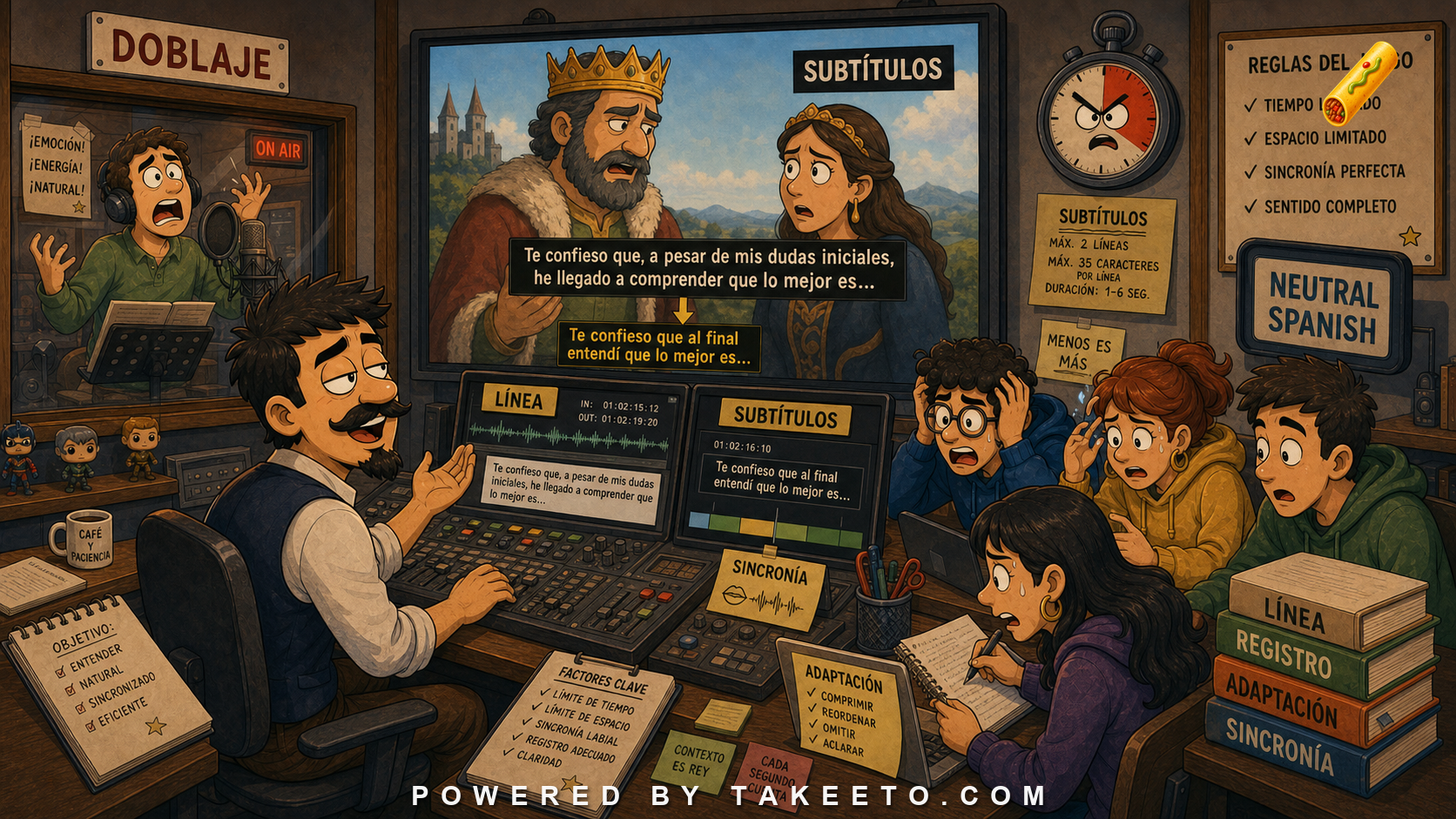
Subtitles are not transcripts
Learners often watch a film or series with Spanish subtitles and assume the subtitles are a written version of everything being said.
They are not.
Subtitles are a translation product under pressure. They must fit the screen, match timing, remain readable, compress culture, preserve plot, and carry tone with limited space. A subtitle may omit filler, merge two lines, soften a joke, replace an idiom, or choose a shorter structure because the viewer has only a few seconds to read.
The key principle is:
Subtitle Spanish is constrained Spanish, not complete Spanish.
That does not make it bad. It means learners must use subtitles intelligently.
The subtitle problem: space, speed, and timing
A subtitle line has limited room. Viewers must read while watching faces, action, scene changes, and visual information. If the text is too long, the viewer misses the scene. If it is too literal, it may be unreadable or unnatural.
Spoken dialogue contains many elements that subtitles often reduce:
- repeated names,
- false starts,
- filler,
- discourse markers,
- overlapping speech,
- hesitation,
- fragments,
- culturally dense references,
- jokes that require restructuring.
Spoken English:
Well, I mean, you know, I didn’t exactly say that.
Possible subtitle:
No dije exactamente eso.
Literal material has disappeared, but the communicative point remains.
A learner who treats the subtitle as a transcript may think Spanish “forgot” several words. In reality, the subtitle did its job.
Reading speed shapes grammar
Subtitles often prefer shorter, cleaner clauses.
A literal translation may be:
Bueno, quiero decir, si lo piensas bien, no es que no quiera ayudarte.
A subtitle might be:
Si lo piensas bien, sí quiero ayudarte.
Or:
No es que no quiera ayudarte.
The subtitle chooses what matters for the scene. It may preserve hesitation if hesitation is dramatically important. It may remove it if the plot meaning is more important.
Learner action:
When subtitle Spanish is simpler than the audio, ask whether compression, not grammar, explains the difference.
Dubbing solves a different problem
Dubbing is not subtitling with voices. Dubbing must fit mouth movement, timing, acting, character, scene rhythm, and audience expectations.
A dubbed line may choose a phrase not because it is the closest translation, but because it fits the actor’s mouth movement and the timing of the shot.
Important dubbing constraints include:
- lip synchronization,
- sentence length,
- emotional timing,
- voice performance,
- character register,
- cultural adaptation,
- continuity across episodes,
- audience familiarity.
A subtitle can be concise because viewers still hear the original audio. Dubbing must replace the audio experience. It therefore carries more burden: voice, rhythm, tone, and performance.
Neutral Latin American dubbing and Spain-specific versions
Spanish media translation often distinguishes between Latin American Spanish and Spanish for Spain. Many productions also use a “neutral” Latin American register intended to travel across markets.
Neutral dubbing typically avoids strongly regional vocabulary, local slang, and country-specific pronunciation markers where possible. It often favors ustedes over vosotros and widely understood vocabulary choices.
Spain-specific versions may use vosotros, vale, ordenador, móvil, and other Peninsular forms where appropriate. Latin American versions may use computadora, celular, and different idioms depending on the localization strategy.
Neither version is “the real Spanish.” Both are market and audience choices.
Register must survive compression
A subtitle has to preserve not only information but relationship.
Consider English:
Would you mind stepping outside for a moment?
Too literal or too long:
¿Le importaría salir afuera por un momento?
Possible subtitle:
¿Puede salir un momento?
More formal:
¿Podría salir un momento?
More abrupt:
Salga un momento.
The right choice depends on the scene. A police officer, a doctor, a friend, and an angry boss would not all get the same subtitle.
Learner action:
Do not ask only whether a subtitle has the “same words.” Ask whether it preserves force, relationship, and scene function.
Subtitles can teach, but they can also mislead
Subtitles are useful for learners because they expose written Spanish, paraphrase difficult speech, and help connect meaning to scenes. But they can mislead if treated as exact grammar evidence.
Subtitles may:
- omit discourse markers that real speakers use,
- normalize messy speech into clean written Spanish,
- use regional vocabulary chosen for market reach,
- avoid slang that appears in the audio,
- simplify complicated syntax,
- change jokes or idioms,
- shorten politeness formulas.
This matters for learners. If you want conversational Spanish, subtitles alone are not enough. If you want reading practice, subtitles can be useful. If you want translation analysis, compare subtitle, dub, and literal transcript.
Example bank walkthrough
neutral Spanish
A constructed media register meant to be broadly understood.
Learner action: use it as a comprehension aid, not as proof that all Spanish speakers talk that way.
doblaje
Dubbing: replacing the original audio with Spanish voice performance.
Learner action: listen for timing, register, and character voice, not only vocabulary.
subtítulos
Subtitles: written text synchronized with video.
Learner action: treat them as compressed translation, not full transcript.
línea
A subtitle line or dialogue line.
Learner action: notice how one spoken turn may become one or two subtitle lines.
registro
Register: level of formality, social relationship, and genre.
Learner action: check whether compression preserved politeness or made the speaker sound too blunt.
adaptación
Adaptation: changing form to preserve function in the target culture or medium.
Learner action: expect jokes, idioms, and cultural references to shift.
sincronía
Synchronization: timing with audio, mouth movement, scene rhythm, or reading time.
Learner action: remember that timing can force wording changes.
Subtitle analysis workflow
When studying Spanish with subtitles:
- Watch once for meaning. Do not pause every line.
- Choose a short scene. Thirty seconds is enough.
- Write down the subtitle. Treat it as a translation product.
- Compare with audio if you understand the source. What was omitted?
- Label changes: compression, register shift, idiom adaptation, timing, cultural replacement.
- Rewrite literally. This shows what the subtitle avoided.
- Rewrite naturally. This shows alternatives.
- Decide learner value. Is this line useful for speaking, reading, or translation analysis?
What subtitles usually remove
Subtitles are compressed because viewers must read while watching. The compression is not random. Subtitlers tend to remove or reduce material that is recoverable from image, tone, or context.
Common reductions include:
| Spoken dialogue feature | Subtitle treatment | Risk for learners |
|---|---|---|
| false starts | often removed | learners think real speech is cleaner than it is |
| repeated address terms | reduced | relationship cues may disappear |
| filler and hesitation | removed or simplified | learners miss pacing and uncertainty |
| cultural references | adapted or condensed | literal meaning may be hidden |
| jokes and wordplay | replaced by target-language effect | grammar may not match the spoken line |
| politeness markers | compressed | register can look flatter than it sounded |
For example, spoken English might say:
Look, I mean, I’m not saying it was your fault, okay?
A Spanish subtitle might become:
No digo que fuera culpa tuya.
This is efficient and readable. But the subtitle drops look, I mean, and okay?—all of which manage relationship, tension, and stance. The learner who treats the subtitle as a transcript will miss the interpersonal work.
Dubbing solves the mouth; subtitles solve the eye
A subtitle is constrained by reading speed and screen space. A dub is constrained by timing, mouth movement, acting, and synchrony. These pressures create different Spanish.
An English line such as:
You have got to be kidding me.
Possible subtitle:
No puede ser.
Possible dubbed line:
Me estás tomando el pelo.
Possible neutralized dub:
No me digas.
None of these is “the” literal translation. Each solves a different production problem. A subtitle may choose brevity. A dub may choose mouth rhythm and emotional force. A regional version may choose an idiom that sounds alive to its audience.
The learner’s question should be:
What constraint is this Spanish solving?
Not:
Why did they fail to translate the words?
Learner method: three-column viewing
A serious subtitle routine uses three columns:
| Column | Purpose |
|---|---|
| Original dialogue | What was actually said? |
| Literal/structural note | What does the source grammar do? |
| Final subtitle/dub | What Spanish solution was chosen? |
After viewing, choose one line and ask:
- What was omitted?
- What was compressed?
- What was adapted culturally?
- Did the Spanish preserve register?
- Did the Spanish preserve emotional force?
- Would a fuller translation be better for study, even if worse for screen use?
For learners, the best line is often not the shortest subtitle. It is the comparison between spoken source, literal meaning, and final adaptation.
A small alignment example
Original English:
I was just trying to help.
Literal meaning:
I only intended to help / my action was an attempt to help.
Possible subtitle:
Solo quería ayudar.
Possible dub:
Yo solo intentaba ayudar.
Possible defensive version:
Lo único que quería era ayudar.
Each Spanish option carries a slightly different weight. Solo quería ayudar is compact and natural. Intentaba ayudar emphasizes attempt. Lo único que quería... sounds more defensive or emotionally marked. A good subtitler chooses based on scene, timing, and character.
What not to learn from subtitles
Subtitles are useful for vocabulary, reformulation, and gist. They are weak as evidence for exact syntax, exact spoken rhythm, or complete dialogue. A subtitle that omits a pronoun, softener, or discourse marker is not proving that Spanish does not use those forms. It is proving that the subtitle had to fit the screen.
The strongest learner habit is to treat subtitles as edited Spanish under pressure. They are real Spanish, but not neutral evidence of how people speak line by line.
Study task: do not memorize the subtitle as the only answer
For each useful subtitle line, create at least two alternative Spanish versions: one fuller and one more compressed. This keeps the learner from treating the published subtitle as a universal translation.
Example source idea:
I didn’t mean it like that.
Possible Spanish solutions:
No quería decirlo así.
No lo decía en ese sentido.
No era mi intención que sonara así.
No quise decir eso.
Each version fits a different character, timing, and register. The first is broad and natural. The second is more explanatory. The third is softer and more responsible. The fourth may shift the meaning toward denial.
This exercise trains judgment. Subtitling is not about finding the phrase that “matches” the English words. It is about choosing a Spanish line that fits time, image, character, and function. For learners, producing alternatives reveals what the professional subtitle had to sacrifice.
Suggested interactive module: subtitle alignment viewer
A strong tool for this article would show three or four layers side by side.
Suggested functions:
- Original audio transcript. What was said.
- Literal Spanish translation. What word matching would produce.
- Final subtitle. What appeared on screen.
- Dubbed line. What voice actors performed.
- Constraint labels: length, timing, lip sync, register, joke adaptation.
- Reading-speed meter: estimated characters per second.
- Learner mode: identify what was compressed or changed.
Final rule
Subtitles and dubbing are not failed literal translation. They are translation under pressure.
Subtitles sacrifice completeness for readability. Dubbing sacrifices literalness for performance and synchronization. Learners should use both critically: subtitles for compressed reading, dubbing for voice and register, and transcripts for actual speech.
Media Spanish is real Spanish, but it is shaped by the screen.