
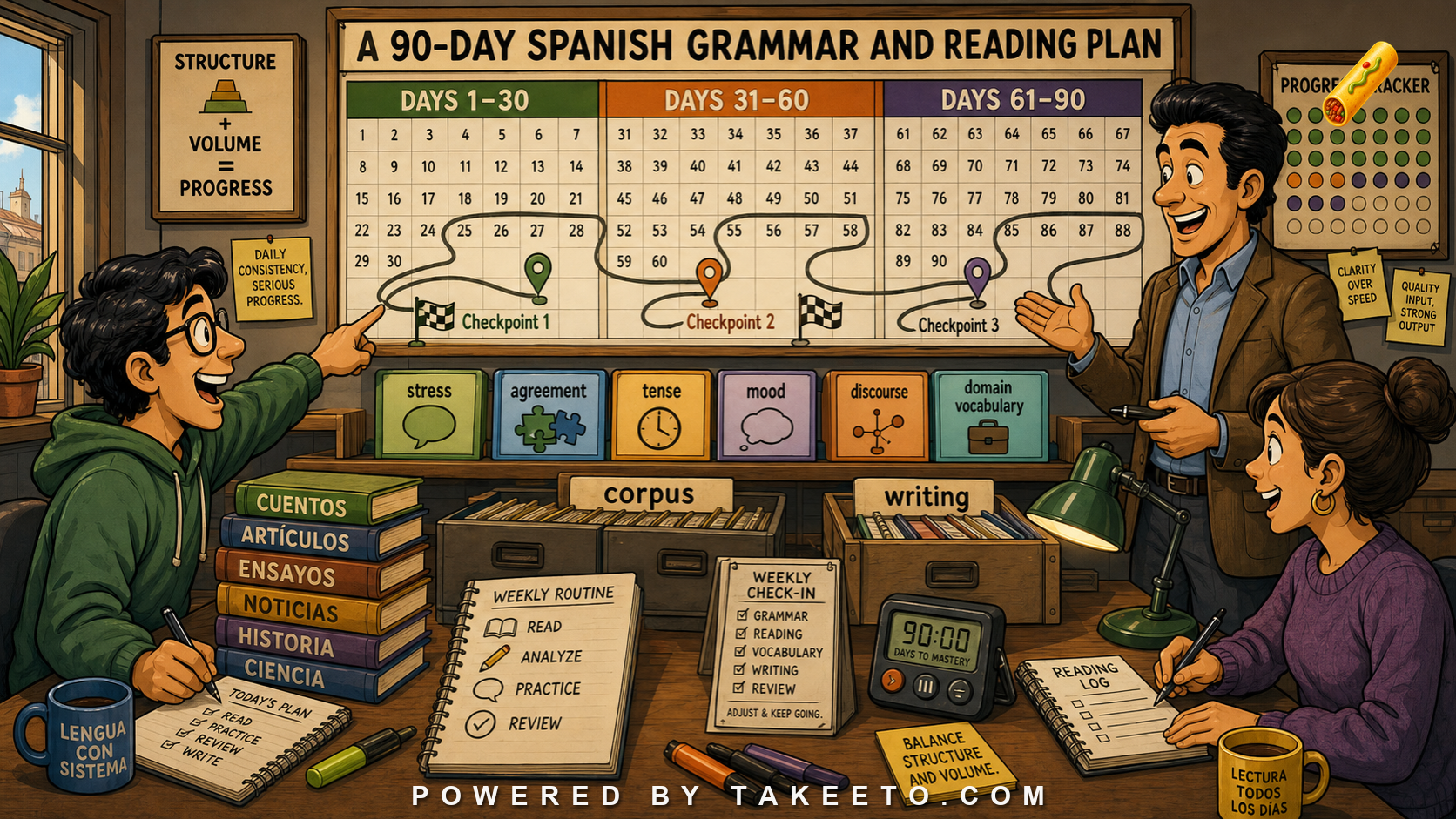
Three months should have an architecture
A ninety-day Spanish plan fails when it becomes a pile of good intentions.
The learner wants grammar, reading, listening, vocabulary, speaking, writing, pronunciation, and confidence. So they add everything: a grammar book, podcasts, flashcards, videos, conversation, news, novels, subtitles, a notebook, and a streak counter. For a week, this feels serious. Then it becomes unmanageable.
A serious ninety-day plan needs architecture.
Thirty days can establish a loop. Ninety days can build a curriculum arc. The learner has enough time to move from sound and orthography, through morphology and syntax, into discourse and domain reading. But that movement must be planned. Otherwise the learner simply circles familiar material while avoiding the deeper problems.
The key principle is:
A ninety-day Spanish plan should move from form control to sentence control to text control.
This does not mean you study pronunciation for thirty days and ignore reading. It means each phase has a dominant question.
- Phase 1: Can I see and hear Spanish accurately?
- Phase 2: Can I parse Spanish structure reliably?
- Phase 3: Can I follow Spanish across paragraphs and domains?
The daily core stays the same
Even across ninety days, the daily core should remain simple:
- read Spanish,
- listen to Spanish,
- retrieve Spanish,
- produce a little Spanish,
- correct Spanish.
The emphasis changes by phase, but the loop remains stable. This is how the plan avoids fragmentation. A learner should not have to reinvent the study routine every week.
A daily ninety-day routine might include:
- one new passage,
- one old passage,
- due flashcards,
- one audio pass,
- one sentence or paragraph of writing,
- one targeted correction.
The passage is the anchor. Grammar study should feed back into reading. Vocabulary review should feed back into passages. Writing should reveal what reading has not yet stabilized.
Phase 1, days 1–30: sound, spelling, and basic form
The first month should strengthen the learner's control of Spanish surface form. “Surface” does not mean superficial. If stress, accent marks, vowel quality, gender, and agreement remain unstable, advanced reading will always be slower than it needs to be.
Phase-one priorities:
- Spanish stress rules,
- written accent marks,
- vowel clarity,
- syllable awareness,
- gender patterns,
- adjective agreement,
- present-tense forms,
- common irregular verbs,
- basic pronoun reference,
- high-frequency connectors.
A learner should not spend the whole first month memorizing tables. The point is to link form to text.
Example:
La decisión fue difícil, pero los estudiantes aceptaron el cambio.
A phase-one learner can audit this sentence for several features:
- la decisión is feminine,
- difícil does not change for gender,
- los estudiantes is plural masculine or mixed group,
- aceptaron is third-person plural preterite,
- pero marks contrast,
- stress in decisión falls on the final syllable and is marked.
This is not slow forever. It is slow training so later reading becomes automatic.
Phase-one weekly rhythm
A good week in phase one:
- Monday: stress and pronunciation focus.
- Tuesday: noun gender and article agreement.
- Wednesday: adjective agreement and noun phrases.
- Thursday: present tense and high-frequency verbs.
- Friday: passage re-reading and audio alignment.
- Saturday: short writing task and correction.
- Sunday: audit and light review.
The learner is not limited to those topics, but one topic should lead the attention each day.
A phase-one writing task can be small:
Describe your room, your schedule, or your city using ten noun phrases. Then audit every article and adjective.
The value is not literary quality. The value is form accountability.
Phase 2, days 31–60: morphology and syntax
The second month should move from word-level form toward sentence architecture.
Priorities:
- preterite versus imperfect,
- future and conditional,
- present perfect and past perfect where relevant,
- subjunctive in high-frequency environments,
- object pronouns,
- reflexive and pronominal verbs,
- passive and impersonal se,
- relative clauses,
- subordinate clauses,
- prepositional government,
- ser and estar in context,
- por and para in context.
This is the month where many learners feel exposed. They know many words, but sentences remain slippery.
Example:
Aunque el informe se publicó el año pasado, todavía se considera una referencia importante porque plantea preguntas que no se habían formulado antes.
A phase-two learner should not translate this immediately. First, parse it.
- Aunque introduces concession.
- se publicó is passive/impersonal-like published event.
- todavía se considera means it is still considered.
- porque introduces cause.
- plantea states what the report does argumentatively.
- que no se habían formulado antes is a relative clause modifying preguntas.
The learner's question becomes:
What is the sentence doing structurally?
That question is more useful than:
What does each word mean?
Syntax drills that are not mechanical
A ninety-day plan should include sentence unpacking.
Take a dense sentence and rewrite it in simpler Spanish:
Original:
La aprobación de la propuesta por parte del comité permitió la continuación del proyecto.
Unpacked:
El comité aprobó la propuesta. Por eso, el proyecto pudo continuar.
Then reverse the process:
El comité aprobó la propuesta. El proyecto continuó.
Compressed:
La aprobación de la propuesta por parte del comité permitió que el proyecto continuara.
This builds control over nominal style, clauses, and causality. It also makes formal Spanish less intimidating.
Phase-two weekly rhythm
A phase-two week can rotate by structure:
- Monday: tense and aspect in narrative.
- Tuesday: mood and subordination.
- Wednesday: pronouns and reference chains.
- Thursday: se constructions.
- Friday: connectors and clause bracketing.
- Saturday: paragraph rewriting.
- Sunday: mixed audit.
This is also the phase where flashcards should include phrases, not only single words.
Poor card:
depender = to depend
Better card:
depender de = to depend on
El resultado depende de varios factores.
Poor card:
darse cuenta = to realize
Better card:
darse cuenta de que = to realize that
Me di cuenta de que faltaba información.
Syntax is stored in patterns.
Phase 3, days 61–90: discourse and domain reading
The third month should move beyond sentence correctness into text literacy.
Priorities:
- paragraph structure,
- discourse markers,
- source attribution,
- stance and hedging,
- academic connectors,
- news and policy language,
- domain vocabulary,
- register shifts,
- argument structure,
- summaries and abstracts,
- public-facing documents.
At this point, the learner should read not only learner passages but also controlled excerpts from real domains: news, essays, educational texts, policy summaries, product notices, museum labels, app copy, or academic abstracts.
The central question becomes:
How does this text guide the reader?
Look for signals:
sin embargo, asimismo, en este sentido, de acuerdo con, cabe señalar, por otra parte, en consecuencia, ahora bien
These are not decoration. They are architecture.
Example:
Ahora bien, los datos no permiten afirmar que la medida haya producido el cambio observado. En este sentido, conviene distinguir entre correlación y causalidad.
A phase-three learner should notice:
- Ahora bien introduces a pivot or qualification.
- no permiten afirmar is cautious evidence language.
- haya producido uses subjunctive under the scope of assertion limitation.
- En este sentido frames the next explanation.
- conviene distinguir is formal recommendation language.
This is advanced reading. It requires grammar, but grammar alone is not enough.
Weekly writing and corpus checks
A ninety-day plan should include writing once a week. Not because writing is the only goal, but because writing exposes weak structure.
Weekly writing tasks:
- Week 1: description with agreement audit.
- Week 2: narrative using preterite and imperfect.
- Week 3: opinion paragraph with evidence.
- Week 4: summary of a passage.
- Week 5: explanation using cause and result.
- Week 6: formal email or request.
- Week 7: abstract-style paragraph.
- Week 8: comparison of two viewpoints.
- Week 9: domain summary.
- Week 10: rewrite from informal to formal register.
- Week 11: critique or review.
- Week 12: final self-assessment and learning plan.
A corpus check is not required for every learner, but serious learners can use one question per week:
- Do people say depender en or depender de?
- Is tomar una decisión more natural than hacer una decisión?
- Does plantear una pregunta appear in academic writing?
- What nouns commonly occur with cumplir?
The learner does not need to become a corpus linguist. The habit is enough: when uncertain about usage, investigate real patterns instead of guessing from English.
Milestones that matter
A ninety-day plan should define milestones carefully. Avoid fake promises like “fluent in three months.” Better milestones are observable.
By day 30:
- You can explain basic stress rules.
- You notice accent marks more reliably.
- You catch many agreement errors in your writing.
- You can read learner passages with less panic.
By day 60:
- You can bracket long sentences by finite verbs and clauses.
- You can identify common se patterns.
- You can explain several tense and mood contrasts in context.
- You can rewrite dense sentences into simpler clauses.
By day 90:
- You can follow paragraph-level argument more reliably.
- You recognize formal connectors and evidence language.
- You can summarize a short domain text.
- You can audit your writing for register, collocation, and structure.
- You know what your next study phase should target.
These outcomes are serious. They are not glamorous, but they are durable.
Common failure modes
Too much grammar, not enough reading
A learner studies rules and avoids text. The result is fragile knowledge. The rule seems clear until it appears inside a paragraph.
Repair: every grammar point must be attached to real sentences.
Too much reading, not enough parsing
A learner reads many pages but skims through structure. The result is vague comprehension and repeated errors.
Repair: parse a few sentences deeply each day.
Too much vocabulary, not enough collocation
A learner memorizes translations but cannot write natural Spanish.
Repair: store verbs with prepositions and nouns with common verbs.
Too much new content, not enough review
A learner moves quickly and forgets quickly.
Repair: schedule old passages and old errors into the week.
Too much self-judgment, not enough evidence
A learner feels “bad at Spanish” but cannot name the actual problem.
Repair: keep a visible error log and classify errors.
Example bank walkthrough
Stress
Stress affects pronunciation, listening, and accent marks.
Learner action: mark stress in new words during phase one.
Agreement
Agreement reveals whether nouns, adjectives, articles, and pronouns are connected.
Learner action: audit noun phrases weekly.
Tense
Tense locates events in time and discourse.
Learner action: compare tense choices in narrative passages.
Mood
Mood marks assertion, desire, uncertainty, evaluation, and subordination.
Learner action: collect subjunctive examples by trigger and function.
Discourse
Discourse is how sentences become arguments, explanations, stories, and instructions.
Learner action: highlight connectors and reference chains.
Domain vocabulary
Domain vocabulary lets the learner read law, medicine, education, media, science, or work texts.
Learner action: learn terms through short domain passages, not naked lists.
Corpus
A corpus can answer usage questions with real examples.
Learner action: use corpus checks for collocation and preposition doubts.
Writing
Writing exposes whether recognition has become production.
Learner action: write weekly, then audit one structure at a time.
Remediation pass: make the ninety days cumulative
A ninety-day plan fails when it becomes three unrelated thirty-day challenges. The learner studies pronunciation for a while, then “moves on” to grammar, then “moves on” to reading, and by the end the earlier skills have faded. A serious ninety-day plan should not move on in that way. It should layer.
The better model is cumulative pressure.
Days 1–30 make sound, spelling, stress, accent marks, and basic form more visible. Days 31–60 do not abandon those skills. They use them while increasing pressure on morphology, syntax, tense, mood, pronouns, prepositions, and clause structure. Days 61–90 do not abandon grammar. They use grammar inside discourse, domain texts, register shifts, source language, and longer reading.
The sequence is not:
sound, then grammar, then reading.
It is:
sound under grammar, grammar under discourse, discourse under domain pressure.
That distinction matters because Spanish weakness often hides until pressure changes. A learner may know agreement in textbook sentences but lose it in fast writing. They may know the subjunctive after quiero que but miss it in formal noun clauses. They may understand por lo tanto in isolation but fail to use it to track an argument. They may pronounce words clearly in isolation but fail to recognize them when connected speech weakens consonants.
The ninety-day plan should deliberately increase that pressure.
Phase-transfer checkpoints
Each thirty-day phase should end with a transfer checkpoint. This is a task that proves the earlier material can survive the next level of difficulty.
At the end of phase 1, the learner should complete a sound-to-text checkpoint:
- listen to a short passage without text;
- write what they can catch;
- compare to transcript;
- mark stress, accent marks, reduced forms, and word boundaries;
- read the passage aloud with planned pauses.
The goal is not perfect dictation. The goal is seeing whether sound and spelling are now connected.
At the end of phase 2, the learner should complete a grammar-to-reading checkpoint:
- choose a paragraph with multiple clauses;
- mark finite verbs;
- bracket subordinate clauses;
- identify pronoun and demonstrative references;
- rewrite the paragraph in shorter Spanish sentences.
The goal is not a literary translation. The goal is proving that grammar can support reading.
At the end of phase 3, the learner should complete a domain-to-argument checkpoint:
- choose a short policy, academic, legal, medical, or technical text;
- identify the document purpose;
- mark claims, evidence, obligations, or recommendations;
- list domain terms separately from general vocabulary;
- write a plain-Spanish summary and an English summary.
The goal is not domain expertise. The goal is controlled literacy.
Before/after repair: ninety days with real milestones
Weak ninety-day plan:
Month 1: basics. Month 2: grammar. Month 3: advanced reading. Study one hour a day and review vocabulary.
This sounds reasonable, but it hides the actual work. It does not define basics, does not say how grammar will be tested, and does not explain how advanced reading differs from more vocabulary.
Stronger ninety-day plan:
Days 1–30: build sound-script control. Daily passage plus audio; weekly stress/accent audit; one pronunciation recording each week; dictation-style alignment twice a week.
Days 31–60: build grammar under sentence pressure. Daily passage plus cards; three clause-bracketing drills per week; one contrast set per week such as por/para, preterite/imperfect, ser/estar, or subjunctive/indicative; one short writing repair per week.
Days 61–90: build discourse and domain literacy. Two longer passages per week; domain glossary notes; connector and reference-chain annotation; weekly summary in Spanish; one corpus or dictionary check for collocation, preposition, or register.
The stronger plan can be evaluated. It tells the learner what evidence to produce.
Grammar and reading integration examples
A ninety-day plan should repeatedly show how a grammar point becomes a reading skill.
Stress and accent marks become reading skills when the learner uses them to distinguish público, publicó, and publico, or hacia and hacía. Accent marks are not decoration; they encode stress, category, and sometimes tense.
Agreement becomes a reading skill when a long noun phrase appears:
las medidas adoptadas por la autoridad competente
The learner must connect las, medidas, and adoptadas across intervening words.
Tense and aspect become reading skills when a news report moves between background and event:
El gobierno analizaba la propuesta cuando se anunció la medida.
The learner must understand that analizaba sets a background process and se anunció marks a reported event.
Mood becomes a reading skill when formal texts state requirements, purposes, or non-factual conditions:
para que los solicitantes puedan acceder al beneficio
The learner should not translate puedan as a mysterious advanced form. It is a subjunctive form licensed by a purpose clause.
Prepositions become reading skills when they carry argument structure:
depender de, consistir en, acceder a, relación con, falta de, interés en
A learner who knows the noun or verb but not the preposition still lacks the structure.
Connectors become reading skills when the paragraph turns:
Ahora bien, estos resultados no permiten concluir que...
The learner must hear the argument shift before translating.
This is the spirit of the ninety-day plan: grammar is not a museum of rules. It is a set of reading instruments.
Mini-workshop: the weekly writing-and-corpus check
Once a week, the learner should choose one uncertainty and investigate it. The point is not to become a corpus linguist. The point is to stop treating Spanish usage as a private guess.
A simple workflow:
- Choose one question from the week: depender de or depender en? tomar una decisión or hacer una decisión? interesado en or interesado por?
- Check a reliable dictionary or grammar reference.
- Look at several real examples from a corpus, news source, academic text, or trusted publication.
- Write three original sentences.
- Add one note to the flashcard, passage annotation, or error log.
- Revisit it the following week.
Example:
Question: Can I say aplicar para un trabajo?
Finding: In many Spanish contexts, solicitar un puesto, presentar una solicitud, or postularse a/para may be better depending on region and register. Aplicar para may appear under English influence in some regions, but it is not a safe universal formal default.
Repair: Add register note. Practice solicitar, presentar una solicitud, and postularse in job-related contexts.
This kind of investigation turns grammar study into usage literacy.
Milestone matrix for days 30, 60, and 90
The plan should include milestones that test multiple skills at once.
| Day | Reading milestone | Listening milestone | Grammar milestone | Production milestone |
|---|---|---|---|---|
| 30 | Read a controlled passage and mark stress/accent issues | Align slow audio with text | Explain agreement and basic tense errors found in the passage | Record a clear reading of 8–10 sentences |
| 60 | Bracket a dense sentence with subordinate clauses | Identify at least three reduced or linked forms in a clip | Repair a paragraph for agreement, tense, mood, and prepositions | Write a 150-word summary using target grammar |
| 90 | Read a domain text and identify purpose, claims, and terms | Follow natural-speed audio with transcript support | Explain remaining errors by category, not by shame | Write a plain-Spanish summary and a formal-register version |
Milestones should be demanding but not theatrical. The point is not to stage a final performance. The point is to create evidence of transfer.
What to do when the plan becomes too heavy
A ninety-day plan will eventually become too heavy if the learner never reduces anything. Review backlog grows. Notes accumulate. Passages become longer. Life interrupts. The answer is not always more discipline. Sometimes the answer is better triage.
Use this triage order:
- Protect due review enough to prevent collapse, but do not let cards consume the whole session.
- Protect passage reading because it keeps vocabulary, grammar, and discourse connected.
- Protect audio alignment at least several times per week.
- Reduce new material before reducing review of serious errors.
- Keep one weekly writing or summary task even if short.
- Drop decorative tasks: copying notes, watching unrelated videos, reorganizing notebooks, collecting resources.
A plan is not serious because it is maximal. It is serious because it preserves the learning loop under pressure.
Quality-control checklist for the 90-day article
A finished version of this article should make the reader feel that ninety days has architecture. It should not be a list of topics. It should show why phonology and orthography come early, why morphology and syntax need middle-stage pressure, and why discourse and domain reading belong in the final phase.
It should also resist fake precision. Not every learner will finish the same number of decks, passages, or exams. The article should define outputs rather than pretending one schedule fits everyone. The most important outputs are evidence: annotated passages, recorded readings, repaired writing, error logs, corpus notes, and summary tasks.
Finally, the article should make clear that ninety days is not an endpoint. It is enough time to build a durable learning engine and identify the next level of work.
What to do when a phase exposes missing prerequisites
A ninety-day plan should not collapse when the learner discovers a gap. In fact, discovering the gap is one of the plan's main benefits. The repair is to pause the affected layer without abandoning the whole sequence.
If phase one reveals weak stress and accent marks, the learner should not rush into dense narrative tense work as if pronunciation and orthography do not matter. Add five minutes of stress marking to every reading session for two more weeks. If phase two reveals unstable agreement, do not make the entire month about agreement; instead, require every writing task to include a noun-phrase audit. If phase three reveals that academic prose is too dense, reduce the domain-text length and increase clause-bracketing.
The rule is:
Extend the repair thread, not the whole phase.
This keeps the plan moving while preventing old weaknesses from being buried. A learner can continue into discourse reading while still carrying a pronoun repair set. They can read policy summaries while still practicing final stress. The plan becomes layered rather than stalled.
Volume rules for the three-month learner
A ninety-day learner needs enough volume to change, but not so much that quality disappears. Use three volume rules.
First, new material must earn its place. If yesterday's passage was not reviewed, today's new passage should be shorter. Second, old material should become faster. A passage that required heavy support in week one should be easier in week three; if it is not, the learner needs a parsing or vocabulary repair. Third, output should stay small but regular. One carefully audited paragraph per week is better than daily paragraphs that no one corrects and the learner never revisits.
Volume without return produces familiarity. Volume with review produces command.
Suggested interactive module: 90-day progress roadmap
A strong tool for this article would let learners build a three-month plan around phases, not vague ambition.
Suggested functions:
- Phase planner: days 1–30, 31–60, 61–90.
- Daily core checklist: passage, audio, review, writing, correction.
- Grammar-focus rotation: stress, agreement, tense, mood, se, connectors.
- Old-passage return schedule: re-reading built into the plan.
- Writing prompt generator: one weekly task by phase.
- Corpus question log: usage questions and answers.
- Milestone tracker: observable outcomes instead of fluency claims.
- Weakness dashboard: errors grouped by structure and domain.
- Final assessment packet: day-90 reading, writing, audio, and self-audit.
Final rule
A ninety-day Spanish plan should move in a direction.
Start with sound and form. Move into sentence structure. Then build paragraph and domain literacy. Keep reading, listening, retrieval, writing, and correction connected the whole time.
The point is not to spend ninety days around Spanish. The point is to spend ninety days building a Spanish system inside your head.