
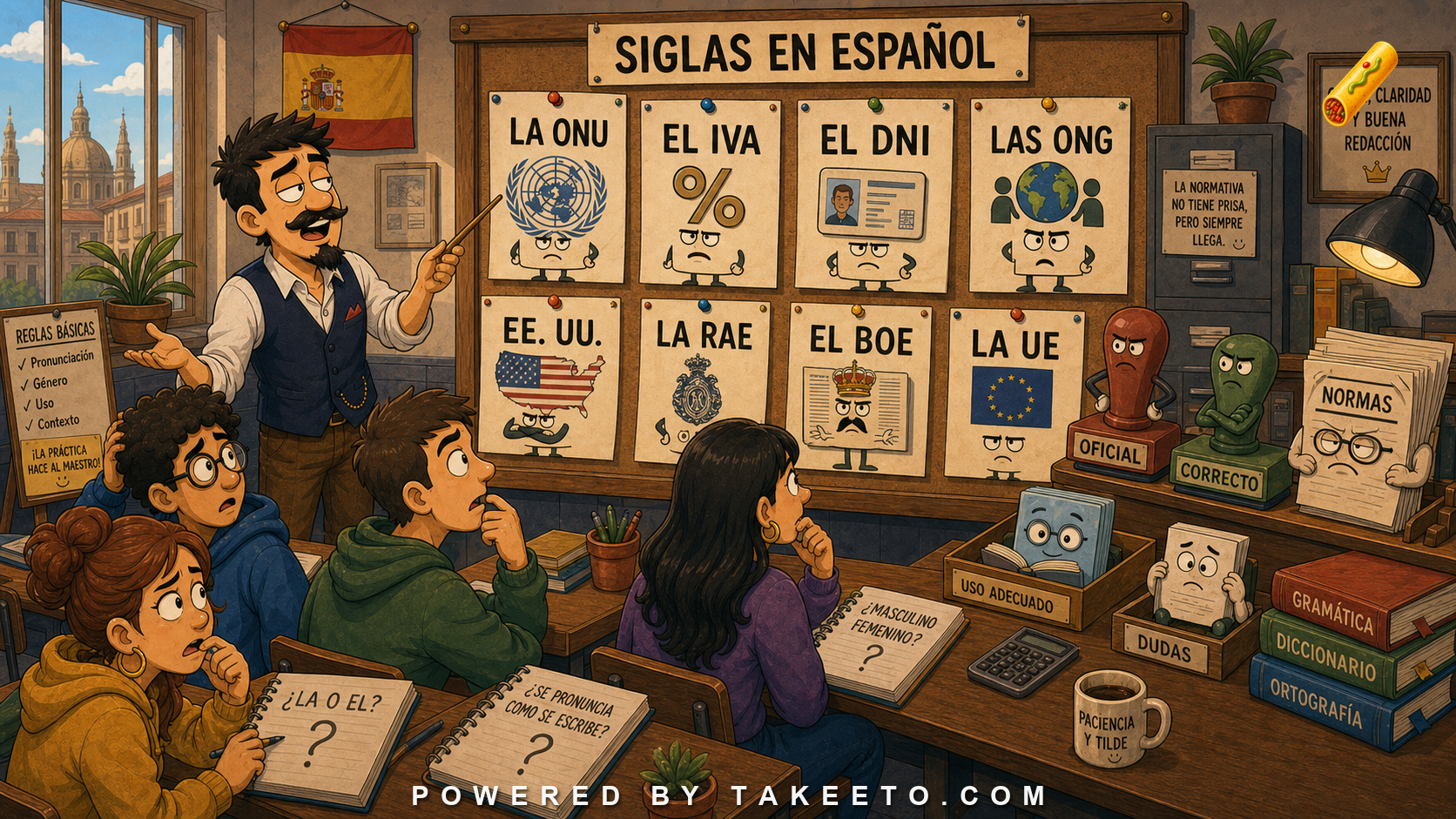
Public Spanish is full of compressed names
News articles, government websites, school forms, tax notices, medical instructions, and identity documents often contain forms such as:
ONU
IVA
DNI
ONG
RAE
BOE
UE
These are not just capital letters. They are public-language vocabulary. To use them well, a learner must know their expansion, gender, article, pronunciation, plural behavior, and domain.
The key principle is:
Spanish siglas and acronyms behave like words in sentences, but their grammar usually comes from the full expression behind them.
Sigla, acrónimo, and abbreviation
A sigla is formed from initial letters of a multiword expression.
ONU → Organización de las Naciones Unidas
DNI → documento nacional de identidad
UE → Unión Europea
An acrónimo may be pronounced as a word or become lexicalized as an ordinary word.
ovni
pyme
An abreviatura is different. It is a shortened written representation of a word or phrase, often with periods.
pág. → página
Sr. → señor
EE. UU. → Estados Unidos
This is why EE. UU. appears in the same public-language environment but does not behave like ONU or DNI.
Gender comes from the head noun
Many Spanish siglas take gender from the main noun in the expanded expression.
la ONU
la Organización de las Naciones Unidas
el IVA
el impuesto sobre el valor añadido / agregado, depending on country
el DNI
el documento nacional de identidad
la RAE
la Real Academia Española
el BOE
el Boletín Oficial del Estado
la UE
la Unión Europea
Do not assign gender by final letter. ONU is feminine because organización is feminine. DNI is masculine because documento is masculine.
Pronunciation: letters or words
Some siglas are read letter by letter:
DNI
de-ene-i
ONG
o-ene-ge
Some are often read as words:
ONU
o-nu
IVA
i-va, in many contexts
Pronunciation can vary by country, institution, and familiarity. The written form alone does not always tell the whole story. For high-frequency public terms, learn from audio and local usage.
Plural in writing
In careful Spanish, all-capital siglas are normally invariable in writing. Plural is shown by the article, adjective, number, or context.
las ONG
several NGOs
varias ONG
several NGOs
los DNI
the identity documents
Avoid English-style written plurals such as ONGs or ONG’s in careful Spanish. You may hear pluralized pronunciations in speech, but formal writing usually keeps the sigla unchanged.
Lexicalized acronyms
Some acronyms become ordinary words and follow ordinary spelling and plural rules.
ovni → ovnis
pyme → pymes
These may be written in lowercase because they have entered the general vocabulary. The boundary between sigla and lexicalized word can shift over time and by style guide, so learners should follow reputable contemporary usage.
Articles with siglas
A good learner entry for a sigla should include the article:
la ONU
el IVA
el DNI
las ONG
la RAE
el BOE
la UE
The article helps the learner remember gender and use the sigla inside real sentences.
La ONU publicó un informe.
The UN published a report.
El IVA subió.
VAT rose.
La UE anunció nuevas medidas.
The EU announced new measures.
Country-specific public language
Some siglas are local. DNI is familiar in some national systems, especially Spain-related contexts, but identity documents vary across the Spanish-speaking world. IVA is widespread, but the exact legal expansion and tax system vary by country.
Learner rule:
For taxes, identity documents, agencies, and legal notices, learn the local expansion and system, not only the letters.
EE. UU. as contrast
EE. UU. is included in this article because learners often see it beside siglas. But it is an abbreviation, not a sigla.
EE. UU.
Estados Unidos
It keeps periods and a space. Its plural-looking doubled letters come from abbreviation conventions, not from acronym pluralization.
This contrast is useful:
ONU: sigla
EE. UU.: abbreviation
Common learner errors
The first error is assigning gender by the final letter:
la ONU
el IVA
el DNI
The second is pluralizing siglas with English-style s in careful writing:
las ONG
The third is treating EE. UU. as a sigla. It is an abbreviation.
The fourth is ignoring country-specific meaning. Public acronyms are often administrative vocabulary tied to local institutions.
Remediation notes: plural, article, and country-specific expansions
The biggest practical problem with Spanish siglas is that they look fixed but behave grammatically in sentences. The capital-letter form usually does not take a written plural -s in careful standard writing:
las ONG
the NGOs
varios DNI
several identity documents
los CD / los cedés, depending on style and lexicalization
the CDs
The plural is shown by determiners, adjectives, and context, not by writing ONGs in formal Spanish. In informal or influenced writing, learners may see forms with -s, but the careful production target is to pluralize outside the sigla.
Gender normally comes from the head noun of the expansion:
la ONU
la Organización de las Naciones Unidas
el IVA
el impuesto sobre el valor añadido / agregado
el DNI
el documento nacional de identidad
la UE
la Unión Europea
But learners should remain alert to country-specific expansions. IVA is a tax label across much of the Spanish-speaking world, but the exact full name and tax system can vary. DNI is not the identity document label in every country. Public-language acronyms are embedded in institutions.
Pronunciation also needs to be learned, not guessed. Some siglas are read letter by letter:
DNI
de-ene-i
ONG
o-ene-ge
Others are commonly read as words:
ONU
o-nu
IVA
i-va
Acronyms that become ordinary words may eventually lose capital letters and take normal plurals:
un ovni / unos ovnis
a UFO / UFOs
una pyme / unas pymes
a small or medium-sized business / SMEs
This is why sigla and acrónimo are not just terminology. They predict how the form behaves in real prose.
Finally, keep EE. UU. out of the sigla bucket. It is an abbreviation with periods and internal spacing. A learner who classifies it correctly will not try to treat it like ONU or UE.
Example bank walkthrough
la ONU
Feminine because the head noun is organización.
Learner action: learn siglas with article and expansion.
el IVA
Masculine because the head noun is impuesto.
Learner action: check local expansion and legal context.
el DNI
Masculine because the head noun is documento.
Learner action: recognize identity-document domain.
las ONG
Plural shown by article; sigla remains unchanged in careful writing.
Learner action: avoid ONGs in formal Spanish.
EE. UU.
Abbreviation for Estados Unidos.
Learner action: keep periods and spacing.
la RAE
Feminine because the head noun is Academia.
Learner action: learn institutional siglas as phrase units.
el BOE
Masculine because the head noun is Boletín.
Learner action: use the expanded name to determine gender.
la UE
Feminine because the head noun is Unión.
Learner action: article, expansion, and domain belong together.
Suggested interactive module: acronym card
A strong tool for this article would turn each public sigla into a structured card.
Suggested functions:
- Expansion field: full Spanish name.
- Head-noun detector: gender from the main noun.
- Article trainer: el/la/los/las.
- Pronunciation mode: letters vs word.
- Plural mode: las ONG, varios DNI.
- Lexicalized mode: ovni/ovnis, pyme/pymes.
- Abbreviation contrast: EE. UU., RR. HH.
- Country-specific warning: taxes, IDs, agencies.
Final rule
Spanish siglas are compressed forms with real grammar.
Their gender usually comes from the head noun, their plural is usually marked outside the all-capital form, and their pronunciation must be learned from use. EE. UU. belongs nearby, but it is an abbreviation, not a sigla.
Acronyms are not just capital letters. They are public-language vocabulary.