
Dense prose is not solved by faster translation
Intermediate learners often read Spanish by moving left to right and translating each word into English. That method works for short sentences. It breaks down in essays, reports, legal notices, academic prose, and administrative documents.
A dense sentence may contain several verbs, a relative clause, a parenthetical phrase, a passive construction, and a reference back to a previous paragraph. Translating one word at a time does not reveal the architecture. It only produces a pile of English fragments.
The key principle is:
Advanced reading begins with structure, not translation.
The reader’s first job is not to produce beautiful English. The first job is to answer: what is the main clause, what modifies it, what refers back, and what logical relation is being signaled?
Find the finite verbs first
A finite verb is a verb marked for person, tense, or mood:
se establece
fue aprobado
indicaron
podría afectar
haya sido modificado
In dense prose, finite verbs are anchors. A sentence with three finite verbs probably contains at least three clauses. Infinitives, gerunds, and participles matter too, but finite verbs usually reveal the skeleton.
Example:
Se establece que las personas que hayan presentado la solicitud antes del plazo podrán conservar dicho beneficio.
Before translating, mark finite verbs:
Se establece que las personas que hayan presentado la solicitud antes del plazo podrán conservar dicho beneficio.
Now the shape is clearer:
- Main clause: se establece
- Embedded content: que las personas podrán conservar dicho beneficio
- Relative clause inside the subject: que hayan presentado la solicitud antes del plazo
A word-by-word translation hides this hierarchy. Clause bracketing reveals it.
Separate main information from inserted information
Spanish formal prose often inserts clarifying material inside a sentence:
El informe, elaborado por la comisión técnica, señala que la medida tendrá efectos limitados.
The inserted phrase is useful, but it is not the main action. Strip it temporarily:
El informe señala que la medida tendrá efectos limitados.
Then add back:
elaborado por la comisión técnica
This is not dumbing the sentence down. It is reading it in layers.
Track reference chains
Dense prose often uses reference words instead of repeating nouns:
dicha medida
el mencionado informe
lo anterior
este proceso
tal decisión
el cual
These words cannot be understood in isolation. They point backward.
Example:
El ministerio publicó una nueva norma sobre becas universitarias. Dicha norma entrará en vigor en septiembre. Lo anterior no afectará a los estudiantes ya matriculados.
Reference chain:
- dicha norma = the new rule about university scholarships
- lo anterior = the fact that the rule will enter into force in September, or the content of the previous statement depending on context
Learners often translate dicho as “said” and move on. That is not enough. In formal Spanish, dicho usually means “the previously mentioned.” It is a pointer.
Do not overtranslate connectors
Connectors are reading instructions:
sin embargo
debido a
por lo tanto
en este sentido
ahora bien
asimismo
They do not merely decorate the paragraph. They tell you whether the next statement contrasts, explains, adds, reframes, or concludes.
Example:
El programa ha aumentado su cobertura. Sin embargo, los resultados aún son desiguales.
The second sentence is not just “however.” It limits the optimism of the first sentence. That relationship is more important than the English equivalent of the connector.
Relative clauses: que and el cual
The word que does many jobs, but in dense prose it is often a relative marker:
los documentos que fueron entregados
la comisión que revisó el caso
una medida que podría afectar a miles de personas
Formal prose may use el cual, la cual, los cuales, las cuales for clarity, especially after prepositions or when the antecedent is complex:
Se aprobó una resolución mediante la cual se establecen nuevos criterios.
Unpack it:
Se aprobó una resolución. Mediante esa resolución, se establecen nuevos criterios.
The relative clause is not a separate topic. It modifies or explains the noun before it.
Parsing is not the same as full translation
A serious reader can understand a Spanish sentence structurally before translating it elegantly.
For example:
Debido a la falta de información actualizada, se decidió suspender temporalmente el procedimiento.
Structural reading:
- Cause: debido a la falta de información actualizada
- Main event: se decidió suspender
- Action suspended: el procedimiento
- Duration/limit: temporalmente
A functional translation may come later:
Because updated information was lacking, the procedure was temporarily suspended.
But the first task was structural mapping.
Example bank walkthrough
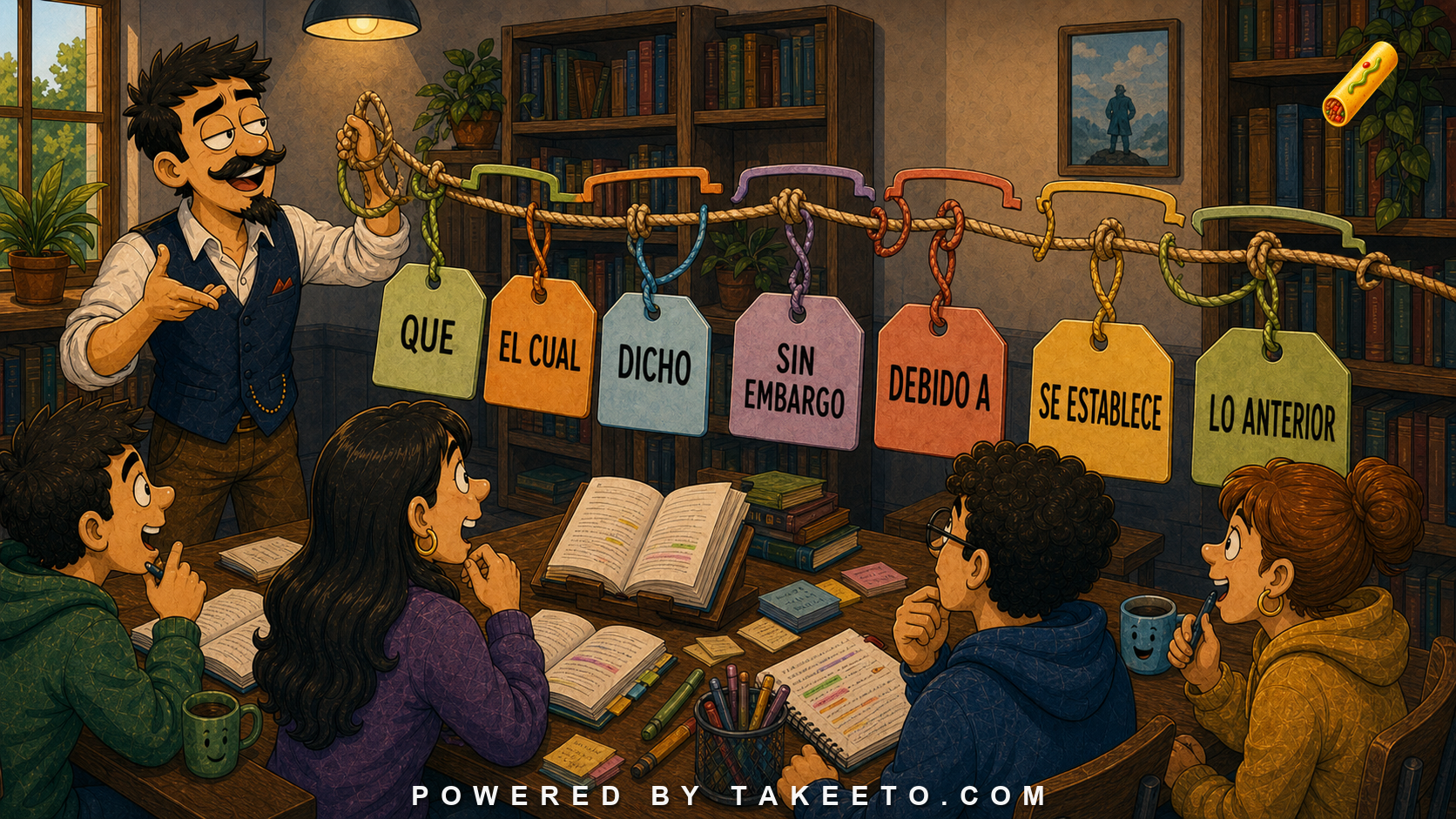
que
Can introduce content clauses, relative clauses, or comparisons.
Learner action: identify whether que connects a verb to its content, modifies a noun, or belongs to a fixed expression.
el cual
Formal relative pronoun.
Learner action: find its antecedent before translating.
dicho
Anaphoric adjective meaning previously mentioned.
Learner action: draw an arrow back to the noun it repeats.
sin embargo
Contrast marker.
Learner action: ask what expectation is being limited or reversed.
debido a
Cause marker before a noun phrase.
Learner action: identify cause separately from main event.
se establece
Impersonal/passive administrative formula.
Learner action: ask what rule or fact is being established, not who established it.
lo anterior
Abstract reference to previous content.
Learner action: decide whether it points to a sentence, a claim, a process, or a whole paragraph.
Dense-reading workflow
- Read once without translating. Notice topic and register.
- Mark all finite verbs. These are clause anchors.
- Bracket subordinate clauses. Especially clauses with que, aunque, si, cuando, el cual.
- Remove parenthetical phrases temporarily. Restore them after the main clause is clear.
- Track reference words. Draw arrows for dicho, este, tal, lo anterior.
- Label connectors. Contrast, cause, result, addition, reformulation, conclusion.
- Produce a structural paraphrase in Spanish if possible. This prevents premature English distortion.
- Translate only after structure is stable. Translation is the final step, not the first.
Common learner failure: translating before resolving reference
A frequent advanced-reading mistake is to translate lo anterior, dicho, or el cual before identifying the antecedent. The result can be fluent English attached to the wrong idea.
Practice with this paragraph:
La universidad modificó el reglamento de becas. Dicha modificación se aplicará únicamente a las solicitudes nuevas. Lo anterior no afectará a quienes ya reciben apoyo.
Do not translate first. Answer three questions:
- What is dicha modificación?
- What does lo anterior summarize?
- Who is excluded from the effect of the change?
Only then write an English translation. If you translate first, lo anterior may become a vague “the above,” which sounds formal but does not prove comprehension. Advanced reading requires reference discipline. Every abstract pointer must land somewhere.
Mini-workshop: one sentence, three layers
Take a sentence from an academic article or official report. Make three versions:
- Layer 1: main clause only.
- Layer 2: main clause plus subordinate clauses.
- Layer 3: full sentence with parentheticals and connectors restored.
Example:
Se establece que los solicitantes podrán presentar documentación adicional.
Layer 1:
Se establece algo.
Layer 2:
Se establece que los solicitantes podrán presentar documentación adicional.
Layer 3:
Se establece que los solicitantes que no hayan recibido respuesta podrán presentar documentación adicional dentro del plazo indicado.
This exercise trains structural patience. The goal is not to simplify every text permanently. The goal is to see how dense prose is assembled.
Common failure mode: translating too early
The most common advanced-reading error is not ignorance; it is impatience. The learner sees a long sentence and immediately starts producing English. That makes every relative clause feel like an interruption and every connector feel like a nuisance. In reality, the sentence has not been understood yet. A better discipline is to delay translation for thirty seconds. Mark verbs, brackets, references, and connectors first. Only then choose English wording.
Another failure mode is treating formal reference words as vague decoration. Dicha solicitud, lo anterior, and el cual are not fancy noise. They are how the paragraph avoids repeating itself. When a dense paragraph becomes confusing, the repair is often not more vocabulary; it is tracing the reference chain with arrows.
Remediation pass: make structure visible before meaning feels urgent
The repair for dense prose is not simply “read more slowly.” Slow confusion is still confusion. The reader needs a sequence that prevents the most tempting mistake: trying to understand a long sentence as a stream of meanings before identifying its internal architecture.
A useful remediation routine begins with verb mapping. On the first pass, the learner marks only conjugated verbs. This feels artificial at first, but it changes the reading problem immediately. Instead of asking “What does this whole sentence mean?”, the learner asks “How many clauses am I dealing with?” A sentence with se establece, hayan presentado, and podrán conservar is no longer a single fog bank. It is a main reporting structure plus embedded content plus a relative condition.
The second repair is reference locking. Every formal pointer must be tied to an antecedent before translation begins. If the learner cannot say what dicha medida, tal circunstancia, lo anterior, or el cual points to, the paragraph has not been understood yet. This is not pedantry. Misresolved reference is one of the most common ways advanced readers misunderstand official and academic prose.
The third repair is connector labeling. A connector should never be treated as a decorative translation unit. Sin embargo tells the reader to revise an expectation. Debido a introduces a cause. En este sentido frames a statement as belonging to a previous line of reasoning. Ahora bien often signals a turn in the argument. When connectors are labeled by function, the paragraph becomes an argument rather than a chain of sentences.
Before/after repair: from fluent translation to controlled parsing
Weak reading note:
Se establece que las personas que hayan presentado la solicitud antes del plazo podrán conservar dicho beneficio.
“It is established that the people who have presented the request before the deadline will be able to keep said benefit.”
That translation is not useless, but it leaves several things underchecked. It does not prove that the reader knows what dicho beneficio refers to, whether que hayan presentado is a relative clause, or why se establece avoids naming an authority.
Stronger reading note:
Main formula: se establece = an institutional rule is being stated.
Beneficiaries: las personas.
Condition: que hayan presentado la solicitud antes del plazo.
Result: podrán conservar dicho beneficio.
Reference: dicho beneficio points to a benefit named earlier in the text.
Only after that note should the learner translate. The output may be less literal and more useful:
The rule states that people who submitted the application before the deadline may keep the previously mentioned benefit.
Mini-workshop: bracket one paragraph, not one sentence
Take a paragraph from a report, essay, regulation, or article. Do not choose a learner text. Choose real Spanish. Then create four layers.
- Finite verb layer: mark every conjugated verb.
- Clause layer: bracket main clauses, relative clauses, content clauses, and conditional clauses.
- Reference layer: draw arrows from dicho, tal, este, el cual, lo anterior, and similar forms to their antecedents.
- Discourse layer: label connectors as contrast, cause, result, addition, reformulation, concession, or conclusion.
Then write a five-line Spanish paraphrase using shorter sentences. This last step matters because it prevents the learner from treating English translation as the only proof of comprehension. A reader who can paraphrase dense Spanish in simpler Spanish has real structural control.
Editorial quality checks for this article
A finished version of this article should avoid making dense prose sound mysterious. The article should show that difficult sentences are difficult for specific reasons: multiple finite verbs, embedded clauses, abstract reference, nominalizations, and discourse connectors. It should include enough examples that the reader can practice without a teacher standing nearby.
It should also avoid the opposite error: pretending all dense prose is bad prose. Some long Spanish sentences are precise and elegant. Others are bureaucratic fog. The reader’s job is not to hate complexity. The reader’s job is to see what the complexity is doing, decide whether it is justified, and translate or rewrite only after the structure is under control.
Extended remediation: transfer the parse to authentic dense paragraphs
The final test for advanced reading is not whether the learner can parse a sentence prepared by a teacher. It is whether the same method survives an authentic paragraph from a policy report, academic introduction, newspaper analysis, or institutional notice. Real paragraphs contain topic continuity across sentences, not just one impressive sentence. The reader has to track how dicha medida, lo anterior, este resultado, and tal decisión move the argument forward.
Contrast set
- sentence-only success: The learner brackets one sentence correctly but loses the next paragraph because references point outside the sentence.
- paragraph-level control: The learner builds a small map: sentence 1 introduces the measure, sentence 2 limits it, sentence 3 explains the consequence, and sentence 4 names an exception.
The contrast set should be read aloud or rewritten, not merely admired. Advanced learners often understand a correction when they see it, then fail to reproduce it when the task changes. The repair is to make the contrast portable: identify the decision, name the cue, and apply the same decision to a new sentence, clip, paragraph, or writing task.
Real-use transfer drill
- Choose a paragraph of four to six sentences from a formal source.
- Write a one-line function label for each sentence: definition, claim, evidence, contrast, result, exception, or summary.
- Draw all reference arrows across sentence boundaries, not only within one sentence.
- Reduce the paragraph to three plain Spanish bullet points.
- Translate only after the paragraph map is complete.
The deliverable is a structural note, not a beautiful translation: “Main claim: X. Limitation: Y. Evidence: Z. Reference chain: dicha medida = scholarship rule; lo anterior = delayed implementation.” If the learner can produce that note, translation quality will usually improve naturally.
Do not let the method become a slow ritual for every sentence. Use full bracketing on difficult passages, then gradually internalize the habits. The long-term goal is faster structural awareness, not permanent dependence on diagrams.
A good remediation pass ends with a usable artifact: a marked paragraph, a recording comparison, a collocation card, a frame note, a stance map, a change-claim table, or a revision pair. Without an artifact, the learner may feel enlightened but have nothing to review. With an artifact, the explanation becomes part of a study system.
Suggested interactive module: dense-sentence parser
A strong tool for this article would let learners paste a long Spanish sentence and mark it in layers.
Suggested functions:
- Finite verb detector: Highlights conjugated verbs.
- Clause brackets: User marks main, subordinate, relative, and parenthetical clauses.
- Reference arrows: Link dicho, tal, este, lo anterior to antecedents.
- Connector labels: Cause, contrast, concession, result, reformulation.
- Plain paraphrase field: Learner rewrites the sentence in simpler Spanish.
- Translation field: Only unlocked after structural parsing.
- Error prompts: Warns when a learner translates before resolving antecedents.
Final rule
Do not attack dense Spanish prose word by word.
Find the verbs. Bracket the clauses. Track references. Respect connectors. Translate only after the structure is visible.
Advanced reading is not faster guessing. It is slower, cleaner parsing until the sentence becomes manageable.