
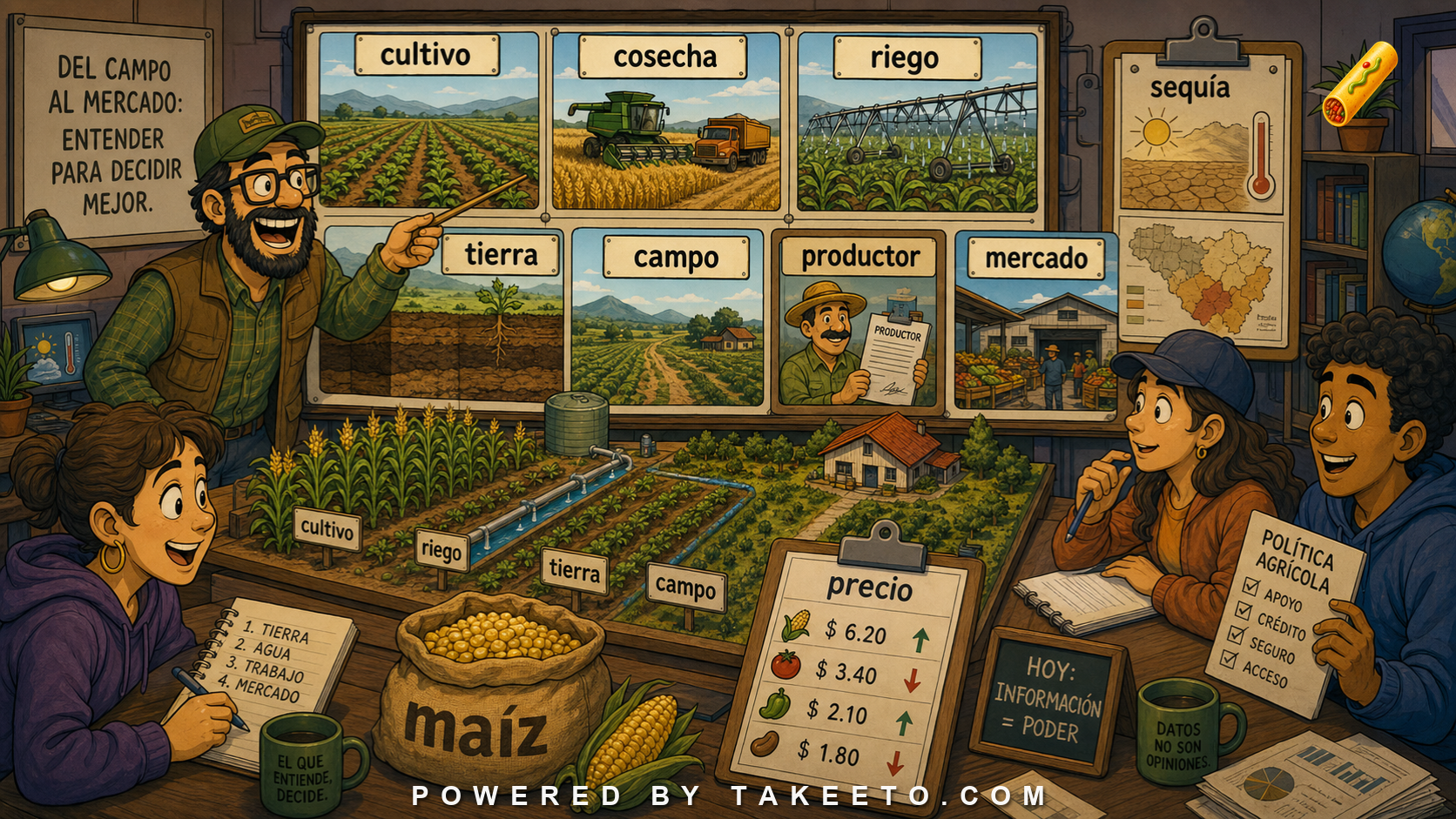
Agriculture is vocabulary plus systems
Agricultural Spanish is not only names of crops. It includes land, labor, water, weather, markets, ownership, policy, transport, exports, and food prices. A news story about maíz may be about farmers, rainfall, subsidies, imports, livestock feed, inflation, or indigenous food traditions.
The key principle is:
Agricultural Spanish becomes readable when you connect the crop word to land, labor, weather, and market structure.
Land and field language
Important terms:
tierra
campo
parcela
finca
rancho
hacienda
terreno
suelo
propiedad rural
Tierra can mean land, soil, earth, or territory. Campo can mean countryside, field, rural sector, or agricultural world. Finca, rancho, and hacienda vary by region and history. A learner should avoid one-to-one translation.
Los productores del campo pidieron apoyo ante la sequía.
Here campo refers to the agricultural/rural sector, not merely “field.”
Crops and harvest
Core crop vocabulary:
cultivo
cosecha
siembra
maíz
trigo
arroz
frijol / judía / poroto
caña de azúcar
café
soja / soya
papa / patata
Cultivo can mean crop, cultivation, or cultivated plant depending on context. Cosecha can mean harvest as an event, yield, or crop output. Siembra is sowing or planting.
La cosecha de maíz cayó por falta de lluvias.
This means production fell, not that a physical harvest “fell” on the ground.
Irrigation, water, and drought
Agricultural reports often revolve around water:
riego
regadío
secano
lluvia
sequía
escasez hídrica
acuífero
embalse
caudal
Riego is irrigation. Secano refers to rain-fed agriculture. Sequía affects production, prices, rural employment, and sometimes migration.
Los cultivos de secano fueron los más afectados por la sequía.
This sentence implies crops without irrigation were hit hardest.
Producers, labor, and rural actors
Important actor terms:
productor
agricultor
campesino
jornalero
trabajador rural
cooperativa
exportador
intermediario
sindicato agrario
Campesino can mean peasant, small farmer, rural person, or political identity depending on country and context. Jornalero is a day laborer. Productor is often used in policy and trade language, sometimes broadly.
Pequeños productores denunciaron que los precios no cubren los costos.
The sentence frames producers as economically vulnerable. Denunciar marks a public complaint.
Markets, prices, and trade
Agricultural Spanish frequently includes market language:
mercado
precio
costos de producción
cadena de suministro
exportación
importación
arancel
subsidio
rendimiento
tonelada
Rendimiento can mean yield, often output per hectare. Precio en origen may refer to the price received by producers before retail markup. Cadena alimentaria or cadena de suministro refers to the path from production to consumer.
El precio al consumidor subió aunque el precio pagado al productor se mantuvo estable.
This sentence separates farm-gate price from retail price.
Indigenous-origin crop names and regional vocabulary
Spanish agricultural vocabulary includes many regionally specific and indigenous-origin words. Maíz, tomate, chocolate, aguacate, cacahuate, ají, papa, and many crop names have histories across languages and regions. Some terms vary sharply:
papa / patata
frijol / judía / poroto / habichuela
maíz / choclo / elote, depending on form and region
aguacate / palta
A learner should treat crop vocabulary as regional, culinary, agricultural, and cultural at the same time.
Weather and risk language
Agricultural texts often use weather-risk combinations:
helada
granizo
sequía
inundación
plaga
enfermedad
pérdida de cosecha
seguro agrícola
alerta fitosanitaria
Plaga means pest or infestation, not plague only. Fitosanitario refers to plant health. Helada is frost, a major risk to crops.
Example bank walkthrough
Cultivo: crop or cultivation. Ask whether the text refers to plant type, practice, or land use.
Cosecha: harvest or yield. Ask whether the focus is timing, quantity, or market.
Riego: irrigation. Look for water infrastructure and drought context.
Tierra: land, soil, or territory. Context decides.
Campo: field, countryside, or agricultural sector.
Productor: producer/farmer in policy and market language.
Mercado and precio: ask who pays and who receives.
Sequía: drought; often links climate, water, prices, and labor.
Maíz: crop word with agricultural, economic, and cultural weight.
Agricultural reading workflow
- Identify the crop or product.
- Identify the place and region.
- Identify the actors: producers, workers, companies, government, consumers.
- Identify weather or water conditions.
- Separate production from price.
- Track the supply chain.
- Watch for policy terms: subsidy, regulation, import, export.
- Mark regional crop vocabulary.
- Translate campo carefully.
- Summarize the system, not only the sentence.
Before/after revision drill
Weak translation:
The field wants help.
Source Spanish:
El campo reclama apoyo urgente ante la pérdida de cosechas por la sequía.
Better translation:
The agricultural sector is calling for urgent support after crop losses caused by drought.
Here el campo is not a literal field. Reclama is a public demand. Pérdida de cosechas is economic damage, not only a physical event. Agricultural translation should identify the sector behind the image.
Remediation: agriculture is an economy, not just a vocabulary field
Agricultural Spanish is often taught as lists of crops and animals. That is too shallow for real reading. News, policy, trade, and local reporting talk about agriculture as a system: land, labor, water, weather, credit, price, transport, export markets, regulation, and family livelihood.
A sentence such as this contains several layers:
Los pequeños productores de maíz pidieron apoyo ante la caída de precios y el aumento del costo de los fertilizantes.
The surface vocabulary is simple: producers, corn, support, prices, fertilizer. The domain logic is deeper. Pequeños productores identifies scale and social position. Pidieron apoyo points to policy or institutional response. Caída de precios affects income. Aumento del costo de los fertilizantes affects production cost. The sentence is about a squeeze between selling price and input cost.
A learner who only learns maíz = corn misses the argument.
Actor terms: productor, agricultor, campesino, jornalero
Do not treat all agriculture people-words as synonyms.
productor often frames the person as an economic producer.
agricultor frames the person by activity: farming.
campesino can indicate rural smallholder, peasant identity, class, tradition, or political position depending on region and context.
jornalero refers to a day laborer or wage agricultural worker.
ganadero works with livestock.
cooperativa may refer to collective organization for production, credit, marketing, or services.
The wrong translation can distort power relations. A jornalero agrícola is not the same actor as an export agribusiness owner. Campesino may be neutral, proud, political, or class-marked depending on speaker and country. Read the surrounding text before deciding.
Mini-workshop: weather-to-market chain
Analyze this paragraph:
La sequía redujo la cosecha de frijol en varias comunidades. Como resultado, los precios locales subieron y algunas familias recurrieron a la compra de productos importados. Las organizaciones rurales solicitaron créditos blandos y apoyo para sistemas de riego.
Mark the chain:
sequía = climate/weather pressure
redujo la cosecha = production effect
precios locales subieron = market effect
familias recurrieron a productos importados = consumption/food access effect
organizaciones rurales solicitaron créditos y riego = institutional response
This is how much agricultural Spanish works: a physical condition becomes a production problem, then a price problem, then a household problem, then a policy demand.
Before/after: from crop list to agricultural analysis
Weak learner sentence:
En la región hay maíz, café y caña de azúcar.
Better:
La región combina cultivos de subsistencia, como el maíz, con cultivos comerciales, como el café y la caña de azúcar, lo que crea distintas necesidades de crédito, transporte y acceso al mercado.
The better sentence does not simply name crops. It classifies them by role and links them to domain vocabulary. This is the move from vocabulary to literacy.
Regional and indigenous-origin crop names
Agricultural Spanish includes many regional and indigenous-origin words: maíz, tomate, chile, aguacate, yuca, papa/patata, frijol/poroto/habichuela, calabaza/zapallo. These are not merely trivia. Regional crop names signal geography, cuisine, trade, and identity.
A serious learner should keep regional synonym sets rather than hunting for one universal “correct” word. A policy report from Mexico, a recipe from Peru, and a market bulletin from Argentina may not choose the same labels.
Reading checklist for agricultural Spanish
Mark seven items:
- Product: crop, livestock, input, processed good.
- Scale: household, smallholder, cooperative, industrial, export.
- Resource: land, water, seed, fertilizer, labor, credit.
- Risk: drought, flood, pest, price volatility, disease.
- Market: local sale, export, intermediary, subsidy, import.
- Actor: producer, worker, company, ministry, cooperative, community.
- Action: plant, harvest, irrigate, demand support, regulate, export.
Agricultural Spanish is where environment, economy, and rural society meet. Treat it accordingly.
Suggested interactive module: agriculture vocabulary field map
A strong tool would connect terms to domains.
Suggested functions:
- Land map: tierra, parcela, finca, suelo.
- Crop cycle: siembra, cultivo, cosecha, rendimiento.
- Risk layer: sequía, helada, plaga, inundación.
- Market layer: precio, exportación, costo, subsidio.
- Regional term notes: papa/patata, frijol/poroto/judía.
Mini-workshop: decoding a farm-price sentence
Consider:
Los pequeños productores denunciaron que el precio en origen no cubre los costos de producción.
Break it into roles. Pequeños productores are the actors. Denunciaron signals public complaint. Precio en origen is the price received near the production source, not the retail price. Costos de producción includes expenses required to produce the crop or product.
A plain-language version:
Small producers publicly complained that the price they receive is lower than what it costs them to produce.
This is not just a crop sentence. It is a market-power sentence. It implies a difference between consumer price, intermediary margin, and producer income.
Common learner mistakes
A common mistake is translating campo mechanically as “field.” In el campo exige medidas urgentes, campo means the agricultural or rural sector. Another mistake is treating campesino as neutral everywhere. It can be descriptive, political, class-marked, or identity-based depending on country and speaker.
Also watch cosecha. It can mean the act of harvesting, the harvested crop, or the yield. In la cosecha cayó, the meaning is usually production fell, not that something physically fell. Agricultural Spanish often compresses whole systems into one familiar-looking word.
Applied reading drill: follow the chain from weather to price
Agricultural Spanish often hides a causal chain in one compact sentence:
La sequía redujo el rendimiento de los cultivos y presionó al alza el precio del maíz.
Unpack it slowly. Sequía is the climate or weather stress. Rendimiento is yield. Cultivos are the crops. Presionar al alza is market language: it means pushing prices upward. Precio del maíz is the consumer or commodity consequence.
A full plain-language version would be:
Because there was not enough water, the crop produced less per hectare. With less supply, the price of maize/corn faced upward pressure.
This is the central skill in agricultural reading: follow the chain. Weather affects water. Water affects yield. Yield affects supply. Supply affects price. Price affects households, producers, exporters, and policy.
Use this annotation routine:
- Mark the natural condition: rain, drought, frost, heat.
- Mark the crop or livestock product.
- Mark the production effect: yield, harvest, loss.
- Mark the actor: producer, cooperative, government, exporter.
- Mark the market effect: price, shortage, import, subsidy.
Agricultural Spanish is rarely only about plants.
Final rule
Agricultural Spanish is not just food vocabulary. It is the language of land, water, labor, risk, and markets. When you see cultivo, ask what system surrounds it.