
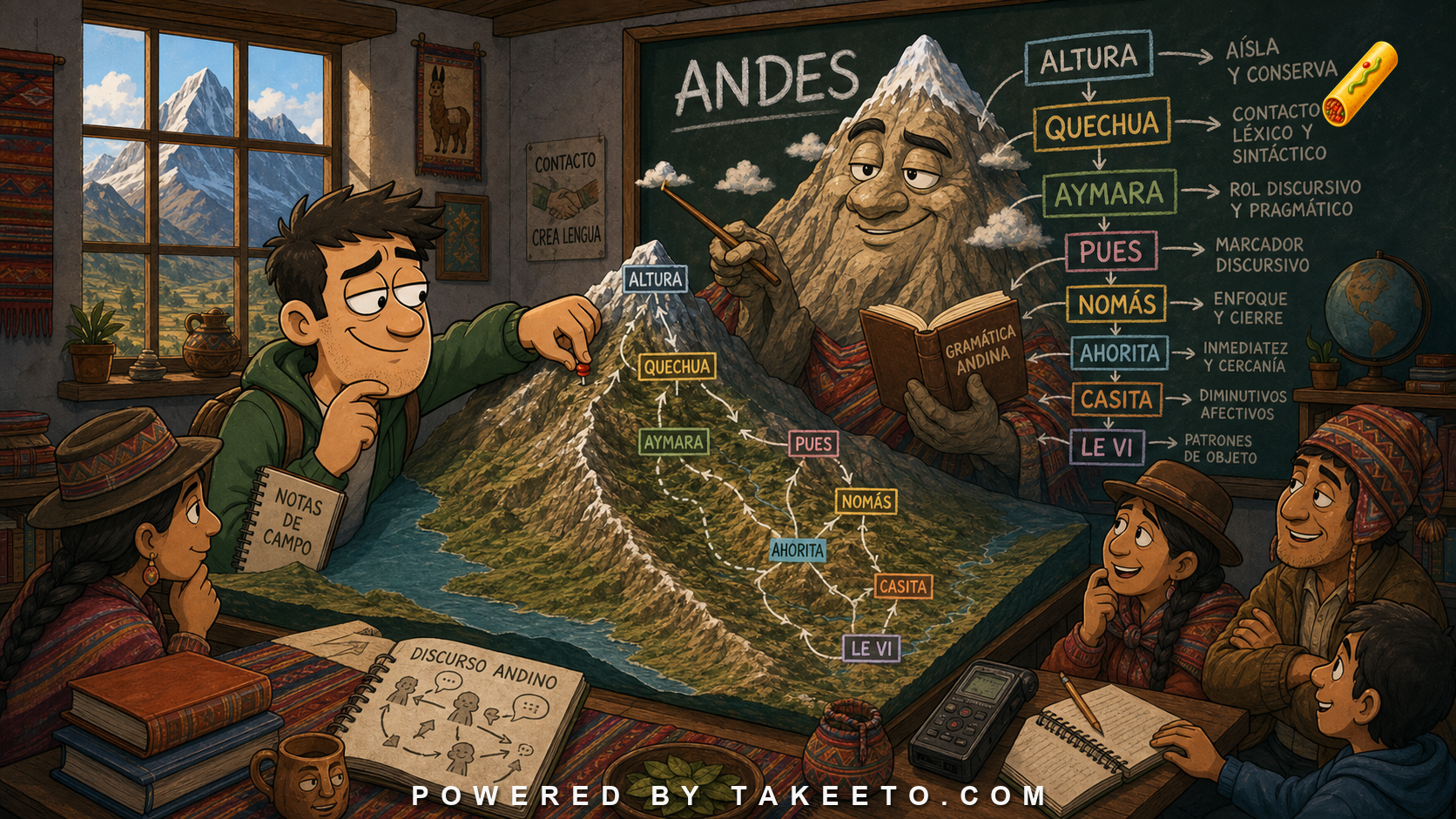
Andean Spanish is a contact zone, not a single accent
“Andean Spanish” refers broadly to Spanish varieties associated with the Andean highlands, especially in parts of Peru, Bolivia, Ecuador, Colombia, northern Chile, and northwestern Argentina. But the label covers many local realities: urban Lima is not rural Cusco, Quito is not La Paz, highland Colombia is not highland Bolivia, and bilingual Quechua-Spanish speakers do not all speak the same way.
The key principle is:
Andean Spanish is a family of regional varieties shaped by highland geography, colonial history, education, migration, and contact with indigenous languages.
A learner should not treat Andean speech as “Spanish with mistakes.” It is structured Spanish in a multilingual world.
Contact languages matter
Major contact languages in Andean regions include Quechua and Aymara, along with many other indigenous languages depending on country and locality. Contact can affect vocabulary, discourse style, pronunciation, syntax, and social identity.
Some contact effects are widely documented. Others are debated, localized, or dependent on bilingual proficiency. A careful learner avoids two opposite errors:
- pretending contact has no effect,
- blaming every regional feature on indigenous languages without evidence.
Good dialectology labels evidence.
Pronunciation: retention and regional sound patterns
Many highland varieties preserve certain consonants more clearly than coastal varieties. For example, syllable-final s may be pronounced more fully in many highland contexts than in Caribbean or coastal Spanish. Some regions maintain distinctions or pronunciations that are less common elsewhere, including local treatment of ll, r, or vowel patterns.
But the Andes are not phonetically uniform. Urban educated speech, rural bilingual speech, and regional varieties can differ sharply.
Learner action: do not use one “Andean accent” video as a model for the whole region.
Diminutives: casita, ahorita, un ratito
Diminutives are highly productive across Spanish, but Andean varieties often make rich use of diminutive forms in social and affective contexts.
casita
little house / dear house / modest house
ahorita
right now / soon / just now, depending on region
un ratito
a little while
A diminutive does not always mean physically small. It can soften, show affection, reduce imposition, express politeness, or signal social stance.
Example:
Espéreme un ratito nomás.
Please wait just a little bit.
Here the diminutive and nomás work pragmatically, not just literally.
Pues and nomás as discourse tools
Words like pues and nomás can organize discourse, soften statements, emphasize limits, or mark regional style.
Venga nomás.
Come on in / go ahead, depending on context.
Así es, pues.
That’s how it is, then / that’s right, depending on tone.
Learners often try to translate these one-for-one. That fails. These words are discourse tools. Their meaning depends on position, intonation, relationship, and region.
Learner action: collect real examples and label function: softener, limiter, confirmation, insistence, invitation.
Leísmo and object-pronoun patterns
Some Andean varieties show object-pronoun patterns that differ from the textbook direct/indirect distinction. Learners may hear:
Le vi a Juan.
instead of:
Lo vi a Juan.
In some regions, le can be used with human direct objects. This overlaps with broader Spanish leísmo patterns, but local systems can have their own distribution.
Learner production target: unless you are deliberately learning a local system, use broadly standard object pronouns:
Lo vi a Juan.
La vi a María.
Le di el libro a Juan.
Learner recognition: when you hear le vi, do not assume the speaker is confused. Identify the regional and grammatical pattern.
Evidential influence: be cautious
Some discussions of Andean Spanish mention evidentiality: marking whether information is witnessed, inferred, reported, or assumed. Quechua and Aymara have evidential systems, and researchers have examined how contact may influence discourse in Andean Spanish.
This is an important topic, but learners should be cautious. It is easy to overstate structural transfer or turn complex bilingual practices into simplistic formulas.
A safe learner statement:
In some Andean contact settings, speakers may use discourse patterns influenced by indigenous-language evidential systems, but the details vary and should be studied with evidence.
That is better than claiming “Andean Spanish has Quechua grammar” as a blanket statement.
Vocabulary of indigenous origin
Andean Spanish includes many words of Quechua, Aymara, or other indigenous origin, especially for food, geography, animals, social life, agriculture, and local culture.
Examples that learners may encounter depending on region:
cancha
field/court; also toasted corn in some contexts
papa
potato
choclo
corn on the cob / maize, regionally
guagua
baby/child in some Andean regions; bus in some Caribbean contexts, so beware
cóndor
condor
Loanwords travel unevenly. A word may be local, national, pan-American, or global. Always label region.
Formal educated norms and local speech
Andean speakers often command multiple registers. A lawyer in La Paz, a teacher in Cusco, a student in Quito, and a farmer in a bilingual community may shift across formal Spanish, local Spanish, indigenous languages, and mixed repertoires.
A learner must avoid treating local features as lack of education. Social variation is not a ladder from “wrong” to “right.” It is a repertoire.
At the same time, for formal writing across countries, learners should control standard grammar and spelling. Respecting dialect does not remove the need for register.
Example bank walkthrough
pues
Discourse marker with regional functions.
Learner action: listen for position and tone before translating.
nomás
Limiter, softener, or invitation marker in many American varieties, including Andean contexts.
Learner action: store as a pragmatic word, not only “no more.”
ahorita
Temporal/discourse word whose meaning varies by region.
Learner action: infer urgency from context.
casita
Diminutive with affective or softening value.
Learner action: do not translate every diminutive as “little.”
le vi
Regional object-pronoun pattern.
Learner action: recognize variation; produce standard forms unless locally guided.
la altura
High altitude is a real Andean life context and a frequent topic in travel/health discourse.
Learner action: learn practical vocabulary: altura, soroche, mareo, respirar.
Quechua-origin vocabulary
Important part of regional lexicon.
Learner action: learn words in context and with region labels.
Learner listening method
For Andean Spanish, use three layers:
- General Spanish structure: tense, agreement, pronouns, particles, word order.
- Regional Spanish features: diminutives, discourse particles, local vocabulary, object-pronoun patterns.
- Contact context: indigenous-language influence, bilingualism, social identity, register shifts.
Do not collapse all three into one vague idea of “accent.”
Remediation notes: contact without deficit framing
The repair for this article is to keep two ideas together. First, Andean Spanish is deeply shaped by multilingual contact, especially with Quechua and Aymara in many areas. Second, not every Andean feature should be reduced to "influence" from an indigenous language. Contact explanations require evidence, and speakers are not walking examples of linguistic interference.
A safer analytical model has three layers:
Regional Spanish inheritance: features that belong to Spanish dialect history.
Contact-conditioned patterns: features strengthened, shaped, or reinterpreted through bilingual contact.
Bilingual discourse practices: choices made by speakers who move between Spanish and indigenous languages or mixed repertoires.
This prevents the common learner mistake of hearing a bilingual speaker and labeling everything as "wrong Spanish." It also prevents the opposite mistake of romanticizing contact as if every feature were a direct Quechua or Aymara transfer.
Diminutives need special remediation. In many Andean contexts, forms like casita, ratito, ahorita, and momentito can soften social pressure, mark affection, reduce imposition, or create politeness. They are not baby talk. A sentence such as:
Espéreme un ratito nomás.
is not just about a physically small time. It is a socially managed request. The same applies to nomás: it can limit, soften, invite, or reassure. Learners should store these as discourse tools.
Object-pronoun variation also needs careful handling. A learner may hear le vi a Juan in an Andean or other leísmo system. This should not be treated as random confusion. But the production target for most international learners remains:
Lo vi a Juan.
La vi a María.
Le di el libro a Juan.
Recognition is broad; production is controlled.
The altitude and travel vocabulary should be framed responsibly. Words such as altura, soroche, mareo, falta de aire, and aclimatarse are useful in Andean travel and health contexts. But they are not dialect features in the same sense as pronouns or discourse markers. They are domain vocabulary tied to geography and lived experience.
Finally, formal educated Andean Spanish must be emphasized. A learner who only studies rural or highly local examples may miss newspapers, universities, courts, offices, and professional speech in Lima, Cusco, La Paz, Quito, Bogotá highlands, and other urban centers. Andean Spanish includes local speech and formal standard registers. Respecting the region means learning both.
Working rule:
Label the feature, label the evidence, label the register. Never turn contact into a deficit story.
Suggested interactive module: Andean contact-feature map
A strong tool for this article would combine linguistic features with evidence cautions.
Suggested functions:
- Region selector: Peru, Bolivia, Ecuador, Colombia highlands, northwest Argentina, northern Chile.
- Contact-language layer: Quechua, Aymara, other local languages.
- Feature cards: diminutives, pues, nomás, leísmo patterns, local vocabulary.
- Evidence labels: widely attested, regional, debated, register-sensitive.
- Audio comparison: formal urban speech and informal local speech.
- Vocabulary map: food, geography, agriculture, social life.
- Learner output mode: standard production versus local recognition.
- Stereotype filter: replace vague claims with specific features.
Final rule
Andean Spanish is not one accent and not defective Spanish. It is a set of regional Spanishes shaped by multilingual contact, highland history, social variation, and formal education.
Respect the system. Label the features. Learn standard production, and build regional recognition with humility.