
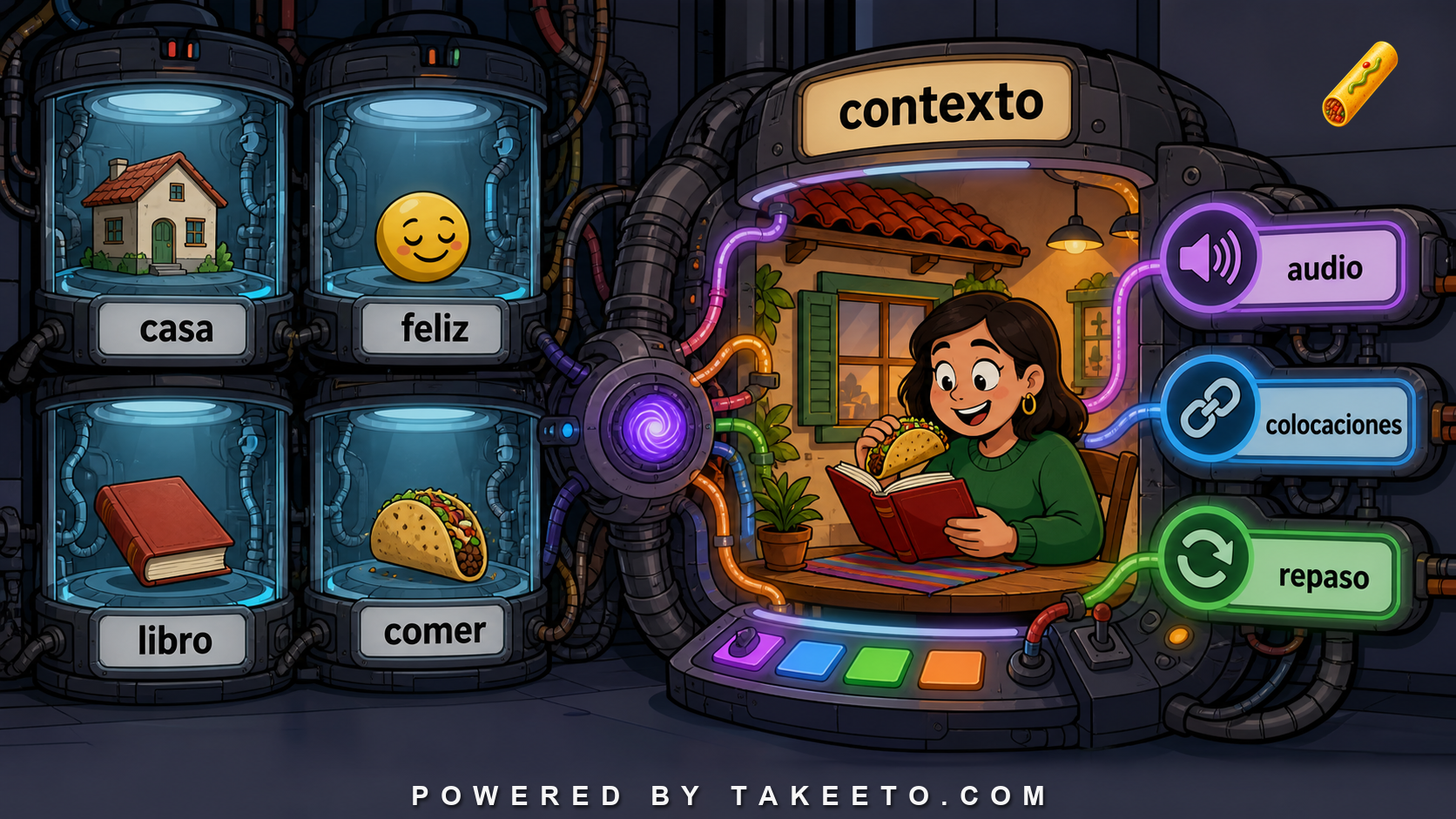
Flashcards can help, but bad cards train shallow knowledge
Spaced-repetition tools such as Anki can be extremely useful. They help learners return to information before it disappears. They support retrieval practice. They make review systematic. But flashcards are not automatically good learning. A weak card can train a weak habit thousands of times.
A card like this looks efficient:
lado A: hacer
lado B: to do / make
It may be useful on day one. But by itself it does not teach hacer una pregunta, hacer ejercicio, hacer frío, hacer daño, hacer que, or the difference between hacer and realizar in formal contexts.
The key principle is:
Flashcards are strongest when they review usable language, not isolated labels.
Retrieval practice and spacing
Retrieval means trying to bring information back from memory. Spacing means spreading review over time. Together, they are powerful.
A learner who reads a word ten times may recognize it. A learner who retrieves it repeatedly over days and weeks is more likely to keep it.
But retrieval must target the right thing.
Bad retrieval:
Spanish word → English gloss.
Better retrieval:
sentence with blank → choose word and form.
audio → identify word in context.
English meaning → produce Spanish phrase.
Spanish sentence → explain why this preposition is used.
The card format should match the skill.
The problem with isolated vocabulary
Isolated cards create several problems.
First, they hide grammar.
gusto = taste / pleasure
But me gusta is not built like English “I like.” A card for gusto does not teach the construction.
Second, they hide collocation.
decisión = decision
But Spanish usually says tomar una decisión, not hacer una decisión.
Third, they hide register.
domicilio = home/address
But domicilio is administrative/legal, not the normal word for “my home” in casual speech.
Fourth, they create false equivalence.
asistir = assist
Actually, asistir a means attend. The English-looking word creates interference.
Context cards
A stronger vocabulary card includes a sentence.
Front:
No puedo asistir ___ la reunión.
Back:
a
No puedo asistir a la reunión.
asistir a = attend
This teaches the word, preposition, and phrase frame.
Another card:
Front:
Spanish for “make a decision” in this sentence:
Tenemos que ___ una decisión antes del viernes.
Back:
tomar
Tenemos que tomar una decisión antes del viernes.
This prevents English calque.
Audio and pronunciation
Vocabulary without sound is incomplete. Spanish learners need stress, vowel quality, linking, and rhythm.
Cards can include:
- native audio,
- learner recording comparison,
- syllable stress mark,
- minimal pairs,
- sentence audio,
- slow and normal speed.
Example:
público / publico / publicó
A flashcard that only gives spelling misses the stress contrast. Audio and accent marks matter.
Collocation cards
A collocation is a natural word partnership. Spanish vocabulary grows through collocations.
Useful card targets:
cometer un error
make a mistake
prestar atención
pay attention
tomar una decisión
make a decision
tener sentido
make sense
cumplir una promesa
keep a promise
These should be reviewed as chunks, not just individual words.
Interference and false friends
Interference happens when another language pushes the learner toward the wrong Spanish pattern.
Examples:
aplicar para un trabajo
English-shaped; prefer solicitar un trabajo / postularse a un puesto depending on region/context.
realizar una decisión
English-shaped; prefer tomar una decisión.
actualmente = actually
false friend; actualmente means currently.
Flashcards can either reinforce interference or fight it. Good cards explicitly warn:
Not: realizar una decisión.
Use: tomar una decisión.
Sentence, passage, and deck design
A vocabulary deck should not be a bag of disconnected words. It should connect to readings, listening passages, grammar topics, and review goals.
A good card may come from a passage the learner has already read. That gives memory hooks. The learner knows the story, register, and sentence.
Types of useful Spanish cards:
- sentence cloze cards,
- audio recognition cards,
- collocation cards,
- verb-preposition cards,
- minimal-pair cards,
- register contrast cards,
- translationese correction cards,
- short passage recall cards.
Card overload
Anki failure often comes from too many cards. Learners add everything, then drown.
Better rules:
- create fewer, better cards,
- delete low-value cards,
- suspend cards that do not help,
- review daily but not obsessively,
- connect cards to real reading,
- use production cards sparingly but seriously,
- reformulate cards that repeatedly fail.
A failed card is not a moral problem. It may be a bad card.
Example bank walkthrough
Retrieval means active recall, not rereading.
Spacing means review over time.
Context prevents shallow word-gloss learning.
Collocation teaches natural word partnerships.
Pronunciation requires audio and stress awareness.
Sentence cards preserve grammar.
Review must be sustainable.
Interference warns where English or another language creates bad Spanish.
Flashcard quality workflow
- Start from a real sentence.
- Decide the target: word, phrase, grammar, pronunciation, register.
- Make the prompt unambiguous.
- Include context.
- Include audio when pronunciation matters.
- Include collocation and preposition.
- Add a warning for false friends or calques.
- Avoid overloaded cards.
- Revise cards that repeatedly fail.
- Link review back to reading and listening.
Mini-workshop: repair a weak card
Take a weak card such as actualmente = actually/currently and rebuild it. Front: Actualmente vivo en Lima. Back: currently, not actually. Add a contrast: En realidad often translates English “actually.” Add audio if available. Now the card teaches meaning, interference, and use. The goal is not more cards. The goal is fewer cards that change future behavior.
Card-type bank for Spanish
A Spanish deck should include several card types. Recognition cards help with reading. Production cards ask the learner to produce a phrase. Cloze cards remove one verb form or connector. Audio cards train listening and pronunciation. Collocation cards prevent English-shaped Spanish. Contrast cards compare pairs such as por/para, ser/estar, saber/conocer, pedir/preguntar. Passage cards send the learner back to a short text instead of isolating everything.
Example cloze:
Aunque ___ difícil, vale la pena.
Depending on intended meaning, the answer may raise a mood discussion. That is better than a flat vocabulary card because it forces grammar retrieval.
Deck health matters. If daily reviews are too heavy, reduce new cards. If cards feel easy but speaking does not improve, add production and audio. If you keep failing a card, improve the cue. The deck is a tool, not a scoreboard for self-worth.
Remediation drill: build cards from a passage, not a word list
Choose one Spanish paragraph. Select five items, but make each card represent a different learning behavior.
- Collocation card: tomar una decisión, not decisión = decision.
- Connector card: sin embargo in a full sentence.
- Grammar card: a subjunctive clause with context.
- Audio card: one sentence to hear and repeat.
- False-friend card: a phrase that blocks English interference.
This passage-based method keeps vocabulary attached to syntax and discourse. It also prevents deck bloat because you must choose.
Now test each card. Can you answer it quickly? Does it train one thing? Does it include enough context? Is it worth seeing again? If not, delete or rewrite it. Good deck hygiene is part of learning.
For remediation, add production cards only when the phrase is worth producing. Recognition cards are fine for rare reading vocabulary. Production cards should target high-value structures, collocations, and mistakes you actually make.
A deck built from living passages becomes a memory system for Spanish you have really encountered. A deck built from random lists often becomes a museum of words you never use.
Suggested interactive module: card-quality rubric
A strong tool would grade language-learning flashcards.
Suggested functions:
- Context score: isolated word, phrase, sentence, passage.
- Skill target: recognition, production, listening, pronunciation, grammar.
- Collocation field: common partners and prepositions.
- Audio requirement flag: stress, minimal pair, listening phrase.
- Interference warning: false friends and translationese.
- Cognitive load check: one target per card.
- Rewrite suggestions: transform weak cards into better prompts.
- Deck balance report: vocabulary, grammar, audio, review passages.
Applied card drill: repair a bad flashcard
Bad card:
cuenta = account
Better set:
tener en cuenta = take into account
darse cuenta de = realize
la cuenta del restaurante = the bill
cuenta bancaria = bank account
Now each card teaches a phrase and a context. The learner is less likely to overuse one English translation. Good flashcard design often means splitting one vague card into several precise cards.
Remediation focus: fixing flashcards that create recognition without usable Spanish
Flashcards are useful when they train retrieval of the right information. They are harmful when they train a shallow word-pair reflex that collapses meaning, grammar, sound, collocation, and register into one English equivalent. A card that says quedar = to stay may actively damage learning because quedar also appears in me queda bien, quedamos a las seis, queda lejos, quedarse, and quedar en.
The remediation task is to upgrade cards from isolated vocabulary to contextual retrieval. A good card asks the learner to recover a word in a sentence, choose a preposition, hear pronunciation, notice agreement, or distinguish two near-synonyms. Spaced repetition should support language structure, not replace it.
Common failure modes to repair
- Making one-card-many-meanings overload: A card with six unrelated meanings becomes recognition clutter.
- Using English prompts that force translationese: If the prompt says “make a decision,” the learner may produce realizar una decisión unless collocation is trained.
- Ignoring audio: Silent cards undertrain pronunciation and listening.
- Reviewing cards that were never understood: Spaced repetition preserves memory; it does not create understanding from confusion.
Before/after: repair a weak flashcard
Weak version:
quedar = to stay / remain
Stronger version:
Front: La camisa me ___ bien. Back: queda — “The shirt fits/looks good on me.” Note: quedarle bien a alguien is not “stay.”
The stronger card trains construction, agreement, pronoun logic, and meaning together.
Upgrade workshop: card-quality triage
- Delete or suspend cards you consistently fail because you never understood the source sentence.
- Split overloaded words into separate construction cards.
- Add context: one sentence, audio, collocation, or image where useful.
- Ask for production only when the pattern has been seen enough times.
- Connect cards to passages so review does not become detached from reading.
Quality-control checklist
- Does the card test one thing?
- Can the learner answer without guessing between several unrelated meanings?
- Does it include the preposition, gender, verb pattern, or register label needed for correct use?
- Would audio reveal a pronunciation or stress issue?
- Is the card connected to a passage, conversation, or example bank?
Applied remediation drill: decide whether a flashcard failed because memory failed or design failed
Use this source-style excerpt:
A learner repeatedly fails the card “aprovechar = to take advantage of.” In reading, they still miss phrases such as “aprovechar el tiempo,” “aprovechar la oportunidad,” and “aprovecharse de alguien.”
A fast but weak reading might say:
The learner needs to review the same card more often.
That reading is incomplete. A stronger reading says:
The card is underdesigned. It mixes useful use, opportunity language, time-use collocation, and the pronominal form aprovecharse de, which may imply exploiting someone.
The repair comes from five checks:
- Repeated failure may signal bad card design, not weak discipline.
- Aprovechar el tiempo is a collocation, not just a translation.
- Aprovechar la oportunidad is opportunity language.
- Aprovecharse de alguien changes construction and moral meaning.
- Separate cards should test separate patterns.
Create three cards: Hay que aprovechar el tiempo, Aprovechó la oportunidad para viajar, and Se aprovechó de su confianza. Add notes for collocation and register. The learner now reviews three usable Spanish patterns instead of one vague English gloss.
Final rule
Flashcards are not the enemy. Bad flashcards are.
Use Anki or any spaced-repetition tool to review context, collocation, pronunciation, sentences, and interference, not only isolated translations. The goal is not to know that a word exists. The goal is to recognize it, hear it, use it, and place it in Spanish.