Arabic influence is real, but it is not magic
Spanish has many words of Arabic origin. That fact is exciting enough without turning it into fantasy. Arabic influence came through centuries of contact in the Iberian Peninsula, especially during and after the period of Al-Andalus, as well as through science, trade, administration, agriculture, and cultural exchange. The influence is especially visible in vocabulary.
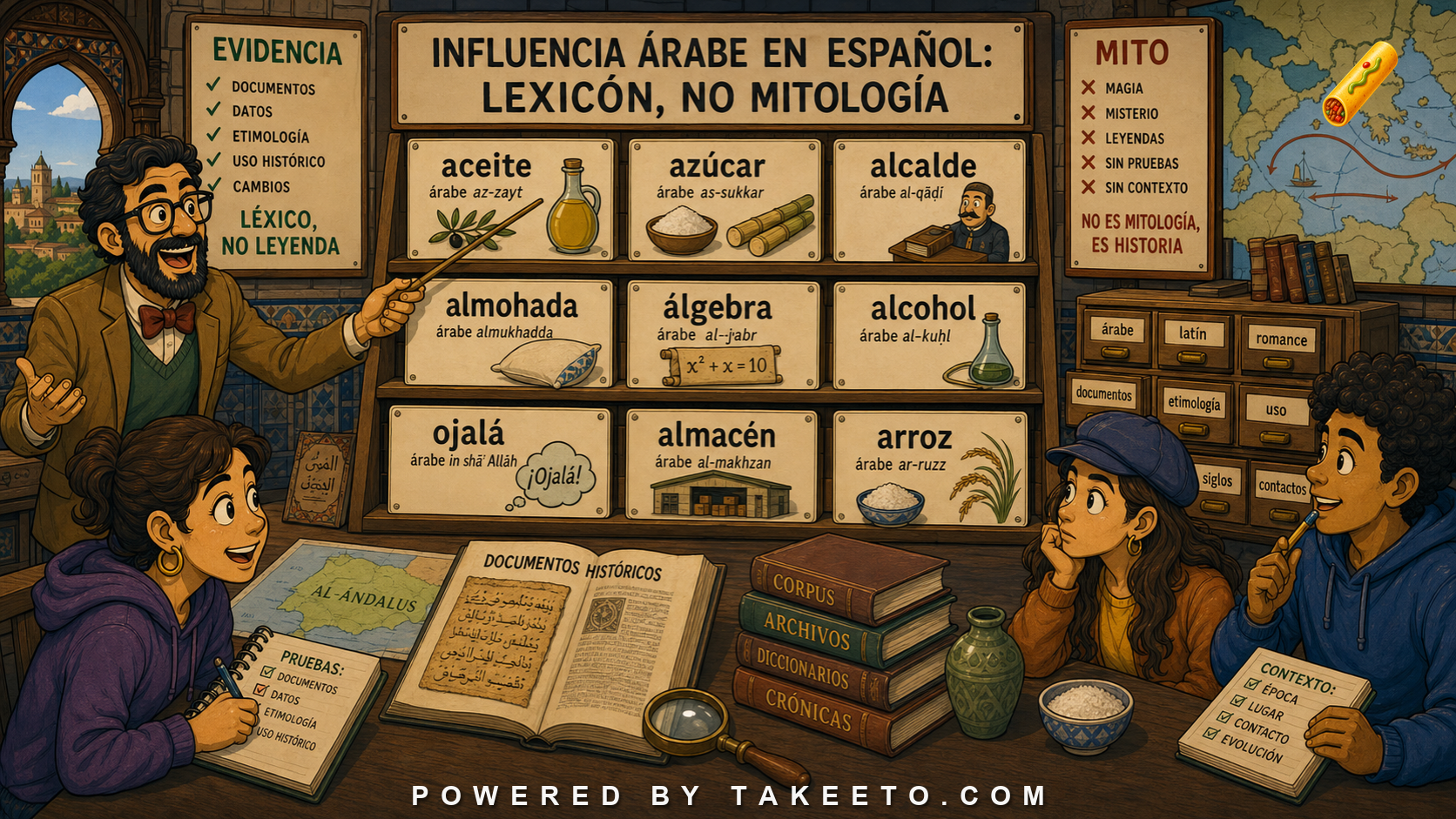
Words such as aceite, azúcar, alcalde, almohada, álgebra, alcohol, ojalá, almacén, and arroz are everyday reminders of that history.
The key principle is:
Arabic shaped a major layer of Spanish vocabulary, but Spanish grammar remains Romance, and not every exotic-looking word is Arabic.
A serious learner should appreciate the influence without using it to make false claims.
Historical contact in Al-Andalus
The Iberian Peninsula was multilingual for centuries. Latin-based Romance varieties, Arabic, Hebrew, Berber languages, and other local speech forms interacted in complex social settings. Arabic had prestige in administration, scholarship, religion, science, poetry, agriculture, and urban life in many periods and places.
Words entered Romance speech through daily contact, technical knowledge, trade, governance, and material culture. Some later passed into written Castilian. Some were regionally concentrated; others became standard Spanish.
The point is not that Spanish “comes from Arabic.” It does not. Spanish is a Romance language descended from Latin. The point is that Spanish, like every real language, carries layers of contact.
The famous al- pattern
Many Arabic-origin Spanish words begin with al- because Arabic has a definite article al- that was incorporated into borrowed forms.
Examples:
alcalde
mayor
almacén
warehouse/storehouse
almohada
pillow
alfombra
rug/carpet
alcázar
fortress/palace
This pattern is useful, but it is not a perfect detector. Not every Spanish word beginning with al- is Arabic, and not every Arabic-origin word begins with al-. A learner should use al- as a clue, not proof.
Learner action: when you suspect Arabic origin, verify with a historical dictionary rather than inventing an etymology.
Fields of Arabic-origin vocabulary
Arabic-origin vocabulary is especially visible in several semantic fields.
Agriculture and food:
aceite, aceituna, azúcar, arroz, azafrán
Administration and urban life:
alcalde, almacén, aduana, barrio
Science and scholarship:
álgebra, algoritmo, cifra, alcohol
Domestic life and objects:
almohada, alfombra, jarra
Architecture and place:
alcázar, aldea, azotea
Some words entered through Arabic but ultimately came from other languages. Arroz, for example, has a longer path beyond Arabic. Etymology is often a chain, not a single birthplace.
Ojalá and emotional grammar
Ojalá is one of the most famous Arabic-origin items in Spanish. In modern Spanish it functions as a wish marker:
Ojalá venga.
I hope he/she comes.
Ojalá pudiera.
If only I could.
The modern grammar is Spanish grammar: ojalá typically combines with subjunctive forms. Its history matters, but learners should not treat the modern word as a literal theological phrase every time it appears. Words can keep etymological history while changing function.
Learner action: study both history and current grammar. Do not reduce modern usage to origin.
Arabic did not make Spanish grammar Arabic
A common exaggeration says Spanish is “part Arabic” in its grammar or that much of Spanish is secretly Arabic. This is misleading. Spanish core morphology, verb conjugation, gender/number agreement, article system, syntax, and most high-frequency function words are Romance developments from Latin.
Arabic influence is most visible in lexicon. There may be debated contact effects in certain areas, but the broad structure of Spanish is not Arabic. Calling Spanish “Arabic-based” erases its Romance history and misunderstands contact.
The accurate sentence is:
Spanish is a Romance language with a significant Arabic lexical layer.
Beware fake etymologies
Arabic influence is attractive, so folk etymologies multiply. A word sounds old, begins with a, or has a romantic story attached to it, and someone declares it Arabic. That is bad language history.
Responsible etymology requires evidence: historical forms, sound correspondences, documented transmission, and specialist dictionaries. A learner does not need to become an etymologist, but should learn caution.
Useful phrases:
“This word is of Arabic origin.”
“This word entered Spanish through Arabic.”
“This etymology is debated.”
“This popular explanation is not reliable.”
Example bank walkthrough
aceite
Oil, especially edible oil.
Learner action: connect food vocabulary with historical contact.
azúcar
Sugar.
Learner action: note the accent and ordinary modern use.
alcalde
Mayor.
Learner action: Arabic-origin administration word, now fully Spanish.
almohada
Pillow.
Learner action: al- is a clue here, but not a universal rule.
álgebra
Mathematical term with Arabic transmission.
Learner action: technical vocabulary often travels through scholarly languages.
alcohol
Scientific/everyday word with a complex semantic history.
Learner action: do not assume modern meaning equals original meaning.
ojalá
Wish marker in modern Spanish.
Learner action: learn its subjunctive patterns, not only its origin story.
almacén
Warehouse/store, with regional commercial meanings.
Learner action: check local meaning.
arroz
Rice.
Learner action: etymology can involve multiple languages in sequence.
Remediation notes: transmission chains and the al- trap
The repair here is to make etymology less binary. Saying “this word is Arabic” can hide three different claims: the word originated in Arabic, entered Spanish through Arabic, or contains an Arabic article or form but has a longer source chain. Arroz, azúcar, alcohol, and álgebra are not all the same kind of story. Some terms moved through Greek, Persian, Sanskrit, Arabic, medieval Latin, or Romance intermediaries before becoming modern Spanish. The learner’s phrase should be careful: entró por el árabe, procede del árabe hispánico, tiene transmisión árabe, or la etimología es discutida.
The al- pattern is useful but dangerous. Alcalde, almohada, almacén, alcázar, and alfombra show the Arabic definite article fossilized in Spanish forms. But not every al- word is Arabic, and many Arabic-origin words do not begin with al-. Treat al- as a search clue, not proof. It should trigger a dictionary check, not a story.
The modern-usage repair is just as important. Ojalá may have an Arabic historical source, but in modern Spanish it is a Spanish mood-and-desire marker. Learners need ojalá venga, ojalá viniera, and ojalá hubiera venido more than they need a romantic origin tale. Origin does not tell you whether the verb should be subjunctive; modern grammar does.
Avoid exaggerations. Spanish is not “part Arabic” in its core grammar. Its verb system, gender/number agreement, articles, pronoun architecture, and most high-frequency function words are Romance. Arabic contact gave Spanish an important lexical and cultural layer. That is already significant. Inflating it weakens the explanation.
Production target: verify Arabic-origin claims and then learn the word as Spanish. Ask: current meaning, gender, plural, collocations, register, and region. El almacén, la almohada, el azúcar in many uses, el aceite, ojalá + subjunctive: these are modern Spanish facts.
Suggested interactive module: Arabic-origin vocabulary field map
A strong tool for this article would combine etymology and modern usage.
Suggested functions:
- Semantic-field map: food, agriculture, administration, science, architecture, domestic life.
- al- detector: clue label plus false-positive warning.
- Etymology chain: source language, transmission language, Spanish form.
- Modern grammar card: current meaning, gender, plural, common phrases.
- Myth warning: flag popular but unsupported explanations.
- Subjunctive mode for ojalá: present, imperfect, pluperfect examples.
Final rule
Arabic influence on Spanish is substantial, especially in vocabulary. It is not a license for mythology.
Spanish is a Romance language with an Arabic lexical layer. Learn the words, respect the history, verify etymologies, and keep origin separate from modern grammar.