
The English instinct is wrong here
English speakers see b and v and assume they must represent two different sounds.
That assumption is reasonable in English. Bat and vat are different words because English contrasts /b/ and /v/. The lips behave differently. The sound category is different. The spelling distinction maps onto a living pronunciation distinction.
Spanish is different.
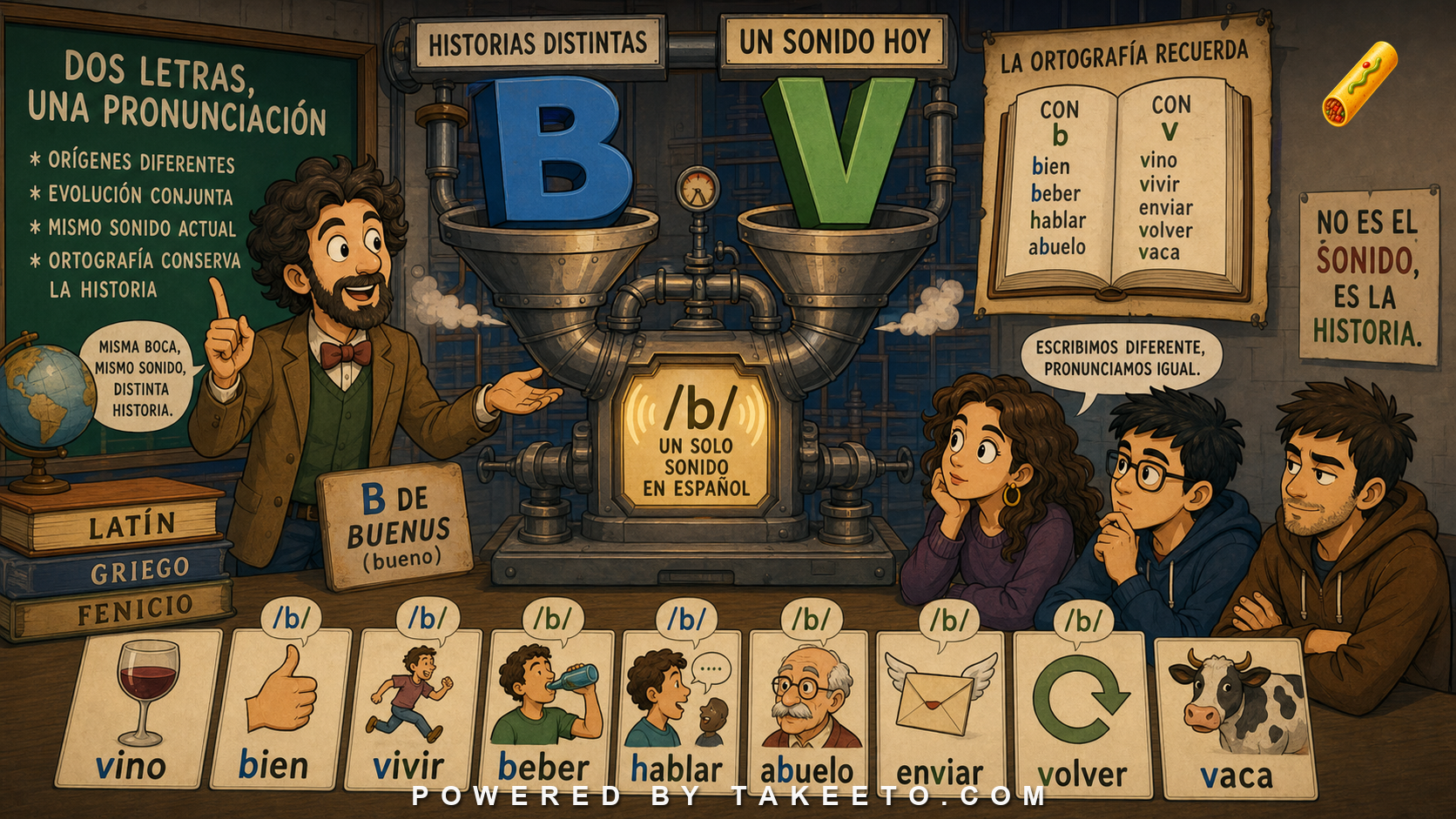
In most modern Spanish, b and v represent the same phoneme. Baca and vaca are pronounced alike. Botar and votar are pronounced alike. Bello and vello are pronounced alike. A learner who tries to pronounce Spanish v like English /v/ is usually not being more precise. They are importing an English distinction that standard Spanish generally does not have.
The practical rule is:
In ordinary modern Spanish, b and v are spelling distinctions, not a reliable pronunciation distinction.
One phoneme, multiple realizations
Saying “b and v sound the same” is true, but it is not the whole story.
Spanish has a phoneme often represented as /b/. That phoneme can be pronounced in different ways depending on position.
In careful descriptions, two broad allophones matter for learners:
- A stronger stop-like [b], often after a pause or after nasal consonants.
- A softer approximant-like [β̞], often between vowels and in many other continuous speech contexts.
Compare:
| Word/phrase | Likely realization pattern |
|---|---|
| bien | stronger at the beginning after pause |
| vino | stronger at the beginning after pause |
| un vaso | stronger after n |
| ambos | stronger after m |
| saber | softer between vowels |
| vivir | second v often softer between vowels |
| la boca | often softer after a vowel in connected speech |
| la vaca | same sound pattern as comparable b context |
The important point: this alternation is not b versus v. It is position and phonetic context.
Beber and vivir both contain letters that map to the same sound category. The pronunciation may vary inside the word, but not because one letter is b and the other is v.
Why the spelling distinction remains
If b and v sound the same, why keep both letters?
Because spelling is not just sound. It carries history, etymology, word-family identity, and international convention.
Spanish inherited many spellings from Latin and developed through centuries of sound change. Earlier stages of the language had distinctions that later merged. The spelling system preserved many historical differences even after speech changed.
This is not unique to Spanish. English keeps many silent letters and historical spellings. French spelling preserves distinctions that speech has reduced or lost. Writing systems often outlive sound changes.
Spanish b/v spelling is therefore a historical memory. It helps distinguish words in writing even when pronunciation does not.
| Pair | Pronunciation in most Spanish | Meaning distinction in writing |
|---|---|---|
| vaca / baca | same | cow / roof rack or carrier, depending on usage |
| votar / botar | same | vote / throw away, bounce, launch, etc. |
| vello / bello | same | body hair / beautiful |
| tuvo / tubo | same | had / tube |
| vienes / bienes | same or very close depending on dialect | you come / goods |
The writing distinction matters even if the sound distinction does not.
Do not use English /v/ as a spelling strategy
Some learners are told, or infer, that v should be pronounced with the upper teeth touching the lower lip, as in English very.
That advice is bad for most Spanish learning contexts.
A labiodental [v] may occur in some speakers due to contact with other languages or particular regional histories, but it is not the general standard pronunciation of Spanish v. If you consistently pronounce vino with English /v/, you may be understood, but your accent will sound foreign and spelling-driven.
This is one of those cases where spelling misleads English speakers.
Better:
- vino begins like bien in ordinary Spanish pronunciation.
- vivir does not require an English /v/ at either position.
- la vida has a soft Spanish /b/-type sound in connected speech, not English /v/.
Stop and approximant: the useful learner version
You do not need to become a phonetician, but the stop/approximant alternation is worth learning because it makes Spanish sound more natural.
Stronger [b]-like realization
Often appears:
- at the beginning of an utterance: Bien.
- after a pause: Vino Juan.
- after m: también, ambos
- after n: un vaso, enviar in many contexts
Softer [β̞]-like realization
Often appears:
- between vowels: saber, beber, la vida, lava if spelled with v in the word
- in continuous speech after many non-nasal sounds
The softer sound is not English /v/. It is made with both lips close together, with air passing through, and without the firm closure of [b].
Learners often improve by aiming for “soft b” rather than “v.”
Spelling strategies that actually work
If pronunciation will not tell you whether a word uses b or v, how do you spell correctly?
You need orthographic memory, word families, and patterns.
Learn word families
| Family | Forms |
|---|---|
| vivir | vivo, vive, vivimos, vida, vivienda in related families but not always simple spelling prediction |
| beber | bebo, bebida, bebedor |
| volver | vuelvo, vuelta, devolución in broader family |
| saber | sabe, sabido, sabiduría |
| haber | hay, había, habrá, he, hemos |
Word families help more than isolated memorization.
Learn common prefixes and morphemes
- bien-, bene-: bienestar, beneficio
- bi-/bis-: bicicleta, bisabuelo
- vice-: vicepresidente
- sub-: submarino, subvención with assimilation and spelling complications
Learn high-frequency contrast pairs
- tuvo / tubo
- votar / botar
- vaca / baca
- bello / vello
- revelar / rebelar
These pairs are worth explicit attention because sound alone will not save you.
Read a lot
This sounds blunt because it is. Spelling distinctions with no pronunciation contrast become easier through exposure. You need visual memory.
What about names and regional speech?
Some bilingual speakers, speakers in contact zones, or speakers influenced by local languages may produce something closer to a labiodental [v]. Individual speakers may also hypercorrect in formal contexts.
Do not turn these observations into a false global rule.
For a learner, the safest general standard is:
- Do not contrast b and v in ordinary Spanish pronunciation.
- Do learn to spell them correctly.
- Do accept that some speakers may vary.
- Do not correct native speakers because their b and v sound the same.
Practice progression
Stage 1: erase the English v
Say these pairs with the same initial sound:
- bien / vino
- beso / vaso
- boca / vaca
- beber / vivir
Do not use English /v/ in the second word.
Stage 2: practice soft intervocalic sound
- sabe
- beber
- la vida
- una vaca
- abuelo
- volver
Try to soften the sound between vowels or in connected speech. Do not overdo it into a w sound.
Stage 3: spelling families
Write and say:
- vivir, vivo, vive, vivimos
- beber, bebo, bebida
- saber, sabe, sabía
- volver, vuelvo, volvió
- haber, había, hubo, habrá
Separate pronunciation practice from spelling memory.
Common learner mistakes
Mistake 1: Pronouncing every v as English /v/
This creates an unnecessary foreign accent feature.
Mistake 2: Pronouncing every b/v as a hard [b]
This is better than English /v/, but it can still sound stiff. Spanish often softens the sound between vowels.
Mistake 3: Expecting spelling from listening alone
If you hear tuvo and tubo, the pronunciation may not tell you which word is meant. Context and spelling knowledge matter.
Mistake 4: Thinking “same sound” means “same letter”
Spanish spelling preserves both letters. Do not collapse them in writing.
Suggested interactive module: b/v sound and spelling trainer
A useful tool for this article would separate pronunciation training from spelling training.
Suggested functions:
- Audio comparison: baca/vaca, botar/votar, bello/vello pronounced alike by several speakers.
- Allophone visualizer: show stronger [b]-like and softer [β̞]-like contexts.
- Spelling quiz: identify b or v from meaning, not sound alone.
- Word-family cards: group words visually by spelling family.
- Accent warning: detect English /v/ in learner recordings and suggest a bilabial target.
Example input:
la vida
Possible output:
- Letter: v
- Phoneme: /b/
- Likely realization in connected speech: soft bilabial approximant
- Warning: not English /v/
Final rule
Spanish b and v are two letters with one main modern sound category in most varieties.
The distinction lives in spelling, history, and word identity, not in a general pronunciation contrast. Learn to pronounce both with Spanish bilabial behavior. Then learn to spell them through exposure, families, and meaning.
Do not let English spelling instincts outrank Spanish reality.