
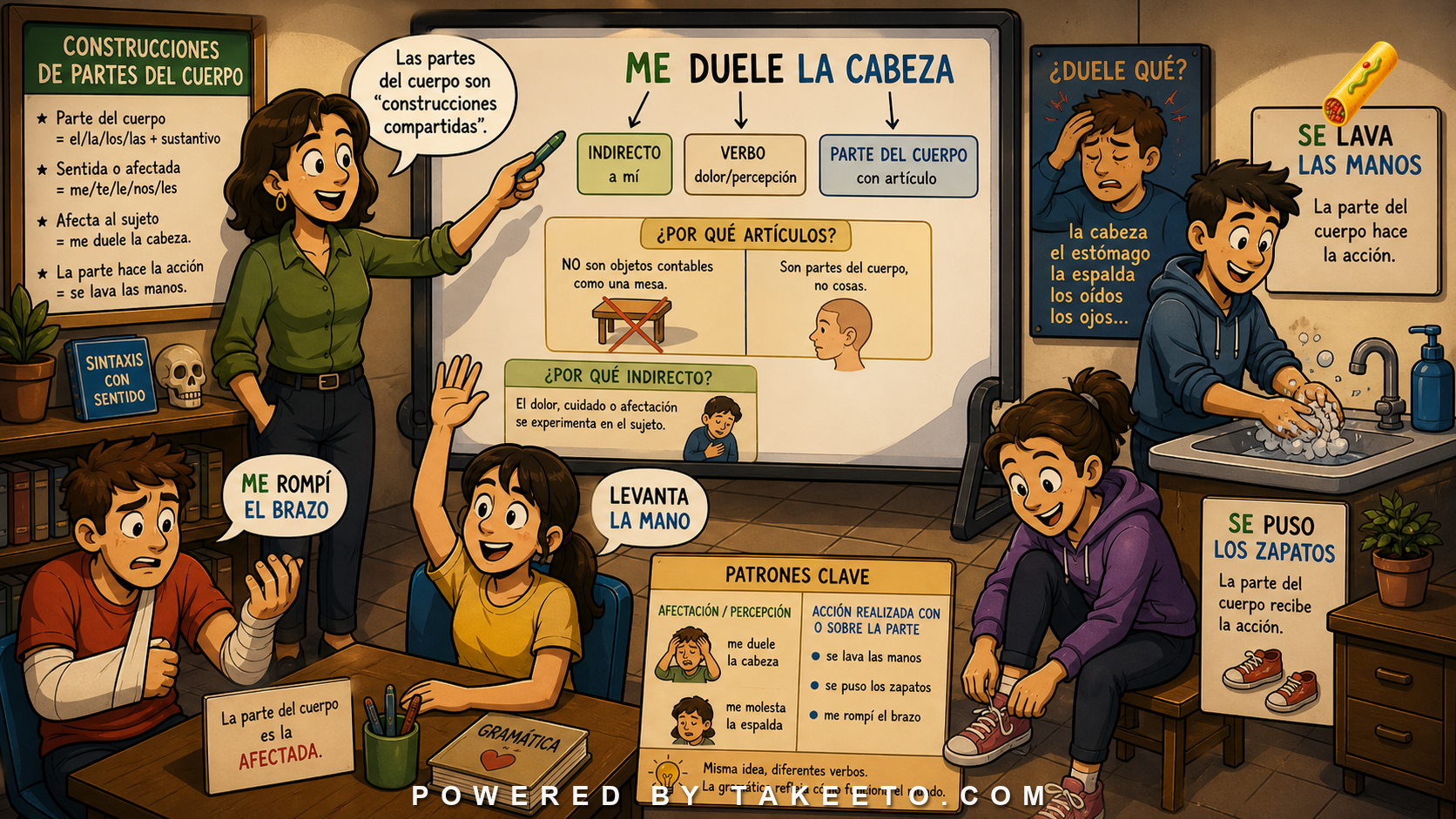
Spanish does not always possess body parts the English way
English says “my head hurts,” “she washed her hands,” “I broke my arm,” “raise your hand,” and “he put on his shoes.” Spanish often uses a different architecture:
Me duele la cabeza.
My head hurts.
Se lavó las manos.
She washed her hands.
Me rompí el brazo.
I broke my arm.
Levanta la mano.
Raise your hand.
The body part often takes the definite article el/la/los/las, while the person affected is marked by an indirect object, reflexive pronoun, or context.
The key principle is:
Spanish often marks the affected person separately and uses the definite article with the body part.
This is one of the most important differences between English and Spanish everyday grammar.
Me duele la cabeza: the affected-person pattern
The verb doler works much like gustar in structure. The thing that hurts is the grammatical subject, and the affected person is an indirect object.
Me duele la cabeza.
My head hurts.
Literally, the head hurts to me.
More examples:
Me duelen los pies.
My feet hurt.
¿Te duele el estómago?
Does your stomach hurt?
A mi hermano le duele la espalda.
My brother’s back hurts.
The verb agrees with the body part:
Me duele la cabeza.
singular
Me duelen las rodillas.
plural
Learners often forget agreement because English makes the person the subject. Spanish makes the pain location the subject.
Definite article instead of possessive
Spanish usually says:
la cabeza
los pies
las manos
el brazo
not:
mi cabeza, mis pies, sus manos
when the affected person is already clear.
Me duele la cabeza.
Not normally: Me duele mi cabeza.
Se lavó las manos.
Not normally: Se lavó sus manos.
The possessive is possible when there is contrast, ambiguity, or emphasis:
Me duele mi rodilla, no la otra.
My knee hurts, not the other one.
But the ordinary pattern is article plus affected-person marking.
Washing, moving, and touching body parts
With reflexive or affected-person structures, Spanish uses articles.
Me lavé las manos.
I washed my hands.
Se cepilló los dientes.
He brushed his teeth.
Te cortaste el pelo.
You cut your hair / got your hair cut.
Le tocaron el hombro.
They touched his/her shoulder.
Me agarró del brazo.
He/she grabbed me by the arm.
The person is not expressed through a possessive adjective. It is expressed through me, te, se, le, etc.
Injury and accidental events
Spanish often uses reflexive or indirect-object structures for injuries and accidents.
Me rompí el brazo.
I broke my arm.
Se torció el tobillo.
She twisted her ankle.
Me corté el dedo.
I cut my finger.
These forms can imply that the event happened to the person, not necessarily that they intentionally injured themselves. The reflexive/pronominal structure marks the affected participant.
For accidents beyond body parts, Spanish often uses se me:
Se me cayó el vaso.
I dropped the glass / The glass fell on me.
This article focuses on body parts, but the underlying affected-person logic is broader.
Clothing and personal items
The same pattern appears with clothing and accessories.
Me puse los zapatos.
I put on my shoes.
Se quitó el abrigo.
She took off her coat.
Ponte el cinturón.
Put on your seatbelt.
Me olvidé las gafas.
I forgot my glasses. Regional and structure-dependent; olvidé mis gafas is also possible.
With clothing, the reflexive pronoun usually tells whose item it is.
Se puso los zapatos.
She put on her shoes.
Use possessives when contrast or ownership matters:
Se puso mis zapatos por error.
She put on my shoes by mistake.
Commands: levanta la mano
In classroom or group commands, Spanish often uses the article:
Levanta la mano.
Raise your hand.
Cierra los ojos.
Close your eyes.
Abre la boca.
Open your mouth.
The command’s addressee makes ownership obvious. English requires “your”; Spanish does not.
For plural or formal commands:
Levanten la mano.
Raise your hands.
Cierre los ojos.
Close your eyes.
Body parts in medical speech
In health contexts, both everyday and clinical structures appear.
Everyday:
Me duele la garganta.
My throat hurts.
Tengo dolor de garganta.
I have a sore throat / throat pain.
Me mareo.
I get dizzy.
More clinical:
Presenta dolor abdominal.
The patient presents abdominal pain.
Learners in medical contexts must be careful. Everyday patient speech and clinical documentation use different grammar and vocabulary.
Common learner traps
The first trap is overusing possessives.
Incorrect: Me duele mi cabeza.
Correct: Me duele la cabeza.
The second trap is making the person the subject with doler.
Incorrect: Yo duelo la cabeza.
Correct: Me duele la cabeza.
The third trap is forgetting plural agreement.
Me duelen los pies.
Not: Me duele los pies.
The fourth trap is translating reflexives literally as intentional self-action.
Me rompí el brazo.
Usually: I broke my arm, not “I broke the arm to myself” intentionally.
Remediation notes: agreement, affected person, and accidental events
The body-part pattern becomes much easier when learners stop asking “Where is the possessive?” and start asking “Who is affected?” Spanish often gives the affected person as an indirect object and the body part as a definite noun phrase.
The agreement belongs to the body part, not to the person:
Me duele la cabeza.
My head hurts.
Me duelen los pies.
My feet hurt.
Me does not control singular or plural agreement. La cabeza gives duele; los pies gives duelen.
The same affected-person logic appears with grooming and injury:
Me lavé las manos.
I washed my hands.
Se cepilló los dientes.
He/She brushed his/her teeth.
Me rompí el brazo.
I broke my arm.
These sentences do not normally need mis, sus, or mi because the indirect/reflexive pronoun already identifies the affected person. Possessives are possible when contrast is needed:
Me puse mis zapatos, no los tuyos.
I put on my shoes, not yours.
But as a default, English possessive habits produce unnatural Spanish.
Accidental-event sentences deserve special attention:
Se me cayó el vaso.
I dropped the glass / The glass slipped from me.
Se le rompió el teléfono.
His/Her phone broke on him/her.
This is not exactly the same as me rompí el brazo, but it shares the affected-person perspective. Spanish can present an event as happening to or affecting someone without making that person a direct agent. That is why body-part and personal-item sentences often feel less agentive than their English translations.
In medical or clinical speech, the same grammar may appear in more formal frames:
Le duele el pecho desde hace dos días.
His/Her chest has hurt for two days.
Presenta dolor en la rodilla derecha.
He/She presents pain in the right knee.
The second is clinical register, not ordinary conversation. Learners should master the everyday pattern first: me/te/le duele(n) + el/la/los/las + body part. Then learn how formal registers recast the same information.
Example bank walkthrough
me duele la cabeza
Pain construction with affected person and definite article.
Learner action: make la cabeza the subject of duele.
se lavó las manos
Reflexive body-care construction.
Learner action: article, not possessive.
me rompí el brazo
Injury construction.
Learner action: do not assume intentional self-harm; it can be accidental.
levanta la mano
Command with body part.
Learner action: use article because addressee is clear.
se puso los zapatos
Clothing pattern.
Learner action: reflexive pronoun marks whose shoes.
Suggested interactive module: body-part sentence builder
A strong tool for this article would force learners to assign body part, affected person, and verb agreement.
Suggested functions:
- Pain builder: me/te/le duele(n) + article + body part.
- Agreement checker: singular duele, plural duelen.
- Care routine mode: wash hands, brush teeth, comb hair.
- Injury mode: break arm, twist ankle, cut finger.
- Clothing mode: put on/take off shoes, coat, glasses.
- Possessive warning: shows when mi/su is unnecessary or contrastive.
- Command mode: levanta la mano, cierra los ojos.
Final rule
Spanish body-part grammar often marks the person with me/te/le/se and marks the body part with el/la/los/las.
Do not translate English possessives automatically. In Spanish, the affected person and the body part are usually separate pieces of the sentence.