
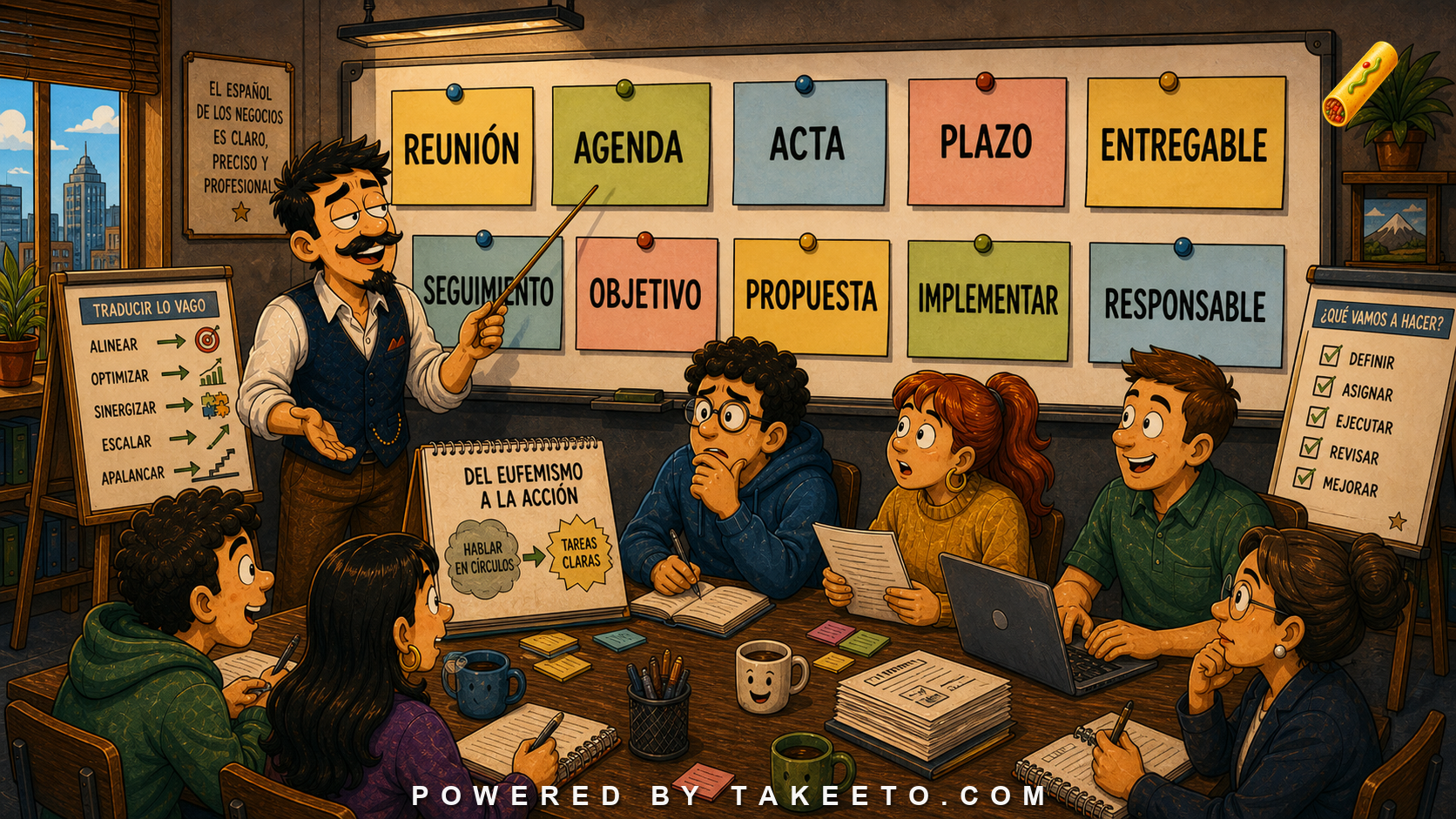
Business Spanish manages action without always naming actors
Business Spanish often sounds clear on the surface and evasive underneath. It is full of meetings, deadlines, objectives, proposals, follow-up, alignment, implementation, responsibility, and carefully softened disagreement.
The real difficulty is not vocabulary. It is reading how responsibility is assigned, softened, delayed, or hidden.
Compare:
Pedro enviará el informe el viernes.
Pedro will send the report on Friday.
El informe se enviará el viernes.
The report will be sent on Friday.
Queda pendiente el envío del informe.
Sending the report remains pending.
All three concern the same action. Only the first clearly names the responsible person.
The key principle is:
Business Spanish is action language, but it often packages action in nouns, passives, and impersonal structures.
Reunión, agenda, and acta
Three meeting words organize business communication: reunión, agenda / orden del día, and acta. In some contexts, agenda is common for the list of topics; orden del día sounds more formal or institutional. Acta is not just “notes.” It can be the official record of decisions, attendees, votes, commitments, and agreements.
Useful phrases include convocar una reunión, asistir a una reunión, revisar la agenda, levantar acta, and aprobar el acta. A casual note may remind people what was discussed; an acta may become evidence of what was decided.
Learner action: distinguish informal notes from an official record.
Objetivo, propuesta, acuerdo, and decisión
Business writing often moves from intention to decision through a sequence: objetivo, propuesta, acuerdo, decisión, plan de acción, seguimiento. A propuesta is not a decision. An acuerdo may be a formal agreement or simply a meeting consensus. Seguimiento is not the action itself; it is the monitoring after the action.
Examples:
Se presentó una propuesta para mejorar el proceso.
A proposal was presented to improve the process.
Se acordó implementar la propuesta en dos fases.
It was agreed to implement the proposal in two phases.
El equipo dará seguimiento a los resultados.
The team will follow up on the results.
Learner action: identify whether an item is only discussed, proposed, approved, assigned, implemented, or reviewed.
Plazo, entrega, and entregable
A plazo is a deadline, term, or period. An entregable is a deliverable: a concrete output expected by a date. Entrega is the act or event of delivering; entregable is the thing delivered.
Examples:
El plazo vence el 30 de junio.
The deadline expires on June 30.
El primer entregable será el informe técnico.
The first deliverable will be the technical report.
La entrega está prevista para el tercer trimestre.
Delivery/submission is planned for the third quarter.
Learner action: connect every deliverable to an owner and date, even when the text hides one.
Responsable and responsibility language
Responsable can be a person in charge or an adjective meaning responsible/accountable. Business texts also use queda a cargo de, corresponde a, se asigna a, and se delega en.
The danger is that se constructions can obscure agency:
Se revisará el documento.
The document will be reviewed.
By whom? When? According to what criteria? A good business reader asks those questions.
Implementar and anglicisms
Corporate Spanish uses many international verbs: implementar, optimizar, monitorear / monitorizar, escalar, alinear. Some anglicisms are entrenched in particular industries. Others are unnecessary calques.
A learner should not assume every English business word can be Spanishified. Realizar una llamada is natural; hacer un call is informal corporate slang in some settings. For “apply for a job,” postularse, presentar una solicitud, or solicitar un puesto may be safer than mechanically using aplicar, depending on country and register.
Learner action: learn the local corporate dialect, but keep a formal international alternative available.
Corporate euphemism
Some business Spanish softens unpleasant realities: ajustes de personal, optimización de recursos, oportunidades de mejora, reasignación de funciones, proceso de transformación, desafíos operativos.
Euphemism is not always dishonest. Organizations often need neutral language. But a reader should be alert when vague positive nouns hide concrete effects.
Learner action: ask what changed, who is affected, what must be done, and what is being avoided.
Example bank walkthrough
reunión
Meeting.
Learner action: identify whether it is informational, decision-making, review, or negotiation.
agenda
List of topics or schedule.
Learner action: compare with orden del día in formal settings.
acta
Official minutes/record.
Learner action: treat it as evidence of decisions and commitments.
plazo
Deadline, period, or term.
Learner action: check start date, end date, and consequence of missing it.
entregable
Concrete output expected.
Learner action: tie it to a responsible person.
seguimiento
Follow-up or monitoring.
Learner action: do not confuse monitoring with completion.
objetivo
Goal.
Learner action: separate objective from action plan.
propuesta
Proposal.
Learner action: ask whether it has been approved.
implementar
To implement.
Learner action: watch for corporate calques and domain-specific uses.
responsable
Person in charge or accountable.
Learner action: locate responsibility when se hides it.
Business reading workflow
For business texts, ask: What decision has actually been made? What is still only proposed? What action is required? Who owns it? What is the deadline? What deliverable proves completion? What follow-up is expected? What euphemism may be hiding a concrete change?
Remediation notes: business Spanish hides agency on purpose
The first draft explains business vocabulary, but the remediation pass needs to make one feature louder: business Spanish often reduces visible agency. This is not only grammar. It is institutional behavior. A meeting note may say se acordó, queda pendiente, se dará seguimiento, se implementará, or se revisará la propuesta without clearly stating who must do the work.
The learner's job is to recover four hidden slots:
decision: what was agreed?
owner: who is responsible?
deadline: by when?
evidence: how will completion be known?
This matters because responsable is not just an adjective meaning “responsible.” In business documents, responsable may be a role label: the person or team assigned to a task. A sentence like Responsable: Finanzas does not praise the finance department's character; it assigns ownership.
Several English-to-Spanish corporate calques need caution. Implementar is now common in many business and technical environments, but it should not crowd out aplicar, poner en marcha, ejecutar, llevar a cabo, desplegar, or adoptar when those are clearer. Entregable is common in project contexts, but in some settings producto, resultado, documento final, hito, or material may sound less jargon-heavy. Dar seguimiento is normal in many American business registers; hacer seguimiento is also used. The safer learner move is to mirror the local institution's wording.
The word agenda also deserves repair. In Spanish it can mean a diary/planner, a schedule, a list of matters to address, or a broader political/business agenda. In a meeting context, orden del día may be the more formal or precise label for the agenda of items. Acta is not simply “notes”; in many institutions it is the official minutes or record. Casual notes may be notas, apuntes, or resumen de la reunión.
Business euphemism should be read critically. Optimizar recursos may mean improve efficiency, but it may also hide cuts. Reestructuración may mean reorganization, but it may involve layoffs. Área de oportunidad may be a polite way to name a problem. Ajuste can be tiny or consequential. The language often protects relationships, brands, and hierarchies.
A stronger business-reading workflow is:
- Underline every verb of action: revisar, enviar, aprobar, implementar, validar.
- Circle every passive or se form where the actor is hidden.
- Mark every deadline expression: plazo, fecha límite, antes del, a más tardar.
- Identify the owner: responsable, encargado, área, equipo, proveedor.
- Rewrite the note as a task list in plain Spanish.
The repair rule:
Business Spanish is not understood until every elegant noun phrase has been converted back into an actor, action, deadline, and deliverable.
Suggested interactive module: meeting-minutes template
A strong tool for this article would turn business language into accountable action.
Suggested functions:
- Meeting type selector: planning, review, negotiation, status update.
- Decision extractor: proposed, agreed, approved, rejected, pending.
- Owner field: responsible person/team.
- Deadline field: plazo, fecha límite, vencimiento.
- Deliverable tracker: informe, propuesta, presentación, contrato.
- Euphemism detector: vague nouns and passive responsibility.
- Anglicism alternatives: formal Spanish options by region/register.
- Email generator: follow-up note with clear action items.
Final rule
Business Spanish is not hard because the words are rare. It is hard because responsibility can be hidden inside polite nouns, passive structures, and corporate euphemism.
Read every meeting note as an action map: decision, owner, deadline, deliverable, and follow-up.