
“They speak fast” is not an explanation
Learners often describe Caribbean Spanish as “fast.” That reaction is understandable. A learner trained on slow classroom Spanish may hear a Cuban, Puerto Rican, Dominican, or coastal Caribbean speaker and feel lost.
But speed is only part of the story. Much of the difficulty comes from predictable sound processes:
- syllable-final s weakens,
- final d may disappear,
- final r may weaken or change,
- r and l can interact in some varieties,
- common phrases compress,
- intonation and rhythm differ from classroom models.
The key principle is:
Caribbean Spanish is not careless Spanish. It is systematic Spanish with reduction patterns learners can train themselves to hear.
Calling it “just fast” prevents learning. Analysis helps.
What counts as Caribbean Spanish?
“Caribbean Spanish” usually refers to varieties associated with Cuba, Puerto Rico, the Dominican Republic, and often Caribbean coastal regions of countries such as Colombia, Venezuela, Panama, and parts of Central America.
These varieties are not identical. Havana is not San Juan. Santo Domingo is not Barranquilla. Coastal Venezuela is not the same as inland Venezuela. But they share enough phonetic tendencies that learners can benefit from a Caribbean listening strategy.
The category is a listening map, not a single accent.
Syllable-final s weakening
One of the most important features is weakening of s at the end of a syllable.
A written phrase like:
los amigos
may sound closer to:
loh amigo
lo amigo
loh amigoh
depending on speaker, region, speed, and register.
The s may be aspirated, sounding like a light h, or deleted. This affects plurals, verb endings, and function words.
Examples:
estás
may sound like ehtáh / etá
los dos
may sound like loh doh / lo do
Learner action: when you hear a missing or weakened final sound, mentally test whether an s belongs there by grammar and context.
Plurals can be heard through context
If s weakens, how do speakers know singular from plural?
They use context, determiners, vowels, agreement, syntax, and expectation. Native speakers are not guessing randomly. The grammar remains present even when one sound weakens.
Compare:
los amigo(s) llegaron
Even if final s is weak, los, verb agreement, and context point to plural.
Learners should not panic when they do not hear every s. Instead, train reconstruction:
lo amigo llegaron → los amigos llegaron
This is not “correcting” the speaker. It is mapping speech to the underlying grammar.
Final d loss
Final or intervocalic d, especially in endings like -ado, may weaken or disappear.
cansado
cansao
terminado
terminao
verdad
verdá
This feature appears in many Spanish varieties, not only the Caribbean, but it is prominent in many Caribbean and coastal speech styles.
Learner action: when you hear -ao, check for written -ado.
R and l variation
In some Caribbean varieties, syllable-final r and l may weaken, neutralize, or interact.
Examples learners may encounter:
comer
comel / comé, depending on context and region
hablar
hablá
puerta
puelta, in some speech styles
Not every Caribbean speaker does this, and it is often socially and regionally marked. It can vary by formality. A speaker may use more conservative pronunciation in formal contexts and more local pronunciation with family or friends.
Learner action: listen descriptively. Do not imitate strongly marked features unless you belong to the speech community or have good local guidance.
Para allá and connected speech
Common phrases compress.
para allá
may become something closer to:
pa’llá
pa allá
Similarly:
para acá → pa’cá
usted está → uté tá / usted tá
está bien → ta bien / está bien
This is not unique to Caribbean Spanish, but the combination of reduction and rhythm can make phrases feel very different from the written form.
Learner action: build a list of high-frequency compressed phrases and practice expanding them.
Vowel clarity helps more than learners expect
Even when consonants weaken, Spanish vowels often remain relatively clear. Learners trained in English may expect heavy vowel reduction, but Spanish reduction works differently. In Caribbean Spanish, consonants may carry less surface information, while vowels, stress, and intonation carry a great deal.
This means the learner’s listening strategy should not be “find every consonant.” It should be:
- catch the stressed vowels,
- identify the phrase frame,
- restore likely final consonants,
- check verb endings and agreement,
- use context.
Social meaning matters
Some reduced pronunciations are ordinary regional speech. Some are informal. Some are stigmatized by outsiders or by local class systems. Some are used in music and informal identity performance but reduced in formal speech.
The learner must not confuse “not classroom Spanish” with “wrong.” At the same time, the learner should not imitate the most locally marked features as a costume. Respect means understanding the system and controlling your own production target.
Listening strategy: reconstruct the written form
Take:
¿Ustedes están listos?
In fast Caribbean speech, parts may weaken. The learner may hear:
¿Ustede(s) etán listo(s)?
¿Utede tán listo?
The task is not to complain about speed. The task is to reconstruct:
ustedes + están + listos
Practice with written transcripts and audio. Mark which sounds are weakened. Then listen again without the transcript.
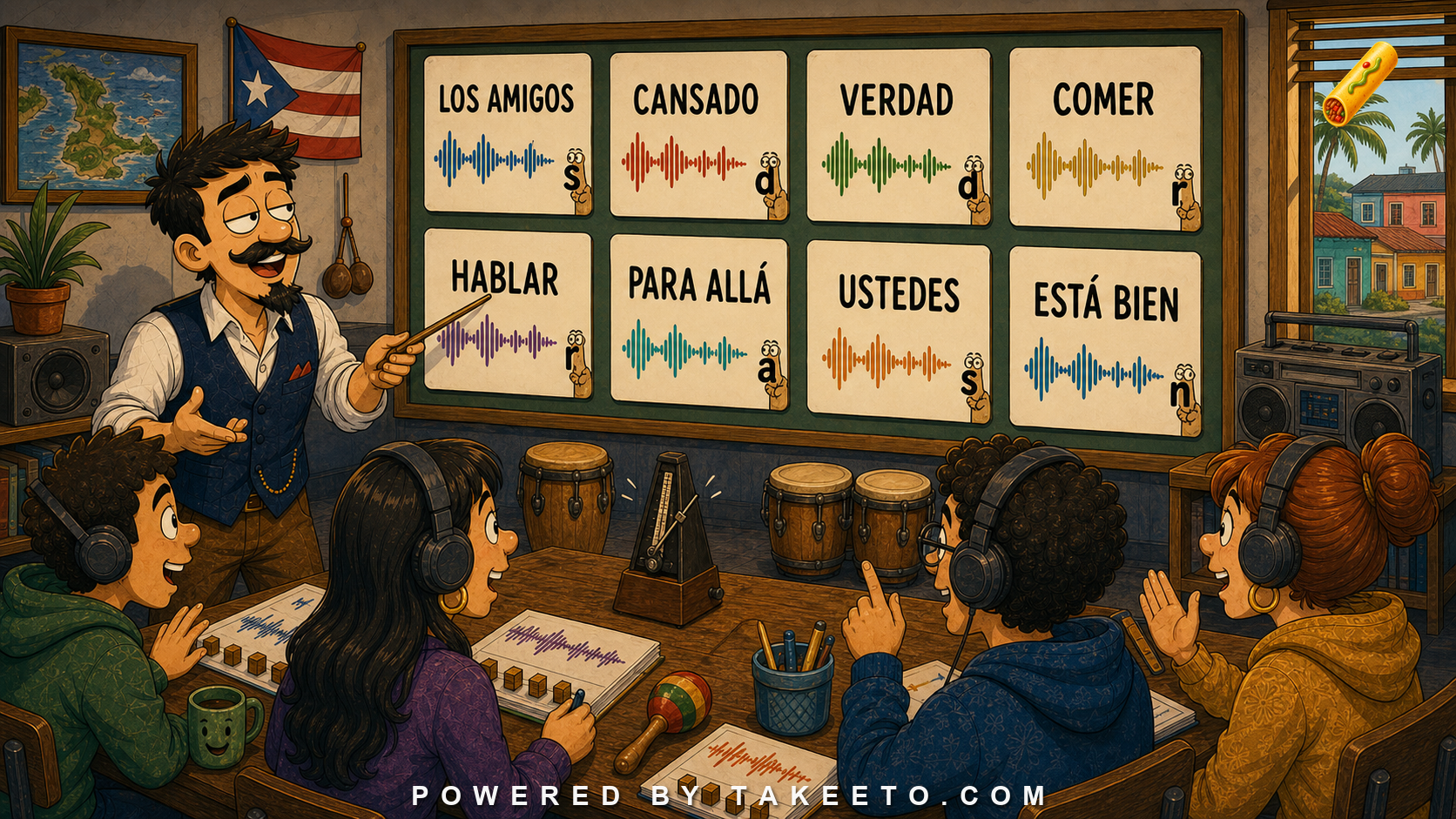
Example bank walkthrough
los amigos
Final s in los and amigos may weaken.
Learner action: use determiner, noun, and verb agreement to recover plural meaning.
cansado
May sound like cansao in informal speech.
Learner action: connect -ao to -ado.
verdad
May sound like verdá.
Learner action: expect final d weakening in common words.
comer / hablar
Final r may weaken or vary.
Learner action: identify infinitives from syntax, not only final r.
para allá
Can compress to pa’llá.
Learner action: store frequent phrase contractions.
ustedes
Final s may weaken, but the pronoun remains plural in grammar.
Learner action: do not rely only on final consonants for number.
está bien
Can reduce in connected speech.
Learner action: learn common conversational chunks.
Caribbean listening drill
Use a four-pass routine:
- First pass: listen for meaning without transcript.
- Second pass: read transcript and mark final s, d, r, l.
- Third pass: listen again and circle weakened sounds.
- Fourth pass: shadow lightly without exaggerating local features.
The goal is recognition, not caricature.
Remediation notes: reconstructing Caribbean grammar without caricature
The most important learner repair is this: weakened sounds are not missing grammar. When a Caribbean speaker weakens syllable-final s, the plural system has not disappeared. When -ado sounds like -ao, the participle has not become ungrammatical. The grammar is still recoverable through determiners, verb agreement, word order, discourse context, and shared expectation.
A learner should practice hearing two layers at once:
Surface speech: loh amigo llegaron
Underlying grammar: los amigos llegaron
This is not "correcting" the speaker. It is learning how a regional sound pattern maps onto written and grammatical Spanish.
The article also needs a stronger warning about imitation. It is useful to recognize Caribbean weakening; it is not automatically wise for a learner to imitate the strongest local reductions. If your production target is not Caribbean Spanish, keep your own consonants relatively clear while training your ear to understand reduced forms. If your target is Caribbean Spanish, learn from real community input, not from exaggerated comedy or music stereotypes.
Sound processes also interact with register. A speaker may pronounce more final consonants in a formal interview, job setting, classroom, court, or public speech, and use more reduction with family or friends. This means one speaker can sound "clear" in one context and heavily local in another. Learners should not assign one pronunciation to one person permanently.
A good reconstruction drill uses grammar categories:
Plural noun phrase: lo muchacho → los muchachos.
Second-person verb: tú sabe may need context; do not assume the same system everywhere.
Past participle: cansao → cansado.
Infinitive: hablá/comé may be reduced infinitive, command, or voseo-like form depending on region and context.
Fixed phrase: pa'llá → para allá.
This kind of drill prevents learners from chasing every sound separately. The task is to restore phrase frames.
The article should also be explicit that "Caribbean" is a broad listening category, not a single dialect. Cuba, Puerto Rico, the Dominican Republic, Panama, coastal Colombia, coastal Venezuela, and other coastal areas share some tendencies, but they differ in vocabulary, social meaning, rhythm, and local norms. A Puerto Rican r/l pattern, a Dominican reduction, a Cuban intonation contour, and a Barranquilla rhythm should not be collapsed into one cartoon accent.
Practical learner rule:
For comprehension, exaggerate your awareness of final consonants. For production, do not exaggerate the accent.
That combination builds respect and competence at the same time.
Suggested interactive module: final-consonant weakening visualizer
A strong tool for this article would turn written Spanish into possible Caribbean listening forms.
Suggested functions:
- Input phrase: User enters standard written Spanish.
- Weakening overlay: Mark syllable-final s, final d, final r.
- Audio modes: careful, informal, fast connected speech.
- Reconstruction quiz: User hears reduced form and restores spelling.
- Region notes: Cuba, Puerto Rico, Dominican Republic, coastal Colombia/Venezuela, with caution labels.
- Register slider: formal interview → casual conversation → music.
- Phrase bank: para allá, está bien, los amigos, ustedes.
- Respect reminder: recognition before imitation.
Final rule
Caribbean Spanish is not “bad Spanish spoken fast.” It is Spanish with systematic sound patterns.
Train final consonant reconstruction, phrase compression, and regional rhythm. Once you hear the system, the speed becomes less mysterious.