
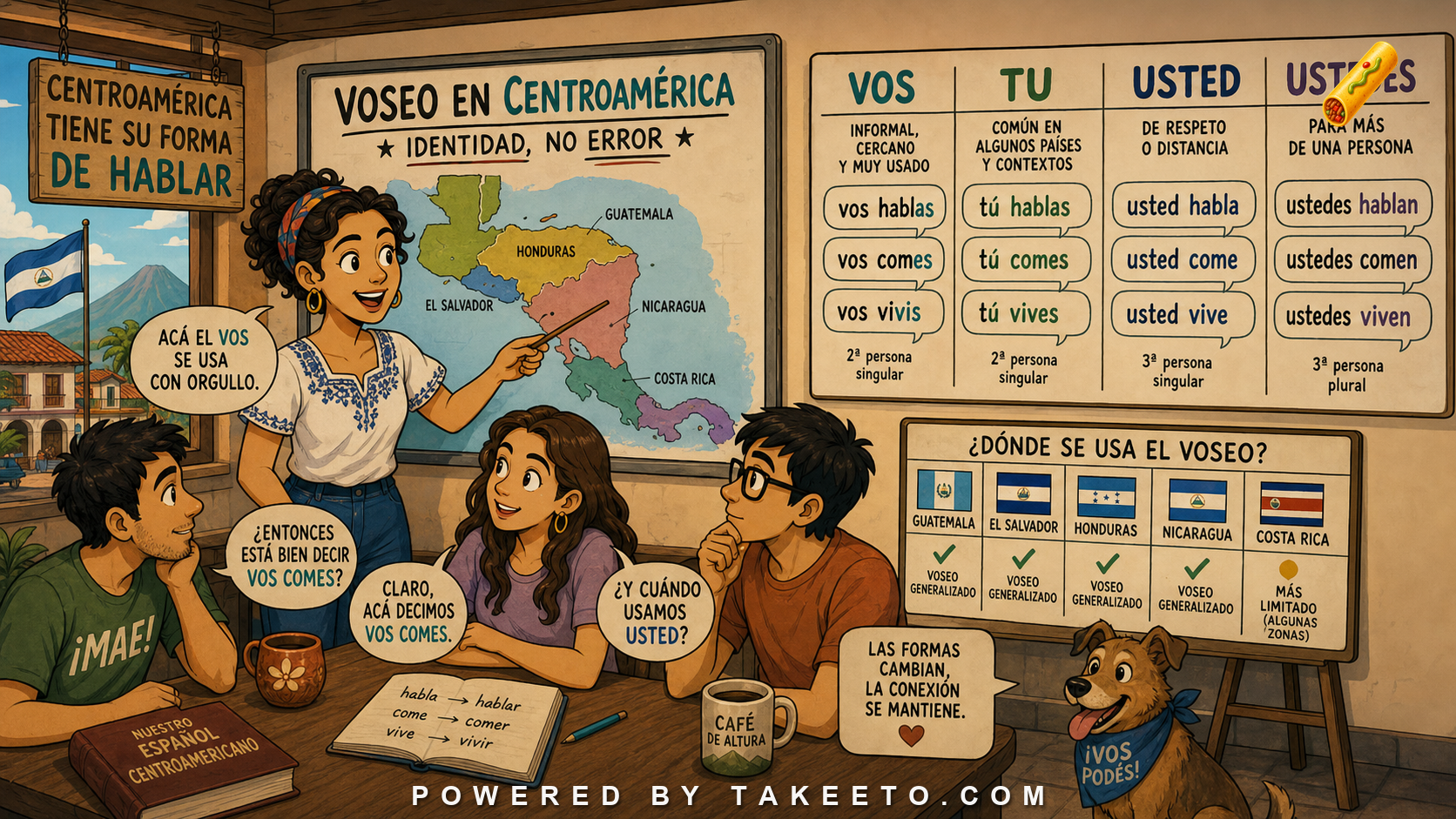
Voseo is bigger than Argentina
Many learners associate vos with Argentina. That is understandable because Argentine media has made Rioplatense vos globally visible. But voseo is much broader. It is present in many parts of Central America, including countries such as Guatemala, El Salvador, Honduras, Nicaragua, Costa Rica, and others, with different levels of prestige, intimacy, and formal recognition.
The key principle is:
Central American voseo is not borrowed from Argentina and not secondary to it. It is part of local address systems.
Learners who understand only Rioplatense voseo will miss important Central American patterns.
What voseo means
Voseo is the use of vos and/or corresponding verb forms for singular “you.” It may involve the pronoun, the verb ending, or both.
Vos hablás.
You speak.
Vos comés.
You eat.
Vos vivís.
You live.
But real systems vary. Some speakers use vos with voseo verb forms. Some may mix tú pronouns with voseo-like verbs or vos with forms influenced by tú depending on region and style. Address systems are social, not just grammatical.
Present-tense forms
A common Central American pattern resembles other American voseo forms:
hablar → vos hablás
comer → vos comés
vivir → vos vivís
Stress falls on the final syllable. This makes the forms easy to hear once you know what to expect.
Compare:
tú hablas
vos hablás
tú comes
vos comés
tú vives
vos vivís
The meaning may be the same in broad terms, but the social setting differs.
Commands
Voseo commands are also important:
hablá
speak
comé
eat
vení
come
decí
say
hacé
do/make
Learners often hear vení or decime and fail to connect them to venir and decir. The command system deserves early recognition practice.
Voseo, tuteo, and ustedeo together
Central America is not a simple vos zone replacing tú everywhere. Many communities use three address resources:
vos
intimate, familiar, local, peer, sometimes informal
tú
varying by country; sometimes less common, sometimes associated with media, education, romance, or cross-regional speech
usted
respect, distance, formality, but also intimacy in some regional systems
In Costa Rica, for example, learners often notice broad use of usted and vos, with tú occupying a different social place than in many textbooks. In Guatemala, El Salvador, Honduras, and Nicaragua, vos is deeply woven into everyday speech, but distribution varies by region, class, and relationship.
The main learner lesson:
Do not ask, “Is vos formal or informal?” Ask, “Who is speaking to whom, in which country, and with what relationship?”
Status and stigma
Voseo has carried different prestige levels in different places and periods. In some contexts it has been stigmatized as rural, informal, or less educated. In others it is a normal national feature or a marker of authenticity and closeness. Written representation may lag behind spoken reality; people may speak vos but use tú in some formal writing or school materials.
Learners should not treat stigma as grammar. A stigmatized form can be completely systematic. A prestigious form can still be regionally limited.
Respectful adaptation
If you live or work in a voseo region, you need to understand vos. Whether you should produce it depends on your relationship to the community, your proficiency, and the setting.
Good learner progression:
- Recognize vos forms in listening.
- Understand commands and common irregulars.
- Use usted in formal or uncertain situations.
- Mirror local speakers only when socially appropriate.
- Learn local norms from real interaction, not a continent-wide rule.
Written voseo
In texts, social media, advertising, and local messaging, vos may appear in writing:
¿Vos qué pensás?
What do you think?
Vení mañana.
Come tomorrow.
Some formal institutional writing may avoid it; other local public language may use it deliberately to sound close or national. Again, region and register decide.
Example bank walkthrough
vos hablás
Present-tense voseo form of hablar.
Learner action: hear final stress.
vos comés
Present-tense voseo form of comer.
Learner action: connect comés to comes without treating it as a different verb.
vos vivís
Present-tense voseo form of vivir.
Learner action: compare with tú vives.
tú hablas
Tuteo form.
Learner action: understand that tú may coexist with vos regionally.
usted habla
Formal, respectful, or regionally intimate depending on context.
Learner action: use safely when uncertain, but do not assume coldness.
ustedes hablan
Plural “you all” across Central America.
Learner action: do not use vosotros in normal Central American speech.
Remediation notes: Central American voseo is local, not auxiliary Rioplatense
The main repair is to stop treating Central American voseo as a footnote to Argentina. Central American voseo has its own histories, prestige patterns, written conventions, and interactional meanings. Learners should not import Rioplatense assumptions directly into Guatemala, El Salvador, Honduras, Nicaragua, Costa Rica, Panama, or neighboring contact zones.
A useful distinction:
Pronominal voseo: use of vos as the pronoun.
Verbal voseo: use of voseo verb forms such as hablás, comés, vivís.
Mixed systems: pronoun and verb forms do not always align in the way a textbook table predicts.
This explains why learners may encounter forms that look inconsistent from the outside. Some communities favor vos hablás. Others may show different mixtures of vos, tú, usted, and verb endings depending on register or speaker.
The command forms deserve extra attention because they occur constantly:
Vení.
Decime.
Mirá.
Hacelo.
Contame.
A learner who only knows vos hablás will still miss a lot of interaction if commands are not trained. Clitic forms are especially high-value:
decime = di + me in a voseo command system.
contame = cuéntame.
hacelo = hazlo.
The social meaning also varies strongly. Vos may be intimate, ordinary, national, peer-like, stigmatized in certain formal settings, or excluded from some school writing. Usted may be respectful, distant, or intimate depending on country and relationship. Tú may be media-influenced, school-associated, romantic, regional, or relatively uncommon in some communities.
Learners should therefore avoid a continent-wide rule such as:
vos = informal, usted = formal, tú = neutral.
A better scenario test is:
Would a young person say this to a friend? Would a child say this to a parent? Would a clerk say this to a customer? Would it appear in an advertisement? Would it appear in a formal notice?
Finally, written voseo deserves respect. In some contexts, public campaigns, ads, social media, and local brands use vos to sound close and local. In other contexts, writers may avoid it in favor of more formal language. That difference is not hypocrisy; it is register control.
Recognition sequence:
- vos hablás / comés / vivís.
- sos / tenés / venís / podés / querés.
- vení / decí / hacé / mirá.
- decime / contame / hacelo.
- Local negative commands and subjunctive forms.
Central American voseo is not a curiosity. It is everyday grammar for millions of speakers.
Suggested interactive module: Central American voseo map
A useful tool for this article would connect forms with social meaning.
Suggested functions:
- Country selector: Guatemala, El Salvador, Honduras, Nicaragua, Costa Rica, Panama, neighboring zones.
- Conjugation cards: hablás, comés, vivís, tenés, sos, venís.
- Command cards: hablá, comé, vení, decí, hacé.
- Address scenarios: friend, parent, teacher, stranger, service worker, partner.
- Register labels: spoken, written, formal, colloquial, intimate, stigmatized, prestigious.
- Comparison mode: Central American voseo versus Rioplatense voseo.
- Listening quiz: identify tú, vos, and usted forms.
Final rule
Voseo is not only Argentine.
Central America contains major voseo systems with their own forms, prestige, and social meanings. Learn vos hablás, vos comés, vos vivís, and commands like vení. Then learn when people actually use them. Grammar gives the forms; community gives the meaning.