
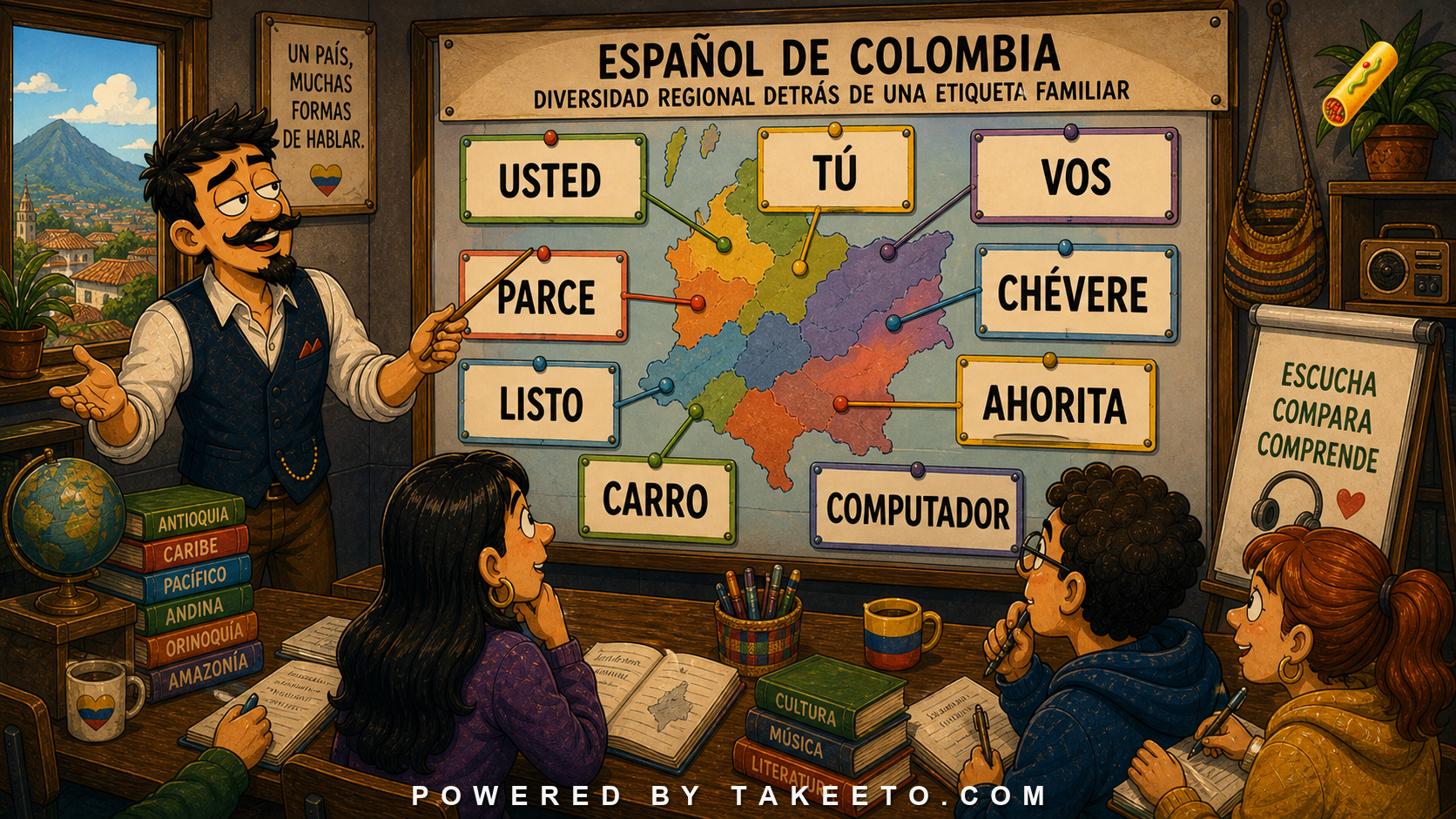
Colombian Spanish is not one “clear accent”
Colombian Spanish is often praised by learners as “clear” or “neutral.” That reputation usually reflects exposure to certain educated urban varieties, especially from Bogotá or media voices. But Colombia is not one accent. It contains highland, coastal, Paisa, Caleño, Llanero, Amazonian, Pacific, Caribbean, and many other regional patterns.
The key principle is:
Colombian Spanish is a set of regional Spanishes, not a single neutral model.
Learners can absolutely use Colombian Spanish as a target, especially if their teachers, friends, work, travel, or media exposure are Colombian. But they need to know which Colombian Spanish they are learning.
Bogotá and prestige
Bogotá Spanish has often been associated with formal education, careful articulation, and national prestige. Learners may hear relatively clear syllable-final consonants and careful standard forms in news, academic, and professional speech.
But Bogotá speech also has local vocabulary, intonation, address patterns, and social meanings. It is not “Spanish without accent.” It is a regional variety with high institutional visibility.
A learner who trains only on Bogotá news may still struggle with coastal Colombia, Medellín, Cali, or casual youth speech.
Caribbean coast
Colombian Caribbean Spanish shares some features with broader Caribbean speech. Learners may hear final s weakening, rapid connected speech, and coastal vocabulary or rhythm.
A speaker from Barranquilla or Cartagena may sound very different from a speaker from Bogotá. This difference is not a difference in correctness. It is regional identity.
Learner action: do not expect all Colombian speech to match the “clear Bogotá” stereotype.
Paisa Spanish
The Paisa region, associated with Medellín and Antioquia, is famous for distinctive intonation, vocabulary, and address patterns. Learners may hear vos, usted, or tú depending on speaker and context.
Words such as parce may appear in colloquial speech:
¿Qué más, parce?
What’s up, man/friend?
As always, recognition should come before production. Parce can sound natural among peers and artificial or inappropriate if used without social footing.
Cali and voseo
In Cali and parts of southwestern Colombia, voseo may be present in informal speech.
Vos sabés.
You know.
But Colombian address systems are complex. Tú, vos, and usted can coexist and shift by intimacy, region, class, gender, age, and moment in the relationship.
Learners should not assume one pronoun equals one emotion. Usted may be respectful, distant, affectionate, routine, intimate, or even used in flirting or family contexts depending on region and speaker.
Usted, tú, and vos
Colombian Spanish is one of the best examples of why address pronouns cannot be reduced to “formal versus informal.”
In some regions and relationships, usted is common even among people who are close. In other contexts, tú may sound friendly, elegant, flirtatious, urban, or ordinary. Vos may mark regional identity and familiarity in certain areas.
A learner should listen before choosing.
Safe strategy:
- Use usted in formal service, professional, older-person, or uncertain situations.
- Mirror the other person carefully when invited.
- Recognize vos and tú even if you produce one more than the others.
- Do not overinterpret a Colombian speaker’s usted as cold.
Chévere, listo, and conversational markers
Several words are useful across Colombian contexts.
chévere
cool, nice, great
listo
okay, ready, done, understood
ahorita
now, soon, in a moment, recently depending on context
carro
car
computador
computer, common in Colombia
Listo is especially important. It can close a transaction, confirm understanding, or mean “okay.”
Listo, muchas gracias.
Okay, thank you very much.
Learners who translate listo only as “ready” will miss a lot of Colombian interactional rhythm.
Media stereotypes and national reality
Foreign learners may encounter Colombian Spanish through music, telenovelas, narco dramas, comedy, football, or news. These media sources do not represent the whole country. Some dramatized accents are stylized. Some slang is character-specific. Some vocabulary is linked to crime genres and should not be imitated.
A serious learner should diversify sources: news, interviews, podcasts, regional YouTube channels, lectures, service interactions, and conversations.
Example bank walkthrough
usted
Can mark respect, distance, routine politeness, or intimacy depending on region and relation.
Learner action: do not assume it is always formal and cold.
tú
Used in many contexts, but its social meaning varies.
Learner action: observe local norms before defaulting.
vos
Present in parts of Colombia, especially in regional informal systems.
Learner action: recognize forms like vos sabés.
parce
Colloquial friend/address term.
Learner action: recognize it; use only with appropriate social permission.
chévere
Widely understood positive adjective.
Learner action: useful but still informal.
listo
Ready, done, okay, understood.
Learner action: learn it as an interactional closure marker.
ahorita
Elastic time word.
Learner action: interpret by context.
carro
Car.
Learner action: contrast with coche and auto in other regions.
computador
Computer, common Colombian form.
Learner action: recognize alongside computadora and ordenador.
Remediation notes: Colombian address systems and the "clear Spanish" trap
The original article challenges the myth of one clear Colombian accent. The upgrade is to make address systems the center of the learner problem. Colombian Spanish is one of the clearest cases where tú, vos, and usted cannot be reduced to a single formality ladder.
A learner may hear:
¿Usted ya comió? from a close family member.
Tú sabes in urban, friendly, romantic, or media contexts.
Vos sabés in regional informal speech.
Su merced in specific regional or traditional contexts.
None of these can be interpreted from grammar alone. The relationship, region, tone, age, class, and moment matter.
The practical repair is to train three habits:
- Do not overreact to usted. It may be respectful, affectionate, habitual, serious, or distant.
- Do not force tú as "friendly." In some contexts it may sound nonlocal, flirtatious, childish, or too familiar.
- Recognize vos without assuming Argentina. Colombian voseo exists in regional systems, especially in places such as the southwest and other local contexts.
The vocabulary section also needs production labels. Chévere is broadly useful but still informal. Listo is extremely important because it works as "ready," "okay," "done," "understood," or a transaction closer. Parce is highly socially loaded. It can be friendly among peers and very unnatural from a learner without social footing.
Examples:
Listo, muchas gracias. = Okay / all set, thank you.
¿Listo? = Ready? / okay? / understood?
Qué pena con usted. = Sorry / excuse me / I apologize, in some Colombian contexts.
Parce = recognize first; produce later, if ever.
The media warning should be stronger. Colombian Spanish in music, narco dramas, comedy, or stylized television may amplify particular social registers. Learners who imitate those registers risk sounding unserious or offensive. Balance them with interviews, news, lectures, ordinary service interactions, workplace content, and regional videos.
A good Colombian learning map has at least four columns:
Bogotá/highland formal: often accessible to learners, but still local.
Caribbean coast: final-consonant weakening and coastal rhythm.
Paisa: distinctive intonation and address patterns.
Southwest/Cali and other regions: voseo and local vocabulary in specific systems.
Production rule:
Start politely, listen closely, and mirror only after you understand the relationship.
That is more reliable than memorizing that usted = formal and tú = friendly.
Suggested interactive module: Colombian address-pronoun map
A useful tool for this article would center address systems.
Suggested functions:
- Region map: Bogotá, Caribbean coast, Paisa, Cali, Pacific, Llanos.
- Pronoun scenarios: usted, tú, vos by relationship and setting.
- Audio samples: formal Bogotá, coastal speech, Paisa intonation, Caleño voseo.
- Vocabulary cards: parce, chévere, listo, carro, computador.
- Register labels: safe, colloquial, youth, professional, regional.
- Interaction simulator: choose a pronoun and get social feedback.
- Media filter: news versus drama versus street interviews.
Final rule
Colombian Spanish is not one clear neutral accent.
It is a rich set of regional systems. Learn Bogotá prestige speech if useful, but also train for coastal, Paisa, Caleño, and other varieties. Pay special attention to usted, tú, and vos, because address is where Colombian Spanish teaches the biggest lesson: pronouns carry relationships, not dictionary labels.