
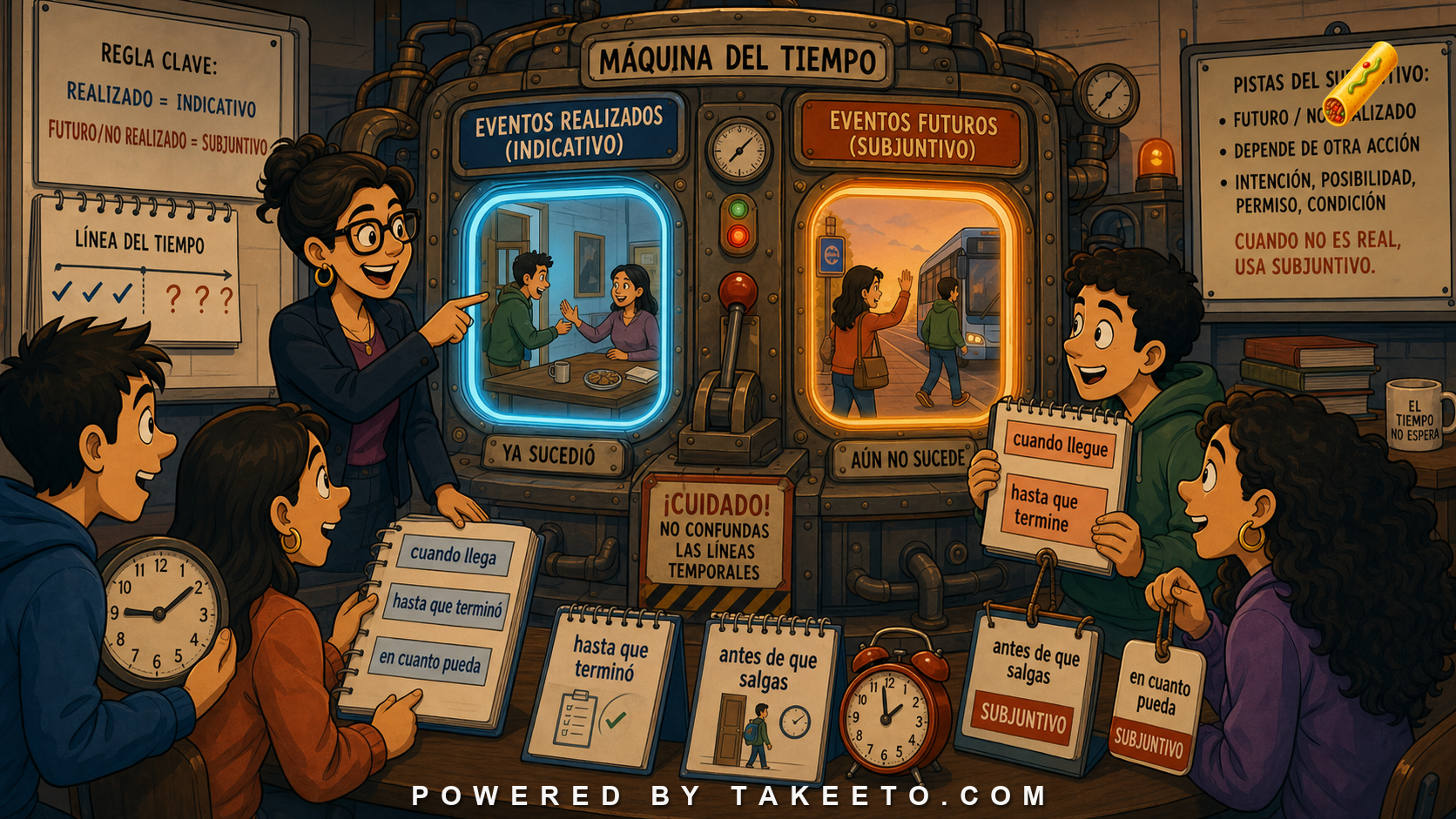
Spanish time clauses care whether the event has happened
English says:
When I arrive, I will call you.
The verb “arrive” is present in form, but future in meaning. Spanish does not copy that surface pattern. Spanish asks whether the event in the time clause is already realized, habitual, or still pending.
Compare:
Cuando llega, siempre llama.
When he arrives, he always calls.
Cuando llegue, te llamará.
When he arrives, he will call you.
The first sentence describes a habitual pattern. The arriving is part of a repeated or known reality. The second sentence points to a future arrival that has not happened yet. Spanish uses the subjunctive.
The key principle is:
Temporal clauses use the indicative for realized, factual, or habitual events and the subjunctive for future events that have not yet occurred.
This is one of the most important practical uses of the subjunctive in Spanish.
Realized time: indicative
Use the indicative when the temporal clause refers to an event that is already real, completed, repeated, or presented as factual.
Cuando llegó, todos aplaudieron.
When she arrived, everyone applauded.
The arrival happened.
Cuando llega a casa, se quita los zapatos.
When he gets home, he takes off his shoes.
This is a habitual pattern.
Hasta que terminó el examen, nadie salió.
Until the exam ended, nobody left.
The exam ended. The event is realized.
Indicative time clauses often appear in narrative, description, habit, biography, and general routines.
Future time: subjunctive
Use the subjunctive when the temporal clause refers to a future event that has not happened yet.
Cuando llegue, te aviso.
When I arrive, I will let you know.
Hasta que termine, no podemos irnos.
Until it ends, we cannot leave.
En cuanto pueda, te llamo.
As soon as I can, I will call you.
The event is expected, but not yet realized. Spanish marks that pending status with the subjunctive.
This does not mean the event is doubtful in a strong sense. It may be very likely. The subjunctive is not saying “maybe.” It is saying “not yet actual in the timeline.”
The main temporal connectors
The same realized-versus-future logic applies to many time expressions.
cuando
Cuando tengo tiempo, leo.
When I have time, I read.
Cuando tenga tiempo, leeré.
When I have time, I will read.
hasta que
Esperé hasta que llegó.
I waited until he arrived.
Esperaré hasta que llegue.
I will wait until he arrives.
en cuanto / tan pronto como
En cuanto lo vio, sonrió.
As soon as she saw him, she smiled.
En cuanto lo vea, sonreirá.
As soon as she sees him, she will smile.
después de que
Después de que terminó la reunión, salimos.
After the meeting ended, we left.
Después de que termine la reunión, saldremos.
After the meeting ends, we will leave.
antes de que
Antes de que normally points to something not yet realized from the perspective of the main action, so it commonly takes the subjunctive.
Salimos antes de que empezara la lluvia.
We left before the rain started.
Salgamos antes de que empiece la lluvia.
Let’s leave before the rain starts.
Even in past narration, the event after antes de que is future relative to the leaving.
English present tense hides future meaning
English commonly uses the present tense after “when,” “until,” and “as soon as” even when the meaning is future.
I will call you when I arrive.
A learner may want to translate:
Te llamaré cuando llego.
That is not the standard pattern. Spanish normally says:
Te llamaré cuando llegue.
The mistake comes from copying English verb form instead of Spanish event status.
Do not ask: “Does English use present?”
Ask:
Has the event in the time clause happened yet from the speaker’s point of view?
If not, Spanish usually wants the subjunctive.
Habitual future-looking clauses can be tricky
Sometimes a sentence has a general meaning, not a specific future event.
Cuando una persona llega tarde, debe avisar.
When a person arrives late, they should notify someone.
This is a general rule. The indicative is natural because it describes a repeated or generic situation.
But if the sentence refers to a pending future case:
Cuando llegue Marta, dile que me llame.
When Marta arrives, tell her to call me.
The specific arrival has not happened yet, so use the subjunctive.
Hasta que: completed boundary versus pending boundary
Hasta que is especially useful for seeing the timeline.
No salimos hasta que terminó la clase.
We did not leave until class ended.
The boundary event happened.
No saldremos hasta que termine la clase.
We will not leave until class ends.
The boundary event is pending.
No salgas hasta que te avise.
Do not leave until I let you know.
The notification has not yet occurred.
En cuanto and urgency
En cuanto and tan pronto como often introduce a future trigger.
En cuanto pueda, lo haré.
As soon as I can, I will do it.
Tan pronto como lleguen, empezamos.
As soon as they arrive, we will begin.
The subjunctive does not make the sentence uncertain. It marks the trigger as not yet realized.
The reference point can move
The usual beginner rule says: future time clause, use the subjunctive. That is useful, but the deeper rule is about the reference point. The event may be future relative to now, or future relative to a past moment inside the story.
Compare:
Te llamé cuando llegué.
I called you when I arrived.
Both actions are completed from the speaker’s present viewpoint, so llegué is indicative.
Te dije que te llamaría cuando llegara.
I told you I would call you when I arrived.
Here the arrival was future from the point of te dije. Even though the whole report may now be in the past, the temporal clause is pending inside that earlier viewpoint, so Spanish uses llegara.
The same logic appears after hasta que:
Esperé hasta que terminó.
I waited until it ended.
The endpoint happened.
Dije que esperaría hasta que terminara.
I said I would wait until it ended.
The endpoint was pending from the viewpoint of the statement.
This also explains antes de que. The event after antes de que is normally later than the main event from that local viewpoint:
Salimos antes de que empezara la tormenta.
We left before the storm started.
This sentence does not necessarily mean the storm never started. It means that at the moment of leaving, the starting of the storm had not yet occurred. Spanish marks that relative non-realization with the subjunctive.
Example bank walkthrough
cuando llega
Indicative: habitual or factual arrival.
Learner action: use this for routines or known events.
cuando llegue
Subjunctive: pending future arrival.
Learner action: use this after a future, command, intention, or plan.
hasta que terminó
Indicative: the endpoint happened.
Learner action: use in past narration or factual description.
hasta que termine
Subjunctive: the endpoint has not happened yet.
Learner action: use with future, command, prohibition, or waiting.
en cuanto pueda
Subjunctive: future ability is pending.
Learner action: learn as a common polite promise formula.
antes de que salgas
Subjunctive: the leaving is future relative to the main action.
Learner action: expect subjunctive after antes de que.
Decision routine
For temporal clauses, ask:
- Is the event already completed?
- Is it habitual or repeated?
- Is it a general truth?
- Is it future and not yet realized?
- Is it future relative to another past event?
- Does the main clause contain a plan, command, intention, future, or prohibition?
Realized or habitual: indicative. Pending future: subjunctive.
Suggested interactive module: temporal-clause timeline
A strong tool for this article would show a main event and a subordinate time event on a timeline.
Suggested functions:
- Event status toggle: realized, habitual, pending.
- Connector selector: cuando, hasta que, en cuanto, tan pronto como, antes de que, después de que.
- Main-clause mode: past narrative, present habit, future plan, command.
- Mood prediction: indicative or subjunctive.
- English trap warning: present tense in English does not mean indicative in Spanish.
- Practice timeline: drag the event before or after “now.”
- Automatic examples: cuando llega/llegue, hasta que terminó/termine.
Final rule
Spanish time clauses do not choose mood by English tense. They choose mood by event status.
Use the indicative for events that are realized, factual, habitual, or generic. Use the subjunctive for future events that are still pending.
When English says “when I arrive,” Spanish asks whether the arrival has happened yet.