
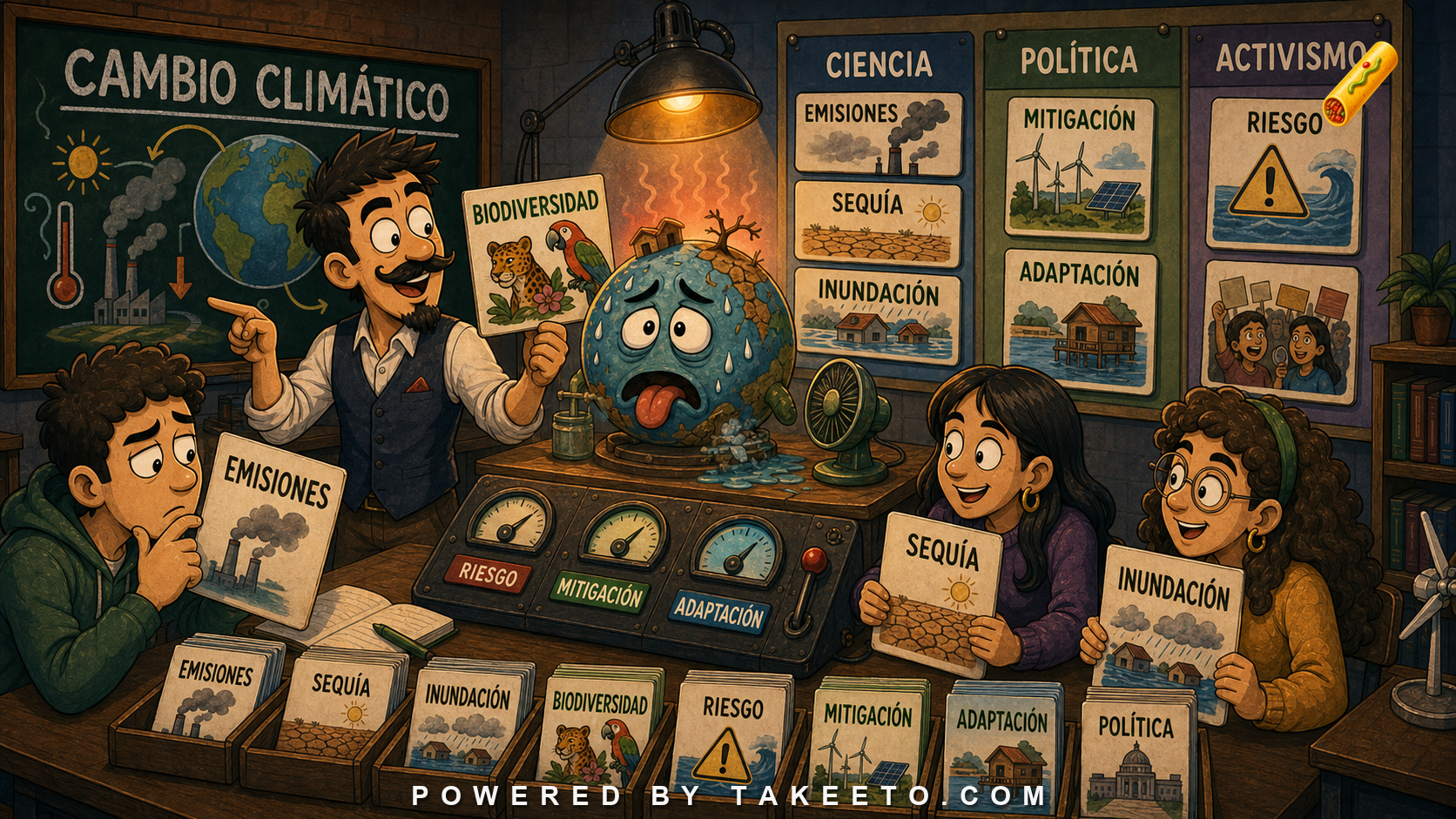
One topic, several registers
Environmental Spanish appears in research reports, government plans, news articles, NGO statements, classroom materials, protest slogans, and local warnings. The vocabulary overlaps, but the register changes.
A scientific report may say:
Las proyecciones indican un aumento en la frecuencia de eventos extremos.
A government plan may say:
Se implementarán medidas de adaptación y mitigación.
An activist banner may say:
No hay planeta B.
All three are environmental Spanish. They do different jobs.
The key principle is:
Environmental Spanish must be read by register: science estimates, policy commits or avoids committing, activism mobilizes.
Climate, weather, and risk
Important terms:
clima
tiempo
cambio climático
calentamiento global
fenómeno meteorológico
evento extremo
riesgo
vulnerabilidad
exposición
resiliencia
Clima refers to long-term climate patterns. Tiempo refers to weather, though learners may see estado del tiempo or pronóstico for forecasts. Riesgo is not only danger; in policy and disaster language it often combines hazard, exposure, and vulnerability.
Las comunidades costeras presentan mayor vulnerabilidad ante inundaciones.
This sentence is not only about water. It also frames social exposure and capacity.
Emissions, mitigation, adaptation
Core climate-policy terms:
emisiones
gases de efecto invernadero
carbono
huella de carbono
mitigación
adaptación
transición energética
neutralidad climática
Mitigación means reducing causes of climate change, especially emissions. Adaptación means adjusting systems to climate impacts already happening or expected.
La mitigación busca reducir las emisiones.
La adaptación busca reducir la vulnerabilidad frente a los impactos.
Learners should not merge these. They are related but distinct pillars of climate language.
Drought, floods, fires, biodiversity
Environmental Spanish is often local and physical:
sequía
inundación
incendio forestal
deforestación
pérdida de biodiversidad
contaminación
escasez de agua
degradación del suelo
Sequía appears in agriculture, water policy, energy, food prices, and migration discussions. Inundación appears in emergency alerts, urban planning, insurance, and disaster relief. Biodiversidad appears in conservation, tourism, indigenous land rights, and policy.
Do not treat environmental vocabulary as isolated science words. It crosses public life.
Nominalization and policy style
Government and institutional writing often uses nouns where ordinary speech would use verbs:
la reducción de emisiones
la implementación de medidas
la protección de ecosistemas
el fortalecimiento de la resiliencia
la gestión integral del riesgo
Nominalizations let policy documents sound serious, but they can hide actors.
Se promoverá la conservación de los recursos hídricos.
Who will promote it? How? With what budget? By when? Formal Spanish may not answer immediately.
Source and uncertainty language
Environmental claims often use uncertainty carefully:
según el informe
las proyecciones indican
se prevé
podría aumentar
existe evidencia de
los modelos sugieren
con alto grado de incertidumbre
The word proyección is important. It is not the same as a direct observation. A projection depends on assumptions, models, and scenarios.
Se prevé un aumento de las temperaturas máximas.
This is forecast-like or projection language. It needs source, period, and scenario.
Activist and political register
Activist environmental Spanish tends to compress moral urgency:
justicia climática
defensa del territorio
crisis climática
extractivismo
transición justa
derechos de la naturaleza
el agua vale más que el oro
This language is not neutral policy phrasing. It frames environmental issues as justice, power, and survival. A learner should read it as public argument, not as a technical glossary.
The same term can shift by speaker. Transición energética may sound technocratic in a ministry report and political in a labor or indigenous-rights statement.
Example bank walkthrough
Cambio climático: broad climate change. Ask whether the text discusses causes, impacts, policy, or activism.
Emisiones: releases of gases or pollutants. Ask which gases and from what sector.
Sequía: drought. Ask whether the register is weather, agriculture, water policy, or emergency.
Inundación: flood. Watch for disaster, infrastructure, insurance, and planning contexts.
Biodiversidad: biological diversity. Often tied to conservation and land use.
Riesgo: risk. Ask what hazard, exposure, and vulnerability are involved.
Mitigación: reducing causes.
Adaptación: reducing harm from impacts.
Environmental reading workflow
- Identify the register: science, policy, journalism, activism, emergency.
- Separate weather from climate.
- Mark cause language and impact language.
- Distinguish mitigation from adaptation.
- Identify actors: government, company, community, scientists, activists.
- Find source and uncertainty markers.
- Watch nominalizations that hide responsibility.
- Translate slogans by function, not word-by-word.
- Note regional environmental issues.
- Summarize the text’s stance.
Before/after revision drill
Weak reading:
The government will fight climate change.
Source Spanish:
El plan contempla medidas de mitigación y adaptación, con énfasis en la gestión del riesgo en zonas costeras.
Better reading:
The plan includes measures to reduce emissions and to prepare for climate impacts, especially risk management in coastal areas.
The better reading unpacks mitigación, adaptación, and gestión del riesgo. It also avoids making the plan sound more decisive than contempla allows. Policy verbs matter.
Remediation: distinguish science, policy, activism, and public warning
Environmental Spanish often uses the same nouns across different registers, but the communicative purpose changes. Riesgo, emisiones, sequía, biodiversidad, mitigación, and adaptación may appear in scientific reports, government plans, activist statements, news articles, classroom materials, and emergency notices. The same word does not do the same job in every document.
Scientific register asks:
What is happening, according to what evidence, and with what uncertainty?
Policy register asks:
What measures will institutions adopt, fund, regulate, or evaluate?
Activist register asks:
Who is responsible, who is harmed, and what action is demanded?
Emergency register asks:
What should the public do now?
A learner who treats all environmental Spanish as “climate vocabulary” misses these differences. In one text, riesgo is a modeled probability. In another, it is a legal basis for restriction. In another, it is a moral argument. In another, it is an instruction to evacuate or avoid exposure.
Mini-workshop: one topic, four registers
Topic: flooding.
Scientific:
Los modelos proyectan un aumento en la frecuencia de inundaciones costeras bajo escenarios de altas emisiones.
Policy:
El plan municipal contempla obras de drenaje, actualización de mapas de riesgo y restricciones de construcción en zonas inundables.
Activist:
Las comunidades afectadas exigen medidas urgentes y denuncian la falta de inversión en infraestructura básica.
Emergency notice:
Evite cruzar calles inundadas y siga las indicaciones de las autoridades locales.
All four texts involve inundación, but the grammar and stance differ. The scientific sentence uses modelos, proyectan, frecuencia, and escenarios. The policy sentence uses plan, contempla, obras, mapas, and restricciones. The activist sentence uses exigen and denuncian. The emergency notice uses imperatives and public-safety instructions.
A good translation does not force them into the same tone.
Mitigación and adaptación
Two key environmental terms are often confused:
mitigación = reducing the causes or severity of climate change, especially emissions.
adaptación = adjusting systems and communities to effects that are already happening or expected.
Examples:
Reducir las emisiones del transporte público es una medida de mitigación.
Elevar viviendas en zonas inundables puede ser una medida de adaptación.
Some policies combine both. A city may electrify buses to reduce emissions and redesign drainage to handle heavier rainfall. A learner should not translate adaptación as vague “adaptation” without identifying what is adapting to what.
Before/after: repairing vague environmental prose
Weak:
El cambio climático afecta mucho al campo y el gobierno debe hacer algo.
Stronger:
La sequía prolongada redujo el rendimiento de los cultivos de temporal, por lo que las asociaciones de productores pidieron apoyo técnico, inversión en riego y medidas de adaptación climática.
The stronger sentence identifies the hazard, the affected system, the consequence, the actor, and the requested measures. It also avoids using cambio climático as a catch-all explanation when the immediate issue is drought and crop yield.
Uncertainty is not denial
Environmental Spanish often uses cautious language:
podría aumentar
se prevé
es probable que
según los escenarios
con distintos grados de incertidumbre
Learners sometimes read this as weakness. In serious scientific and policy writing, uncertainty language is part of accuracy. A forecast can be uncertain and still actionable. A risk can be probabilistic and still serious.
The reader’s task is to identify the type of uncertainty: timing, location, intensity, attribution, economic effect, or policy outcome. Do not collapse all uncertainty into “maybe.”
Environmental reading checklist
For each passage, mark:
- Hazard or pressure: sequía, inundación, calor, contaminación, pérdida de biodiversidad.
- Affected system: salud, agricultura, vivienda, agua, energía, ecosistema.
- Actor: gobierno, empresa, comunidad, científicos, movimientos sociales.
- Register: science, policy, activism, emergency, journalism.
- Action: medir, regular, exigir, reducir, financiar, evacuar, prevenir.
Environmental Spanish is a map of evidence, risk, responsibility, and action. Vocabulary alone is not enough.
Suggested interactive module: environmental register comparison table
A useful tool would show the same topic across registers.
Suggested functions:
- Register selector: scientific, policy, news, activist, emergency.
- Term cards: mitigación, adaptación, riesgo, resiliencia.
- Actor highlighter: who is responsible or affected?
- Uncertainty labels: projection, observation, estimate, warning.
- Plain-language rewrite: dense policy to accessible explanation.
Mini-workshop: one environmental issue in three registers
Use sequía as the test word.
Scientific register:
Las proyecciones indican un aumento en la frecuencia de sequías prolongadas.
Policy register:
El municipio implementará medidas de adaptación ante la sequía.
Activist register:
Sin agua no hay futuro: exigimos justicia hídrica.
All three discuss drought, but they do different things. The scientific sentence frames evidence and projection. The policy sentence frames institutional action. The activist sentence frames urgency and justice.
A learner who translates only vocabulary misses the rhetorical work. Ask what the sentence is trying to do: estimate, regulate, persuade, warn, mobilize, or allocate responsibility.
Common learner mistakes
One mistake is treating mitigación and adaptación as synonyms. They are not. Mitigation reduces causes, especially emissions. Adaptation reduces vulnerability to impacts. Another mistake is translating riesgo only as danger. In environmental policy, risk often combines hazard, exposure, vulnerability, and capacity.
Finally, be careful with nominalizations such as la gestión integral del riesgo or la implementación de medidas. They sound authoritative, but they may hide who must act. When a text says se promoverá, ask who will promote, fund, enforce, or measure the action.
Applied reading drill: identify the register before judging the claim
Use the same environmental topic across three registers:
Los modelos proyectan un aumento de la temperatura media.
El plan establece medidas de adaptación para zonas vulnerables.
Exigimos justicia climática para las comunidades afectadas.
The first sentence is scientific. It uses modelos, proyectan, and temperatura media. The second is policy language. It uses plan, medidas, adaptación, and zonas vulnerables. The third is activist language. It uses exigimos, justicia climática, and comunidades afectadas.
None of these is automatically better or worse. They perform different jobs. Scientific Spanish describes and qualifies. Policy Spanish organizes action through institutions. Activist Spanish mobilizes responsibility and urgency. A learner who calls the activist sentence “less objective” may miss its purpose. A learner who reads the policy sentence as already solved may miss the gap between plan and implementation.
Before translating or evaluating environmental Spanish, label the register. Then ask whether the language is making a measurement claim, assigning an obligation, warning the public, selling an image, or demanding change.
Final rule
Environmental Spanish is not one vocabulary list. It is a meeting point of science, public policy, risk communication, and activism. Read the register first, then the words.