
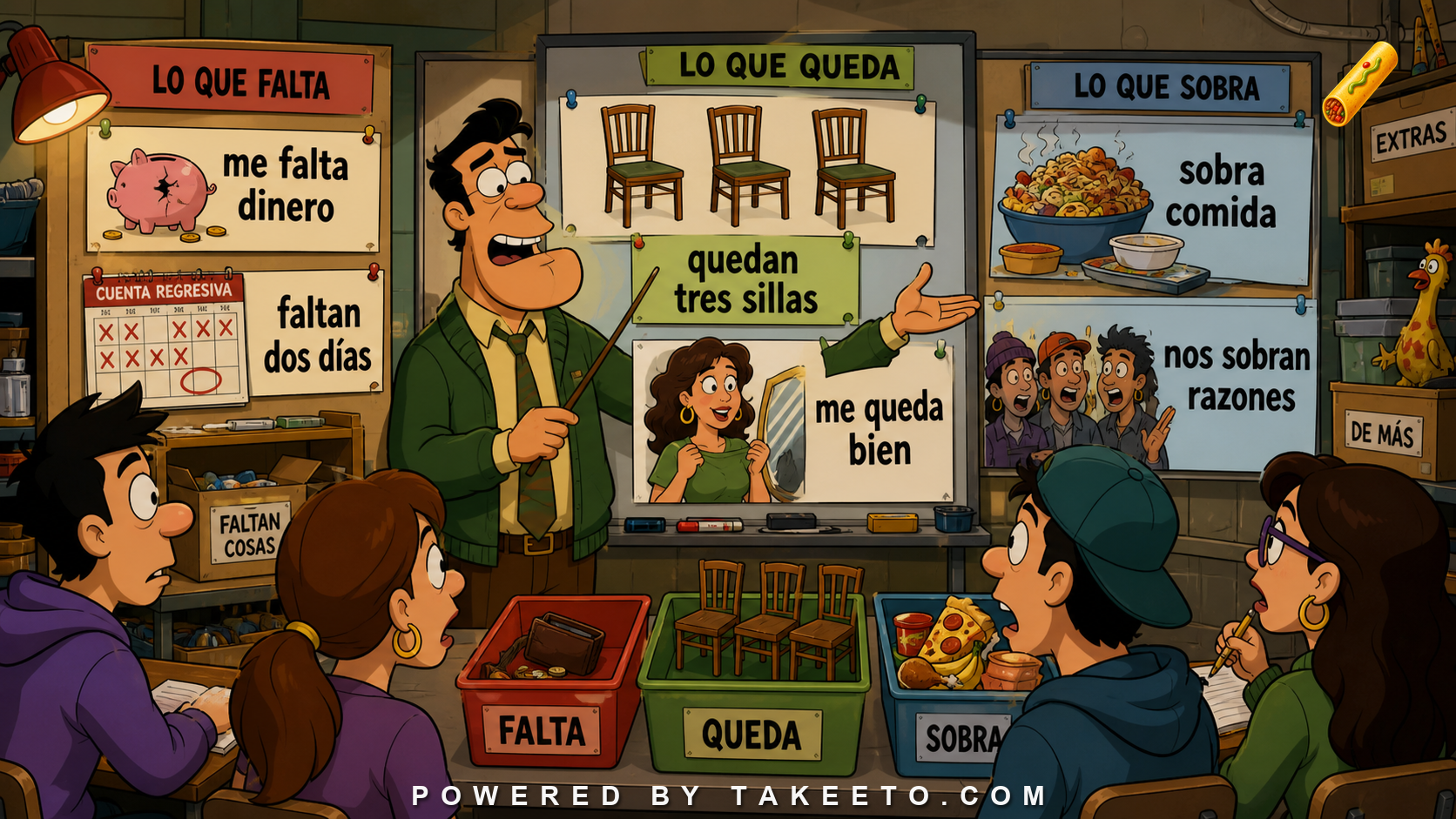
Spanish often starts with the quantity, not the owner
English says:
I need money.
We have three chairs left.
There is food left over.
I have two days left.
Spanish often frames these situations with verbs whose subject is the thing lacking, remaining, or exceeding:
Me falta dinero.
I lack money / I need money.
Quedan tres sillas.
Three chairs remain.
Sobra comida.
There is food left over.
Me quedan dos días.
I have two days left.
The learner problem is predictable: English makes the person the subject; Spanish often makes the quantity or item the subject.
The durable rule is:
With faltar, quedar, and sobrar, track the thing that is missing, remaining, or extra. That thing often controls the verb.
Faltar: lacking or remaining to completion
Faltar means that something is missing, lacking, absent, or still needed before completion.
Me falta dinero.
I lack money / I need money.
Falta una página.
One page is missing.
Faltan dos estudiantes.
Two students are absent/missing.
Faltan tres días para el examen.
There are three days left until the exam.
The verb agrees with what is missing or remaining:
| Thing missing/remaining | Verb | Sentence |
|---|---|---|
| dinero | falta | Me falta dinero. |
| una página | falta | Falta una página. |
| dos estudiantes | faltan | Faltan dos estudiantes. |
| tres días | faltan | Faltan tres días. |
When a person is affected, Spanish often marks that person with an indirect object pronoun:
Nos falta tiempo.
We do not have enough time.
Te falta práctica.
You need practice.
Les faltan recursos.
They lack resources.
The person is not the subject. The missing thing is.
Faltar is not always “to need”
Because me falta dinero can be translated “I need money,” learners sometimes equate faltar with necesitar. They overlap, but they are not identical.
Necesito dinero.
I need money.
This makes I the subject and presents need directly.
Me falta dinero.
Money is lacking to me / I am short of money.
This presents a gap in what I have or require.
The faltar version is especially natural for missing pieces, remaining time, shortages, and incomplete sets:
Falta una firma.
A signature is missing.
Me faltan dos capítulos.
I have two chapters left.
No falta nada.
Nothing is missing.
Quedar: remain, be left, fit, arrange
Quedar is a high-frequency verb with several related meanings. Its central idea is a resulting position, remainder, or settled state.
Remaining or being left
Quedan tres sillas.
Three chairs remain / are left.
No queda café.
There is no coffee left.
Me quedan dos euros.
I have two euros left.
Again, the thing remaining controls agreement:
Me queda un euro.
Me quedan dos euros.
Fitting or suiting
La camisa me queda bien.
The shirt fits/suits me well.
Esos zapatos te quedan grandes.
Those shoes are too big on you.
The clothing item is the subject; the person is an indirect object.
| Subject | Indirect object | Sentence |
|---|---|---|
| la camisa | me | La camisa me queda bien. |
| los zapatos | te | Los zapatos te quedan grandes. |
| ese color | le | Ese color le queda bien. |
Arranging to meet
Quedamos a las ocho.
We agreed to meet at eight.
Quedé con Ana en el café.
I arranged to meet Ana at the café.
This use is different from quedarse, “to stay.”
Me quedo aquí.
I am staying here.
Do not collapse quedar and quedarse into one English word.
Sobrar: surplus or excess
Sobrar means that something is extra, left over, more than needed, or excessive.
Sobra comida.
There is food left over.
Sobran razones para actuar.
There are more than enough reasons to act.
Me sobra tiempo.
I have time to spare.
Nos sobran problemas.
We have more than enough problems.
The thing that is extra controls agreement:
Sobra una silla.
One chair is extra.
Sobran dos sillas.
Two chairs are extra.
With an indirect object, sobrar can mean that someone has more than enough of something:
A ellos les sobra dinero.
They have money to spare.
No me sobra paciencia.
I do not have patience to spare.
Faltar vs quedar vs sobrar
These three verbs form a useful semantic triangle.
| Situation | Spanish | Meaning |
|---|---|---|
| not enough | Me falta dinero. | I am short of money. |
| remaining amount | Me quedan diez euros. | I have ten euros left. |
| more than enough | Me sobra dinero. | I have money to spare. |
For time:
| Situation | Spanish | Meaning |
|---|---|---|
| time needed before event | Faltan dos días. | Two days remain until it happens. |
| time available to me | Me quedan dos días. | I have two days left. |
| excess time | Me sobra tiempo. | I have extra time. |
For objects:
| Situation | Spanish | Meaning |
|---|---|---|
| missing chair | Falta una silla. | One chair is missing. |
| chairs left | Quedan tres sillas. | Three chairs remain. |
| extra chairs | Sobran tres sillas. | Three chairs are extra. |
This framework prevents many translation errors.
Indirect objects mark affected participants
The person affected is often expressed with an indirect object pronoun:
Me falta dinero.
Te quedan dos días.
Nos sobran razones.
The pronoun answers “for whom?” or “in whose situation?”
A full a phrase can clarify:
A Marta le falta experiencia.
Marta lacks experience.
A mis padres les quedan dos años para jubilarse.
My parents have two years left before retirement.
A nosotros nos sobra comida.
We have food left over.
The a phrase and pronoun work together, as in other indirect-object predicates.
Common learner errors
Error 1: Making the person the subject of faltar
Yo falto dinero.
Better:
Me falta dinero.
Error 2: Forgetting plural agreement
Me falta dos euros.
Better:
Me faltan dos euros.
Error 3: Confusing quedar and quedarse
Quedan tres sillas.
Three chairs remain.
Me quedo aquí.
I am staying here.
The pronoun changes the verb pattern and meaning.
Error 4: Translating “fit” with caber when quedar is needed
La camisa me queda bien.
The shirt fits/suits me well.
Caber is about physical capacity: no cabe en la maleta = it does not fit in the suitcase.
Error 5: Missing the excess meaning of sobrar
Sobran razones.
This does not merely mean reasons remain. It means there are more than enough reasons.
Choosing among faltar, quedar, sobrar, necesitar, and tener
English often uses need and have left where Spanish has several choices. The Spanish choice depends on the shape of the situation.
Use necesitar when the person is the active center of need
Necesito dinero.
I need money.
This is direct, agent-like, and person-centered. It is often the simplest choice when you mean “I need X.”
Use faltar when there is a gap
Me falta dinero.
I am short of money.
This frames the situation as an absence in a set, plan, requirement, or personal sphere. It is excellent for missing ingredients, documents, signatures, skills, time, and remaining steps.
Falta una firma.
One signature is missing.
Me faltan dos cursos para graduarme.
I still need two courses to graduate.
Use quedar when there is a remainder
Me quedan dos días.
I have two days left.
Queda café.
There is coffee left.
The focus is not lack, but what remains available.
Use sobrar when there is more than needed
Sobra comida.
There is food left over.
Nos sobran motivos.
We have more than enough reasons.
Sobrar often carries a sense of excess, not mere survival.
Use tener when possession is straightforward
Tengo dos euros.
I have two euros.
Me quedan dos euros.
I have two euros left.
The second sentence implies a previous amount, a budget, a dwindling resource, or a relevant endpoint. The first simply states possession.
A good production test is this: if the sentence is about a missing piece, use faltar; if it is about what remains, use quedar; if it is about excess, use sobrar; if it is simple possession, use tener; if it is direct need, use necesitar. These verbs overlap, but they do not frame the situation the same way.
Quedar in social arrangements and result states
Quedar is not only about quantities. It also appears in social and result-state meanings that learners should separate carefully.
Arranging to meet
Quedamos a las ocho.
We agreed to meet at eight.
Quedé con Lucía en el centro.
I arranged to meet Lucía downtown.
Here quedar does not mean “remain.” It means that an arrangement was set. The preposition con marks the person you arranged to meet.
Result of an action or process
El informe quedó claro.
The report came out clear / ended up clear.
La casa quedó destruida.
The house was left destroyed.
This use presents the state resulting after an event. It is close to “end up” or “be left.”
Quedarse with states
Me quedé dormido.
I fell asleep / ended up asleep.
Se quedó callada.
She remained silent.
With quedarse, the subject enters or remains in a state. This is different from me queda bien, where clothing suits or fits me.
A good learner note should therefore separate at least four entries:
- quedar = remain/be left;
- quedar bien/mal a alguien = fit/suit someone;
- quedar con alguien = arrange to meet someone;
- quedarse = stay/remain/become fixed in a state.
This prevents the common overtranslation “quedar = stay.” It is much more flexible than that.
Micro-drill: one noun, three frames
Take one noun and place it under the three quantity-state verbs.
Falta café.
Coffee is missing / there is not enough coffee.
Queda café.
There is coffee left.
Sobra café.
There is extra coffee / more than enough coffee.
Now add a person:
Me falta café.
I am short of coffee.
Me queda café.
I have coffee left.
Me sobra café.
I have coffee to spare.
The noun stays the grammatical center, but the event frame changes. This drill is more useful than memorizing three English translations, because it trains you to see absence, remainder, and excess as different relations.
Diagnostic refinement: the noun that controls agreement is usually the quantity
The verbs faltar, quedar, and sobrar often confuse learners because English prefers to start from the person: “I need money,” “we have three chairs left,” “we have too much food.” Spanish frequently starts from the quantity or item.
Me falta dinero.
Money is lacking to me / I lack money.
Me faltan dos documentos.
Two documents are missing for me.
Quedan tres sillas.
Three chairs remain.
Nos sobra comida.
We have food left over / there is too much food for us.
The agreement follows the thing lacking, remaining, or exceeding, not the affected person:
| Item/quantity | Verb | Sentence |
|---|---|---|
| dinero | falta | Me falta dinero. |
| dos documentos | faltan | Me faltan dos documentos. |
| una hora | queda | Queda una hora. |
| tres sillas | quedan | Quedan tres sillas. |
| comida | sobra | Sobra comida. |
| razones | sobran | Nos sobran razones. |
The indirect object changes the perspective:
Falta dinero.
Money is missing.
Me falta dinero.
I am short of money.
Quedan dos entradas.
Two tickets remain.
Nos quedan dos entradas.
We have two tickets left.
Quedar adds extra meanings that need separate entries. It can mean “fit”:
La camisa me queda bien.
It can mean “arrange to meet”:
Quedamos a las ocho.
It can mean “stay/remain” in pronominal form:
Me quedé en casa.
A strong remediation table should therefore separate quantity-state meanings from social-arrangement and fit meanings. Otherwise learners flatten quedar into “remain” and then cannot parse ordinary sentences.
The practical rule: find the thing or quantity first, make the verb agree with it, then read any indirect object as the person whose situation is affected.
Suggested interactive module: quantity-state dashboard
A useful tool for this article would show a quantity bar with three zones: lacking, remaining, excess.
Suggested functions:
- Verb selector: faltar, quedar, sobrar.
- Agreement checker: singular/plural thing controls the verb.
- Affected-person marker: adds me/te/le/nos/os/les and optional a phrases.
- Contrast cards: me falta dinero / me queda dinero / me sobra dinero.
- Quedar meanings: distinguishes remain, fit/suit, arrange to meet, and quedarse.
Example input:
I have two pages left.
Output:
- Thing remaining: dos páginas.
- Person affected: me.
- Verb agrees with dos páginas: quedan.
- Result: Me quedan dos páginas.
Final rule
Faltar, quedar, and sobrar are not just vocabulary items. They organize quantity, absence, remainder, and excess around the thing involved. That thing often controls the verb: me falta una página, me faltan dos páginas, quedan tres sillas, sobran razones.
Use indirect object pronouns for the affected person, and resist the urge to force English subject patterns into Spanish. Ask what is missing, what remains, and what is extra. The verb will follow that structure.