
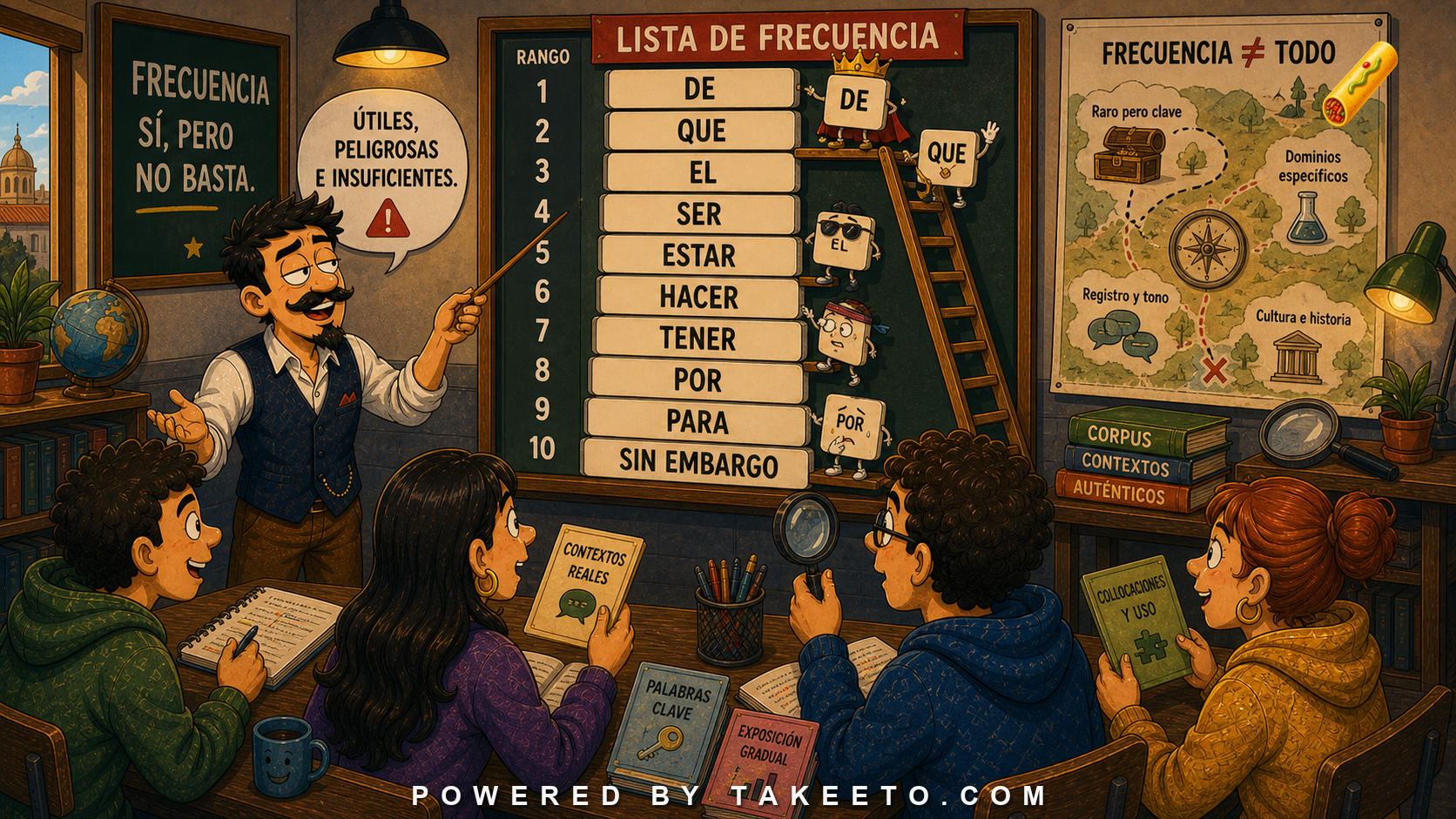
Frequency is useful, but it is not a curriculum
A Spanish frequency list can be intoxicating. If the most common words cover a huge portion of texts, why not simply memorize the top thousand words and call that learning?
Because frequency is only one kind of value.
The most frequent Spanish words include items like:
de, que, el, ser, estar, hacer, tener, por, para
These are essential. But they are also grammatically complex, semantically flexible, and impossible to master from a list alone.
A learner who memorizes de = of/from, que = that/what, por = for/by, and para = for has not learned how Spanish works. They have memorized dictionary shadows.
The key principle is:
Frequency helps prioritize exposure, but learning requires structure, phrases, grammar, domains, and use.
Token frequency and lemma frequency
A token is each occurrence of a word form in a text.
In the sentence:
El estudiante leyó el texto.
There are two tokens of el.
A lemma is the dictionary headword grouping related forms.
hablo, habla, hablaron, hablado
may be grouped under the lemma hablar.
Token frequency tells you what forms appear often. Lemma frequency tells you what underlying words are important.
Both matter. A beginner needs common forms, not only dictionary forms. Es, fue, era, soy, and ser are connected, but they do not look alike to a new learner.
Function words dominate lists
The top of a frequency list is full of function words:
de
que
el
la
en
y
a
los
se
These words are common because they build grammar. They do not behave like simple vocabulary labels.
Que can appear in relative clauses, complement clauses, comparisons, exclamations, and fixed expressions.
Creo que viene.
The person that called...
¡Qué bien!
más alto que yo
A frequency list says que is important. It does not teach its uses.
Learner action: treat high-frequency function words as grammar projects.
Dispersion matters
A word may be frequent because it appears many times in one domain, author, genre, or topic. Dispersion asks how widely a word is spread across different texts.
A medical term may be frequent in hospital documents but rare elsewhere. A legal formula may dominate contracts but not conversation. A political term may spike during an election.
A good learning target is not only frequent, but widely useful for your goals.
For a traveler, equipaje, reserva, and reembolso may be more immediately useful than a high-frequency abstract word from newspapers. For an academic reader, sin embargo, por consiguiente, and cabe señalar matter more than restaurant phrases.
Frequency must be filtered by purpose.
Domain bias changes lists
A list built from subtitles will differ from one built from newspapers, novels, academic articles, legal documents, or social media.
Subtitles may overrepresent conversation, pronouns, discourse markers, insults, and short verbs.
Newspapers may overrepresent government, public events, dates, attribution verbs, and formal nouns.
Academic corpora may overrepresent connectors, nominalizations, and discipline terms.
A general frequency list is a compromise, not a universal map.
Learner action: ask what texts the list came from before trusting it.
Phrase frequency matters
Many important units are multiword expressions.
sin embargo
nevertheless
por supuesto
of course
tener que
have to
darse cuenta
realize
a pesar de
despite
A single-word frequency list may separate these into pieces and hide the expression.
For example, sin and embargo may appear separately, but sin embargo is a discourse connector and must be learned as a unit.
Learner action: study phrase frequency, not only word frequency.
High frequency does not mean easy
Some high-frequency words are hard precisely because they are flexible.
Ser and estar are early and frequent, but their contrast takes years to refine.
Hacer appears in concrete actions, weather, time expressions, causation, and idioms.
Tener appears in possession, age, obligation, physical states, and idiomatic expressions.
Por and para are high-frequency prepositions with dense semantic networks.
A frequency list can tell you to study them early. It cannot make them easy.
Low frequency does not mean unimportant
A word may be rare in general corpora but crucial in a domain.
If you rent an apartment, fianza, avería, and arrendador matter.
If you read immigration forms, acreditar, adjuntar, and renovación matter.
If you manage health care, antecedentes, dosis, and alergia matter.
Frequency must be combined with life relevance.
Recognition and production differ
A learner may need to recognize many words before producing them. Frequency lists often push production too early.
For reading, you may want broad recognition:
vigente, solicitud, expediente, resolución
For speaking, you may need fewer but more flexible words:
necesito, quiero, puedo, tengo, hay, me gustaría
A balanced curriculum separates recognition vocabulary, production vocabulary, and domain vocabulary.
The balanced strategy
Use frequency as one filter among several:
- Frequency: how often does it appear?
- Dispersion: does it appear across domains?
- Structural value: does it teach grammar or word formation?
- Phrase value: does it belong to common expressions?
- Domain value: does it matter for your goals?
- Production value: will you need to say/write it?
- Recognition value: will you need to understand it?
- Risk value: can misreading it cause problems?
A serious learner studies high-frequency structure and goal-specific vocabulary together.
Example bank walkthrough
de
Extremely frequent preposition with possession, origin, material, partitive, complement, and phrase functions.
Learner action: study in constructions, not as one English word.
que
High-frequency connector, relative marker, complementizer, comparison element, and exclamation marker.
Learner action: collect sentence patterns.
el
Article and part of nominal grammar.
Learner action: connect to gender, number, substantivization, and proper-name usage.
ser / estar
High-frequency verbs with deep semantic and constructional differences.
Learner action: learn through contrastive sentence sets.
hacer / tener
Flexible high-frequency verbs.
Learner action: collect expressions such as hace frío, hace dos años, tener hambre, tener que.
por / para
High-frequency prepositions with complex networks.
Learner action: study by meaning domain, not translation list.
sin embargo
A multiword connector hidden by single-word lists.
Learner action: learn phrase units separately.
Remediation notes: frequency is input design, not a moral ranking of words
Frequency-list articles often accidentally teach learners to worship lists. The remediation pass should push back: frequency is useful, but it is not a moral ranking of words, nor a complete curriculum. High-frequency words matter because they appear often, but their usefulness depends on dispersion, phrase behavior, grammatical load, and learner goals.
De, que, el, ser, estar, hacer, tener, por, and para dominate lists because Spanish uses them constantly. But seeing them often does not mean they are easy. In fact, many of the highest-frequency words are structurally complex. Que can be complementizer, relative marker, comparative element, exclamative element, or part of fixed expressions. Se is even more complex. Frequency should tell the learner to keep returning to these words over time, not to “finish” them in week one.
Dispersion is the repair concept. A word that appears moderately often across many genres may be more generally useful than a word that appears extremely often in one narrow domain. Fiscal may be frequent in political/legal news; receta may be frequent in cooking and medical contexts with different meanings. Domain frequency is not general frequency.
Phrase frequency also matters. The learner does not only need sin, embargo, tener, cuenta, a, pesar, de as individual words. They need sin embargo, tener en cuenta, and a pesar de as units. Frequency lists that separate words can hide the real building blocks of fluent reading.
A balanced strategy:
- Use high-frequency lists for early recognition.
- Add phrase lists and collocations.
- Filter by your domain: travel, school, medicine, work, literature, heritage literacy.
- Prioritize structurally powerful words even when they are hard.
- Keep a “low-frequency but personally essential” list.
Examples of personally essential low-frequency vocabulary: a medical condition, a job title, a legal status, a child's school term, a regional food, a family relationship, an immigration document. The frequency list may not care. Your life does.
Repair rule:
Frequency tells you what the corpus saw often. Curriculum design decides what you should learn next.
Suggested interactive module: frequency list explorer
A strong tool for this article would show frequency as evidence, not commandment.
Suggested functions:
- Token/lemma toggle: show raw forms and grouped headwords.
- Dispersion score: across genres, countries, and documents.
- Domain filters: news, conversation, academic, legal, medical, travel.
- Phrase detector: highlight common multiword units.
- Difficulty overlay: grammar complexity, irregular forms, polysemy.
- Learner-goal mode: travel, reading, work, school, heritage literacy.
- Production/recognition tags: what to say vs what to understand.
Final rule
Frequency lists are useful maps, not marching orders.
Use them to prioritize exposure, but do not confuse frequency with mastery, ease, or relevance. High-frequency words need grammar. Low-frequency words may be essential in your domain. Multiword expressions deserve their own place.
Learn Spanish by frequency, structure, and purpose together.