
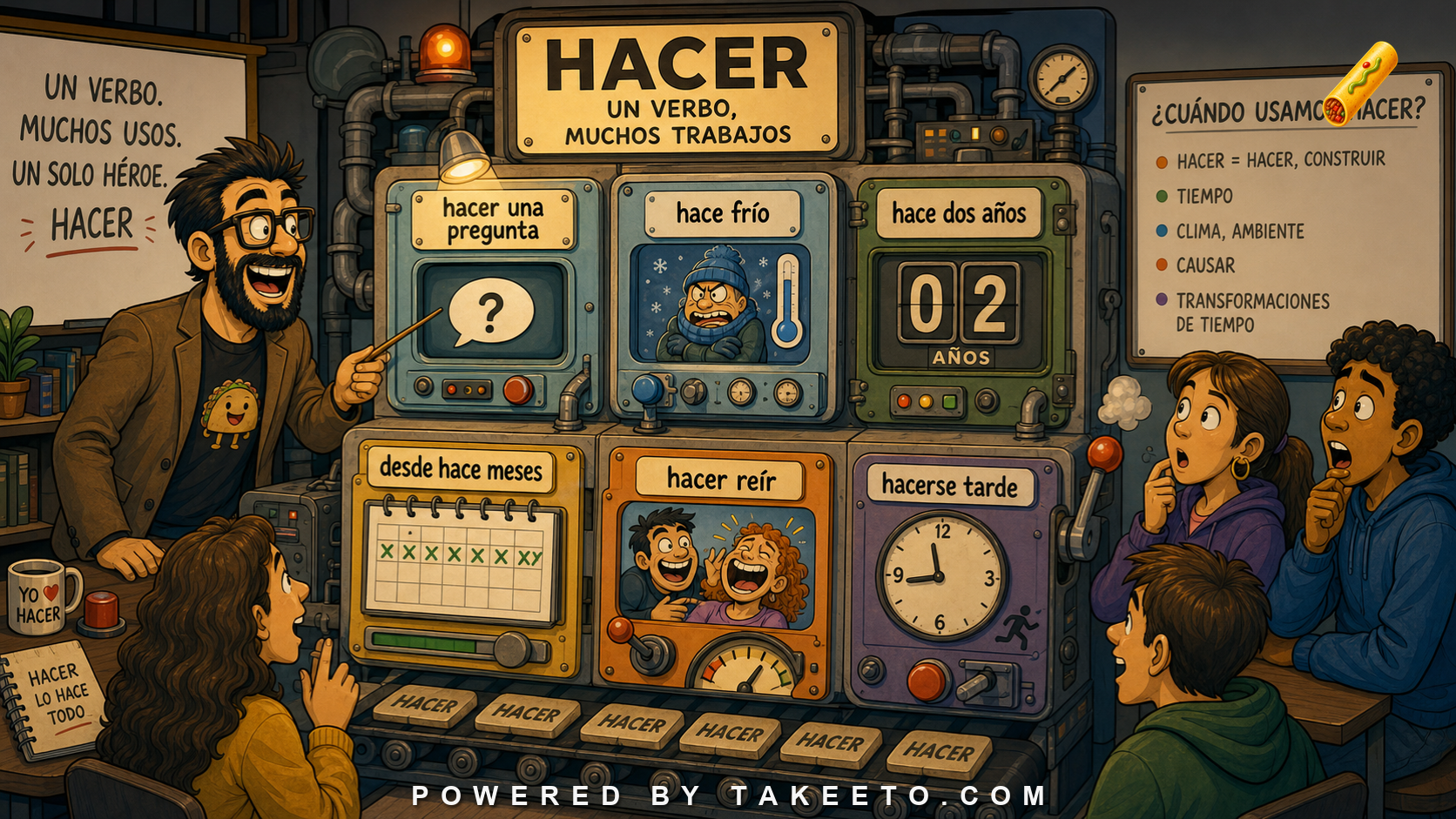
Hacer is not one English verb
Many learners first meet hacer as “to do” or “to make.” That is useful at the beginning, but it soon becomes too small. Spanish uses hacer in concrete action, routine activity, time measurement, weather, causation, social formulas, and pronominal change.
Compare:
Hice una pregunta.
I asked a question.
Hace frío.
It is cold.
Vivo aquí desde hace dos años.
I have lived here for two years.
La película me hizo llorar.
The movie made me cry.
Se hizo tarde.
It got late.
English uses different verbs: ask, be, have lived, make, get. Spanish is not translating one English word. It is using a broad verb of production, occurrence, elapsed time, and caused result.
The key principle is:
Hacer packages something as produced, carried out, elapsed, occurring in the environment, or caused to happen.
Once learners stop treating hacer as only “do/make,” its many uses become much less random.
Concrete hacer: do and make
At the center is the basic meaning of doing or making.
Hice la tarea.
I did the homework.
Hicieron una casa pequeña.
They built/made a small house.
¿Qué haces?
What are you doing?
This use is broad. Hacer can mean performing an action, preparing something, completing a task, producing an object, or creating a result.
Common combinations include:
hacer ejercicio
to exercise
hacer la comida
to make the meal
hacer un trabajo
to do an assignment/job
hacer un plan
to make a plan
hacer una lista
to make a list
The noun often tells you the real action. Hacer una lista is not “do a list” in English; it is “make a list.” Hacer ejercicio is not “make exercise”; it is “exercise.” Spanish learners should store these as verb-noun packages.
Hacer as a light verb
A light verb carries little independent meaning and lets the noun carry the main event. Hacer often works this way.
hacer una pregunta
to ask a question
hacer una visita
to visit, pay a visit
hacer una llamada
to make a call
hacer una pausa
to pause, take a break
hacer una promesa
to make a promise
These are not mistakes or weak Spanish. They are normal event packaging. Sometimes Spanish has a single verb too:
preguntar
to ask
visitar
to visit
llamar
to call
The choice changes register and rhythm. Hacer una pregunta can focus on the event “a question” as something inserted into a conversation. Preguntar is more compact. Both are natural.
Learners should not try to replace every light-verb expression with a single verb. Spanish often likes noun-centered event phrases, especially in formal, institutional, and explanatory writing.
Hace + time: elapsed time
One of the most important nonliteral uses is elapsed time.
Hace dos años llegué a Madrid.
I arrived in Madrid two years ago.
Here hace dos años means “two years ago.” It measures backward from the present or from a reference point.
With present-tense situations, Spanish often uses desde hace:
Vivo aquí desde hace dos años.
I have lived here for two years.
Literally, the structure points to a state continuing “since two years ago.” English uses a perfect tense; Spanish may use the present.
Compare:
Estudio español desde hace seis meses.
I have been studying Spanish for six months.
Nos conocemos desde hace mucho tiempo.
We have known each other for a long time.
A common learner error is to translate English directly:
Incorrect: Estoy viviendo aquí por dos años.
Better: Vivo aquí desde hace dos años.
The Spanish sentence is not merely choosing a different preposition. It is choosing a different time architecture.
Hace in past reference
Hacía can measure elapsed time from a past viewpoint.
Hacía tres años que no lo veía.
I had not seen him for three years.
Cuando nos mudamos, hacía meses que buscábamos casa.
When we moved, we had been looking for a house for months.
This is where learners must stop thinking only in English tense labels. Hacía anchors the elapsed interval in the past.
Weather expressions
Spanish uses hacer for certain weather and environmental conditions.
Hace frío.
It is cold.
Hace calor.
It is hot.
Hace buen tiempo.
The weather is nice.
Hace viento.
It is windy.
The subject is impersonal. Do not add él or lo.
Incorrect: Él hace frío.
Correct: Hace frío.
Not all weather uses hacer. Spanish also uses llover, nevar, hay, está, and caer. But hacer is the natural verb for temperature and general weather conditions.
Causative hacer + infinitive
Hacer can mean causing someone or something to do something.
La noticia me hizo pensar.
The news made me think.
El chiste nos hizo reír.
The joke made us laugh.
El ruido hizo llorar al bebé.
The noise made the baby cry.
This structure is not identical to English “make someone do something” in every context, but the overlap is strong.
Notice the object marking:
La película me hizo llorar.
The movie made me cry.
The affected person is often an object pronoun. With a full noun, Spanish may use a for animate direct objects:
La película hizo llorar a mi hermana.
The movie made my sister cry.
Causative hacer can be emotional, physical, or situational.
Ese comentario me hizo cambiar de opinión.
That comment made me change my mind.
La lluvia hizo cancelar el partido.
The rain caused the game to be canceled.
In careful writing, alternatives such as provocar, causar, obligar a, or llevar a may be more precise. Hacer is flexible, but not always the sharpest verb.
Hacerse in change structures
The pronominal form hacerse can mean becoming, especially through gradual development, role, identity, profession, ideology, or social status.
Se hizo médico.
He became a doctor.
Se hizo famoso.
She became famous.
Con los años se hizo más paciente.
Over the years he became more patient.
This connects hacer to production: the subject comes to be made into, or develops into, a new state or role. It often suggests process, agency, or social identity more than sudden emotional change.
Compare:
Se puso nervioso.
He got nervous. Temporary state.
Se volvió desconfiado.
He became distrustful. Character or condition shift.
Se hizo abogado.
He became a lawyer. Role/profession.
Hacerse tarde
A special expression is:
Se hace tarde.
It is getting late.
Se nos hizo tarde.
It got late on us / We ran late.
The second version uses se nos to show that the lateness affected us, often unintentionally.
Perdón, se me hizo tarde.
Sorry, I ran late.
This is a good example of how Spanish packages experience: lateness “made itself” late to me, rather than “I became late.” Do not translate the structure mechanically. Learn the expression as a whole.
Common learner traps
The first trap is overusing hacer where Spanish prefers another verb.
make a decision → tomar una decisión
make a mistake → cometer un error
make friends → hacer amigos
make money → ganar dinero
Sometimes hacer works. Sometimes a collocation wins.
The second trap is translating English “do” in auxiliary questions.
Incorrect: ¿Haces tú estudias español?
Correct: ¿Estudias español?
Spanish does not use hacer as a question auxiliary the way English uses “do.”
The third trap is forgetting that time expressions use Spanish logic:
I have been here for three months.
Llevo tres meses aquí. / Estoy aquí desde hace tres meses.
Hacer is one option, but llevar + time is also extremely common for ongoing duration.
Remediation notes: time, causation, and pronominal traps
The most important repair for hacer is to keep three constructions separate: elapsed time, causation, and pronominal change. They look similar only because the same verb is doing different structural work.
For elapsed time, learners need all three major frames:
Llegué hace dos años.
I arrived two years ago.
Vivo aquí desde hace dos años.
I have lived here for two years.
Hace dos años que vivo aquí.
I have lived here for two years.
The first looks backward to a completed event. The second and third describe a state that began in the past and continues now. English often uses a present perfect; Spanish often uses the present. The learner error is not only choosing the wrong preposition. It is choosing the wrong time model.
A related structure is hacía from a past viewpoint:
Hacía dos años que vivía allí cuando lo conocí.
I had been living there for two years when I met him.
The reference point is no longer now. It is the past moment of meeting.
For causation, hacer + infinitive needs special care because the caused person may appear as an object pronoun:
La noticia me hizo llorar.
The news made me cry.
El profesor les hizo repetir la frase.
The teacher made them repeat the sentence.
When the infinitive has its own direct object, Spanish often treats the person being caused as an indirect object:
Les hice leer el texto.
I made them read the text.
This is not a beginner detail, but it matters for advanced accuracy. Do not reduce the pattern to “make someone do something” and then guess the pronoun mechanically. Ask what the infinitive is doing and whether there is another object in the clause.
Finally, hacerse has several branches. Se hizo médica means she became a doctor. Se hizo tarde means it got late. Se hizo el tonto means he played dumb or pretended not to understand. The last construction is not ordinary becoming; it is role-playing or feigned behavior:
No te hagas el inocente.
Don’t act innocent.
These forms belong in the same family, but they do not all translate as “become.” The remediation rule is simple: before translating hacer, identify the construction. Is Spanish measuring time, causing an action, describing weather, producing an event, entering a role, or pretending? The construction gives the meaning.
Example bank walkthrough
hacer una pregunta
A light-verb construction meaning “to ask a question.”
Learner action: store hacer una pregunta and preguntar as related but not identical options.
hace frío
Impersonal weather expression.
Learner action: do not add a subject pronoun.
hace dos años
Elapsed time meaning “two years ago.”
Learner action: identify whether the phrase points to a past event or ongoing duration.
desde hace meses
Ongoing duration from the past into the present.
Learner action: connect it with Spanish present-tense states.
hacer reír
Causative structure.
Learner action: practice with object pronouns: me hizo reír, nos hizo pensar.
hacerse tarde
Pronominal time expression meaning “to get late.”
Learner action: learn se me hizo tarde as a practical apology phrase.
Suggested interactive module: hacer semantic network
A strong tool for this article would show hacer as a network rather than a list.
Suggested functions:
- Construction selector: concrete action, light verb, time, weather, causation, pronominal change.
- English trap detector: flags false direct translations such as “do you study?” with hacer.
- Elapsed-time timeline: contrasts hace, desde hace, hacía, and llevar + time.
- Weather panel: groups hacer, hay, estar, llover, and caer.
- Causative builder: X hizo + infinitive + affected person.
- Change-verb comparison: hacerse, ponerse, volverse, llegar a ser.
- Collocation deck: hacer una pregunta, hacer ejercicio, hacer caso, hacer falta, hacer amigos.
Final rule
Hacer is not just “do” or “make.” It is a Spanish workhorse for produced actions, light-verb events, elapsed time, weather, causation, and pronominal change.
Learn it by construction. The noun, time phrase, weather adjective, infinitive, or se form tells you which hacer you are dealing with.