
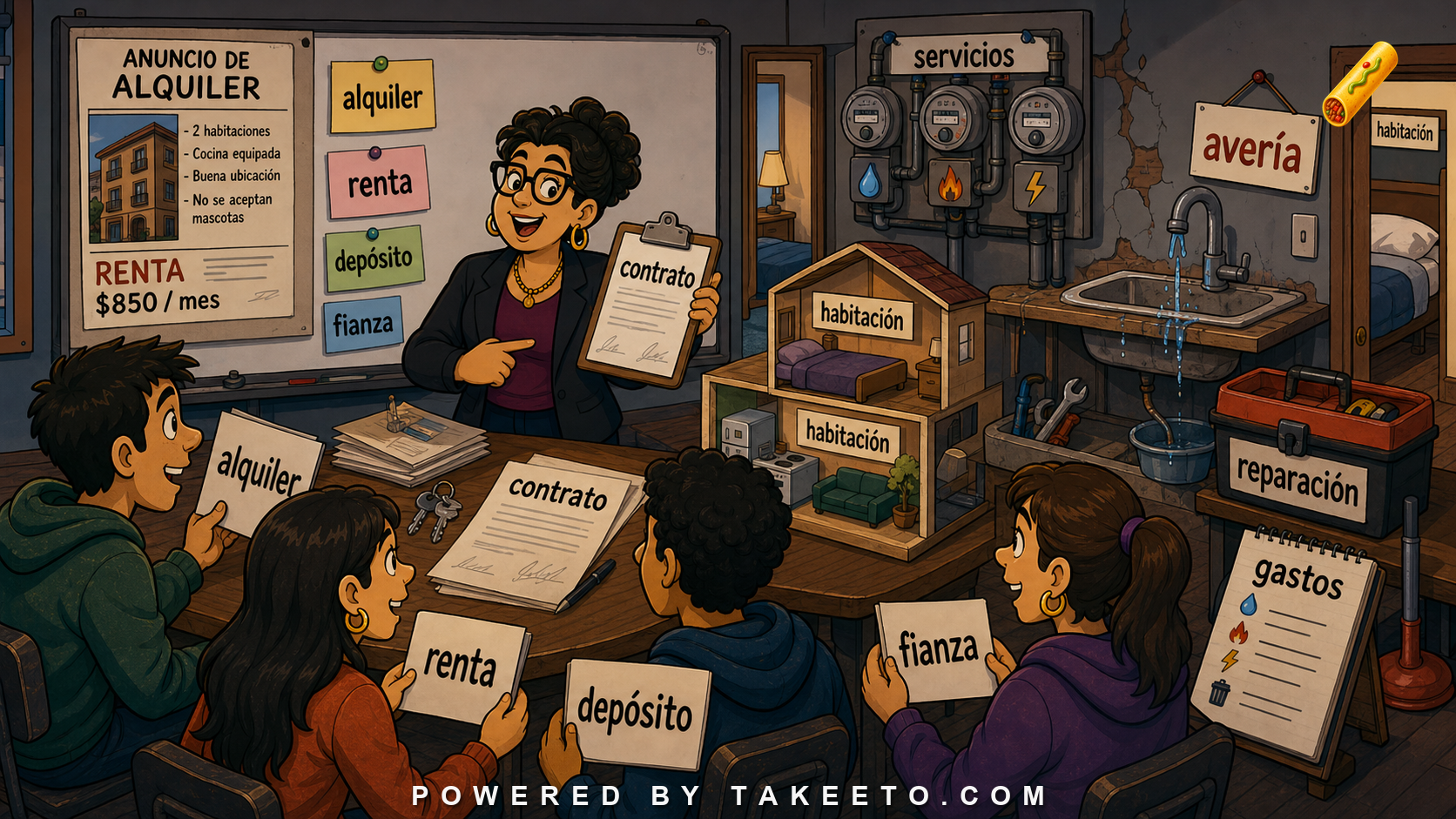
Housing Spanish lives between ads and contracts
Housing language moves quickly from friendly listings to legally significant documents. A listing may say habitación luminosa, gastos incluidos, cerca del metro. A contract may say el arrendatario deberá abonar la fianza y asumir los suministros. A repair message may say hay una avería en la caldera y no funciona el agua caliente.
The key principle is:
Housing Spanish combines space description, payment obligations, legal roles, maintenance, and utilities.
You need to know what is being offered, what is owed, what is included, what is broken, and who must act.
Alquiler, renta, arriendo, and arrendamiento
Rent vocabulary varies strongly by region and register. Alquiler is common in Spain and widely understood. Renta means rent but also income in other contexts. Arriendo is common in several Latin American countries. Arrendamiento is formal/legal. Arrendador is landlord/lessor, and arrendatario is tenant/lessee.
A conversation might say alquilo un piso or rento un departamento depending on country. A contract may say contrato de arrendamiento.
Learner action: learn the local everyday word and the formal contract word.
Piso, departamento, apartamento, habitación, cuarto
Words for housing units vary. Piso can mean apartment/flat in Spain and floor elsewhere. Departamento can mean apartment in many Latin American contexts and department in other contexts. Apartamento is widely understandable. Habitación is room. Cuarto is room, but also quarter/fourth. Recámara and dormitorio are bedroom terms with regional distribution.
Learner action: identify country before interpreting unit type.
Depósito, fianza, garantía, and aval
Upfront money can be labeled differently. Depósito is deposit. Fianza is security deposit or bond in many formal contexts. Garantía may be guarantee or security. Aval may be a guarantor or guarantee.
A listing may require un mes de fianza, dos meses de depósito, aval bancario, or fiador / garante. These terms may carry legal meaning in a given country. This article teaches reading strategy, not legal rules.
Learner action: separate refundable deposit, nonrefundable fee, guarantor requirement, and rent advance.
Gastos, servicios, suministros, and utilities
Housing ads often say what is included. Gastos incluidos means expenses included. Gastos aparte means expenses separate. Servicios incluidos may mean utilities included. Suministros is a utility/supply-service word. Luz, agua, gas, internet, and comunidad appear frequently.
Servicios can mean utilities in housing contexts, but it can also mean services generally. Suministros is more specifically supply utilities.
Learner action: ask exactly what is included and whether there are caps, estimates, or separate contracts.
Contrato and clauses
A lease may use formal terms: contrato, cláusula, duración, renovación, rescisión, incumplimiento, inventario, estado de conservación. Formal clauses often use deberá, queda prohibido, será responsabilidad de, and sin perjuicio de. Read these as obligation, prohibition, responsibility, and reservation of rights.
Learner action: when reading a lease, map every clause to an obligation, right, prohibition, payment, deadline, or condition.
Avería, reparación, mantenimiento, and damage
Repair language is practical and common: avería, reparación, mantenimiento, fuga, humedad, gotera, atasco, persiana, caldera, calentador.
Examples:
Hay una fuga de agua en el baño.
There is a water leak in the bathroom.
La persiana no sube.
The blind/shutter does not go up.
No funciona el calentador.
The heater/water heater is not working.
Learner action: describe the problem, location, urgency, and when it started.
Informal landlord message versus formal notice
Informal:
Hola, la nevera no enfría desde ayer. ¿Podrían revisarla?
Hi, the fridge has not been cooling since yesterday. Could you check it?
Formal:
Por medio de la presente, comunico una avería en el sistema de calefacción y solicito su reparación a la mayor brevedad posible.
I hereby report a fault in the heating system and request its repair as soon as possible.
Learner action: keep written records for serious issues.
Example bank walkthrough
alquiler
Rent/rental.
Learner action: common and widely understood, especially in Spain.
renta
Rent or income.
Learner action: distinguish housing from income/tax contexts.
depósito
Deposit.
Learner action: ask if refundable and under what conditions.
fianza
Security deposit/bond in many formal contexts.
Learner action: treat as potentially legal term.
contrato
Contract/lease.
Learner action: read roles, duration, payment, deposit, utilities, and termination.
servicios
Utilities or services.
Learner action: ask which services are included.
gastos
Expenses/fees.
Learner action: included or aparte?
avería
Breakdown/fault.
Learner action: specify item, location, and urgency.
reparación
Repair.
Learner action: identify who arranges and who pays.
habitación
Room.
Learner action: distinguish room rental from whole-unit rental.
Remediation notes: housing Spanish splits everyday messages from legal obligations
Housing Spanish requires a strong register split. A WhatsApp message to a landlord, an online listing, a lease clause, a utility bill, and an eviction notice may all concern the same apartment, but they are not the same genre. Learners need to identify genre before choosing vocabulary or tone.
In listings, adjectives often sell a lifestyle:
luminoso, céntrico, amplio, reformado/remodelado, amueblado, exterior, bien comunicado.
These are not legal guarantees by themselves. Céntrico may mean near something desirable, not necessarily downtown by your standards. Amueblado requires checking what is included. Gastos incluidos needs the exact services. A estrenar may refer to a new unit, new renovation, or unused condition depending on context.
In contracts, the language becomes obligation-heavy:
arrendador, arrendatario, renta/alquiler, fianza/depósito/garantía, plazo, prórroga, rescisión, incumplimiento, cláusula, suministros.
The terms vary by country. Fianza is common in Spain for deposit; depósito or garantía may be more common elsewhere. Piso is normal in Spain; departamento, apartamento, apto., depto., cuarto, recámara, habitación, and pieza vary by region. The article should not imply a single international housing vocabulary.
Repair vocabulary also needs precision. Avería is a malfunction or breakdown. Daño is damage. Desperfecto is a defect or damage, often in property condition. Fuga is a leak, but gotera is a dripping leak often from ceiling/roof. Humedad may be dampness, moisture, or mold-related problem. Moho is mold. Reparación urgente carries a different force from mantenimiento preventivo.
Learners should also avoid over-direct complaint language. A neutral repair request can be firm without sounding accusatory:
Buenos días. Hay una fuga debajo del fregadero desde ayer. ¿Podrían enviar a alguien a revisarla, por favor? Adjunto fotos.
A more formal notice might say:
Solicito la reparación de la avería indicada, ya que afecta al uso normal de la vivienda.
Repair rule:
For housing Spanish, first identify the genre: ad, lease, bill, inventory, repair request, complaint, or legal notice. Then choose the vocabulary and tone that belong to that genre.
Suggested interactive module: rental listing annotator
A strong tool for this article would decode housing ads and contracts.
Suggested functions:
- Unit type classifier: piso, departamento, apartamento, habitación.
- Cost breakdown: renta/alquiler, depósito/fianza, gastos, servicios, comisión.
- Included-services marker: agua, luz, gas, internet, comunidad.
- Contract-role map: arrendador, arrendatario, fiador/garante.
- Repair vocabulary panel: avería, fuga, humedad, atasco, reparación.
- Marketing-term warning: acogedor, ideal, reformado, céntrico.
- Message templates: landlord, agency, roommate, building manager.
- High-stakes note: legal terms vary by jurisdiction.
Final rule
Housing Spanish moves between marketing, daily life, and law.
Read listings skeptically, contracts structurally, and repair messages concretely. Ask what is included, what is owed, what is broken, who is responsible, and what evidence exists.