
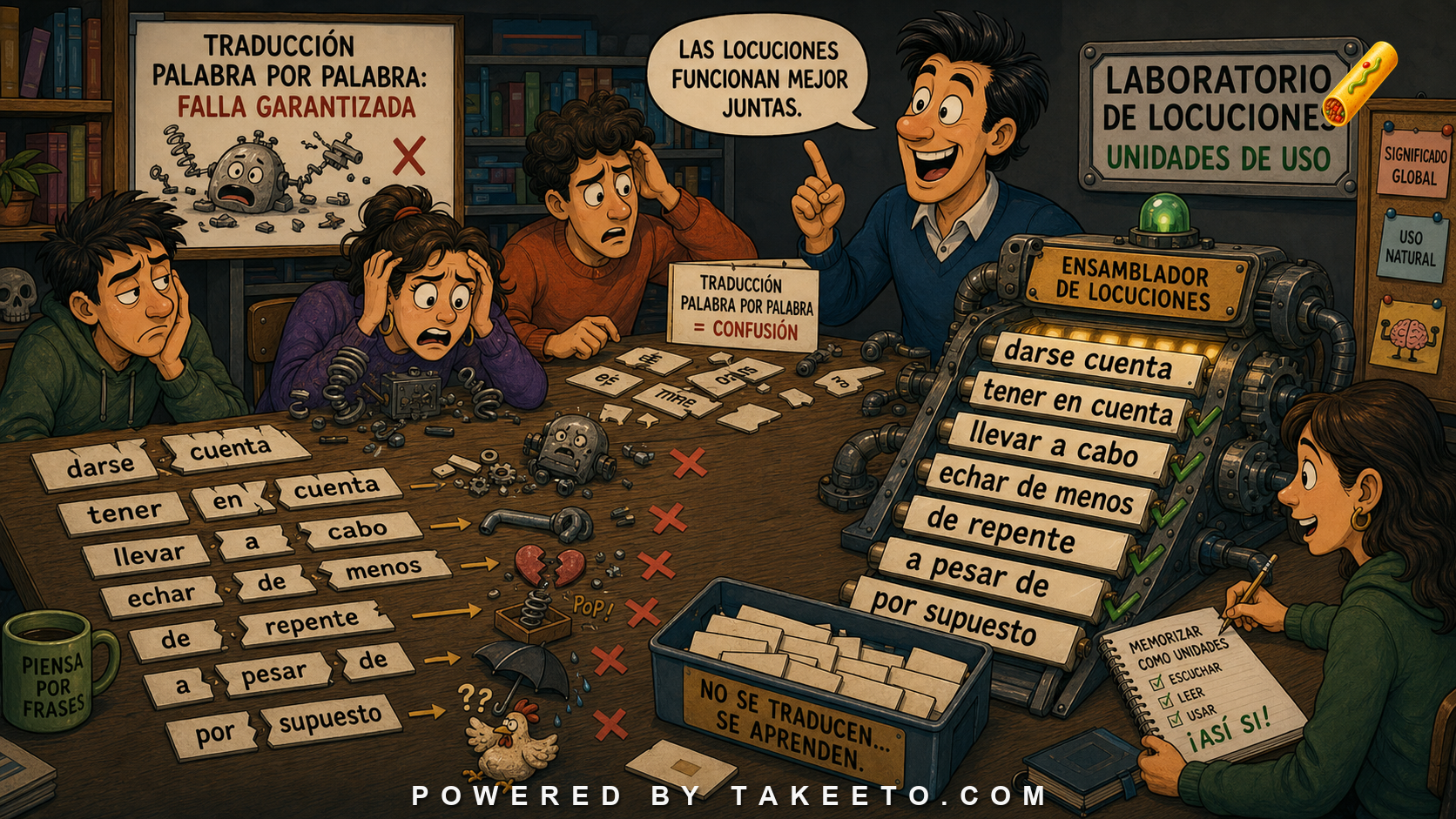
Some Spanish is built in chunks
A learner sees:
Me di cuenta.
They know dar means give and cuenta can mean account or count. So they try:
I gave myself account.
That is not how the expression works.
Darse cuenta means to realize or notice. It is a fixed verbal locution. Its meaning cannot be reliably assembled from the ordinary meanings of dar and cuenta.
The key principle is:
Many Spanish expressions must be learned as structured chunks, not translated word by word.
This does not mean idioms are random. Many have internal grammar. Some are partly transparent. Some allow pronoun changes or tense changes. But the expression as a whole carries the usable meaning.
Idiom, locution, collocation: different kinds of chunk
A locución is a fixed expression that functions like a grammatical unit.
de repente
suddenly
This functions like an adverb.
a pesar de
despite / in spite of
This functions like a preposition.
A locución verbal functions like a verb.
darse cuenta
to realize
llevar a cabo
to carry out
An idiom is often semantically opaque or figurative.
echar de menos
to miss
A collocation is a conventional word partnership that may be transparent but not freely replaceable.
cometer un error
to make an error
Not every fixed expression is equally idiomatic. The learner’s practical question is: how much can I change, and what does the expression do in a sentence?
Opaque expressions: the words do not add up
Some expressions are hard to interpret from parts.
echar de menos
to miss someone/something
The literal pieces do not directly tell an English speaker the meaning.
Lo echo de menos.
I miss him/it.
Echo de menos mi casa.
I miss my home.
A literal translation will fail. The expression must be learned as a unit.
Learner action: when a phrase contains familiar words but makes no sense literally, suspect an idiom or locution.
Partly transparent expressions still need storage
Some expressions make partial sense.
tener en cuenta
to take into account
The words are not completely opaque. Cuenta relates to counting/accounting, and tener en cuenta means holding something in consideration.
But you still cannot freely translate from English and say:
tomar en cuenta
Actually, tomar en cuenta is also used in many areas, especially in the Americas, but tener en cuenta is a major standard expression. The lesson is not that only one exists. The lesson is that phrase choice is conventional and regional.
Learner action: store the expression with variants and region/register notes.
Locutions have grammar
Fixed does not mean frozen in every detail.
Darse cuenta changes for subject, tense, and pronouns:
Me doy cuenta.
I realize.
Nos dimos cuenta.
We realized.
¿Te diste cuenta?
Did you notice?
The se changes with the subject. The verb dar conjugates. But the chunk darse cuenta de remains.
Me di cuenta de que era tarde.
I realized that it was late.
Notice the preposition:
darse cuenta de algo
darse cuenta de que + clause
Learners often omit de because English does not say “realize of.” Spanish requires the construction.
Prepositional locutions behave like prepositions
A locution such as a pesar de functions like a complex preposition.
A pesar de la lluvia, salimos.
Despite the rain, we went out.
A pesar de que llovía, salimos.
Even though it was raining, we went out.
The expression controls what follows it. With a noun or infinitive, use a pesar de. With a finite clause, use a pesar de que.
Another example:
por supuesto
of course
This functions as a discourse adverb or response formula.
—¿Puedo pasar?
—Por supuesto.
Learner action: learn the syntactic frame, not just the translation.
Verbal locutions package events
Llevar a cabo means to carry out, conduct, or complete a planned action.
El equipo llevó a cabo el estudio.
The team carried out the study.
It is common in formal, academic, administrative, and institutional registers.
A learner may overuse hacer because English uses do/make widely. Llevar a cabo gives a more formal event-packaging option.
But it is not always better. In casual conversation, hacer may be more natural.
Hicimos una encuesta.
We did a survey.
Se llevó a cabo una encuesta.
A survey was conducted.
The second sounds more formal and institutional.
Fixed components and limited flexibility
Some locutions allow insertion or modification; others resist it.
tener en cuenta algo
tener muy en cuenta algo
This allows an intensifier:
Hay que tener muy en cuenta este dato.
But many expressions cannot be freely rearranged. A learner should not invent:
tener una cuenta en
dar una cuenta de sí
llevar en cabo
The safest method is to copy real frames:
tener en cuenta + noun
tener en cuenta que + clause
darse cuenta de + noun
darse cuenta de que + clause
llevar a cabo + noun
a pesar de + noun/infinitive
a pesar de que + clause
Idioms and register
Idioms are not all equal in register.
Some are neutral and extremely common:
de repente
suddenly
por supuesto
of course
Some are conversational:
echar de menos
to miss
Some are formal:
llevar a cabo
to carry out
Some may be regional, playful, vulgar, old-fashioned, or literary.
Learners should record register. An idiom notebook without register labels can produce awkward speech.
False friends inside idioms
Words inside idioms may not carry their dictionary sense.
Cuenta in darse cuenta is not a bank account in the sentence.
Cabo in llevar a cabo is not “cape” in the geographic sense for learner purposes.
Supuesto in por supuesto is not something you normally analyze as “supposed” when using the phrase.
The expression is the meaning-bearing unit.
Learner action: after you understand the phrase, stop translating its pieces every time.
Example bank walkthrough
darse cuenta
To realize or notice. Requires pronominal agreement and usually de before the object.
Learner action: practice me di cuenta de que..., not only me di cuenta.
tener en cuenta
To take into account.
Learner action: learn tener en cuenta que... and tener en cuenta + noun.
llevar a cabo
To carry out, especially formal planned action.
Learner action: use it for studies, projects, procedures, plans, and operations.
echar de menos
To miss someone or something.
Learner action: do not translate the words separately.
de repente
Suddenly.
Learner action: store as an adverbial locution.
a pesar de
Despite / in spite of.
Learner action: contrast a pesar de + noun/infinitive with a pesar de que + clause.
por supuesto
Of course.
Learner action: recognize it as a response formula and discourse marker.
Idiom notebook method
For each expression, write:
- Expression: exact form.
- Type: verbal, adverbial, prepositional, adjectival, discourse formula.
- Meaning: functional translation.
- Frame: what follows it?
- Example: one real sentence.
- Register: casual, neutral, formal, literary, regional.
- Flexibility: what can change?
- Warning: literal translation trap.
A good idiom notebook is a grammar notebook, not just a vocabulary list.
Remediation notes: locutions need grammar labels, not just translations
Idioms and locutions require a stronger grammar repair. Learners often store a phrase as an English translation and then use it in the wrong syntactic shape. The phrase darse cuenta de is not just “realize.” It is a pronominal verbal locution that normally takes de before a noun or de que before a clause:
Me di cuenta del error.
Me di cuenta de que había un error.
If the learner memorizes only “realize,” they may produce realicé que, which is English interference and usually not the intended Spanish construction.
Every locution should be stored with its frame:
tener en cuenta algo
darse cuenta de algo / de que...
llevar a cabo algo
echar de menos a alguien / algo
a pesar de algo / de que...
por supuesto as a discourse formula.
The article should also make a clearer distinction between locutions and collocations. Cometer un error is a strong collocation: the words retain their meanings but prefer each other. Darse cuenta is more idiomatic and constructional: the meaning is not predictable from dar plus cuenta in ordinary transfer terms. A pesar de is a prepositional locution: it behaves like a preposition, not like a free phrase.
Flexibility is limited but not absent. Some verbal locutions allow tense, person, object, or modifier changes:
Lo llevó a cabo.
Se dieron cuenta tarde.
Lo tuve muy en cuenta.
Other expressions are more frozen. Learners must learn which slots are open. This is why examples are better than definitions.
A good idiom notebook should therefore use a template:
Expression: darse cuenta de
Type: verbal locution
Frame: alguien se da cuenta de algo / de que + clause
Register: neutral
Example: Me di cuenta de que faltaba una página.
Do not write: realizar que for this meaning.
Repair rule:
Do not store idioms as bilingual glosses. Store them as grammar frames with open slots, register labels, and real examples.
Suggested interactive module: idiom parser
A strong tool for this article would parse fixed phrases as units.
Suggested functions:
- Expression detector: highlight likely locutions in a sentence.
- Type label: verbal, adverbial, prepositional, discourse formula.
- Frame display: required prepositions and clause patterns.
- Literal-vs-functional layer: show why word-by-word translation fails.
- Register tag: neutral, formal, conversational, regional.
- Flexibility test: let users try substitutions and see whether they work.
- Notebook export: save expression, frame, example, and warning.
Final rule
Do not dismantle every Spanish phrase into individual word translations.
Many expressions are stored and used as chunks. Learn their frame, register, flexibility, and example sentence.
Idioms are not exceptions to grammar. They are grammar packaged into reusable units.