
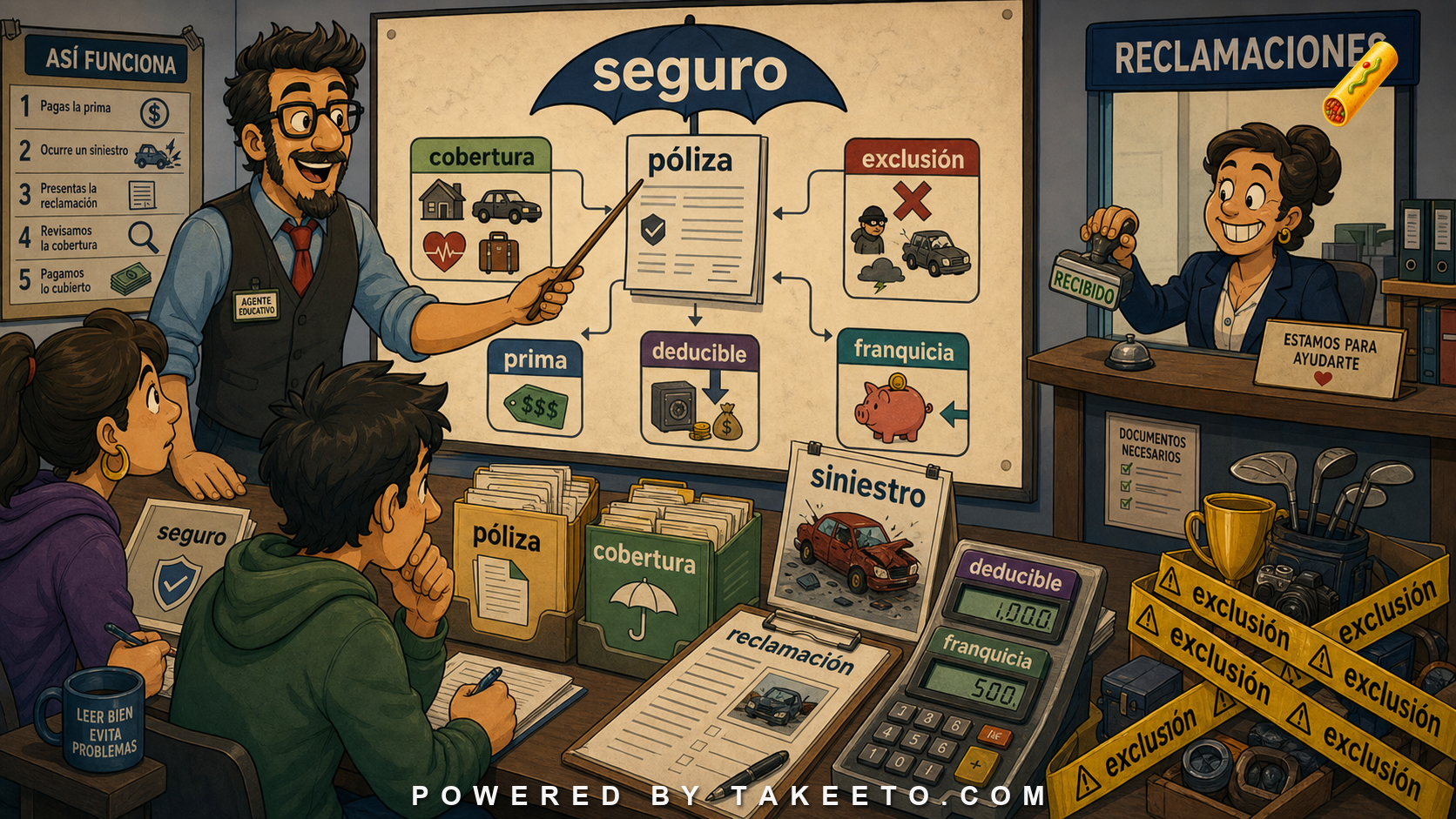
Insurance Spanish is a language of promises and limits
Insurance documents can sound reassuring at first:
cobertura
protección
asistencia
beneficio
But every insurance policy is also a document of limits:
exclusiones
deducible
franquicia
condiciones
plazo
documentación
suma asegurada
The learner’s task is not simply to identify the type of insurance. It is to understand what is covered, under what conditions, up to what amount, after what deductible, with what exclusions, and through what claim procedure.
The key principle is:
Insurance Spanish must be read through coverage, conditions, exclusions, amounts, and claim steps.
This article is language education, not insurance, legal, or financial advice. Insurance terms are jurisdiction- and policy-specific. For real claims or coverage decisions, consult the insurer, policy documents, and qualified professionals as needed.
Seguro, póliza, asegurado, aseguradora
Core roles:
seguro — insurance
póliza — policy
aseguradora / compañía de seguros — insurance company
asegurado — insured person/entity
tomador del seguro — policyholder, in many contexts
beneficiario — beneficiary
corredor / agente — broker/agent
Example:
El tomador del seguro deberá pagar la prima en los plazos establecidos en la póliza.
The policyholder must pay the premium within the periods established in the policy.
Do not assume asegurado and tomador are the same person. In some policies, one person buys the policy, another is insured, and another may be beneficiary.
Cobertura: what is covered
Cobertura means coverage.
Examples:
cobertura médica — medical coverage
cobertura por robo — theft coverage
cobertura de responsabilidad civil — liability coverage
cobertura internacional — international coverage
cobertura básica / ampliada — basic / expanded coverage
Policy language:
La póliza cubre los daños ocasionados por incendio, siempre que se cumplan las condiciones establecidas.
The policy covers damage caused by fire, provided that the established conditions are met.
Watch for condition markers:
siempre que — provided that
siempre y cuando — as long as
salvo — except
excepto — except
únicamente — only
hasta — up to/until
Coverage is rarely absolute. The grammar around cubre often contains the limits.
Prima: the premium
Prima in insurance is the premium: the amount paid for the insurance.
Examples:
pago de la prima — payment of the premium
prima mensual — monthly premium
prima anual — annual premium
falta de pago de la prima — failure to pay the premium
Do not confuse prima with cousin in ordinary Spanish. Domain matters.
Deducible and franquicia
Two important cost-sharing terms are deducible and franquicia. Usage varies by country and insurance type.
General idea:
deducible / franquicia = amount the insured must pay or absorb before or as part of coverage
Example:
El asegurado asumirá un deducible de 500 dólares por siniestro.
The insured will assume a deductible of 500 dollars per claim/loss event.
Example:
La cobertura se aplicará una vez descontada la franquicia correspondiente.
Coverage will apply once the corresponding deductible/franchise amount has been deducted.
A learner should not assume one Spanish term maps uniformly across all countries. In Spain, franquicia is common in many insurance contexts. In parts of Latin America, deducible is common. Some policies may use both with specific definitions.
Siniestro and reclamación
Siniestro is a crucial insurance word. It means the insured event, loss event, claim event, accident, or occurrence that triggers possible coverage. It does not simply mean “sinister.”
Examples:
declarar un siniestro — report a loss/claim event
fecha del siniestro — date of loss/event
número de siniestro — claim/loss number
peritación del siniestro — assessment of the claim/loss
Reclamación can mean claim, complaint, or demand depending on context.
Example:
Presentar una reclamación ante la aseguradora.
File a claim/complaint with the insurer.
In insurance Spanish, siniestro is often the event; reclamación is the claim/request process. But documents differ.
Exclusions: what is not covered
Exclusión is one of the most important policy words.
Example:
Quedan excluidos los daños causados por uso indebido del vehículo.
Damage caused by improper use of the vehicle is excluded.
Common exclusion grammar:
quedan excluidos — are excluded
no estarán cubiertos — will not be covered
la póliza no cubre — the policy does not cover
salvo pacto en contrario — unless otherwise agreed
excepto cuando — except when
Do not read a coverage section without reading the exclusions. The exclusions can reverse your first impression.
Limits and insured amounts
Common terms:
suma asegurada — insured amount
límite de cobertura — coverage limit
importe máximo — maximum amount
tope — cap, often less formal but common
sublímite — sublimit
indemnización — compensation/payment/indemnity
valor asegurado — insured value
Example:
La indemnización máxima por evento será de 10.000 euros.
The maximum compensation/payment per event will be 10,000 euros.
Por evento, por siniestro, por año, and por asegurado can change the meaning drastically.
Documentation requirements
Claims often require documents.
Common phrases:
presentar documentación — submit documentation
aportar comprobantes — provide proof/receipts
factura — invoice
recibo — receipt
informe médico — medical report
denuncia policial — police report
fotografías — photographs
presupuesto — estimate/quote
plazo para notificar — deadline to notify
Example:
El siniestro deberá notificarse dentro de los siete días siguientes a su ocurrencia.
The loss event must be notified within seven days following its occurrence.
Here, ocurrencia means occurrence of the event, not a funny idea.
Regional variation
Insurance vocabulary varies across countries and policy types.
Examples:
deducible / franquicia
reclamación / reclamo
póliza / contrato de seguro
recibo de prima / comprobante de pago
siniestro / evento / pérdida
A policy should define its own terms. If it includes a section called Definiciones, read it before assuming regional meaning.
Annotated insurance clause
La presente póliza cubre daños materiales al vehículo asegurado hasta la suma asegurada indicada, con una franquicia de 300 euros por siniestro. Quedan excluidos los daños derivados de uso no autorizado.
Plain reading:
This policy covers physical/material damage to the insured vehicle up to the indicated insured amount, with a 300-euro deductible/franchise per loss event. Damage resulting from unauthorized use is excluded.
Structure:
cubre = coverage grant
daños materiales = type of loss
vehículo asegurado = insured object
hasta la suma asegurada = limit
franquicia de 300 euros = cost-sharing amount
por siniestro = per claim/loss event
quedan excluidos = exclusion formula
Policy-summary reading strategies
- Find definitions: policy-specific meanings.
- Identify parties: insurer, policyholder, insured, beneficiary.
- Find coverage grants: what is covered.
- Find limits: maximum amounts, sublimits, per-event rules.
- Find cost-sharing: deductible/franchise/copayment if relevant.
- Find exclusions: what is not covered.
- Find claim procedure: deadlines, documents, notification method.
- Find cancellation/renewal: policy term and premium payment.
- Check regional terms: deducible/franquicia, reclamo/reclamación.
- Get help for real claims: policy interpretation can be technical.
Remediation: insurance documents define both protection and refusal
Insurance Spanish looks reassuring because it contains words like cobertura, protección, and beneficiario. But every policy also contains limits, exclusions, conditions, deductibles, waiting periods, documentation requirements, and procedures for denial or adjustment.
Read insurance language through paired questions:
What is covered? / What is excluded?
Who is insured? / Who is not insured?
What event triggers coverage? / What event does not qualify?
What amount is available? / What limit applies?
What must be documented? / What missing document can block the claim?
Example:
La póliza cubre daños por incendio, salvo aquellos ocasionados por dolo o negligencia grave del asegurado.
The good news is cubre daños por incendio. The limit is salvo.... The reader must hold both.
Siniestro, reclamación, and claim logic
In many insurance contexts, siniestro is the insured event or loss occurrence, while reclamación or reclamo is the claim made to the insurer. The exact usage varies regionally and by insurance type.
A useful distinction:
ocurrió el siniestro
the covered event/loss occurred
se presentó una reclamación
a claim was filed
la aseguradora evaluó la reclamación
the insurer evaluated the claim
se rechazó por exclusión
it was denied because of an exclusion
A learner who translates siniestro only as “sinister” has failed completely. It is a technical insurance word.
Mini-workshop: annotate a coverage clause
Clause:
La cobertura será aplicable únicamente si el asegurado notifica el siniestro dentro de las setenta y dos horas siguientes a su ocurrencia y presenta la documentación requerida por la compañía.
Condition 1:
notifica el siniestro
Deadline:
dentro de las setenta y dos horas siguientes a su ocurrencia
Condition 2:
presenta la documentación requerida
Authority requiring documents:
la compañía
Functional reading:
Coverage applies only if the insured notifies the insurer of the loss within seventy-two hours after it occurs and submits the documentation required by the company.
The dangerous word is únicamente. It signals that the conditions are not optional decoration.
Regional variation and false confidence
Insurance vocabulary differs across countries and products:
deducible / franquicia
deductible/excess, with regional and product variation
prima
premium, not cousin
póliza
policy
asegurado / tomador / beneficiario
insured / policyholder / beneficiary, though exact roles vary
cobertura amplia / cobertura limitada
broad/full coverage / limited coverage, depending on product definitions
endoso / anexo / rider
endorsement or added policy document
Do not assume that a familiar word has the same legal meaning in auto, health, life, travel, renters, homeowners, or business insurance.
Policy-summary reading strategy upgraded
For a summary page, extract:
- policy number;
- insured person or property;
- policyholder;
- coverage period;
- premium;
- deductible/franchise;
- covered events;
- exclusions;
- limits and sublimits;
- claim notification procedure;
- required documents;
- cancellation or non-renewal rules.
The remediation goal is not to memorize a glossary. It is to see where a promise becomes conditional.
Plain-language policy summaries are useful but incomplete
Many insurance documents include a summary page or table of benefits. These summaries are helpful, but they rarely replace the full policy. A table may say cobertura incluida while a later clause defines waiting periods, exclusions, geographic limits, maximum amounts, or documentation requirements.
A serious reader uses the summary as a map, then verifies each high-value item in the detailed conditions. The best margin note is:
covered according to summary — check exclusions, limits, notice deadline, and required documents.
Additional remediation: limits, sublimits, and waiting periods
Insurance documents often contain limits inside limits. A policy may have a general maximum and smaller sublimits for specific events, items, or services.
Look for:
límite máximo
sublímite
por evento / por siniestro
por año / por vigencia
periodo de espera
carencia
copago
A policy that says it covers medical care may still have a waiting period for certain services, a copay for visits, a sublimit for dental care, or an annual cap. In Spanish summaries, preserve these restrictions clearly. “Covered” is incomplete unless the limit structure is understood.
Suggested interactive module: insurance policy glossary with regional variants
A strong tool for this article would help learners map insurance terms without pretending policies are simple.
Suggested functions:
- Role map: aseguradora, tomador, asegurado, beneficiario.
- Coverage/exclusion splitter: highlight covered events and excluded events.
- Amount parser: premium, deductible, insured amount, limit.
- Claim timeline: notification deadline, documents, assessment, payment.
- Regional variants: deducible/franquicia, reclamo/reclamación.
- Policy-definition reminder: user must check the document’s own definitions.
- No-advice disclaimer: language support only.
Final rule
Insurance Spanish is not understood when you know the word seguro.
You must identify coverage, exclusions, limits, deductibles or franchises, claim events, documentation, and deadlines. Read the definitions. Then read the exclusions. Then read the claim procedure.
In insurance, what is not covered may matter more than the friendly headline.