
Spanish is Latin changed by time, not Latin copied neatly
Spanish descends from spoken Latin, but that does not mean modern Spanish words are simply Latin words with a Spanish ending. Some words evolved naturally through centuries of sound change. Others were borrowed later from learned Latin, often through scholarship, religion, law, science, literature, or administration. Sometimes both paths produced two related Spanish words from the same Latin source.
That is why Spanish has pairs such as:
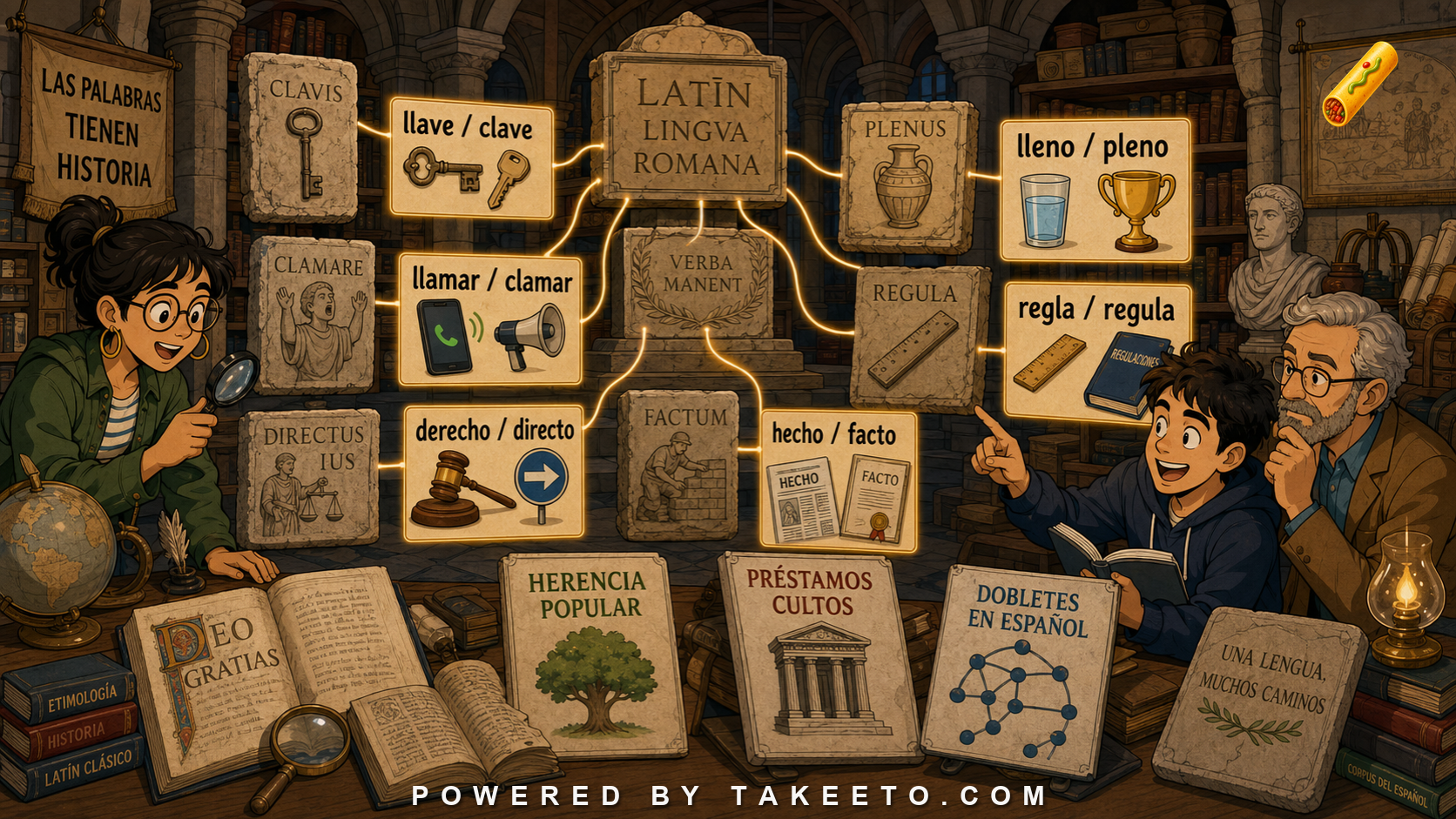
llave / clave
derecho / directo
hecho / facto
lleno / pleno
These pairs are not random synonyms. They are historical clues.
The key principle is:
Spanish vocabulary has inherited popular words, learned Latinisms, semi-learned forms, and doublets; formal vocabulary often looks more Latin because it entered or re-entered through learned channels.
This article gives learners a first map.
Patrimonial words: Latin transformed by regular change
A palabra patrimonial is a word inherited from Latin through continuous spoken use. It has been shaped by sound changes over centuries.
Examples:
Latin factum → Spanish hecho
Latin plenum → Spanish lleno
Latin directum → Spanish derecho
Latin clavem → Spanish llave
These forms may look far from Latin because spoken language changed. Consonants palatalized, vowels shifted, unstressed syllables weakened, and sounds were simplified. The ordinary everyday word is often the one that changed most.
Learner action: do not expect inherited words to look like classroom Latin. Sound change can disguise family resemblance.
Cultismos: learned Latinisms
A cultismo is a learned borrowing from Latin, often introduced through writing, education, religion, science, law, or high-register discourse. It preserves more of the Latin shape.
Examples:
facto
as in de facto
pleno
full, plenary
directo
direct
clave
key, code, crucial element
These words feel more formal, technical, abstract, or institutional. They often live in academic, legal, scientific, and administrative registers.
Learner action: when a Spanish word looks close to Latin or English academic vocabulary, suspect a learned borrowing.
Doublets: two Spanish descendants from one source
A doublet occurs when one Latin source gives Spanish two related forms through different routes: one inherited and transformed, one learned and conservative.
Examples:
Latin clavem → llave and clave
Llave is the ordinary key that opens a door. Clave is a code, musical clef, key idea, or crucial factor.
Latin directum → derecho and directo
Derecho can mean right, straight, law, or right-hand side. Directo is direct.
Latin plenum → lleno and pleno
Lleno is everyday “full.” Pleno is formal: full session, complete, plenary, in full.
Doublets explain why Spanish has multiple words that feel related but not identical. They also explain why formal Spanish often has cognates close to English: English borrowed many learned Latin forms too.
Semicultismos: partial adaptation
Some words are neither fully patrimonial nor fully learned. A semicultismo may show partial sound change or learned pressure that interrupted ordinary development. These categories can be technical and sometimes debated, but the learner-level point is simple: vocabulary history is not binary.
Words can be inherited, borrowed, reborrowed, reshaped, or standardized through writing. A word’s modern form may reflect several forces.
Learner action: use the categories as reading tools, not as rigid labels for every word you meet.
Why formal Spanish looks familiar to English speakers
English has many Latin and French borrowings. Spanish formal vocabulary often includes Latinisms. This creates helpful cognates:
institución
administración
educación
legal
sistema
función
estructura
But cognate comfort is dangerous. Formal Spanish may look easy while hiding grammar, register, and false friends. Actual does not usually mean English “actual”; eventual can differ; asistir often means attend; éxito means success.
Learner action: use Latin-looking words as clues, then verify meaning and usage.
History helps memory
Historical awareness can make vocabulary easier to learn. If you know llave and clave are related, you can remember that both involve “keyness,” but in different domains. If you know lleno and pleno are related, you can see how everyday fullness and formal completeness connect. If you know derecho and directo share history, you can understand semantic branching.
History does not replace modern usage. It supports it.
Example bank walkthrough
llave / clave
Ordinary key versus code/key idea/clef.
Learner action: store them as a doublet with different registers and meanings.
llamar / clamar
Everyday “to call/name” versus formal/literary “to cry out/proclaim.”
Learner action: notice how learned-looking forms often sound elevated.
derecho / directo
Right/law/straight versus direct.
Learner action: do not force one English translation onto related forms.
hecho / facto
Done/fact/event versus learned Latin expression in phrases such as de facto.
Learner action: recognize facto as restricted and formal.
lleno / pleno
Full versus full/complete/plenary in formal contexts.
Learner action: use lleno for ordinary physical fullness; learn pleno in institutional phrases.
regla / regula
Regla is the normal Spanish word; regula appears as a Latin form or technical/historical item in specialized contexts.
Learner action: do not treat all Latin-looking forms as everyday Spanish.
Remediation notes: inherited does not mean simple, learned does not mean better
The main repair is to prevent a prestige mistake. Cultismo does not mean “more correct,” and patrimonial does not mean “corrupted.” A patrimonial word is a word that traveled through everyday speech and changed with the sound system. A learned borrowing is a later, more bookish word taken from Latin or shaped by scholarly tradition. Both are legitimate Spanish.
Doublets should be taught as history plus register. Llave and clave are related historically, but they do not mean the same thing in modern Spanish. Llamar and clamar are not interchangeable. Hecho and facto live in different lexical worlds, with de facto functioning as a learned legal/political expression. Lleno and pleno overlap semantically in some contexts but differ strongly in register and collocation. Derecho and directo show how history can produce separate modern meanings.
Learners should also avoid reverse-engineering Latin too aggressively. Sound change is regular in broad patterns, but individual word histories include analogy, borrowing, dialect variation, learned reintroduction, and semantic drift. A Spanish word that resembles Latin may be learned; it may also be inherited but conserved, borrowed from another Romance language, or reshaped by spelling. Historical explanation needs humility.
This matters for vocabulary learning. Formal Spanish often has Latin-looking words: constitución, institucional, jurídico, administración, evidencia, participación. English speakers may recognize them, but cognate comfort can hide usage differences. Actual does not usually mean “actual” in the English sense of “real”; eventualmente does not always behave like English “eventually”; asistir often means attend, not assist.
Production target: when a Latin-looking word tempts you, learn its collocations. Prestar asistencia, asistir a una reunión, derecho laboral, vía directa, pleno municipal, hecho probado. Etymology opens the door, but usage decides the sentence.
Suggested interactive module: Latin-to-Spanish doublet timeline
A strong tool for this article would show two paths from one Latin source.
Suggested functions:
- Source card: Latin form and basic meaning.
- Popular path: sound changes leading to inherited Spanish word.
- Learned path: later Latinism or scholarly borrowing.
- Register labels: everyday, formal, legal, scientific, literary.
- Cognate warning: helpful English cognate versus false friend.
- Semantic map: how related meanings diverged.
Final rule
Spanish does not contain one layer of Latin. It contains inherited Latin, learned Latin, semi-learned forms, and doublets.
Everyday words often changed more. Formal words often preserve Latin shape. When you see pairs like llave/clave or lleno/pleno, read them as history turned into vocabulary.