
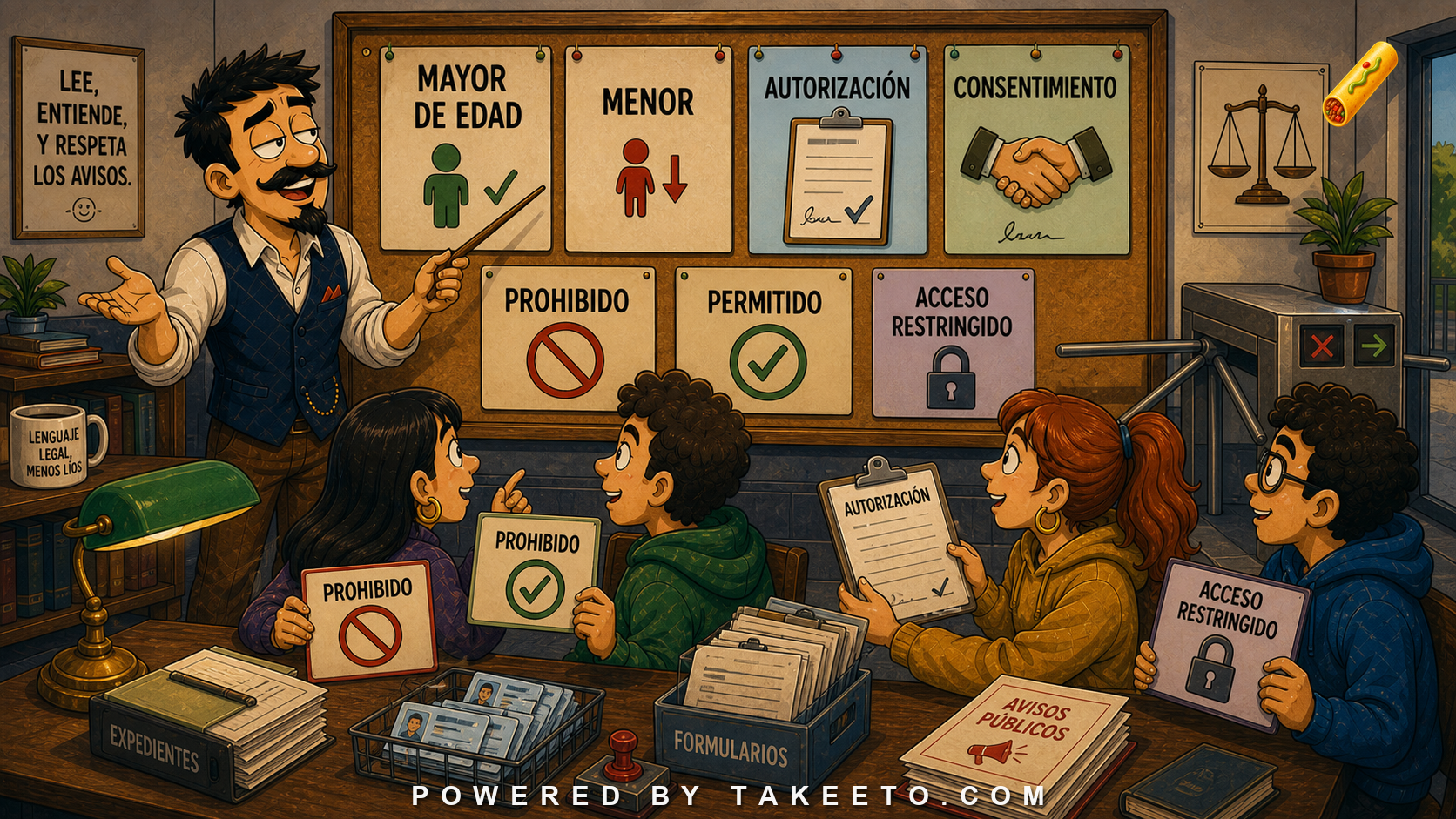
Public notices look simple until they matter
Spanish signs and forms often use compact legal language:
Prohibida la entrada a menores de edad.
Acceso permitido solo con autorización.
Se requiere consentimiento del padre, madre o tutor legal.
These are short sentences, but they can control access, responsibility, liability, and legal permission. Learners must read them carefully and avoid assuming that rules are the same across countries.
The key principle is:
Public legal Spanish is compressed authority. Extract who is allowed, who is forbidden, who must authorize, and under what condition.
Mayor de edad and menor de edad
Core age terms:
mayor de edad
menor de edad
menor
adulto
niño / niña
adolescente
tutor legal
representante legal
Mayor de edad means legally adult. Menor de edad means minor. Menor is common shorthand. The exact age threshold depends on jurisdiction and topic, so learners should not generalize casually.
Los menores de edad deberán estar acompañados por un adulto.
The required action is accompaniment by an adult.
Authorization and consent
Important terms:
autorización
consentimiento
permiso
firma
tutor legal
padre, madre o representante legal
consentimiento informado
Autorización is permission/authorization. Consentimiento is consent. Consentimiento informado appears in medical, research, and legal contexts, where the person must understand what they are agreeing to.
Se requiere autorización firmada por el representante legal.
This means a signed authorization is required from the legal representative.
Permission and prohibition grammar
Common structures:
Prohibido fumar.
Se prohíbe el acceso.
Queda prohibida la venta a menores.
Está permitido el ingreso con reserva.
Solo se permite la entrada con identificación.
No se permite el uso de cámaras.
Notice the grammar:
- Prohibido + infinitive/noun: compressed sign style.
- Se prohíbe: impersonal legal rule.
- Queda prohibido/prohibida: formal state/result.
- Está permitido: permission statement.
- Solo se permite: restricted permission.
Access restrictions
Useful phrases:
acceso restringido
entrada prohibida
solo personal autorizado
uso exclusivo
mayores de 18 años
menores acompañados
identificación obligatoria
Acceso restringido does not necessarily mean impossible entry. It means restricted access. Solo personal autorizado means authorized personnel only. Uso exclusivo means exclusive use.
A sign may not state the penalty. It still has force.
Country-specific caution
Terms can look familiar while legal meaning changes by country. Mayoría de edad, alcohol sale rules, driving eligibility, medical consent, data consent, and school permissions are jurisdiction-specific. Spanish gives the vocabulary; it does not give universal law.
A responsible article can teach reading method, not legal conclusions.
Public forms and notices
Forms may ask:
Nombre del menor
Fecha de nacimiento
Nombre del padre, madre o tutor
Documento de identidad
Firma
Autorizo a...
Declaro bajo protesta / bajo juramento...
Autorizo a means “I authorize.” Declaro means “I declare.” Bajo juramento or similar phrases increase seriousness.
Example bank walkthrough
Mayor de edad: legally adult; check jurisdiction and context.
Menor / menor de edad: minor.
Autorización: permission/authorization, often written.
Consentimiento: consent, sometimes informed consent.
Prohibido: prohibited.
Permitido: permitted.
Acceso restringido: restricted access.
Notice parser workflow
- Identify the action: enter, buy, use, sign, access, participate.
- Identify the person category: adult, minor, authorized staff, customer.
- Identify the rule: prohibited, permitted, required, restricted.
- Identify required document: ID, authorization, consent form.
- Identify who must sign.
- Identify age threshold if stated.
- Do not infer unstated country law.
- Look for exceptions: acompañado, con reserva, con autorización.
- Translate into action: “I may/must/must not ___.”
- For high-stakes issues, verify locally.
Before/after revision drill
Weak interpretation:
Minors cannot enter.
Source Spanish:
Los menores solo podrán ingresar acompañados por un adulto y con autorización firmada.
Better interpretation:
Minors may enter only if accompanied by an adult and with signed authorization.
The weak version reverses the rule. Solo podrán does not prohibit absolutely; it permits under conditions. In public notices, conditions are everything.
Remediation: notices encode authority, condition, and action
Public notices about age, consent, permission, and prohibition are high-stakes because they tell people what is allowed, forbidden, required, or restricted. The language is often compressed:
Prohibida la venta a menores de edad.
Acceso permitido solo con autorización.
Los menores deberán estar acompañados por un adulto responsable.
The learner must identify three things:
authority/action: prohibited, permitted, required, restricted.
condition: age, authorization, accompaniment, document, ticket, membership.
affected person: minor, adult, guardian, customer, visitor, user.
Do not translate only the nouns. The legal or institutional force is in the modal structure.
Forms of prohibition and permission
Common prohibition patterns:
prohibido + infinitive: Prohibido fumar.
se prohíbe + noun/infinitive: Se prohíbe el ingreso con bebidas.
no se permite + infinitive/noun: No se permite entrar con mascotas.
queda prohibido: formal, often regulatory.
acceso restringido: restricted access.
Common permission patterns:
permitido
se permite
podrá
autorizado
con autorización
previa autorización
Common obligation patterns:
debe/deberá
es obligatorio
uso obligatorio
se requiere
deberá presentar
The difference between podrá and deberá is crucial. Podrá grants permission or possibility. Deberá imposes obligation.
Mini-workshop: parse a public notice
Notice:
Para el ingreso de menores de edad, se requiere autorización por escrito de la madre, padre o tutor legal, así como documento de identidad vigente.
Annotation:
para el ingreso = condition for entry.
menores de edad = people under the legal age threshold of the jurisdiction.
se requiere = requirement, not suggestion.
autorización por escrito = written authorization.
madre, padre o tutor legal = authorized adult roles.
así como = also/in addition.
documento de identidad vigente = valid identity document.
Plain version:
Minors can enter only if they have written authorization from a parent or legal guardian and a valid ID document.
High-stakes caution: do not infer the age threshold
Mayor de edad and menor de edad depend on jurisdiction and context. A sign may be about age of majority, age for alcohol purchase, age for entry, age for consent to a service, age for data processing, or age for participation in an activity. These thresholds can differ.
A learner should not say “menor means under 18” as a universal rule. In many contexts that will be right, but the safe reading is:
menor de edad = below the legally relevant age threshold in this jurisdiction and context.
If a decision matters legally, check the actual rule or ask a qualified person.
Before/after: public notice to action list
Official:
Se permitirá el acceso a menores únicamente en compañía de un adulto responsable, previa presentación de la autorización correspondiente.
Action list:
A minor may enter only with a responsible adult.
The required authorization must be presented before entry.
Entry is not automatic.
This action extraction is more useful than a polished translation when the reader is trying to comply.
Notice-reading checklist
For each notice, mark:
- Permission/prohibition/obligation: permitted, forbidden, required.
- Who: minor, adult, guardian, customer, visitor, user.
- Condition: ID, authorization, payment, accompaniment, registration.
- Timing: before entry, at purchase, during use, upon request.
- Authority: establishment, law, municipality, platform, school.
- Consequence: denied access, cancellation, fine, restriction, removal.
Public-notice Spanish is not conversational Spanish. It is institutional speech compressed into action rules.
Additional remediation drill: slow the document down
If this article still feels like vocabulary, turn one authentic-looking sentence into a four-line analysis before translating it. Write the original sentence. Then list the actor, the action, the object, and the condition or consequence. Only after that, produce a plain-language paraphrase.
This drill matters because domain Spanish often compresses too much into noun phrases. The learner sees familiar words and moves too quickly. Slowing the sentence down reveals whether the reader understands the document logic or only recognizes terms. For article 271, the safest practice is to treat each key term as a field in a larger system: who is acting, what status is changing, what evidence or condition controls the action, and what the reader should do with the information.
A useful production rule is: do not write a polished sentence until you can write a plain one. Plain Spanish is not inferior; it is the diagnostic layer that proves comprehension.
Suggested interactive module: notice parser
A strong tool would label public notices by legal function.
Suggested functions:
- Obligation/prohibition/permission labels.
- Age category detector: mayor, menor, mayores de 18.
- Authorization chain: parent, guardian, representative.
- Document requirement highlighter: identificación, firma, autorización.
- Plain-language output: who can do what under what condition.
Mini-workshop: extracting the legal action from a sign
Notice:
Acceso restringido. Solo personal autorizado. Uso obligatorio de casco.
Extract the rules:
- Entry is restricted.
- Only authorized personnel may enter.
- Helmet use is mandatory.
Notice that none of the phrases uses a full conversational sentence. Public notices rely on compact nouns and adjectives because they are posted in physical space.
Now compare:
Los menores deberán ingresar acompañados por un adulto responsable.
This is more complete, but the method is the same: identify who, what action, and under what condition.
Common learner mistakes
One mistake is treating permitido and prohibido as enough. You still need the object: what exactly is allowed or forbidden? Another is assuming menor means small rather than minor. In legal/public language, menor de edad is a legal category.
A final mistake is universalizing legal thresholds. A sign may say mayores de 18 años, which is explicit. If it only says mayores de edad, the age depends on jurisdiction. Vocabulary is not a substitute for local law.
Applied reading drill: classify the notice before reacting
Take three short signs:
Prohibido el acceso a menores.
Se permite el ingreso con autorización.
Uso obligatorio de casco.
They belong to three categories. The first is prohibition. The second is conditional permission. The third is obligation. A learner should classify the rule before translating elegantly.
Now add the actor:
Prohibido el acceso a menores de edad sin acompañante adulto.
The rule is no longer simply “minors prohibited.” It is: minors may not enter without an adult companion. That difference matters. Spanish public notices often hide important conditions in short prepositional phrases: sin autorización, con identificación, bajo supervisión, excepto personal autorizado.
Use this rule parser:
- Is the notice forbidding, permitting, or requiring?
- Who is affected?
- Is there an exception?
- What document, adult, authorization, or condition changes the rule?
- Is the source law, venue policy, safety rule, or platform rule?
Never translate age or consent notices casually when action depends on them.
Final rule
Spanish public notices are short because they assume authority. Read them by role, action, condition, and restriction. Do not turn vocabulary recognition into legal certainty.