
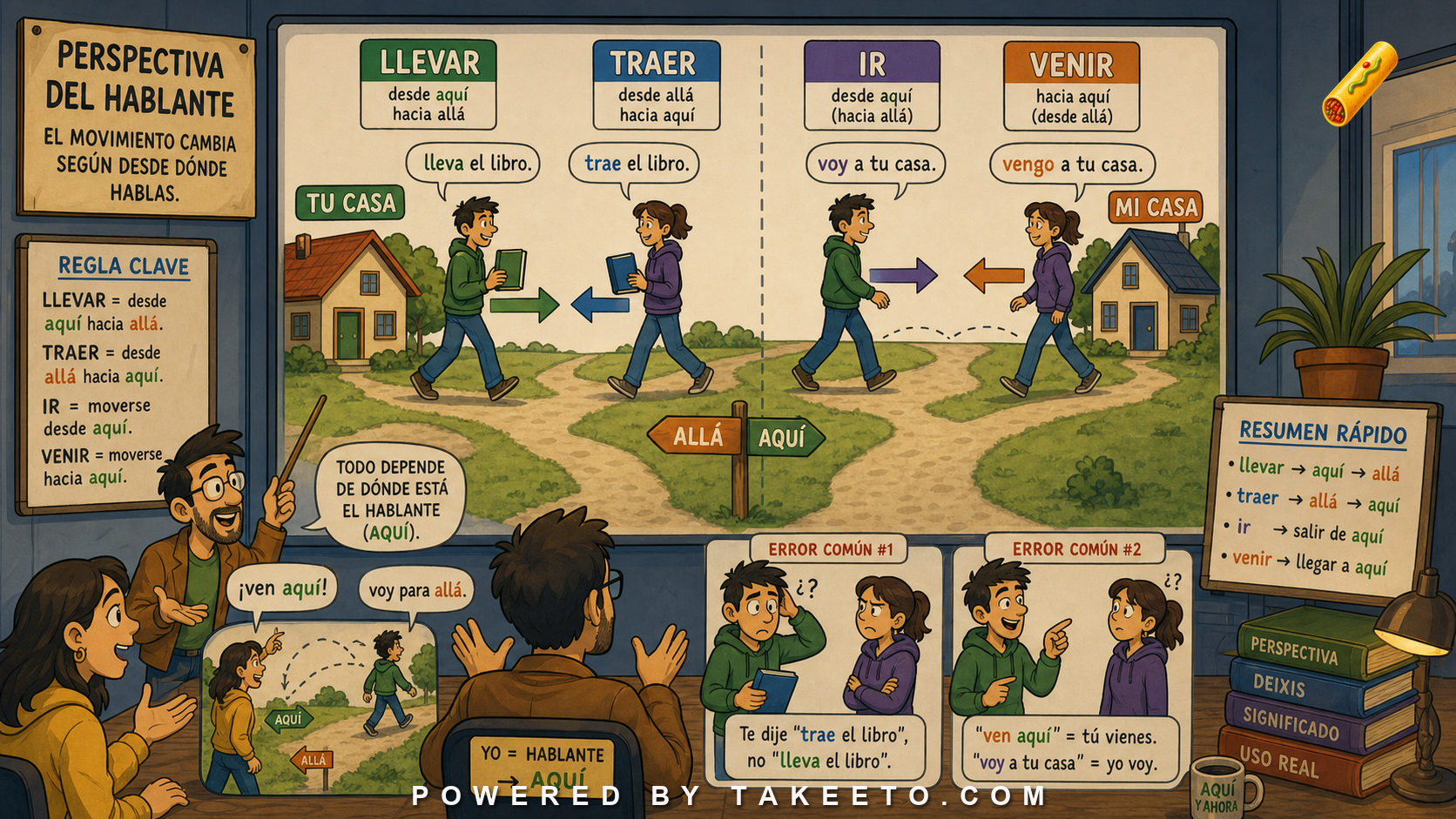
Motion verbs depend on the center of the conversation
Spanish motion verbs are not only about direction in physical space. They depend on a deictic center: the point from which the speaker conceptualizes movement.
Compare:
Ven aquí.
Come here.
Voy para allá.
I’m going over there.
The difference is not distance alone. It is whether movement is toward or away from the relevant center.
The same logic affects transfer verbs:
Trae el libro.
Bring the book here.
Lleva el libro a la oficina.
Take the book to the office.
The key principle is:
Ir/llevar usually move away from the speaker’s center; venir/traer move toward the speaker’s or shared deictic center.
But the center can shift depending on conversation, invitation, phone calls, and future meeting places.
Ir: movement away or toward a destination not centered here
Ir means to go.
Voy a tu casa.
I’m going to your house.
Vamos al cine.
We are going to the movies.
Fueron a Madrid.
They went to Madrid.
The movement is not toward the speaker’s current location. It is toward another destination.
When someone calls you from another room, Spanish often says:
Ya voy.
I’m coming / I’ll be right there.
Literally it uses “I go,” because the speaker is moving away from their current location toward the other person.
Venir: movement toward the speaker or shared center
Venir means to come, usually toward the speaker or a place treated as the conversational center.
Ven aquí.
Come here.
¿Vienes a mi casa?
Are you coming to my house?
Vino a verme.
He came to see me.
The destination is connected to the speaker’s location, planned location, or viewpoint.
A speaker can say:
¿Vienes a la fiesta mañana?
if the speaker will be at the party and treats the party as the shared center. English also does this with “come.”
Voy a tu casa versus vengo a tu casa
This contrast is subtle.
Voy a tu casa.
I’m going to your house.
This is the ordinary speaker-centered description: from where I am, I go to your house.
Vengo a tu casa.
This can be possible when the speaker is adopting the hearer’s location as the deictic center, is already on the way toward that place, or is speaking from a shifted perspective. But learners should not treat it as the default equivalent of English “I’m coming to your house.”
A safe learner pattern:
Voy a tu casa.
I’m coming/going to your house.
And when responding to a call:
Ya voy.
I’m coming.
Traer: bring toward the center
Traer means to bring toward the speaker or relevant center.
Trae el libro.
Bring the book here.
¿Puedes traer agua?
Can you bring water?
Traje los documentos.
I brought the documents.
Use traer when the object moves toward where the speaker is, will be, or imagines the center.
At a meeting:
Trae el informe a la reunión.
Bring the report to the meeting.
The meeting becomes the shared destination.
Llevar: take away or carry to another place
Llevar means to take, carry, or bring to a place away from the speaker’s center.
Lleva el libro a la oficina.
Take the book to the office.
Voy a llevar comida a la fiesta.
I’m going to take food to the party.
¿Puedes llevar a los niños a la escuela?
Can you take the children to school?
If the movement is toward the speaker, traer is usually expected. If it is toward another destination, llevar is usually expected.
Bring/take mismatches with English
English sometimes says “bring” when Spanish prefers llevar, especially if the destination is the hearer’s location or a future event.
English:
I’ll bring the documents to your office.
Spanish often:
Llevaré los documentos a tu oficina.
Why? From the speaker’s current perspective, the documents move away to the hearer’s office.
But if the speaker is already at the office or treats it as the shared center, traer may be possible.
This is why rigid translation fails. Determine the center.
Phone conversations and shifting centers
Phone calls create perspective shifts.
If someone asks:
¿Vienes a la reunión?
they may be asking whether you will come to a meeting where they will be present. The meeting is the shared deictic center.
If you reply:
Sí, voy.
you are saying you are going from your location to that event.
If someone says from inside a building:
Ven a recepción.
you move toward their location. You might answer:
Ya voy.
Spanish uses ir in the response even though English says “I’m coming.”
Regional and contextual variation
There is variation across regions and speakers in how strictly ir/venir and llevar/traer align with the speaker’s location, the hearer’s location, and shared destinations. Some contexts allow either verb with a shift in viewpoint.
Learners should not panic over every borderline case. But they should learn the core system first:
- venir/traer: toward the center;
- ir/llevar: away from the center or toward another destination.
People can be carried through the same system
The transfer verbs are not only for objects.
Llevo a mi hija a la escuela.
I take my daughter to school.
Traje a mi hermano a la reunión.
I brought my brother to the meeting.
¿Puedes llevarme al aeropuerto?
Can you take me to the airport?
Tráeme al niño un momento.
Bring the child to me for a moment.
The a before people marks the personal direct object. The deictic logic remains the same: traer toward the center, llevar toward another destination.
English may say “bring me to the airport” in some varieties, but Spanish will usually use llevar if the airport is away from the speaker’s current center:
¿Me puedes llevar al aeropuerto?
Future shared locations can become the center
A party, meeting, class, or appointment can become the conversational center even if nobody is there yet.
¿Vas a ir a la reunión?
Are you going to the meeting?
This treats the meeting as a destination away from the current center.
¿Vienes a la reunión?
Are you coming to the meeting?
This is natural if the speaker will be there or treats the meeting as a shared center.
Likewise:
Lleva el informe a la reunión.
Take the report to the meeting.
Trae el informe a la reunión.
Bring the report to the meeting.
Both can be possible depending on where the speaker places the center. The verb choice tells you the speaker’s viewpoint.
Example bank walkthrough
voy a tu casa
Default for moving from speaker’s location to the hearer’s house.
Learner action: Spanish may use ir where English says “come.”
vengo a tu casa
Possible with shifted center, but not the safest default.
Learner action: use carefully and listen for context.
trae el libro
Bring the book here/toward the center.
Learner action: use traer for motion toward speaker or shared point.
lleva el libro
Take/carry the book away to another place.
Learner action: use llevar for destination away from the center.
ven aquí
Come here.
Learner action: venir toward speaker location.
voy para allá
I’m going over there / I’m on my way.
Learner action: common response to being summoned.
Deictic decision routine
Ask:
- Where is the speaker now?
- Where is the hearer?
- Where is the event or destination?
- Is the movement toward the speaker or shared center?
- Is the object moving toward or away from that center?
- Has the conversation shifted the center to a future meeting place?
Then choose:
- venir for movement toward the center;
- ir for movement away or to another destination;
- traer for bringing toward the center;
- llevar for taking/carrying away or to another destination.
Suggested interactive module: deictic center map
A strong tool for this article would let learners place speaker, hearer, object, and destination on a map.
Suggested functions:
- Location nodes: speaker, hearer, event, object.
- Center selector: current speaker, hearer, future meeting place.
- Motion arrow: toward or away from center.
- Verb recommendation: ir, venir, llevar, traer.
- Phone-call mode: Ya voy, ¿vienes?, tráelo.
- English trap warning: bring/take and come/go mismatches.
- Regional note: allowed perspective shifts.
Final rule
Spanish motion verbs are perspective verbs.
Use venir and traer for movement toward the speaker or shared center. Use ir and llevar for movement away or toward another destination. When English says “come” or “bring,” Spanish still asks: toward whose center?
Find the center, and the verb usually follows.