
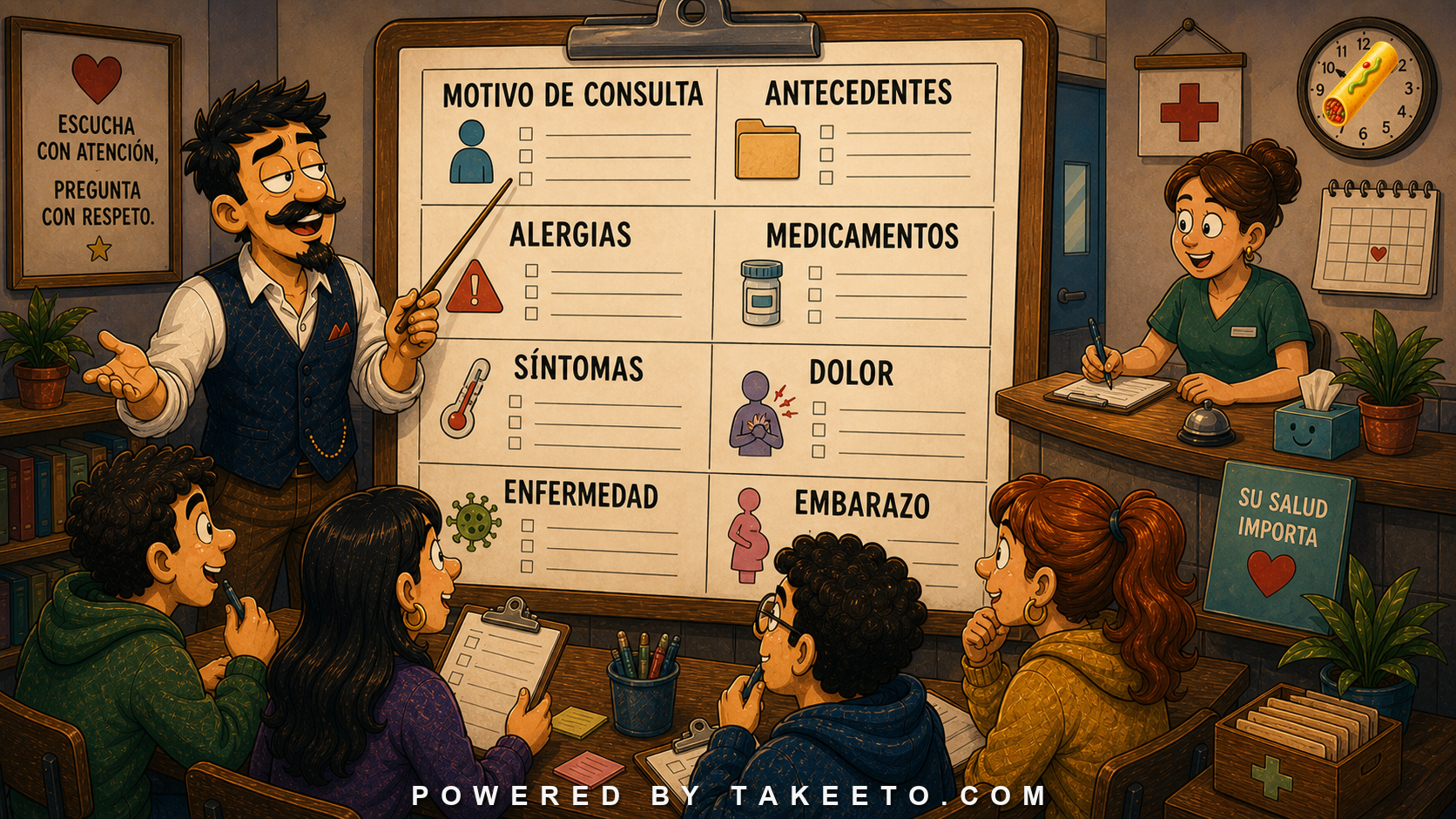
Intake forms are compressed medical interviews
A medical intake form looks simple: name, date of birth, symptoms, allergies, medications, medical history. But linguistically it is dense. It compresses a clinical interview into headings, checkboxes, yes/no questions, short prompts, and institutional vocabulary.
For Spanish learners, the challenge is not only knowing words like dolor or alergia. The challenge is recognizing how forms categorize a person’s condition:
Why are you here?
What symptoms do you have?
What conditions have you had before?
What medications do you take?
What allergies or risks must the clinician know?
What family history may be relevant?
The key principle is:
Medical intake Spanish organizes patient information by reason, symptom, history, risk, medication, and consent.
This article is about language comprehension. It is not medical advice, diagnosis, or a substitute for a qualified clinician or medical interpreter. If a form affects care, accuracy matters. Guessing is not brave; it is risky.
Datos personales: identification fields
The beginning of a form often asks for identifying information.
Common fields:
nombre completo — full name
fecha de nacimiento — date of birth
edad — age
sexo — sex
género — gender
domicilio / dirección — address
teléfono — phone
correo electrónico — email
contacto de emergencia — emergency contact
parentesco — relationship
Some terms vary by country and institution. Domicilio often means address or residence in official forms. Parentesco means the relationship between people: mother, spouse, sibling, child, friend, guardian.
A learner should not confuse sexo and género. Forms may use one, both, or neither, depending on institution and country. In medical contexts, exact questions can matter for care, but terminology and practice vary.
Motivo de consulta: why the patient is there
One of the most important headings is:
motivo de consulta
This means reason for visit or reason for consultation.
Examples:
dolor de garganta — sore throat
fiebre — fever
dolor abdominal — abdominal pain
mareos — dizziness
revisión anual — annual check-up
seguimiento — follow-up
control prenatal — prenatal care/check-up
A patient may write a short phrase, not a full sentence.
Possible full sentence:
Tengo dolor de cabeza desde ayer.
I have had a headache since yesterday.
Compressed form response:
Dolor de cabeza desde ayer.
Headache since yesterday.
Forms often encourage noun phrases. That does not mean the Spanish is incomplete for the genre.
Síntomas: what the patient feels or shows
Síntoma refers to a symptom. Forms may ask the patient to check boxes.
Common symptom words:
dolor — pain
fiebre — fever
tos — cough
náuseas — nausea
vómitos — vomiting
diarrea — diarrhea
mareo / mareos — dizziness
cansancio / fatiga — tiredness/fatigue
dificultad para respirar — difficulty breathing
pérdida de apetito — loss of appetite
sangrado — bleeding
hinchazón — swelling
A useful pattern:
dolor de + body part
Examples:
dolor de cabeza — headache
dolor de garganta — sore throat
dolor de espalda — back pain
dolor de pecho — chest pain
dolor abdominal — abdominal pain
Dolor abdominal sounds more clinical than dolor de barriga. Both may be understood, but register differs.
Duration and onset
Forms often ask when symptoms began.
Common prompts:
¿Desde cuándo presenta los síntomas?
Since when have you had the symptoms?
Fecha de inicio
Start date/onset date
Duración
Duration
¿El dolor es constante o intermitente?
Is the pain constant or intermittent?
Useful expressions:
desde ayer — since yesterday
desde hace tres días — for three days
hace una semana — one week ago
empezó de repente — it started suddenly
fue gradual — it was gradual
va y viene — it comes and goes
Learners often confuse desde and desde hace. In patient language:
Me duele desde ayer.
It has hurt since yesterday.
Me duele desde hace tres días.
It has hurt for three days.
Pain scale and quality
Medical forms may ask about pain intensity and type.
Common terms:
intensidad — intensity
escala del dolor — pain scale
leve — mild
moderado — moderate
intenso / severo — severe
agudo — sharp/acute
punzante — stabbing
ardor — burning
presión — pressure
calambre — cramp
constante — constant
intermitente — intermittent
Example:
En una escala del 0 al 10, ¿qué intensidad tiene el dolor?
On a scale from 0 to 10, how intense is the pain?
A learner should not overtranslate. Agudo can mean acute in medical contexts or sharp when describing pain. Severo may be used in some medical texts, but grave and intenso may appear too, depending on context.
Alergias: medication and substance risks
Forms often ask:
¿Tiene alergias?
Do you have allergies?
Alergias a medicamentos
Medication allergies
Alergias conocidas
Known allergies
Examples:
penicilina — penicillin
látex — latex
mariscos — shellfish
frutos secos — nuts/tree nuts, depending on context
polen — pollen
Common response patterns:
No conocidas.
None known.
Alergia a la penicilina.
Allergy to penicillin.
Reacción: dificultad para respirar.
Reaction: difficulty breathing.
The word reacción is important. A form may ask not only what the allergy is, but what reaction it caused.
Medicamentos: current medications
Medical forms ask about medications the patient currently takes.
Prompts:
Medicamentos actuales
Current medications
¿Toma algún medicamento?
Do you take any medication?
Dosis
Dose
Frecuencia
Frequency
Vía de administración
Route of administration
Example entries:
ibuprofeno, 400 mg, según necesidad
ibuprofen, 400 mg, as needed
metformina, 500 mg, dos veces al día
metformin, 500 mg, twice daily
Learners should know tomar means take medicine, not only drink. Medicamento, medicina, fármaco, and tratamiento differ by region and register.
Antecedentes personales and family history
Antecedentes is a major medical-form word. It means medical history, prior conditions, or background history depending on the phrase.
Common headings:
antecedentes personales — personal medical history
antecedentes familiares — family medical history
antecedentes quirúrgicos — surgical history
antecedentes ginecológicos — gynecological history
enfermedades previas — previous illnesses
enfermedades crónicas — chronic diseases
Example conditions:
diabetes
hipertensión
asma
enfermedad cardíaca
cáncer
enfermedad renal
depresión
ansiedad
The form may ask whether the patient or family members have had these conditions. Watch for singular versus family reference.
¿Tiene antecedentes familiares de diabetes?
Do you have a family history of diabetes?
This does not ask whether the patient personally has diabetes.
Embarazo and reproductive health
Forms may include pregnancy-related questions:
¿Está embarazada?
Are you pregnant?
Fecha de última menstruación
Date of last menstrual period
lactancia
breastfeeding
método anticonceptivo
contraceptive method
antecedentes obstétricos
obstetric history
This vocabulary can be sensitive. In translation or interpretation, precision and respect matter. Do not soften or omit questions because they feel awkward.
Yes/no checkbox language
Forms may use checkboxes:
Sí / No
Actualmente
Anteriormente
Nunca
No sabe / No recuerda
No aplica
Common prompts:
Marque todas las opciones que correspondan.
Check all that apply.
Especifique.
Specify.
En caso afirmativo, indique cuál.
If yes, indicate which one.
En caso negativo, continúe con la siguiente sección.
If no, continue to the next section.
The phrase en caso afirmativo is common in forms and means “if yes.”
Patient vs clinician vocabulary
Patients may say:
Me duele el pecho.
My chest hurts.
A form may say:
dolor torácico
chest pain
Patients may say:
Me falta el aire.
I can’t get enough air.
A form may say:
dificultad respiratoria
respiratory difficulty
Patients may say:
Tengo azúcar.
I have diabetes, in some colloquial contexts.
A form may say:
diabetes mellitus
Learners should recognize both everyday and clinical forms, but should not invent clinical vocabulary if unsure. Clear patient language is better than false sophistication.
Annotated intake prompt
Motivo de consulta: dolor abdominal desde hace dos días, acompañado de náuseas. Antecedentes personales: hipertensión. Medicamentos actuales: losartán 50 mg una vez al día. Alergias conocidas: no refiere.
Plain reading:
Reason for visit: abdominal pain for two days, accompanied by nausea. Personal medical history: hypertension. Current medications: losartan 50 mg once a day. Known allergies: none reported.
Language notes:
desde hace dos días = duration
acompañado de = accompanied by
antecedentes personales = personal medical history
una vez al día = once daily
no refiere = does not report / none reported
Medical intake reading workflow
- Identify the section: personal data, reason for visit, symptoms, allergies, medications, history.
- Separate current from past: actual/current, previo/previous, antecedentes/history.
- Mark time: since when, duration, onset, frequency.
- Mark severity: mild, moderate, severe, pain scale.
- Record medication details exactly: name, dose, frequency, route.
- Do not guess allergies: clarify unknown terms.
- Distinguish patient history from family history.
- Use professional interpretation when care depends on accuracy.
Remediation: forms compress a conversation that still needs context
Medical intake forms can make language look simpler than it is. A box says dolor, alergias, or medicamentos, and the learner thinks the meaning is obvious. But forms compress a clinician-patient conversation. The missing details are often the details that matter.
For dolor, useful follow-up language includes:
ubicación
location
inicio
onset
duración
duration
intensidad
intensity
tipo de dolor
pain quality
factores que lo alivian o empeoran
factors that relieve or worsen it
For medicamentos, a safe form should not only ask whether the patient takes medication. It should ask what, how much, how often, and whether it is prescription, over-the-counter, supplement, herbal product, or occasional medication.
Spanish form language may include:
medicamentos recetados
prescription medications
medicamentos de venta libre
over-the-counter medications
suplementos
supplements
dosis
dose
frecuencia
frequency
fecha de inicio
start date
Patient vocabulary versus clinician vocabulary
A patient may say:
Me duele el pecho.
My chest hurts.
A form may say:
dolor torácico
A patient may say:
Me falta el aire.
I am short of breath.
A clinician form may say:
dificultad respiratoria / disnea
A patient may say:
Me mareo.
I get dizzy.
A clinical form may say:
mareo / vértigo / sensación de desmayo
The learner should not force a patient into technical language they cannot manage. In real care, clarity beats elegance. The best Spanish is the Spanish that accurately communicates symptoms and history.
Mini-workshop: improve a weak intake answer
Weak answer:
Dolor desde hace tiempo.
This is not useless, but it is incomplete. A stronger answer might be:
Dolor en la parte baja de la espalda desde hace tres semanas. Empeora al levantar peso y mejora al descansar. Intensidad aproximada: 6 de 10.
Now the form captures location, duration, trigger, relief, and intensity.
Weak allergy answer:
Sí.
Better:
Alergia a la penicilina. Me produjo erupción cutánea y dificultad para respirar cuando era niño/a.
If the patient does not know whether an event was a true allergy, Spanish can preserve uncertainty:
No estoy seguro/a si fue alergia, pero tuve una reacción después de tomar...
This is better than guessing.
Safety and interpretation cautions
Medical intake language is high stakes. Learners should never pretend to understand a medical question if they do not. Useful clarification phrases include:
¿Puede explicarlo con otras palabras?
Can you explain it in other words?
No entiendo esta pregunta.
I do not understand this question.
Necesito un intérprete.
I need an interpreter.
No estoy seguro/a.
I am not sure.
No recuerdo la dosis exacta.
I do not remember the exact dose.
A form is not a test of Spanish pride. It is a safety document. The correct remediation behavior is to ask, clarify, and preserve uncertainty when needed.
Suggested interactive module: medical intake form decoder
A strong tool for this article would teach form literacy without providing diagnosis.
Suggested functions:
- Field labels: identify motivo de consulta, antecedentes, alergias, medicamentos.
- Plain-language gloss: explain medical headings in everyday Spanish and English.
- Time-expression helper: desde, desde hace, hace, duración.
- Medication field parser: name, dose, frequency, route.
- Patient/clinician vocabulary pairs: me duele el pecho / dolor torácico.
- Interpreter warning: flag high-stakes care contexts.
Final rule
A Spanish medical intake form is a compressed clinical conversation.
Read it by section: reason, symptoms, duration, allergies, medications, personal history, family history, and current risks. Keep exact names, dates, doses, and reactions. When health care depends on it, do not guess.
Medical Spanish rewards humility as much as vocabulary.