
English “very” and “much” do not map cleanly
Learners often produce sentences like:
Estoy mucho cansado.
Me gusta muy.
The problem is not vocabulary. It is category.
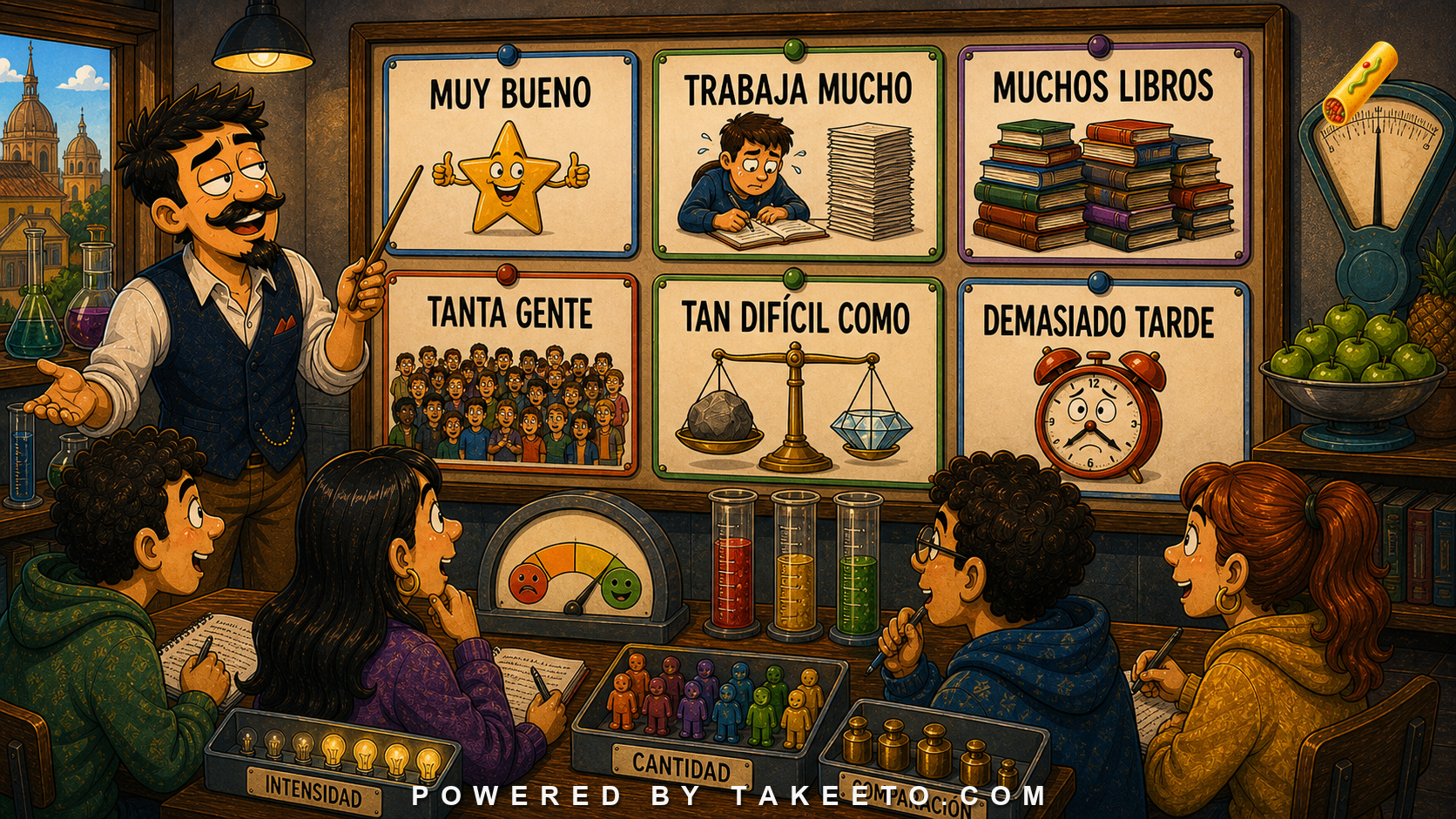
Spanish separates degree words that modify adjectives and adverbs from quantity words that modify nouns or verbs. Muy modifies adjectives and adverbs. Mucho can modify verbs, function as a pronoun, or agree with nouns as mucho/mucha/muchos/muchas.
muy cansado
very tired
trabaja mucho
works a lot
muchos libros
many books
This system extends into tan and tanto. Tan modifies adjectives and adverbs, especially in comparisons or intensification. Tanto modifies verbs, nouns, or works as a pronoun, with agreement when needed.
The basic pattern is:
adjective/adverb degree → muy, tan
verb/noun quantity → mucho, tanto
Muy with adjectives and adverbs
Use muy before adjectives:
muy bueno
very good
muy difícil
very difficult
muy interesante
very interesting
Use muy before adverbs:
muy bien
very well
muy rápido
very quickly
muy lejos
very far
Muy does not change for gender or number because it is an adverbial modifier.
una idea muy buena
unos libros muy buenos
unas respuestas muy buenas
The adjective agrees with the noun. Muy stays the same.
Do not write:
mucha buena idea
unless mucha modifies a noun like cantidad or appears in another structure. The normal phrase is:
una idea muy buena
Mucho with verbs
Use mucho after verbs to mean “a lot” or “much.”
Trabajo mucho.
I work a lot.
Me gusta mucho.
I like it a lot.
Hemos cambiado mucho.
We have changed a lot.
Here mucho does not agree with anything. It modifies the verb phrase or degree of the event.
Compare:
Estoy muy cansado.
I am very tired.
Trabajo mucho.
I work a lot.
The first modifies an adjective. The second modifies a verb. This is the core difference.
Mucho with nouns
Before nouns, mucho becomes a determiner and agrees in gender and number:
mucho dinero
a lot of money
mucha agua
a lot of water
muchos libros
many books
muchas personas
many people
| Noun | Form |
|---|---|
| dinero masculine singular/mass | mucho dinero |
| agua feminine singular | mucha agua |
| libros masculine plural | muchos libros |
| personas feminine plural | muchas personas |
The agreement is with the noun, not with the speaker or subject.
Tengo muchas dudas.
I have many doubts.
Hay muchos problemas.
There are many problems.
Remember that grammatical gender matters. Since problema is masculine:
muchos problemas
not:
muchas problemas
Mucho as pronoun
Mucho can stand alone as a pronoun-like quantity word:
No necesito mucho.
I do not need much.
Muchos no entendieron.
Many did not understand.
Muchas llegaron tarde.
Many women/feminine referents arrived late.
When it refers to people or understood nouns, it may agree:
Muchos prefieren esperar.
Many prefer to wait.
Muchas de las respuestas fueron correctas.
Many of the answers were correct.
Tan with adjectives and adverbs
Tan is the comparison/intensity partner of muy. It modifies adjectives and adverbs.
tan difícil
so difficult / as difficult
tan rápido
so fast / as fast
tan lejos
so far / as far
In equality comparisons, use tan... como:
Es tan alto como su padre.
He is as tall as his father.
Habla tan rápido como Ana.
He/she speaks as fast as Ana.
Tan also appears in exclamative or emphatic contexts:
No sabía que era tan caro.
I did not know it was so expensive.
Es tan fácil que cualquiera puede hacerlo.
It is so easy that anyone can do it.
Like muy, tan does not agree:
una casa tan grande
unos problemas tan difíciles
Tanto with verbs
Tanto modifies verbs in comparison or intensity:
Trabaja tanto como tú.
He/she works as much as you.
No estudies tanto.
Do not study so much.
Te quiero tanto.
I love you so much.
When tanto modifies a verb, it does not agree:
Ellas trabajan tanto como nosotros.
They work as much as we do.
Here tanto modifies trabajan, not ellas.
Tanto with nouns
Before nouns, tanto agrees:
tanto dinero
so much/as much money
tanta gente
so many/as many people
tantos libros
so many/as many books
tantas preguntas
so many/as many questions
In equality comparisons:
Tengo tantos libros como tú.
I have as many books as you.
No hay tanta gente como ayer.
There are not as many people as yesterday.
In result clauses:
Había tanta gente que no pudimos entrar.
There were so many people that we could not enter.
Again, agreement follows the noun.
Muy vs mucho after ser/estar
A common beginner error is using mucho before adjectives because English says “very.”
Incorrect:
Estoy mucho cansado.
Correct:
Estoy muy cansado.
But after a verb, mucho is correct:
Me cansé mucho.
I got very tired / I tired myself a lot.
Compare:
| Spanish | Structure | Meaning |
|---|---|---|
| Estoy muy cansado. | muy + adjective | I am very tired. |
| Trabajo mucho. | verb + mucho | I work a lot. |
| Me gusta mucho. | verb + mucho | I like it a lot. |
| Es muy importante. | muy + adjective | It is very important. |
Demasiado, poco, bastante
The same category distinction applies to other degree and quantity words.
Demasiado can modify adjectives/adverbs as an invariable adverb:
demasiado caro
too expensive
demasiado tarde
too late
It can also modify nouns with agreement:
demasiados problemas
too many problems
demasiada información
too much information
Poco behaves similarly:
poco claro
not very clear
pocos libros
few books
trabaja poco
works little
Bastante is often invariable before adjectives/adverbs and may be variable or invariable with nouns depending on use and analysis, but for learners the key is that it can mean “quite” or “enough/a fair amount.”
bastante difícil
quite difficult
bastantes personas
quite a few people
These words belong in the same mental category map: ask whether you are modifying an adjective, adverb, verb, or noun.
Common learner errors
Error 1: Using mucho before adjectives
Es mucho interesante.
Correct:
Es muy interesante.
Error 2: Using muy after verbs
Me gusta muy.
Correct:
Me gusta mucho.
Error 3: Forgetting agreement with nouns
mucho personas
Correct:
muchas personas
Error 4: Confusing tan and tanto
Tengo tan libros como tú.
Correct:
Tengo tantos libros como tú.
But:
Es tan difícil como pensaba.
because difícil is an adjective.
Error 5: Translating “very much” literally
English says:
I like it very much.
Spanish says:
Me gusta mucho.
Not:
Me gusta muy mucho.
Some varieties have colloquial expressions involving muy mucho in restricted uses, but learners should not use that as the default equivalent of English “very much.”
Diagnostic workflow: identify the word being measured
Every muy/mucho/tan/tanto choice begins with one question: what kind of word or phrase are you measuring?
If you are measuring an adjective, use muy or tan:
muy difícil
tan difícil como parecía
If you are measuring an adverb, use muy or tan:
muy rápido
tan rápido como antes
If you are measuring a verb, use mucho or tanto:
trabaja mucho
trabaja tanto como tú
If you are measuring a noun, use mucho/mucha/muchos/muchas or tanto/tanta/tantos/tantas with agreement:
mucha paciencia
tantos errores
This workflow solves most errors:
very tired → adjective → muy cansado
I like it very much → verb phrase → me gusta mucho
so many people → noun → tanta gente
as difficult as → adjective → tan difícil como
For editing, underline the measured element:
Es ___ interesante.
interesante is an adjective → muy or tan.
Tiene ___ problemas.
problemas is a noun → muchos or tantos.
Corre ___.
corre is a verb → mucho or tanto.
Then ask whether the phrase is simple intensity or comparison. Simple high degree uses muy with adjectives/adverbs and mucho with verbs/nouns. Equality comparison uses tan... como or tanto... como.
This also clarifies demasiado and poco:
demasiado tarde
demasiadas personas
poco claro
pocos recursos
The surface English translation is less important than the Spanish category. If learners build this habit early, comparisons and quantifiers become much less mysterious later.
Repairing English-shaped degree errors
A useful way to master muy, mucho, tan, tanto is to repair common English-shaped sentences. The mistake usually comes from translating an English degree word before identifying the Spanish target.
Start with the target, not the English.
Es mucho interesante.
What is being intensified? The adjective interesante. Spanish uses muy:
Es muy interesante.
Now try:
Me interesa muy.
What is being modified? A verb-like predicate, interesar. Spanish uses mucho:
Me interesa mucho.
Now:
Es muy mejor.
What is being modified? A comparative, mejor. Spanish uses mucho:
Es mucho mejor.
Now:
Tengo tan libros como tú.
What is being compared? A plural noun, libros. Spanish uses tantos:
Tengo tantos libros como tú.
This gives a practical repair table:
| Bad learner form | Diagnostic | Repair |
|---|---|---|
| mucho importante | adjective | muy importante |
| muy me gusta | verb/predicate | me gusta mucho |
| muy mejor | comparative | mucho mejor |
| tan preguntas | plural noun | tantas preguntas |
| tanto difícil como | adjective equality | tan difícil como |
Degree words also interact with word order. Mucho after a verb is common: trabaja mucho. Before a noun it agrees: muchos problemas. Before a comparative it does not agree: mucho mejores resultados is possible because mucho modifies the comparative degree, while mejores agrees with resultados.
This is why a purely vocabulary-based approach fails. The form is chosen by syntax. Once you ask “what is being modified?”, the system becomes much less mysterious.
Edge cases: bastante, demasiado, and local feel
A few degree words add another layer because their force changes by region and context. Bastante may mean “enough,” “quite,” or “a fair amount.” Demasiado may mean “too much” in a negative sense, but in colloquial speech it can sometimes mean “very” with positive evaluation. A learner should not flatten these into one English equivalent.
bastante claro
clear enough / quite clear
demasiada presión
too much pressure
Está demasiado bueno.
It is really good, in some colloquial varieties; literally, too good.
In careful writing, preserve the stricter distinction: muy intensifies, demasiado exceeds an acceptable limit, and bastante depends on whether the context means sufficiency or degree. In conversation, listen locally.
Contrast lab: the same adjective, noun, and verb
Put one idea through the four core patterns:
El examen es muy difícil.
The exam is very difficult.
El examen no es tan difícil como pensaba.
The exam is not as difficult as I thought.
Hay muchas preguntas difíciles.
There are many difficult questions.
Hay tantas preguntas como ayer.
There are as many questions as yesterday.
Now switch to a verb:
Estudia mucho.
He/she studies a lot.
Estudia tanto como su hermano.
He/she studies as much as his/her brother.
The adjective difícil takes muy/tan. The noun preguntas takes muchas/tantas. The verb estudia takes mucho/tanto. This is the system in miniature.
A second drill helps with demasiado:
Es demasiado caro.
It is too expensive.
Hay demasiados gastos.
There are too many expenses.
Gasta demasiado.
He/she spends too much.
The word changes or stays fixed according to what it modifies. Learners who underline the modified element rarely choose the wrong form.
V2 remediation refinement: comparatives change the modifier category
The first draft teaches muy/mucho and tan/tanto by asking what kind of word is being modified. The remediation pass adds a high-frequency trap: comparatives such as mejor, peor, mayor, menor, más, menos do not behave like ordinary adjectives for intensification.
English says “very good” and “much better.” Spanish parallels that distinction:
muy bueno
very good
mucho mejor
much better
Not:
muy mejor
The same applies to peor, mayor, and menor:
mucho peor
much worse
mucho mayor
much older / much greater
mucho menor
much smaller / much younger / much less
Why? Because the modifier is not simply intensifying a quality; it is intensifying a comparative degree. Spanish uses mucho for that job.
With nouns, agreement returns:
muchas mejores opciones
many better options
opciones mucho mejores
much better options
These two are not the same. In muchas mejores opciones, muchas modifies the noun opciones: many options. In opciones mucho mejores, mucho modifies mejores: much better options.
This contrast is worth drilling because it reveals the whole system:
| Phrase | What is modified? | Correct form |
|---|---|---|
| very expensive | adjective | muy caro |
| much more expensive | comparative degree | mucho más caro |
| many expensive books | noun | muchos libros caros |
| so expensive that... | adjective + result | tan caro que... |
| so many books that... | noun + result | tantos libros que... |
The repair habit remains the same: underline the measured element. If the measured element is a comparative, mucho is usually the tool, not muy.
Suggested interactive module: degree-quantity sorter
A useful tool would ask users what kind of word is being modified.
Suggested functions:
- Category detector: adjective, adverb, verb, noun, pronoun.
- Form selector: muy/mucho, tan/tanto, demasiado/demasiada/demasiados/demasiadas.
- Agreement checker: catches mucho personas and tantos agua.
- Comparison builder: tan + adjective/adverb + como, tanto/a/os/as + noun + como, verb + tanto como.
- English-interference warning: flags “very much” literal translations.
Example input:
I have as many questions as you.
Output:
Tengo tantas preguntas como tú. Use tantas because it modifies feminine plural preguntas.
Final rule
Use muy and tan with adjectives and adverbs. Use mucho and tanto with verbs, as pronouns, or before nouns with agreement.
muy bueno, tan difícil
trabaja mucho, trabaja tanto
muchos libros, tantas preguntas
The question is not which English word appears. The question is what Spanish category you are modifying.