
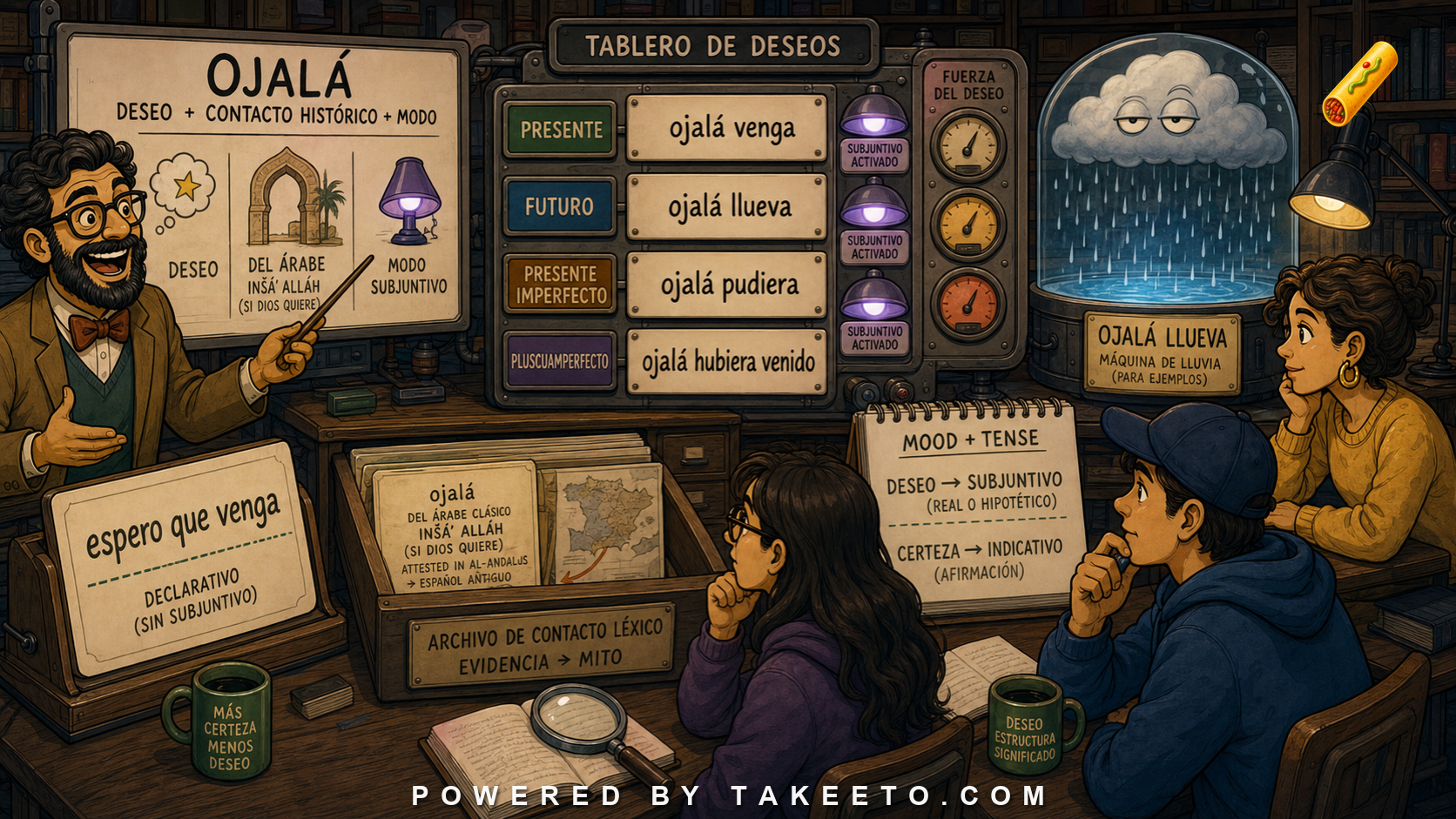
Ojalá is not just a decorative way to say “I hope”
Ojalá is one of the most expressive words in Spanish. It introduces wishes, hopes, regrets, longing, and sometimes desperate desire.
Ojalá venga.
I hope he comes.
Ojalá pudiera ayudarte.
I wish I could help you.
Ojalá hubiera venido.
I wish he had come.
Learners often translate it as “hopefully,” but that does not capture its full grammar. Ojalá almost always leads you into the subjunctive, and the tense of that subjunctive tells you how possible, distant, or impossible the wish feels.
The key principle is:
Ojalá introduces a wish; the subjunctive tense shows whether the wish is possible, distant, or contrary to fact.
A careful historical note
Ojalá comes into Spanish through Arabic contact in the Iberian Peninsula. It is historically connected to an expression meaning roughly “if God wills.” That history matters because it reminds us that Spanish vocabulary is layered: Latin inheritance, Arabic contact, indigenous American contact, learned borrowings, modern loans, and more.
But learners should avoid romanticizing the etymology. Modern ojalá is a Spanish discourse word, not a religious formula in ordinary use for most speakers. It can be used in secular, casual, emotional, and formal contexts.
A responsible way to remember it:
Historically shaped by Arabic contact; synchronically a Spanish marker of wishing.
That keeps history useful without turning it into mythology.
Ojalá + present subjunctive: possible wish
Use the present subjunctive when the wish points to a possible present or future event.
Ojalá venga.
I hope he comes.
Ojalá llueva mañana.
I hope it rains tomorrow.
Ojalá tengas suerte.
I hope you have good luck.
Ojalá todo salga bien.
I hope everything turns out well.
This does not guarantee optimism, but it leaves the wish in the realm of possibility.
Ojalá + imperfect subjunctive: distant or unlikely wish
Use the imperfect subjunctive when the wish feels less likely, impossible in the present, emotionally distant, or contrary to current reality.
Ojalá pudiera ir.
I wish I could go.
Ojalá estuvieras aquí.
I wish you were here.
Ojalá fuera más fácil.
I wish it were easier.
The difference between present and imperfect subjunctive can be subtle.
Compare:
Ojalá pueda ayudarte.
I hope I can help you.
Ojalá pudiera ayudarte.
I wish I could help you.
The first sounds possible. The second suggests that the speaker probably cannot help, or at least feels blocked.
Ojalá + pluperfect subjunctive: regret
Use the pluperfect subjunctive for wishes about the past.
Ojalá hubiera venido.
I wish he had come.
Ojalá lo hubiéramos sabido antes.
I wish we had known it earlier.
Ojalá no hubieras dicho eso.
I wish you had not said that.
This is the grammar of regret. The desired event is no longer possible because the relevant time has passed.
Ojalá and emotional force
Ojalá can be calm, warm, urgent, resigned, or painful.
Ojalá te guste.
I hope you like it.
This can be gentle and ordinary.
Ojalá pudiera volver atrás.
I wish I could go back.
This can be emotionally heavy.
Ojalá no pase nada.
I hope nothing happens.
This can show anxiety.
The word itself marks desire. The surrounding context supplies emotional intensity.
Ojalá versus espero que
Espero que and ojalá can overlap, but they are not identical.
Espero que venga.
I hope he comes.
Ojalá venga.
I hope he comes / may he come.
Espero que is built from a verb: “I hope that...” It presents the hope as the speaker’s mental state.
Ojalá is more direct as a wish marker. It can feel more exclamatory, emotional, or formulaic.
Compare:
Espero que puedas venir.
I hope you can come.
Ojalá puedas venir.
I really hope you can come / may you be able to come.
The second often feels more wish-like.
Ojalá without que
Modern Spanish usually uses ojalá directly before the subjunctive:
Ojalá tengas razón.
You may also encounter ojalá que:
Ojalá que tengas razón.
Both exist. Distribution depends on region, register, rhythm, and speaker preference. Learners should recognize both, but ojalá + subjunctive is the compact core pattern.
Ojalá and commands are different
Do not confuse wishes with commands.
Ojalá vengas.
I hope you come.
Ven.
Come.
Que vengas temprano.
Make sure you come early / I want you to come early.
All can point toward a desired event, but they have different pragmatic force. Ojalá wishes. It does not directly order.
Ojalá can wish for good or bad outcomes
Learners often meet ojalá in warm formulas, but grammatically it does not guarantee kindness. It marks a wish. The wish can be generous, anxious, resigned, angry, or hostile.
Ojalá te vaya bien.
I hope things go well for you.
Ojalá no pase nada.
I hope nothing happens.
Ojalá se arrepienta.
I hope he/she regrets it.
Ojalá no hubiéramos venido.
I wish we had not come.
This matters for reading tone. Ojalá does not always mean cheerful optimism. It means the speaker is projecting desire onto an event outside direct control.
Ojalá, quizá, and tal vez do different jobs
It is useful to separate wish markers from possibility markers.
Ojalá venga.
I hope he comes.
Quizá venga.
Maybe he will come.
Tal vez venga.
Maybe he will come.
Ojalá expresses desire. Quizá and tal vez express possibility or uncertainty. They can overlap emotionally, but they do not do the same discourse job.
This is why ojalá is odd as a neutral forecast. If you simply mean “maybe it will rain,” say:
Quizá llueva.
Tal vez llueva.
If you want rain, say:
Ojalá llueva.
The subjunctive may appear after all three expressions, but the meaning of the expression itself changes the sentence’s force.
Example bank walkthrough
ojalá venga
Possible future wish.
Learner action: present subjunctive for possible outcomes.
ojalá llueva
Possible weather wish.
Learner action: use present subjunctive even if the event is future.
ojalá pudiera
Distant or blocked ability.
Learner action: imperfect subjunctive often means “I wish I could.”
ojalá hubiera venido
Past regret.
Learner action: pluperfect subjunctive for what did not happen.
espero que venga
Verb phrase of hoping plus que.
Learner action: compare with ojalá for tone and structure.
Wish-probability routine
When using ojalá, ask:
- Is the wish still possible?
- Is it future or present?
- Is it unlikely or contrary to present reality?
- Is it about the past?
- Is the tone casual, emotional, regretful, or anxious?
Then choose:
- possible wish: present subjunctive;
- distant or contrary present wish: imperfect subjunctive;
- past regret: pluperfect subjunctive.
Suggested interactive module: wish-probability scale
A strong tool for this article would let learners move a wish along a possibility scale.
Suggested functions:
- Tense slider: venga → viniera → hubiera venido.
- Probability labels: possible, unlikely, impossible past.
- Emotion tags: hope, longing, regret, anxiety.
- Comparison panel: ojalá vs espero que.
- Que toggle: ojalá venga / ojalá que venga.
- Translation alternatives: I hope, I wish, if only.
- Scenario prompts: weather, exam, invitation, missed chance.
Final rule
Ojalá is a wish marker, and its power comes from the subjunctive that follows it.
Use the present subjunctive for possible wishes, the imperfect subjunctive for distant or blocked wishes, and the pluperfect subjunctive for regrets.
Do not reduce ojalá to “hopefully.” It is one of Spanish’s clearest bridges between mood, emotion, and history.