
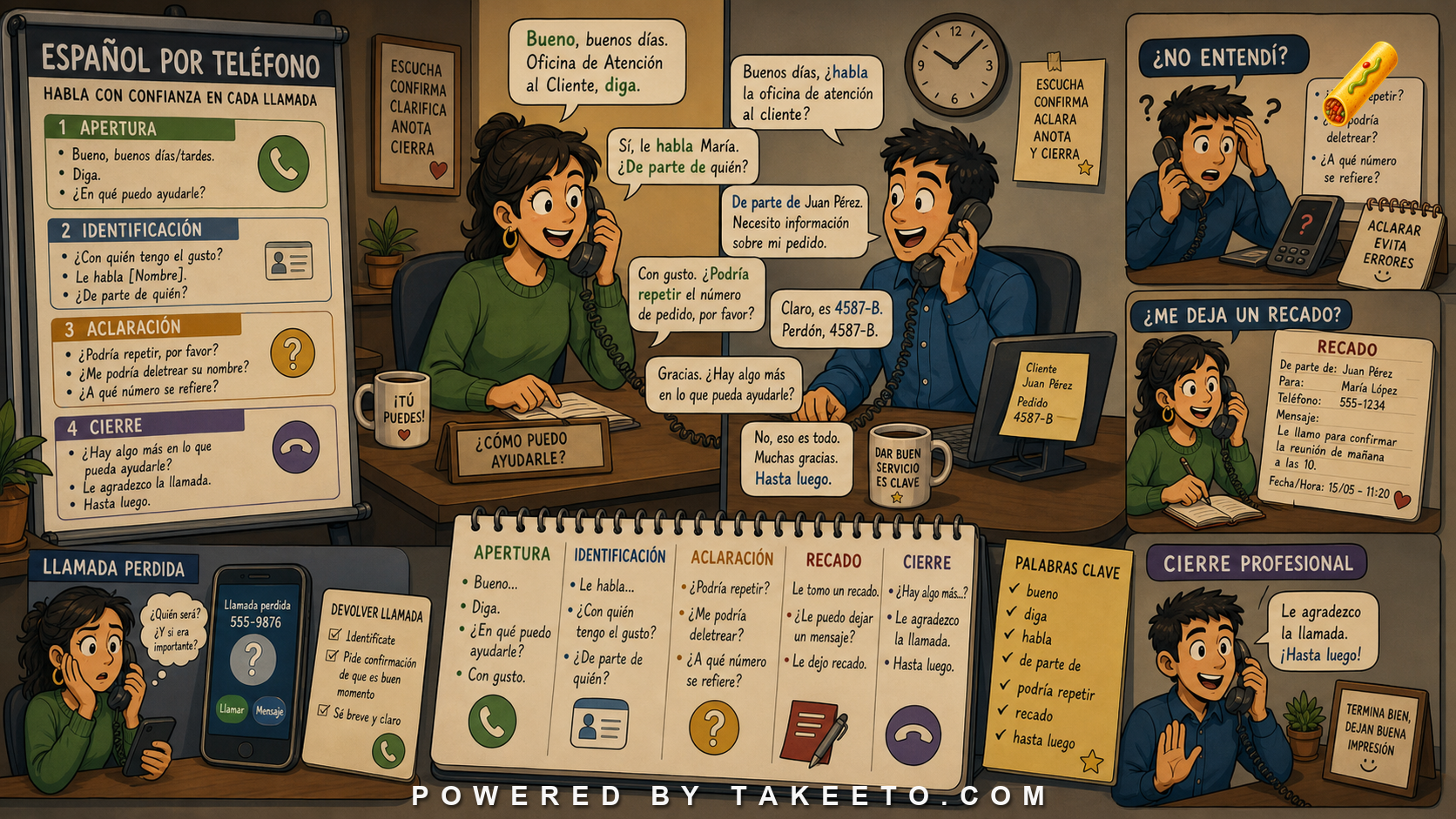
Phone calls need more verbal structure
Phone Spanish can be harder than face-to-face Spanish because you lose visual support. You cannot point, show a document, read facial cues, or rely on shared physical context. That means phone calls need stronger scripts: opening, identification, purpose, clarification, confirmation, and closure.
The key principle is:
Phone Spanish is managed through formulaic stages.
If you know the stages, you can handle calls even when the audio is imperfect.
Answering the phone: regional openings
Phone openings vary by country and context.
Common forms:
¿Bueno?
Hello? / Yes? Common in Mexico and elsewhere.
¿Diga? / Dígame.
Hello? / Speak/tell me. Common in Spain and other regions.
¿Aló? / ¿Hola?
Hello? Common in many places.
Buenas tardes, le atiende...
Good afternoon, you are being assisted by... Service/business context.
Empresa Norte, buenos días.
Norte Company, good morning.
Learners should recognize multiple openings and not be thrown by ¿Bueno?, which is not an evaluation of quality in this context.
Identifying yourself
Useful formulas:
Habla Laura Méndez.
Laura Méndez speaking.
Soy Laura Méndez.
I’m Laura Méndez.
Mi nombre es Laura Méndez.
My name is Laura Méndez.
Llamo de parte de...
I’m calling on behalf of...
Llamo por el anuncio / por la cita / por mi solicitud.
I’m calling about the ad / appointment / application.
Habla is a standard phone formula.
Habla Daniel Torres, de la Universidad Central.
Daniel Torres speaking, from Central University.
Asking for someone
Common phrases:
¿Se encuentra la señora García?
Is Ms. García available?
¿Podría comunicarme con el departamento de admisiones?
Could you connect me with the admissions department?
Quisiera hablar con el doctor Ruiz, por favor.
I would like to speak with Dr. Ruiz, please.
¿Está Ana?
Is Ana there? Informal.
Comunicarme con is useful in formal calls. Pasarme con is common in many regions but more informal.
¿Me puede pasar con contabilidad?
Can you put me through to accounting?
De parte de
De parte de identifies who is calling or on whose behalf.
¿De parte de quién?
Who is calling?
De parte de Carlos Rivas.
Carlos Rivas calling.
Llamo de parte de la doctora Salinas.
I’m calling on behalf of Dr. Salinas.
This phrase is extremely useful in receptionist-style calls.
Leaving a message
Message vocabulary varies regionally.
dejar un mensaje — leave a message
dejar recado — leave a message, common in Mexico and some regions
tomar nota — take a note
devolver la llamada — return the call
número de contacto — contact number
Examples:
¿Le puedo dejar un mensaje?
Can I leave him/her a message?
¿Le deja recado?
Will you leave a message?
¿Podría pedirle que me devuelva la llamada?
Could you ask him/her to return my call?
When giving a number, speak in chunks and confirm.
Clarification under poor audio
Phone calls require repair phrases.
¿Podría repetirlo, por favor?
Could you repeat that, please?
No le escucho bien.
I can’t hear you well.
Se corta la llamada.
The call is breaking up.
¿Me oye?
Can you hear me?
¿Podría hablar un poco más despacio?
Could you speak a little more slowly?
¿Me lo puede deletrear?
Can you spell it for me?
¿Con b de burro o v de vaca?
With b as in burro or v as in vaca? Regionally common spelling clarification.
Spelling over the phone is a real skill. Names, email addresses, and document numbers need confirmation.
Confirming information
Useful frames:
Entonces, la cita es el martes a las diez, ¿correcto?
So the appointment is Tuesday at ten, correct?
Para confirmar, su número es...
To confirm, your number is...
¿Me puede confirmar el correo electrónico?
Can you confirm the email address?
¿Sería tan amable de enviármelo por escrito?
Would you be so kind as to send it to me in writing?
Do not rely on memory after a phone call involving dates, addresses, prices, appointments, or document requirements. Confirm orally and, when possible, ask for written follow-up.
Formal and informal closings
Common closings:
Muchas gracias.
Thank you very much.
Gracias por su ayuda.
Thank you for your help.
Quedo atento/a.
I will stay attentive / I look forward to hearing. More email-like but can appear in formal closure.
Hasta luego.
Goodbye / see you later.
Que tenga buen día.
Have a good day.
Estamos en contacto.
We’ll be in touch.
Phone closings may overlap. Do not be surprised by multiple thanks and goodbyes.
Example bank walkthrough
¿bueno?
Phone opening in several regions.
Learner action: recognize as hello, not “good?”
¿diga?
Phone opening meaning speak/tell me.
Learner action: common in Spain and elsewhere.
habla
“Speaking,” as in Habla Ana.
Learner action: use for identification.
de parte de
On behalf of / who is calling.
Learner action: essential for receptionist calls.
¿podría repetir?
Could you repeat?
Learner action: use early rather than pretending to understand.
le dejo recado
I’ll leave a message.
Learner action: recognize regional message vocabulary.
hasta luego
Goodbye.
Learner action: common phone closing even when no literal later meeting is planned.
Phone-call flowchart
A basic formal call:
- Opening: Buenos días / ¿Diga? / ¿Bueno?
- Identification: Habla X / Soy X.
- Purpose: Llamo por...
- Request: Quisiera hablar con... / ¿Podría comunicarme con...?
- Clarification: ¿Podría repetirlo?
- Confirmation: Entonces, queda confirmado...
- Closure: Muchas gracias, hasta luego.
A message call:
- Ask for person.
- Person unavailable.
- Ask to leave message.
- Provide name, reason, number.
- Confirm message.
- Close politely.
Remediation: phone Spanish needs redundancy
Phone conversations remove visual support. You cannot point, show a document, or rely on facial expression. That means phone Spanish needs more verbal structure, more confirmation, and more repair phrases than face-to-face conversation.
The learner should use a predictable sequence:
- opening,
- identification,
- reason for calling,
- request or information exchange,
- confirmation of names/numbers/dates,
- next step,
- closure.
Skipping identification or confirmation may save seconds but create confusion.
Regional openings and what they signal
Common openings include:
¿Bueno?
¿Diga? / Dígame.
¿Aló? / ¿Hola?
¿Sí?
Buenas tardes, [empresa], le atiende...
These vary by region and context. A business call often uses an institutional opening:
Buenos días, Clínica Central, le atiende Marta. ¿En qué puedo ayudarle?
A private call may be shorter. The learner should be ready to recognize several openings rather than expecting one universal “hello.”
Mini-workshop: make a call script stronger
Weak script:
Hola, soy Ana. Quiero hablar con el doctor.
Stronger:
Buenos días. Mi nombre es Ana Ruiz. Llamo para confirmar una cita con el doctor Martínez para mañana a las diez. ¿Podría indicarme si sigue programada?
Why it works:
Buenos días = formal opening.
Mi nombre es = clear identification.
Llamo para = purpose frame.
confirmar una cita = action.
doctor Martínez = specific person.
mañana a las diez = time.
¿Podría indicarme...? = polite request.
The stronger version reduces follow-up questions.
Clarification phrases are survival tools
Phone audio is imperfect. Learners need repair phrases ready:
¿Podría repetirlo, por favor?
¿Me lo puede deletrear?
¿Sería tan amable de hablar un poco más despacio?
No escuché bien la última parte.
¿Dijo quince o cincuenta?
Entonces, para confirmar, la cita es el martes 12 a las 9:30, ¿correcto?
These phrases are not signs of failure. They are competent phone behavior.
Spelling names and numbers
Names, emails, confirmation codes, dates, and phone numbers are high-risk. Spanish speakers may spell with examples:
B de Barcelona, V de Valencia, M de Madrid, N de Navarra.
Systems differ. Some people use country/city names; others simply repeat letters. Learners should confirm:
¿B de Barcelona o V de Valencia?
¿Con tilde?
¿Todo junto o separado?
¿Guion bajo o guion medio?
Digital contact information adds vocabulary:
arroba, punto, guion, guion bajo, barra, mayúscula, minúscula.
Leaving a message
Useful structure:
Buenos días, habla Ana Ruiz. Llamo por la solicitud enviada el lunes. Mi número es 555-123-456. Agradecería que me devolvieran la llamada cuando sea posible. Muchas gracias.
Key elements:
name, reason, callback number, requested action, thanks.
Do not leave only “llámeme.” Give enough context.
Closure and next step
Phone calls should end by confirming action:
Entonces, quedamos en que enviaré el documento hoy por la tarde.
Perfecto, espero su correo.
Muchas gracias por su ayuda. Hasta luego.
A Takeeto phone module should simulate noisy audio, missing information, and confirmation codes. The learner’s goal is not perfect elegance; it is reliable completion of the call.
Remediation drill: confirmation phrases are not optional
At the end of a phone call, confirm the result.
Weak ending:
Vale, gracias.
Better:
Entonces quedamos para el jueves 28 a las cuatro de la tarde en la oficina de admisiones, ¿correcto?
For numbers:
Le repito el número: 555-274-901. ¿Es correcto?
For email:
Entonces el correo es admisiones arroba universidad punto edu, ¿verdad?
For names:
¿Me confirma si se escribe Hernández con hache?
Handling fast speech
Do not apologize endlessly. Repair clearly.
Perdón, ¿podría repetir la última parte?
¿Me lo puede decir un poco más despacio?
No alcancé a tomar nota del número.
¿Sería posible enviarme la información por mensaje o correo?
These are competence phrases, not failure phrases. Good phone Spanish includes repair.
Closure formulas
Professional:
Muchas gracias por su ayuda. Que tenga buen día.
Neutral:
Perfecto, muchas gracias. Hasta luego.
Informal:
Gracias, hablamos luego.
Do not disappear from the call. Close the interaction.
Extra practice: voicemail and missed-call Spanish
Phone literacy also includes messages.
Voicemail opening:
Hola, habla Mariana López. Llamo de la oficina de becas.
Reason:
Quería darle seguimiento a su solicitud.
Requested action:
Le agradeceríamos que nos devolviera la llamada antes del viernes.
Contact details:
Puede comunicarse al 555-721-884 o escribirnos a becas@ejemplo.edu.
Closure:
Muchas gracias. Que tenga buen día.
If you are leaving the message, be brief. Repeat the number slowly if the channel is audio-only.
For a missed call follow-up by text or email:
Intenté comunicarme por teléfono hace unos minutos. Le escribo para confirmar...
For receiving a call at a bad time:
Disculpe, en este momento no puedo atenderle. ¿Podría devolverle la llamada en unos minutos?
These phrases prevent silence from becoming confusion.
Final phone habit: document the outcome
After an important call, write down what was agreed while it is still fresh:
date and time of call
person or office spoken to
appointment, case number, or next step
documents requested
deadline
whether written confirmation was promised
This turns a fragile listening event into a usable record.
Suggested interactive module: phone-call flowchart by scenario
A strong tool for this article would train scripted phone interactions.
Suggested functions:
- Regional opening recognition: ¿bueno?, ¿diga?, ¿aló?
- Scenario flows: appointment, office, delivery, school, wrong number.
- Audio-noise mode: practice clarification phrases.
- Spelling trainer: names, emails, document numbers.
- Message builder: name, reason, contact, callback request.
- Closure practice: formal and informal endings.
Final rule
Phone Spanish rewards scripts.
Learn openings, identification formulas, de parte de, clarification phrases, message language, and confirmation routines. Do not fake comprehension on the phone. Ask for repetition, spell names, confirm numbers, and close clearly.