
Can is not one Spanish verb
English uses “can” for many meanings:
I can speak Spanish.
Can I enter?
It can rain here.
I can swim.
Spanish does not use one verb for all of these in the same way. The two most important verbs are poder and saber.
Compare:
Puedo hablar.
I can speak / I am able to speak.
Sé hablar español.
I know how to speak Spanish.
The first sentence emphasizes ability, permission, possibility, or opportunity depending on context. The second emphasizes learned skill or know-how.
The key principle is:
Poder expresses ability, permission, possibility, or opportunity. Saber + infinitive expresses learned skill or knowledge how to do something.
Poder as ability
Poder can mean being able to do something because conditions allow it.
Puedo ayudarte.
I can help you.
No puedo abrir la puerta.
I cannot open the door.
¿Puedes venir mañana?
Can you come tomorrow?
This ability may be physical, practical, legal, emotional, or circumstantial. Context tells you what kind.
No puedo más.
I cannot take any more.
Here poder expresses capacity in a broad human sense, not a technical skill.
Poder as permission
Poder also asks or gives permission.
¿Puedo entrar?
May I come in?
Puedes usar mi teléfono.
You can use my phone.
No se puede fumar aquí.
Smoking is not allowed here.
In polite contexts, poder is one of the most useful request verbs.
¿Podría ayudarme?
Could you help me?
The conditional podría softens the request.
Poder as possibility
Poder can express that something may happen or may be true.
Puede llover.
It may rain.
Puede ser verdad.
It may be true.
Podría haber un error.
There could be an error.
This is not ability. Rain is not “able” in the human sense. Poder marks possibility.
Poder as opportunity
Sometimes poder means that an opportunity existed or became available.
Por fin pude hablar con ella.
I finally managed to speak with her.
No pude ver la película.
I could not / did not manage to see the movie.
This use becomes especially important in the preterite.
Saber + infinitive as learned skill
Use saber + infinitive for knowing how to do something.
Sé nadar.
I know how to swim.
Sabe cocinar muy bien.
She knows how to cook very well.
No sabemos conducir.
We do not know how to drive.
¿Sabes tocar la guitarra?
Do you know how to play the guitar?
This is learned ability, not merely opportunity.
Compare:
Puedo conducir hoy.
I can drive today.
Maybe I am available, allowed, sober, or have the car.
Sé conducir.
I know how to drive.
I have the skill.
Puedo hablar versus sé hablar
Puedo hablar español.
I can speak Spanish.
This could mean I am able to speak now, I am allowed to speak, or I have enough ability to communicate.
Sé hablar español.
I know how to speak Spanish.
This specifically frames Spanish speaking as a skill. Depending on context, it may sound slightly emphatic or defensive, as if responding to doubt.
In many ordinary situations, speakers simply say:
Hablo español.
I speak Spanish.
Do not overuse sé hablar when the simple verb is more natural.
Preterite meaning shifts: poder
The preterite of poder often implies success, opportunity, or managed completion.
Pude hacerlo.
I was able to do it / I managed to do it.
No pude hacerlo.
I could not do it / I failed to do it.
Compare with the imperfect:
Podía hacerlo.
I could do it / I was able to do it.
The imperfect describes ability or possibility as a background condition. The preterite often presents an actual outcome.
Ayer podía llamarte, pero no pude.
Yesterday I was able to call you, but I did not manage to.
Preterite meaning shifts: saber
The preterite of saber often means “found out” or “learned the fact.”
Supe la verdad ayer.
I found out the truth yesterday.
¿Cuándo supiste la noticia?
When did you hear/find out the news?
The imperfect sabía describes already knowing.
Sabía la verdad.
I knew the truth.
This contrast is important:
Sabía dónde vivía.
I knew where she lived.
Supe dónde vivía.
I found out where she lived.
Negative implications
No pudo venir means the person did not come because they could not.
No pudo venir.
He could not come / he was unable to come.
It usually implies non-occurrence.
By contrast:
No podía venir.
He could not come / was not able to come.
This describes the condition and may need context to clarify whether the event happened. Preterite tends to package the outcome more strongly.
No puedo and no sé are different failures
The negative forms make the distinction especially clear.
No sé nadar.
I do not know how to swim.
This is a skill gap.
No puedo nadar.
I cannot swim.
This may be because the pool is closed, I am injured, I am not allowed, the water is dangerous, or the situation prevents it. The skill may exist.
More contrasts:
No sé conducir.
I do not know how to drive.
No puedo conducir hoy.
I cannot drive today.
No sabe leer.
He/she does not know how to read.
No puede leer esto.
He/she cannot read this.
The second sentence could be about eyesight, access, permission, language, print size, or circumstance.
The simple verb is often the most natural answer
Learners sometimes overbuild sentences because English uses “can.” In Spanish, a simple present verb often expresses ability in a natural way.
Hablo español.
I speak Spanish.
This is often better than:
Sé hablar español.
when you are simply stating language ability.
Similarly:
Conduzco.
I drive.
may be enough in contexts where English says “I can drive.” Use sé conducir when the skill itself is in question. Use puedo conducir when circumstances or permission are in question.
This gives a three-way choice:
Hablo español.
I speak Spanish.
Sé hablar español.
I know how to speak Spanish.
Puedo hablar español ahora.
I can speak Spanish now / I am allowed or able to speak Spanish now.
Natural Spanish is not always the most literal translation of English “can.”
Example bank walkthrough
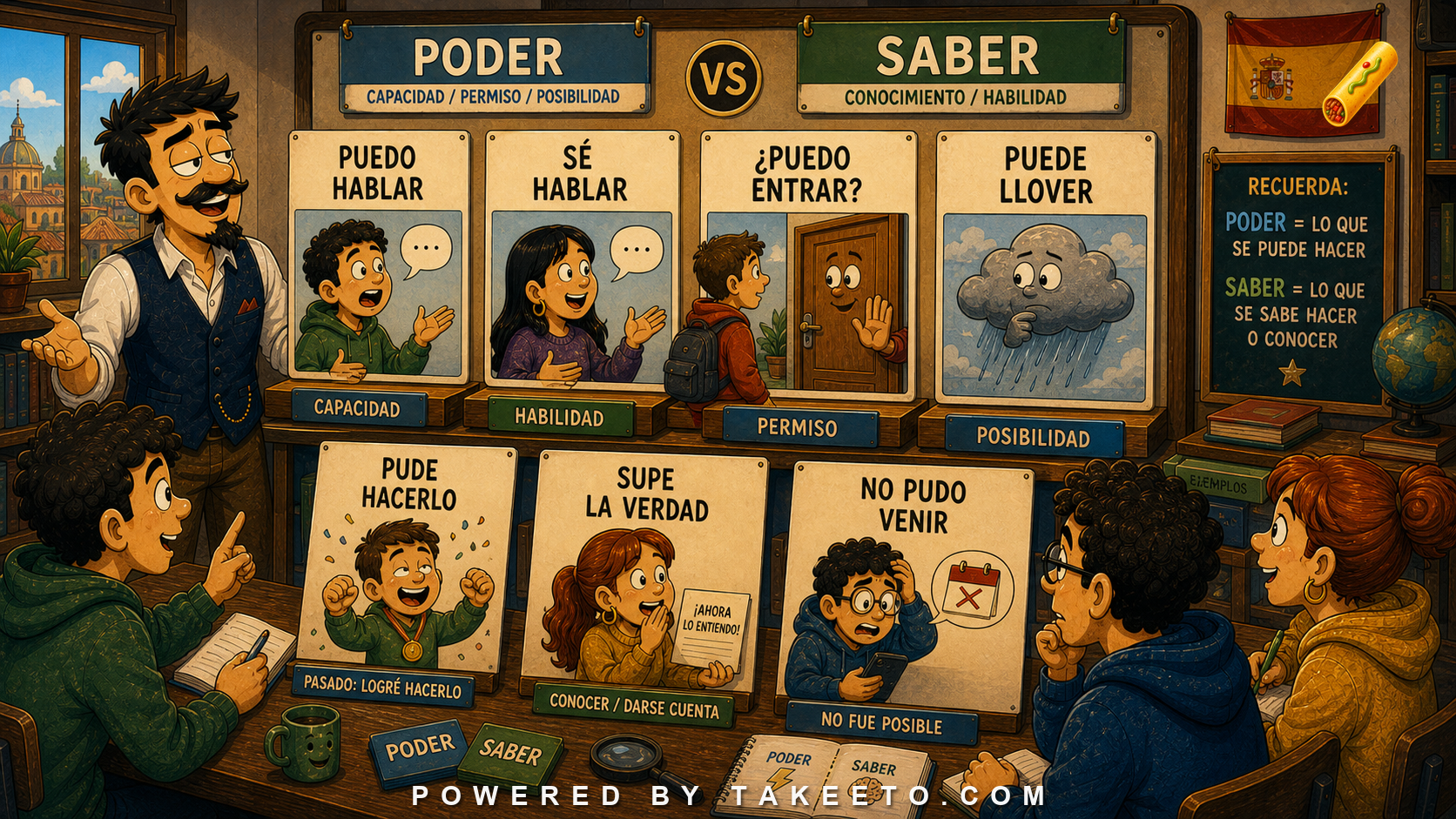
puedo hablar
Ability, permission, or immediate capacity.
Learner action: use context to determine meaning.
sé hablar
Learned skill.
Learner action: use for know-how, but do not overuse where hablo is enough.
¿puedo entrar?
Permission request.
Learner action: translate as “May I come in?”
puede llover
Possibility.
Learner action: poder is not only personal ability.
pude hacerlo
Managed to do it.
Learner action: preterite often implies successful outcome.
supe la verdad
Found out the truth.
Learner action: preterite saber often means discovery.
no pudo venir
Was unable to come, and normally did not come.
Learner action: notice the outcome implication.
Decision routine
Ask:
- Is this about a learned skill?
- Is it about permission?
- Is it about practical ability or opportunity?
- Is it about possibility?
- Is the verb in the preterite or imperfect?
- Does the sentence imply successful completion or discovery?
Then choose saber + infinitive for skill and poder for ability, permission, possibility, or opportunity.
Suggested interactive module: modal meaning classifier
A strong tool for this article would classify “can” meanings before translating.
Suggested functions:
- Meaning selector: skill, permission, ability, possibility, opportunity.
- Verb recommendation: poder, saber, or simple verb.
- Tense contrast: pude/podía, supe/sabía.
- Request mode: puedo/podría.
- Outcome indicator: managed to, failed to, found out.
- Translation traps: I can speak → hablo / puedo hablar / sé hablar.
- Scenario prompts: driving, weather, entering, helping, learning news.
Final rule
Do not translate every “can” with poder automatically.
Use saber + infinitive for learned skill. Use poder for ability, permission, possibility, and opportunity. Watch the preterite: pude often means “managed to,” and supe often means “found out.”
Spanish separates capacity from know-how more clearly than English often does.