
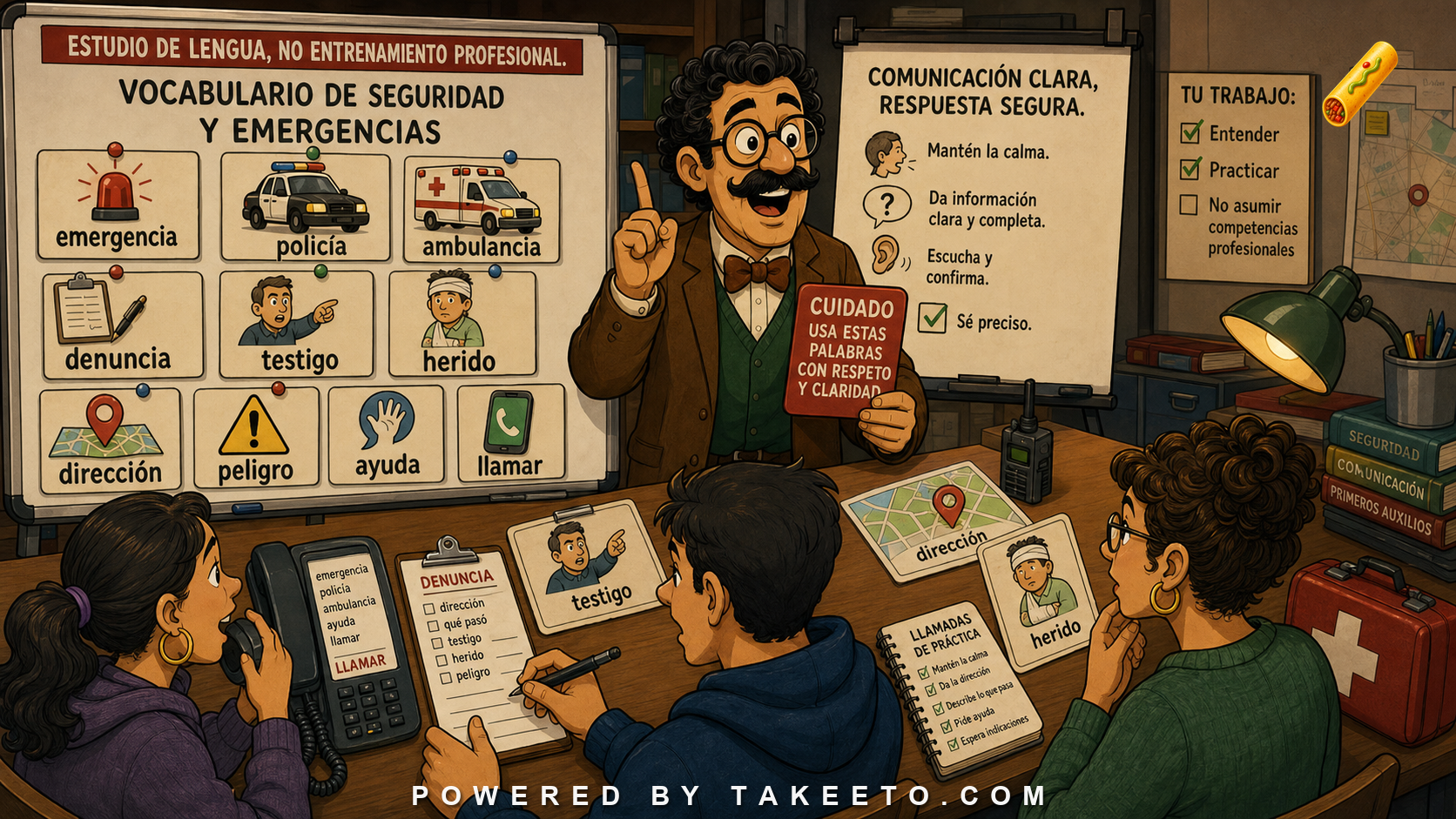
Emergency Spanish is not a performance test
In emergencies, language is secondary to safety. You do not need elegant Spanish. You need to communicate location, danger, injury, identity, and what happened. This article is not a substitute for local emergency training, legal advice, medical interpreting, or police procedure. It is a language-literacy guide for recognizing key words and forming simple, useful messages.
The key principle is:
Emergency Spanish should be short, concrete, location-first, and cautious about legal meaning.
Do not over-explain if you are unsafe. Do not guess legal terms if the consequences are serious. Use professional interpreters when available.
Emergencia, urgencia, peligro
Core urgency vocabulary includes emergencia, urgencia, peligro, ayuda, auxilio, and socorro. Urgencias may refer to an emergency department or urgent care area in medical settings, especially in Spain and many health systems.
Examples:
Es una emergencia.
It is an emergency.
Hay peligro.
There is danger.
Necesito ayuda.
I need help.
¡Auxilio!
Help!
Police, ambulance, firefighters
Emergency services vocabulary includes policía, ambulancia, bomberos, servicios de emergencia, operador/a, and patrulla.
Examples:
Llame a una ambulancia.
Call an ambulance.
Necesito a la policía.
I need the police.
Hay fuego. Llame a los bomberos.
There is fire. Call the firefighters.
Emergency numbers differ by country. Know the local number before you need it.
Location first: dirección and ubicación
Emergency communication should give location early. Use dirección, ubicación, calle, esquina, cerca de, frente a, piso / planta, and edificio.
Examples:
Estoy en la calle Bolívar, esquina con San Martín.
I am on Bolívar Street, corner with San Martín.
La dirección es...
The address is...
Estoy cerca de la estación.
I am near the station.
Learner action: memorize how to say your address, hotel, workplace, or current location.
Injury and medical urgency
Basic injury words include herido/a, lesión, sangre, dolor, inconsciente, no respira, accidente, atropello, and caída.
Examples:
Hay una persona herida.
There is an injured person.
Está inconsciente.
He/she is unconscious.
No puede respirar.
He/she cannot breathe.
Hay mucha sangre.
There is a lot of blood.
Learner action: be concrete. Say what you see, not a diagnosis you cannot support.
Denuncia, reportar, declarar
Legal/reporting verbs need care. Denunciar may mean report or file a formal complaint. Denuncia is a formal report/complaint. Reportar is common in many American contexts and influenced by English. Declarar means give a statement/declare. Testigo, víctima, and sospechoso name legal roles.
A denuncia may be more formal than a simple report in many systems. Declarar may create an official statement. Do not sign or declare things you do not understand.
Learner action: ask for an interpreter or clarification in legal contexts.
Theft, loss, assault, and danger
Common incident terms include robo, hurto, asalto, agresión, amenaza, violencia, acoso, perdido, and desaparecido. These words can have legal nuances. Use simple facts when unsure.
Examples:
Me quitaron la mochila.
They took my backpack from me.
No encuentro mi pasaporte.
I can’t find my passport.
Una persona me amenazó.
A person threatened me.
Public safety notices
Signs and alerts may say prohibido el paso, zona de evacuación, salida de emergencia, mantenga la calma, siga las instrucciones, riesgo de incendio, or peligro de derrumbe.
Learner action: in safety signage, act on the verb: do not enter, evacuate, follow, call, report.
Example bank walkthrough
emergencia
Emergency.
Learner action: use directly when immediate help is needed.
policía
Police.
Learner action: local roles and procedures vary.
ambulancia
Ambulance.
Learner action: pair with location and injury.
denuncia
Formal report/complaint.
Learner action: understand before signing.
testigo
Witness.
Learner action: distinguish witness from victim or suspect.
herido
Injured.
Learner action: use visible facts.
dirección
Address.
Learner action: give it early.
peligro
Danger.
Learner action: name immediate risk.
ayuda
Help.
Learner action: simple and high value.
llamar
To call.
Learner action: know local emergency number.
Emergency script templates
Useful minimal templates include Necesito ayuda. Estoy en..., Hay una persona herida, Necesito una ambulancia, Hay un incendio, Me robaron..., and Quiero pedir un intérprete.
Remediation notes: emergency Spanish prioritizes clarity over elegance
Emergency Spanish should be remediated with one blunt rule: in danger, clarity beats grammar perfection. The learner's goal is not a beautiful sentence. It is to communicate location, event, people involved, injuries, urgency, and contact details.
A simple emergency structure:
Estoy en [lugar]. Hay [problema]. Hay [número] personas heridas. Necesitamos [policía/ambulancia/bomberos]. Mi número es [número].
This structure is more useful than memorizing dozens of isolated words. It supplies the responder with dispatch-relevant information.
The verbs denunciar, reportar, declarar, identificar, and auxiliar need stronger separation. Denunciar often means to file a police/legal report or report an offense to authorities. Reportar can mean report, especially in American varieties and institutional contexts. Declarar means give a statement or declare formally. Identificar may mean identify a person/object or provide ID. Auxiliar means assist or give aid, more formal than everyday ayudar.
Learners should also distinguish robo, hurto, asalto, agresión, amenaza, pérdida, and extraviado. Legal meanings vary by country, so the safer plain-language strategy is to describe the event:
Me quitaron la cartera en la calle.
Entraron en mi habitación y falta mi pasaporte.
Me amenazó con un cuchillo.
No encuentro mi bolso; creo que lo dejé en el taxi.
Do not overclaim legal categories when you are unsure. Describe what happened.
Public safety notices also use compressed language: prohibido el paso, salida de emergencia, zona de evacuación, riesgo de incendio, alto voltaje, piso mojado, no cruzar, mantenga la calma. Learners should treat these as action instructions, not vocabulary exercises.
For medical urgency, clear symptom words matter: dolor en el pecho, dificultad para respirar, hemorragia, desmayo, convulsión, alergia, embarazo, medicamentos, antecedentes. If you need an interpreter, ask directly:
Necesito un intérprete, por favor. No entiendo bien.
Repair rule:
Emergency Spanish should be short, factual, and location-first. Describe what happened before trying to name the legal category.
Suggested interactive module: emergency phrase map
A strong tool for this article would prioritize safety and role clarity.
Suggested functions:
- Location-first script: address, landmark, floor, entrance.
- Service selector: police, ambulance, firefighters.
- Incident vocabulary: accident, theft, fire, injury, threat, missing person.
- Witness/victim role labels: testigo, víctima, denunciante.
- Medical fact prompts: breathing, bleeding, conscious, pain, age.
- Legal caution layer: denuncia, declaración, firma, intérprete.
- Public-sign decoder: no entry, evacuation, emergency exit.
- Offline phrase card: short phrases for urgent use.
Final rule
Emergency Spanish should be simple, factual, and location-first.
Say where you are, what happened, who is hurt, and what service you need. Avoid legal overstatement. Ask for an interpreter when the consequences are serious.