
Poner is a verb of placing into a situation
Learners often translate poner as “to put.” That is the core, but it does not explain why Spanish says:
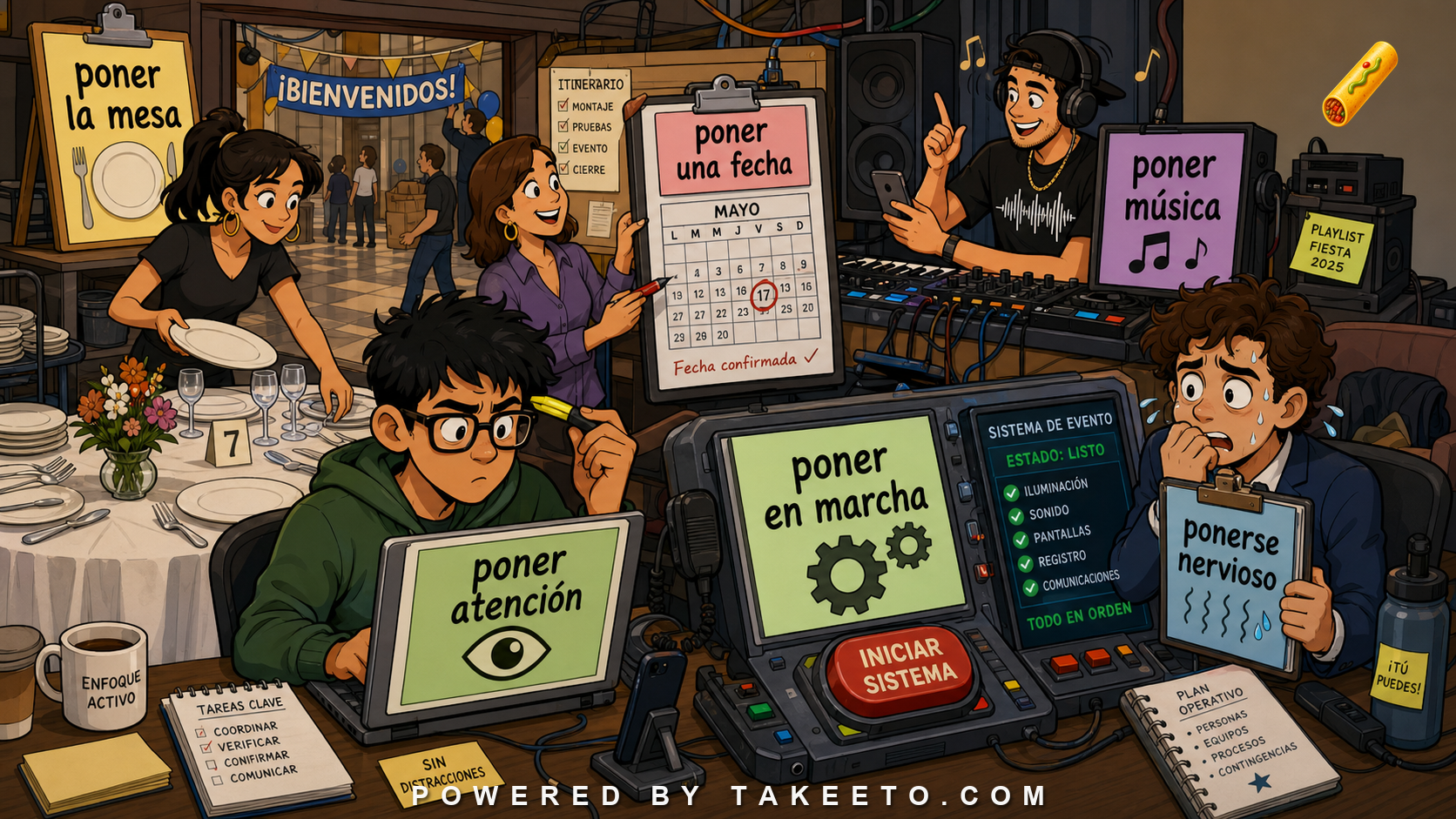
poner música
to put on/play music
ponerse nervioso
to get nervous
poner una fecha
to set a date
poner en marcha
to launch, start up
These are not random idioms. Poner places something into position, use, visibility, operation, written form, social status, or emotional state.
The key principle is:
Poner means putting something somewhere, but “somewhere” may be physical, mental, textual, institutional, emotional, or functional.
That is why poner appears in homes, forms, classrooms, business meetings, media apps, prices, clothing, and moods.
Physical placement
The basic use is concrete placement.
Pon el libro en la mesa.
Put the book on the table.
Puse las llaves en la bolsa.
I put the keys in the bag.
¿Dónde pusiste el teléfono?
Where did you put the phone?
Here the structure is simple: someone places an object in a location.
But even physical poner often belongs to routines:
poner la mesa
to set the table
poner una silla junto a la ventana
to put a chair by the window
poner la ropa en el armario
to put the clothes in the closet
Poner la mesa does not mean placing the table somewhere. It means setting it with plates, glasses, and utensils. The object phrase can name the whole routine.
Poner vs meter and colocar
Meter means putting into an interior or container:
Mete la ropa en la maleta.
Put the clothes into the suitcase.
Poner is more general:
Pon la ropa en la cama.
Put the clothes on the bed.
Colocar is often more deliberate, orderly, or formal:
Coloque el documento en la bandeja.
Place the document in the tray.
In everyday speech, poner is the broad default. Meter emphasizes entry into a space. Colocar emphasizes careful placement or institutional instruction.
Poner + adjective: assign a state
Poner can assign a state or condition to something.
Puse la habitación limpia.
I made the room clean / got the room clean.
El sol puso roja la pared.
The sun turned the wall red.
This structure is less common for learners than ponerse, but it shows the logic: something is put into a condition.
More common are result phrases such as:
poner algo difícil
to make something difficult
poner algo claro
to make something clear
poner nervioso a alguien
to make someone nervous
Esa situación me pone nervioso.
That situation makes me nervous.
The subject causes a state in someone or something.
Ponerse + adjective: entering a state
With se, ponerse often means becoming or getting into a temporary state.
Se puso nervioso.
He got nervous.
Me puse triste.
I became sad.
El cielo se puso oscuro.
The sky got dark.
Se puso enferma.
She got sick.
This is one of the main Spanish change-of-state verbs. It often suggests a visible or temporary shift: emotions, color, health, physical condition, mood.
Compare:
Se hizo médica.
She became a doctor. Role or identity.
Se volvió arrogante.
He became arrogant. Character shift.
Se puso contento.
He got happy. Temporary state.
Do not use ponerse for every English “become.” Ask what kind of change is involved.
Clothing: ponerse and quitarse
Ponerse is also the ordinary verb for putting on clothing and accessories.
Me puse el abrigo.
I put on my coat.
Se puso los zapatos.
She put on her shoes.
Ponte el cinturón.
Put on your seatbelt.
Spanish normally uses the definite article with clothing when the affected person is clear:
Me puse los zapatos.
I put on my shoes.
Not:
Me puse mis zapatos.
The possessive is possible when contrast matters, but the normal pattern is article plus reflexive pronoun.
Media and activation
Poner is common for activating media, playing audio/video, and putting something into operation.
Pon música.
Put on some music.
Voy a poner una película.
I’m going to put on a movie.
¿Puedes poner las noticias?
Can you put on the news?
Pusieron el partido en la televisión.
They put the game on TV.
This is not simply physical putting. It is making media available, active, or perceptible.
The same logic appears in:
poner en marcha
to start up, launch
poner en funcionamiento
to put into operation
poner a cargar el teléfono
to put the phone to charge
Poner places a system into an active state.
Written forms, prices, dates, and names
Spanish uses poner for entering information into a text or official field.
Pon tu nombre aquí.
Write your name here.
¿Qué pongo en esta casilla?
What should I put in this box?
Pusieron mal mi apellido.
They put my surname incorrectly.
Hay que poner una fecha.
We need to set/enter a date.
It also appears with prices:
Le pusieron un precio muy alto.
They set a very high price for it.
El menú pone diez euros, pero cobraron doce.
The menu says ten euros, but they charged twelve.
In some varieties and contexts, poner can mean “say” or “be written” on signs, labels, and documents.
Aquí pone que está cerrado.
It says here that it is closed.
This is an important reading verb. The sign “puts” the information before the reader.
Institutional poner
Formal and institutional Spanish uses poner in expressions of implementation, record, and legal effect.
poner en conocimiento
to bring to someone’s attention
poner en marcha un programa
to launch a program
poner fin a una relación laboral
to put an end to an employment relationship
poner a disposición
to make available
These are not everyday beginner phrases, but learners reading documents will meet them. The pattern is often poner en + abstract noun.
Poner atención
In much of Spanish, prestar atención is very common for “pay attention.” Poner atención is also used in many regions, especially in the Americas, and is understandable across contexts.
Pon atención a las instrucciones.
Pay attention to the instructions.
A learner writing formal international Spanish can often choose prestar atención. A learner listening to everyday speech should recognize poner atención.
Common learner traps
The first trap is overusing poner for every “put” even when containment matters.
Put it in the box.
Mételo en la caja. / Ponlo en la caja.
Both may work, but meter is more specific if entry into a container is central.
The second trap is missing ponerse for emotional changes:
Weak if the intended meaning is “he became nervous”: Llegó nervioso.
Correct for change: Se puso nervioso.
Llegó nervioso is grammatical, but it means that he arrived while already nervous. It does not describe the change into nervousness. For the change itself, use ponerse nervioso.
The third trap is translating “put on” too literally without learning clothing and media patterns:
Me puse la chaqueta.
Puse música.
The same English phrase maps to different Spanish structures.
Remediation notes: state, activation, and institutional poner
The biggest risk with poner is overgeneralizing the English “put.” Spanish poner is broad, but it is not a universal replacement for meter, colocar, dejar, establecer, fijar, escribir, or introducir. The verb is productive because it places something into a new state or functional position; the details still matter.
A useful contrast is poner, dejar, and hacer with result adjectives:
Esta noticia me puso nervioso.
This news made me nervous.
Dejé la puerta abierta.
I left the door open.
Hice más fácil el proceso.
I made the process easier.
Poner often presents the state as imposed or entered. Dejar presents the result as left in place. Hacer presents a caused transformation more generally. These verbs overlap, but they do not frame the result the same way.
Another high-value pattern is ponerse a + infinitive, which means beginning to do something:
Se puso a llorar.
He/She started crying.
Nos pusimos a trabajar.
We got to work.
This is different from ponerse + adjective:
Se puso triste.
He/She got sad.
Both involve entry into a state or activity, but the grammar tells you which: adjective for state, a + infinitive for activity.
Institutional and written Spanish uses poner in ways that often surprise learners:
Ponga su nombre y firma.
Write/put your name and signature.
Le pusieron una multa.
They fined him/her.
Pusieron una fecha límite.
They set a deadline.
El banco puso nuevas condiciones.
The bank imposed/set new conditions.
Here poner does not simply mean placing an object on a surface. It places a rule, label, charge, date, or written item into an official frame. In polished writing, alternatives such as establecer, fijar, imponer, anotar, or indicar may be more precise. Learners should recognize poner as the everyday engine and learn the more formal substitutes as register upgrades.
For poner atención, keep the regional note clear. Prestar atención is widely safe in formal international Spanish. Poner atención is common in many American varieties and everyday contexts. A good learner does not call it wrong; a good learner knows when a different expression is safer for the audience.
Example bank walkthrough
poner la mesa
Routine expression meaning “to set the table.”
Learner action: do not interpret it as moving a table.
poner música
Media activation.
Learner action: use poner for putting on music, a film, or a program.
poner atención
Regional and common expression for paying attention.
Learner action: recognize it; for formal writing also know prestar atención.
ponerse nervioso
Pronominal state change.
Learner action: connect ponerse with temporary emotional or physical states.
poner una fecha
Set or enter a date.
Learner action: use poner in forms and scheduling contexts.
poner en marcha
Launch or start a process.
Learner action: recognize poner en + noun institutional expressions.
Suggested interactive module: poner construction table
A strong tool for this article would classify poner by domain.
Suggested functions:
- Physical placement: object + location.
- Container contrast: poner vs meter.
- Careful placement: poner vs colocar.
- State change: poner nervioso a alguien and ponerse nervioso.
- Clothing mode: me pongo el abrigo, se pone los zapatos.
- Media mode: music, film, TV, playlist, news.
- Form field mode: name, date, price, signature.
- Institutional phrase bank: poner en marcha, poner a disposición, poner fin a.
Final rule
Poner places things, but Spanish places more than physical objects. It places information in forms, music in the room, systems in motion, people into states, clothes on bodies, and prices on goods.
Ask what kind of placement is happening: physical, emotional, textual, social, media-based, or institutional.