
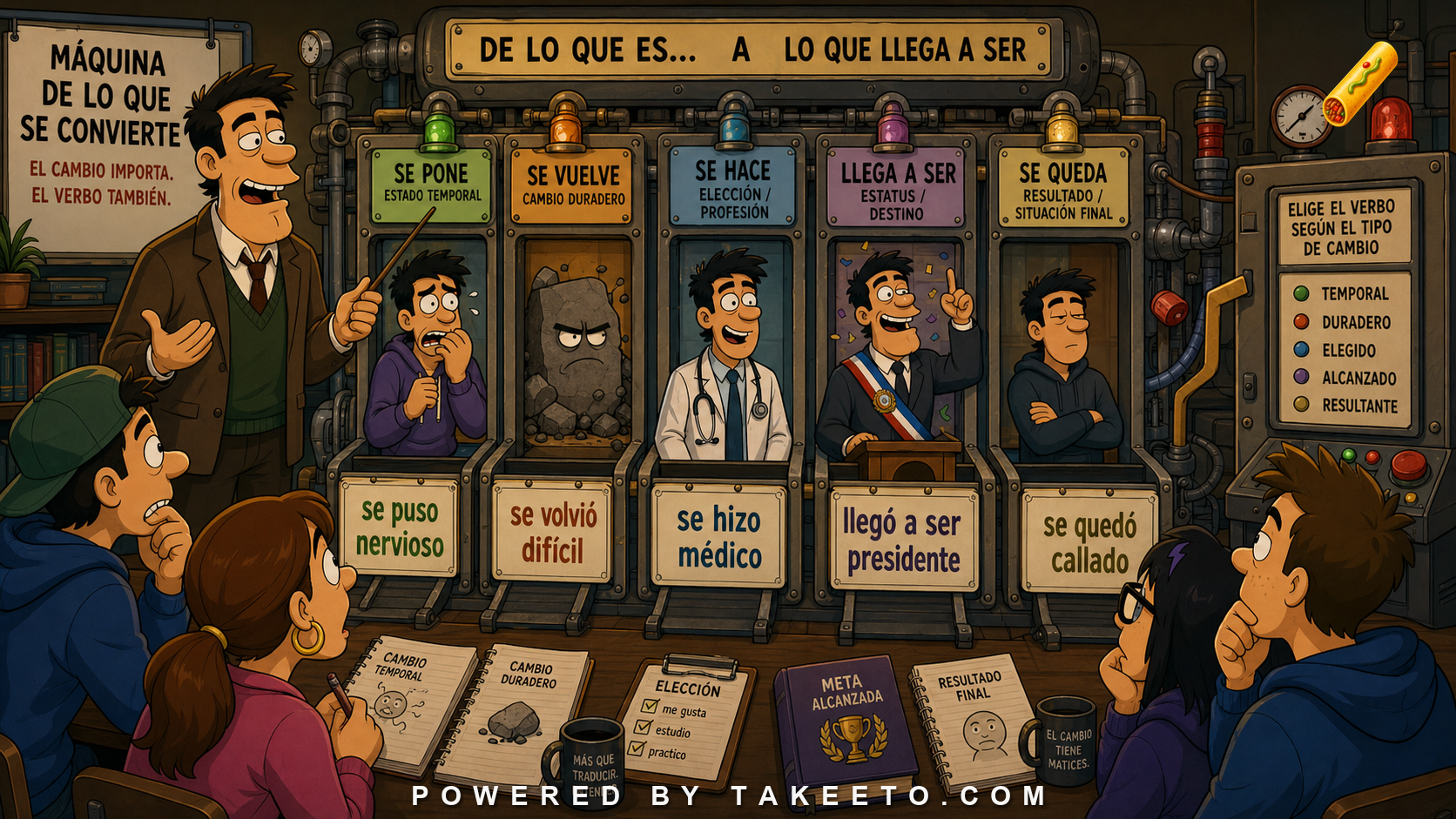
Spanish does not have one general “become”
English uses “become” across many kinds of change:
She became nervous.
The situation became difficult.
He became a doctor.
She became president.
Spanish usually chooses a more specific verb. The right verb depends on what kind of change happened: temporary state, personality shift, chosen identity, gradual development, achieved status, or resulting condition.
Compare:
Se puso nervioso.
He got nervous.
Se volvió difícil.
It became difficult.
Se hizo médico.
He became a doctor.
Llegó a ser presidente.
She eventually became president.
The key principle is:
Spanish becoming verbs classify the type of change: temporary, durable, chosen, gradual, achieved, or resulting.
Do not translate “become” mechanically. Diagnose the change.
Ponerse: temporary state change
Ponerse + adjective often describes a change into a temporary physical, emotional, or visible state.
Se puso nervioso.
He got nervous.
Me puse triste.
I became sad.
El cielo se puso oscuro.
The sky turned dark.
Se puso rojo.
He turned red / blushed.
The change is often sudden or noticeable. It does not usually describe a permanent identity.
Common adjectives with ponerse:
nervioso, triste, contento, enfermo, pálido, rojo, serio
Volverse: durable or character-like shift
Volverse + adjective/noun often describes a change that feels more lasting, internal, dramatic, or characteristic.
Se volvió muy serio.
He became very serious.
La situación se volvió difícil.
The situation became difficult.
Con los años, se volvió desconfiado.
Over the years, he became distrustful.
Volverse can suggest a transformation in condition, personality, or nature. It may be negative or unexpected, though not always.
Compare:
Se puso serio.
He became serious for the moment.
Se volvió serio.
He became a serious person / became serious as a lasting trait.
The contrast is not absolute, but it is useful.
Hacerse: chosen, gradual, social, or professional change
Hacerse often describes a change involving agency, development, ideology, profession, religion, age, or social role.
Se hizo médico.
He became a doctor.
Se hizo vegetariana.
She became vegetarian.
Se hicieron amigos.
They became friends.
Con el tiempo, se hizo famoso.
Over time, he became famous.
It can imply effort, decision, social recognition, or gradual development.
Common domains:
- professions: se hizo abogado;
- ideology/religion: se hizo socialista, se hizo católica;
- relationships: se hicieron amigos;
- gradual status: se hizo rico, se hizo conocido.
Llegar a ser: eventual achieved status
Llegar a ser emphasizes arrival at a status after a process, often with effort, time, or significance.
Llegó a ser presidente.
He eventually became president.
Llegó a ser una figura importante.
She came to be an important figure.
La empresa llegó a ser líder del sector.
The company became a leader in the sector.
This construction gives the change a narrative arc. It often appears in biographies, history, institutional descriptions, and formal writing.
Hacerse presidente and llegar a ser presidente do not feel the same. Llegar a ser highlights achievement over time.
Quedarse: resulting state, often after an event
The outline includes se quedó callado, and it is important because quedarse is another common change/result verb.
Se quedó callado.
He fell silent / remained silent.
Me quedé sorprendido.
I was left surprised.
La puerta se quedó abierta.
The door stayed open / was left open.
Quedarse often means ending up in a state, especially as the result of something that happened. It can also mean remaining in that state.
Compare:
Se puso callado.
He got quiet.
Se quedó callado.
He fell silent and remained silent.
Change into nouns versus adjectives
Different becoming verbs prefer different complements.
Ponerse is usually adjective-oriented:
se puso nervioso
Volverse can take adjectives and some nouns:
se volvió arrogante
se volvió un problema
Hacerse works well with roles and identities:
se hizo médico
se hizo miembro del grupo
Llegar a ser works well with achieved roles, statuses, and descriptions:
llegó a ser directora
llegó a ser conocido
Complement type does not decide everything, but it helps.
Agency and control
Ask whether the subject chose the change.
Se hizo abogado.
He became a lawyer.
This suggests a chosen or achieved professional path.
Se volvió amargado.
He became bitter.
This sounds like a personality change, not necessarily chosen.
Se puso enfermo.
He got sick.
This is a state change, normally not chosen.
Spanish often encodes whether change feels chosen, suffered, developed, or achieved.
Where convertirse en fits
A serious article on becoming should also mention convertirse en, even though the outline focuses on four main verbs. Convertirse en often marks transformation into a new entity, role, condition, or category, especially when the change is significant or structural.
El agua se convirtió en hielo.
The water turned into ice.
El problema se convirtió en una crisis.
The problem turned into a crisis.
La ciudad se convirtió en un centro comercial importante.
The city became an important commercial center.
Compared with hacerse, convertirse en often feels less about chosen personal development and more about transformation. Compare:
Se hizo médico.
He became a doctor.
Se convirtió en una figura pública.
He/she became a public figure.
Both can involve process, but hacerse often highlights agency or social path; convertirse en highlights transformation into a new status or category.
Change verbs can carry judgment
These verbs do not only describe change. They can judge the change.
Se volvió arrogante.
He became arrogant.
often sounds negative or at least evaluative.
Se hizo responsable.
He became responsible.
can suggest growth.
Se puso agresivo.
He became aggressive.
suggests an episode or immediate state.
Se quedó solo.
He ended up alone / was left alone.
can imply result, loss, or consequence.
Learners should listen for the story each verb tells: sudden reaction, lasting transformation, chosen path, social achievement, or final state.
Example bank walkthrough
se puso nervioso
Temporary emotional state.
Learner action: use ponerse for sudden or visible state changes.
se volvió difícil
Condition changed and became difficult.
Learner action: use volverse for a more durable or structural shift.
se hizo médico
Professional identity achieved or chosen.
Learner action: use hacerse for roles, professions, ideologies, and gradual social changes.
llegó a ser presidente
Eventual achieved status.
Learner action: use llegar a ser when the process or achievement matters.
se quedó callado
Ended up/remained silent.
Learner action: use quedarse for resulting states.
Becoming decision routine
Ask:
- Is the change temporary or visible?
- Is it a lasting condition or personality shift?
- Is it chosen, professional, ideological, or social?
- Is the process of achievement important?
- Is the subject left in a state after an event?
- Is the complement an adjective, noun, role, or status?
Then choose:
- ponerse for temporary state changes;
- volverse for durable or character-like shifts;
- hacerse for chosen, gradual, or role-based changes;
- llegar a ser for eventual achieved status;
- quedarse for resulting or remaining states.
Suggested interactive module: change-type selector
A strong tool for this article would classify becoming events by duration and agency.
Suggested functions:
- Duration slider: momentary → lasting.
- Agency slider: accidental → chosen.
- Complement selector: adjective, profession, status, condition.
- Process emphasis: immediate change vs long development.
- Verb recommendation: ponerse, volverse, hacerse, llegar a ser, quedarse.
- Contrast cards: se puso serio vs se volvió serio.
- Translation repair: avoid defaulting to convertirse en.
Final rule
Spanish does not ask only whether something “became” something. It asks what kind of change happened.
Use ponerse for temporary states, volverse for deeper shifts, hacerse for chosen or social development, llegar a ser for achieved status, and quedarse for resulting states.
A good Spanish change verb tells the story of the change.