
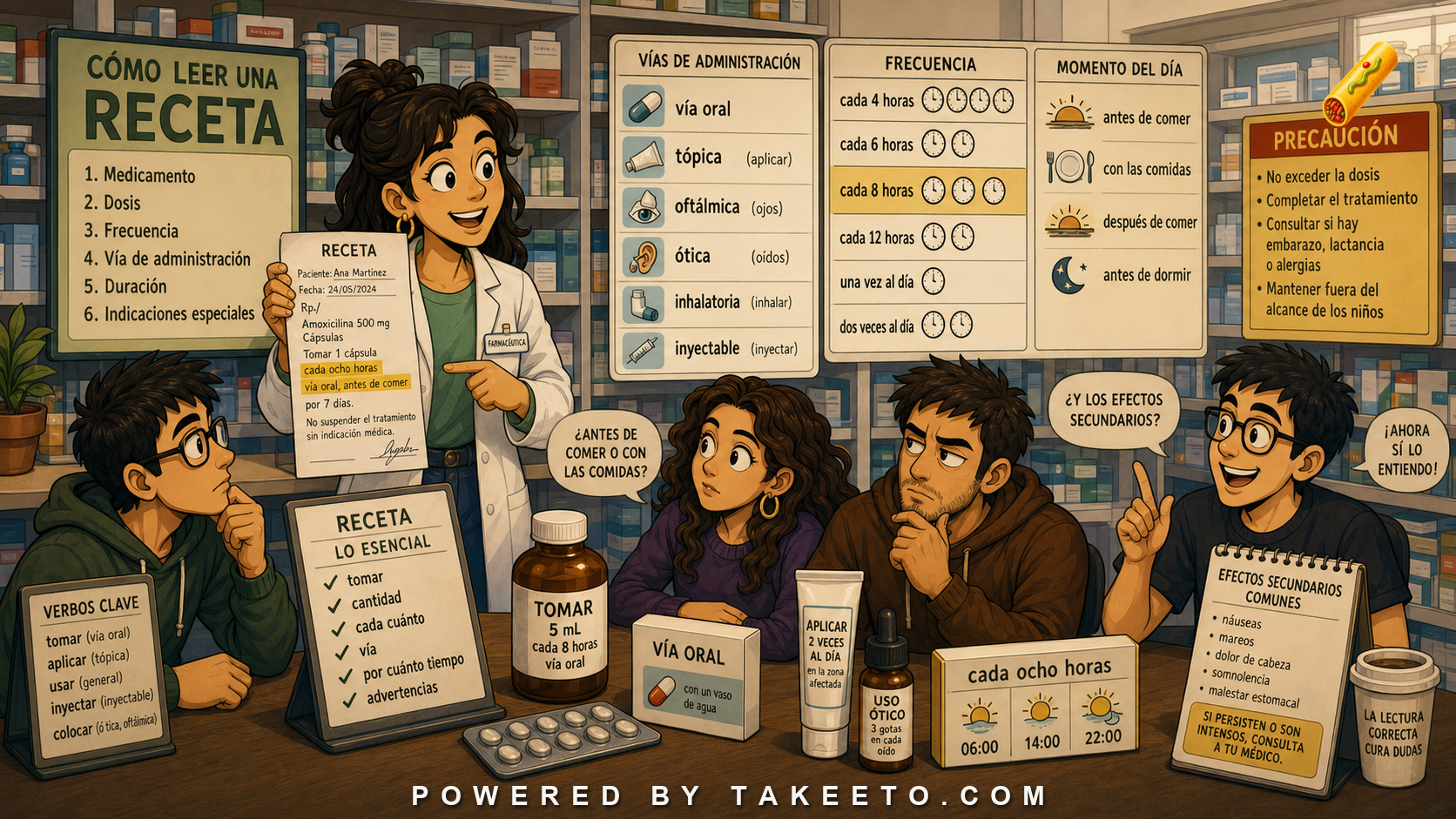
Medication Spanish is small text with high stakes
Prescription labels, medication boxes, pharmacy instructions, and patient leaflets often use short phrases. That can make them look easy. In reality, a small phrase can carry dose, timing, route, duration, and warning information.
Example:
Tomar 1 tableta por vía oral cada 8 horas durante 5 días.
A learner must parse:
action: tomar
dose: 1 tableta
route: vía oral
frequency: cada 8 horas
duration: durante 5 días
The key principle is:
Medication instructions must be read by fields: dose, route, frequency, timing, duration, and warning.
This article is language education, not medical advice. Never change dose, timing, or medication use based on a language guess. Ask a clinician or pharmacist when anything is unclear.
Receta, prescripción, medicamento
Common terms:
receta — prescription
prescripción — prescription, prescribing instruction
medicamento — medication
medicina — medicine, often everyday term
fármaco — drug/pharmaceutical, more technical
tratamiento — treatment
indicaciones — instructions/indications
contraindicaciones — contraindications
prospecto — patient leaflet/package insert, especially in some countries
Receta can mean prescription, but in food Spanish it also means recipe. Context decides.
Dose: how much
Dose terms include:
dosis — dose
tableta / comprimido — tablet
cápsula — capsule
gota — drop
cucharadita — teaspoon
mililitro / ml — milliliter
miligramo / mg — milligram
unidad — unit
Examples:
Tomar una cápsula.
Take one capsule.
Aplicar dos gotas en cada ojo.
Apply two drops in each eye.
Administrar 5 ml.
Administer 5 ml.
Do not assume cucharada and cucharadita are interchangeable. They are different household-measure words, and medication measurement should be precise.
Route: how the medication enters the body
Vía means route in medical instructions.
Common routes:
vía oral — by mouth/oral route
vía tópica — topical route
vía nasal — nasal route
vía oftálmica — eye/ophthalmic route
vía ótica — ear/otic route
vía subcutánea — subcutaneous route
vía intramuscular — intramuscular route
vía intravenosa — intravenous route
Examples:
Tomar por vía oral.
Take by mouth.
Aplicar por vía tópica sobre la zona afectada.
Apply topically to the affected area.
No ingerir. Uso externo.
Do not ingest. External use.
The route is safety-critical. A product applied to skin may not be safe to swallow; drops for one body part may not be appropriate for another.
Frequency: how often
Common frequency expressions:
cada ocho horas — every eight hours
cada 12 horas — every 12 hours
una vez al día — once a day
dos veces al día — twice a day
tres veces al día — three times a day
por la mañana — in the morning
por la noche — at night
antes de dormir — before sleeping/bedtime
según necesidad — as needed
si presenta dolor — if pain occurs
Example:
Tomar una tableta cada 12 horas.
Take one tablet every 12 hours.
Important distinction:
cada 8 horas = every 8 hours
8 veces al día = 8 times per day
Those are not the same instruction.
Duration: for how long
Duration expressions:
durante cinco días — for five days
por siete días — for seven days, common in some regions
hasta terminar el tratamiento — until finishing the treatment
hasta nueva indicación médica — until new medical instruction
suspender si... — discontinue/stop if...
Example:
Tomar durante 10 días, aunque desaparezcan los síntomas.
Take for 10 days, even if symptoms disappear.
Do not stop, continue, repeat, or combine medications based on language inference. Confirm with a medical professional.
Timing with food
Common instructions:
antes de comer — before eating
después de comer — after eating
con alimentos — with food
en ayunas — on an empty stomach
con abundante agua — with plenty of water
no tomar con alcohol — do not take with alcohol
En ayunas is an important phrase. It means fasting/on an empty stomach, often before breakfast or without having eaten, depending on the instruction.
Instruction styles: infinitive, imperative, impersonal
Medication Spanish may use the infinitive:
Tomar una tableta cada 8 horas.
Take one tablet every 8 hours.
It may use formal imperative:
Tome una tableta cada 8 horas.
Take one tablet every 8 hours.
It may use impersonal or passive style:
Se recomienda tomar con alimentos.
It is recommended to take with food.
No se debe exceder la dosis indicada.
The indicated dose must not be exceeded.
All three can occur in labels, leaflets, and instructions. The infinitive style is common in written instructions because it is compact and impersonal.
Warnings and contraindications
Key terms:
advertencia — warning
precaución — precaution
contraindicación — contraindication
efectos secundarios — side effects
reacciones adversas — adverse reactions
sobredosis — overdose
interacción — interaction
consulte a su médico — consult your doctor
manténgase fuera del alcance de los niños — keep out of reach of children
Examples:
No usar en caso de alergia a cualquiera de sus componentes.
Do not use in case of allergy to any of its components.
Consulte a su médico si está embarazada o en período de lactancia.
Consult your doctor if you are pregnant or breastfeeding.
Puede causar somnolencia. No conduzca maquinaria pesada.
May cause drowsiness. Do not operate heavy machinery.
Abbreviations and ambiguity
Prescription abbreviations vary by country, institution, and prescriber. Some are dangerous for learners because they look transparent but are not reliably understood outside context. If you see abbreviations for dose, route, or frequency and are not certain, ask a pharmacist or clinician.
Examples that may appear in some settings:
VO — vía oral
c/8 h — cada 8 horas
PRN — as needed, in some medical contexts influenced by Latin/English conventions
mg, ml — milligrams, milliliters
The safest learner rule:
Full words are learnable; abbreviations must be confirmed.
Annotated medication instruction
Tomar 1 comprimido por vía oral cada 12 horas, después de comer, durante 7 días. No exceder la dosis indicada.
Plain reading:
Take 1 tablet by mouth every 12 hours, after eating, for 7 days. Do not exceed the indicated dose.
Structure:
Tomar = action
1 comprimido = dose/form
vía oral = route
cada 12 horas = frequency
después de comer = food timing
durante 7 días = duration
No exceder = warning/prohibition
Cautious reading workflow
- Identify the medication name exactly.
- Find the dose: amount and form.
- Find the route: oral, topical, eye, ear, injection, etc.
- Find frequency: how often.
- Find timing: food, bedtime, morning, symptoms.
- Find duration: number of days or until further instruction.
- Find warnings: allergies, pregnancy, alcohol, driving, interactions.
- Do not infer missing information.
- Ask a pharmacist or clinician for confirmation.
- Use professional interpretation when necessary.
Remediation: every medication instruction has five slots
Medication Spanish should be read through five slots, not as a sentence:
medicine — amount — route — frequency — duration
Example:
Tomar 1 comprimido por vía oral cada 8 horas durante 5 días.
Map it:
medicine form = comprimido
amount = 1
route = vía oral
frequency = cada 8 horas
duration = durante 5 días
If any slot is missing or ambiguous, the reader should not improvise.
A common learner mistake is treating cada ocho horas as casually equivalent to “three times a day.” It often results in three doses per day, but the scheduling logic differs. Cada ocho horas implies spacing doses every eight hours. Tres veces al día may be less exact unless the label or clinician specifies timing. In medication contexts, these differences can matter.
Instruction verbs and safety force
Medication labels may use:
tomar
to take
administrar
to administer
aplicar
to apply
ingerir
to ingest
suspender
to stop/discontinue
agitar
to shake
conservar
to store/keep
no exceder
do not exceed
evitar
avoid
consultar
consult
Do not flatten suspender into “suspend” as a vague English cognate. In medication language it often means to stop taking or discontinue the medication. No exceder la dosis indicada means do not exceed the indicated dose. Mantener fuera del alcance de los niños is a storage warning, not a dosage instruction.
Mini-workshop: detect ambiguity
Instruction:
Aplicar dos veces al día en la zona afectada.
This tells you:
route/method = apply topically
frequency = twice a day
location = affected area
It does not tell you:
exact amount
duration
whether to cover the area
whether to wash before or after
what to do if irritation occurs
A safer expanded instruction might say:
Aplicar una capa fina en la zona afectada dos veces al día durante siete días, salvo indicación médica diferente.
But a language learner should not invent this expansion for real use. The mini-workshop shows what information is missing so the patient can ask.
Abbreviations and look-alike danger
Prescriptions may include abbreviations that vary by country, institution, and handwriting. Even printed labels can use compressed forms. Do not guess at:
c/8 h
cada 8 horas
VO / v.o.
vía oral
IM
intramuscular
IV
intravenous
PRN / SOS
as needed, depending on local practice and context
gotas, mg, ml, UI
drops, milligrams, milliliters, international units
Some abbreviations are Latin-derived, some local, some institution-specific. Handwritten prescriptions are especially risky.
Cautious reading workflow upgraded
For any medication text, ask:
- What is the exact medication name and concentration?
- What is the exact dose?
- What route is stated?
- How often is it taken or applied?
- For how many days or until what condition?
- Is it before food, after food, at bedtime, or as needed?
- What should be avoided?
- What side effects or warning signs require help?
- What should be done if a dose is missed?
- Is any abbreviation, handwriting, decimal, or unit unclear?
If the answer to item 10 is yes, the remediation rule is absolute: ask a pharmacist, clinician, or qualified interpreter. Do not solve medication ambiguity with confidence.
Suggested interactive module: prescription label annotator
A strong tool for this article would highlight medication instructions by safety field.
Suggested functions:
- Dose highlighter: quantity, unit, form.
- Route detector: vía oral, tópica, oftálmica, ótica.
- Frequency parser: cada 8 horas, dos veces al día, según necesidad.
- Timing labels: before food, after food, fasting, bedtime.
- Duration labels: for X days, until finished, until medical review.
- Warning flagger: no exceder, no ingerir, consulte a su médico.
- Ambiguity alert: abbreviations and missing fields.
- No-medical-advice banner: confirms language only.
Final rule
Medication Spanish must be read as structured safety information.
Do not translate casually. Identify dose, route, frequency, timing, duration, and warnings. When uncertain, ask a pharmacist, doctor, or qualified interpreter.
With medication, a small word can change a large outcome.