
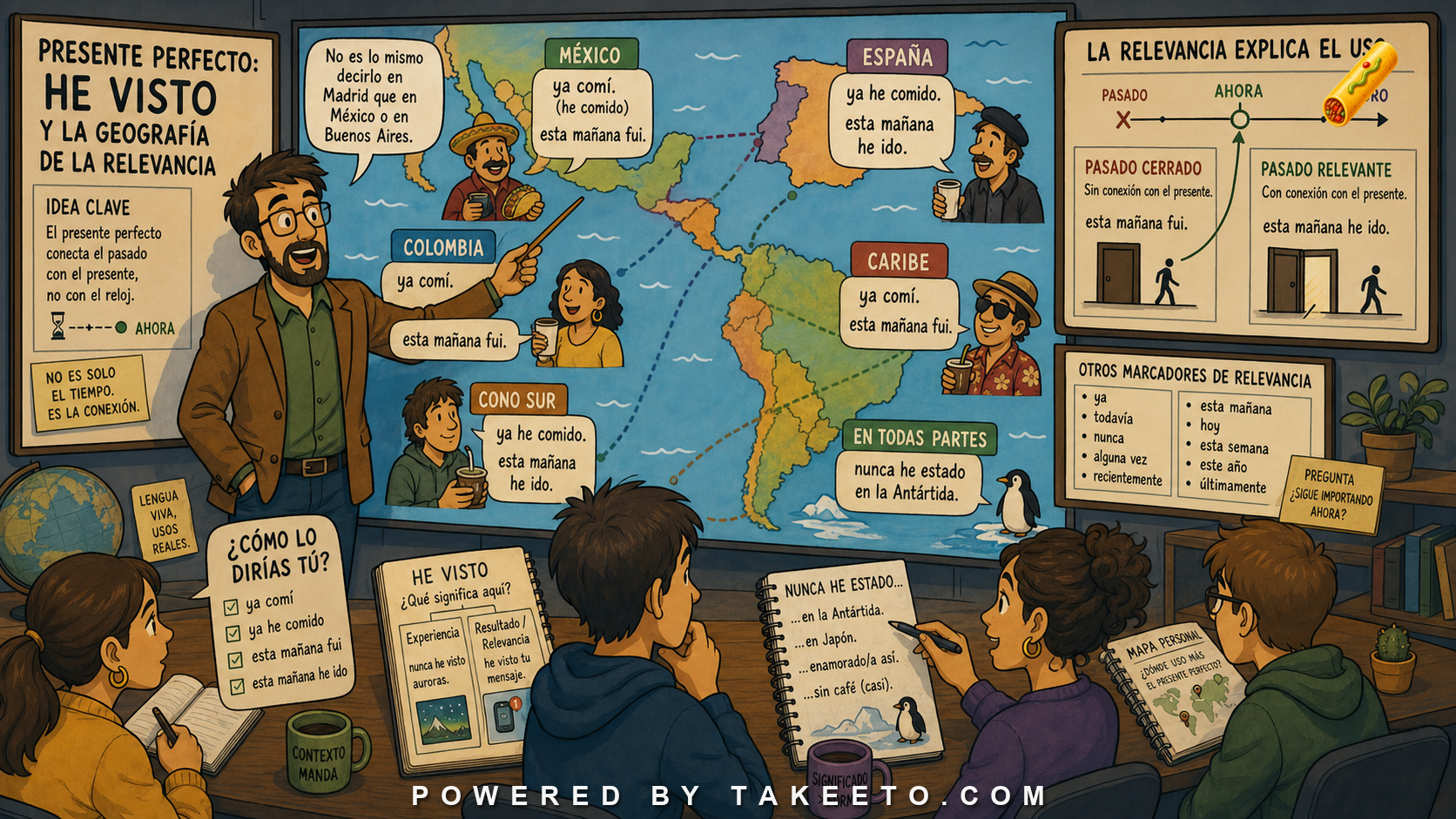
The form is easy; the distribution is not
The Spanish present perfect looks simple:
he visto
has comido
hemos terminado
It is formed with the present tense of haber plus a past participle. In that sense, it resembles English I have seen, you have eaten, we have finished.
But the hard part is not the form. The hard part is deciding when Spanish uses it instead of the preterite.
English-speaking learners often assume this mapping:
I have seen it. = Lo he visto.
I saw it. = Lo vi.
Sometimes that works. Often it does not. Spanish varieties differ sharply in how they divide labor between the pretérito perfecto compuesto and the pretérito perfecto simple.
A learner needs two truths at the same time:
- The present perfect generally connects a past event to the present in some way.
- Different Spanish-speaking regions define that connection differently in everyday use.
That is why this tense is not only grammar. It is dialectology.
How the form works
The structure is:
present tense of haber + past participle
| Subject | Form with ver | Form with comer |
|---|---|---|
| yo | he visto | he comido |
| tú | has visto | has comido |
| usted / él / ella | ha visto | ha comido |
| nosotros/as | hemos visto | hemos comido |
| vosotros/as | habéis visto | habéis comido |
| ustedes / ellos / ellas | han visto | han comido |
The participle does not agree with the subject when used with haber:
Ana ha visto la película.
Ana has seen the movie.
Ana y Lucía han visto la película.
Ana and Lucía have seen the movie.
Not:
Ana ha vista la película.
Ana y Lucía han vistas la película.
Agreement belongs to adjectival participles and passive/resultative constructions, not to haber + participle in ordinary perfect tenses.
Common participles include:
| Infinitive | Participle |
|---|---|
| hablar | hablado |
| comer | comido |
| vivir | vivido |
| ver | visto |
| hacer | hecho |
| decir | dicho |
| escribir | escrito |
| abrir | abierto |
| poner | puesto |
| volver | vuelto |
Present relevance
The central idea of the present perfect is present relevance: a past event is presented as connected to the present situation.
That connection can take several forms.
Experience up to now
He visto esa película.
I have seen that movie.
Nunca he estado en Perú.
I have never been to Peru.
¿Has probado este plato?
Have you tried this dish?
Here the event belongs to a life experience or a time window that includes the present.
Result visible now
Hemos terminado el informe.
We have finished the report.
Se ha roto el vaso.
The glass has broken.
The focus is not only that something happened, but that the result matters now.
Recent past within a present time frame
In many parts of Spain, the present perfect is common with time expressions that include the present day or current period:
Esta mañana he ido al médico.
This morning I went / have gone to the doctor.
Hoy he comido tarde.
Today I ate late.
Esta semana hemos trabajado mucho.
This week we have worked a lot.
The time frame is not closed from the speaker’s viewpoint: today, this morning, this week, this year.
Regional variation: the geography of relevance
The same time expression may invite different choices depending on region.
In much Peninsular Spanish, especially central and northern Spain, the present perfect is very common for recent events within an ongoing present time frame:
Hoy he visto a Ana.
Esta mañana he ido al banco.
Ya he comido.
In many American varieties, the preterite is more common for completed events, even when English might use the present perfect or when Peninsular Spanish might choose he visto:
Hoy vi a Ana.
Esta mañana fui al banco.
Ya comí.
This does not mean one side is “more correct.” It means the tense system is distributed differently across varieties.
A simplified comparison:
| Context | Common in much of Spain | Common in many American varieties |
|---|---|---|
| today, completed event | Hoy he visto a Ana. | Hoy vi a Ana. |
| this morning, completed event | Esta mañana he ido al banco. | Esta mañana fui al banco. |
| already eaten | Ya he comido. | Ya comí. |
| life experience | Nunca he estado allí. | Nunca he estado allí / Nunca estuve allí, depending on context and region. |
| continuing situation | He vivido aquí desde 2020. | He vivido aquí desde 2020. |
This table is not a map of every country. It is a warning against pretending there is one universal English-to-Spanish rule. Spanish speakers from different regions may use both forms, but with different default patterns.
Why “ya comí” and “ya he comido” both matter
The pair ya comí and ya he comido is one of the fastest ways to see the issue.
In many parts of Latin America:
¿Quieres comer?
No, gracias, ya comí.
This is completely normal: “No thanks, I already ate.” The eating is completed.
In much Peninsular Spanish, especially in contexts where the current day is still psychologically active, many speakers prefer:
No, gracias, ya he comido.
A learner who treats ya comí as wrong has learned a regional rule too narrowly. A learner who treats ya he comido as always equivalent to English present perfect has also learned too narrowly.
The real question is: what does this variety do with completed events inside a present time frame?
Present perfect versus preterite by viewpoint
Even within one dialect, the choice can change the viewpoint.
Este año he leído mucho.
This year I have read a lot.
The year is still open. The reading belongs to a current period.
El año pasado leí mucho.
Last year I read a lot.
The time frame is closed. The preterite is natural.
Compare:
| Open or present-connected frame | Closed frame |
|---|---|
| hoy | ayer |
| esta semana | la semana pasada |
| este año | el año pasado |
| últimamente | en 2018 |
| hasta ahora | aquel día |
But regional usage can override or soften this contrast. In many American varieties, hoy fui may be ordinary even though hoy is technically a present-day frame. In many Peninsular contexts, hoy he ido may feel more expected.
The learner’s job is not to impose a single rule. The learner’s job is to recognize the viewpoint and the variety.
English interference
English and Spanish do not align perfectly.
English often requires the present perfect where Spanish may use the present tense:
I have lived here for five years.
Vivo aquí desde hace cinco años.
He vivido aquí durante cinco años.
Both Spanish patterns exist, but the present tense with desde hace is common because the situation continues into the present.
English may also use the simple past where Spanish in Spain often uses the present perfect:
I saw Ana this morning.
Esta mañana he visto a Ana.
Esta mañana vi a Ana.
Both Spanish versions may be natural depending on region and viewpoint.
Do not decide Spanish tense solely from the English tense. Decide from the Spanish time frame, discourse connection, and variety.
Common learner errors
The first error is making the participle agree with the subject:
Ana ha llegada.
Ana ha llegado.
The second error is using tener instead of haber:
Tengo visto esa película.
He visto esa película.
Spanish does have constructions with tener + participle in some contexts, but they are not the ordinary present perfect.
The third error is treating American ya comí as inferior to ya he comido. It is not. It belongs to a different distribution of the perfect system.
The fourth error is erasing the present connection. If the time frame is clearly closed, the preterite is often the safer form:
Ayer vi a Ana.
Last year we visited Chile.
In most varieties, avoid using the present perfect with a clearly closed frame such as ayer unless a specific regional or discourse context licenses it:
Ayer he visto a Ana
A production strategy for learners
Because present perfect usage varies, learners should choose a target norm for production while remaining flexible in comprehension.
If your main model is Peninsular Spanish, practice:
hoy he visto
esta semana he trabajado
ya he comido
If your main model is a Latin American variety with strong preterite preference, practice patterns such as:
hoy vi
esta semana trabajé, where that local pattern is natural
ya comí
But comprehension should include both. A learner who hears ya comí should not think the speaker is being less educated. A learner who hears ya he comido should not think the speaker is being unnaturally formal. These are regional distributions.
Since/for expressions often use present tense
English present perfect often appears with “for” or “since”:
I have lived here for three years.
I have known her since 2020.
Spanish often uses the present tense with desde hace or desde:
Vivo aquí desde hace tres años.
I have lived here for three years.
La conozco desde 2020.
I have known her since 2020.
This is one of the clearest warnings against translating English tense names. Spanish views the state as continuing in the present, so the present tense is natural.
Reading mixed-variety materials
News, subtitles, podcasts, textbooks, and conversations may mix speakers from different regions. You may hear one speaker say:
¿Ya comiste?
and another say:
¿Ya has comido?
The practical response is not to choose one as the only correct form. Build a two-way parser:
- recognize he comido as present perfect;
- recognize comí as preterite;
- ask whether the context is recent, experiential, resultative, or regionally marked.
This prevents false corrections and improves comprehension. Spanish tense usage is not only grammar in the abstract; it is grammar distributed across communities.
Diagnostic refinement: do not turn regional tendencies into country stereotypes
The present perfect varies across the Spanish-speaking world, but the variation is not a simple Spain-versus-America switch. “Spain” contains regional differences, and “Latin America” contains many distributions. Some American varieties use the present perfect productively for experience, continuing relevance, or recent past; some prefer the preterite in contexts where Peninsular Spanish often uses he visto. Speakers also shift by register, education, genre, and contact with other varieties.
A better model is to track four factors:
| Factor | Question to ask |
|---|---|
| time frame | Is the frame open now: hoy, esta semana, hasta ahora? |
| result | Is the result visible or relevant now? |
| experience | Is the sentence about life experience up to now? |
| regional norm | What does this community normally do with recent completed events? |
This model explains why both of these can be normal:
¿Ya comiste?
¿Ya has comido?
and why both of these may appear in educated speech, depending on variety and context:
Hoy fui al banco.
Hoy he ido al banco.
The learner’s production strategy should be honest. Choose one target model for your own writing and speech, especially in exams, classrooms, or professional contexts. But build receptive flexibility so you do not “correct” native speakers from another region.
Also remember that English present perfect is not a reliable guide. English says I have lived here for three years, while Spanish very often says:
Vivo aquí desde hace tres años.
The Spanish present tense is natural because the living continues now. The form he vivido aquí desde hace tres años is possible in many contexts, but it is not required merely because English used “have lived.”
Suggested interactive module: perfect geography table
A strong tool for this article would let learners compare tense choices across regions and contexts.
Example inputs:
| Prompt | Peninsular tendency | Many American tendencies | Note |
|---|---|---|---|
| today / see Ana | Hoy he visto a Ana. | Hoy vi a Ana. | completed event inside today |
| yesterday / see Ana | Ayer vi a Ana. | Ayer vi a Ana. | closed time frame |
| ever / visit Peru | ¿Has estado en Perú? | ¿Has estado en Perú? / ¿Estuviste en Perú? | depends on experiential framing |
| already / eat | Ya he comido. | Ya comí. | high regional contrast |
| since 2020 / live here | He vivido aquí desde 2020 / Vivo aquí desde 2020. | He vivido aquí desde 2020 / Vivo aquí desde 2020. | continuing state |
The tool should not mark one variety as correct and another as wrong. It should label region, time frame, relevance, and discourse effect.
Final rule
The present perfect is haber in the present + past participle: he visto, has comido, hemos terminado. Its core meaning is a past event connected to the present, but Spanish varieties draw that connection differently.
In much of Spain, he visto is common for recent events in present time frames such as hoy, esta mañana, and esta semana. In many American varieties, the preterite often handles completed events in those same frames: vi, fui, ya comí. Neither pattern is defective. Learn to interpret both, then choose production habits according to the variety you are targeting.