
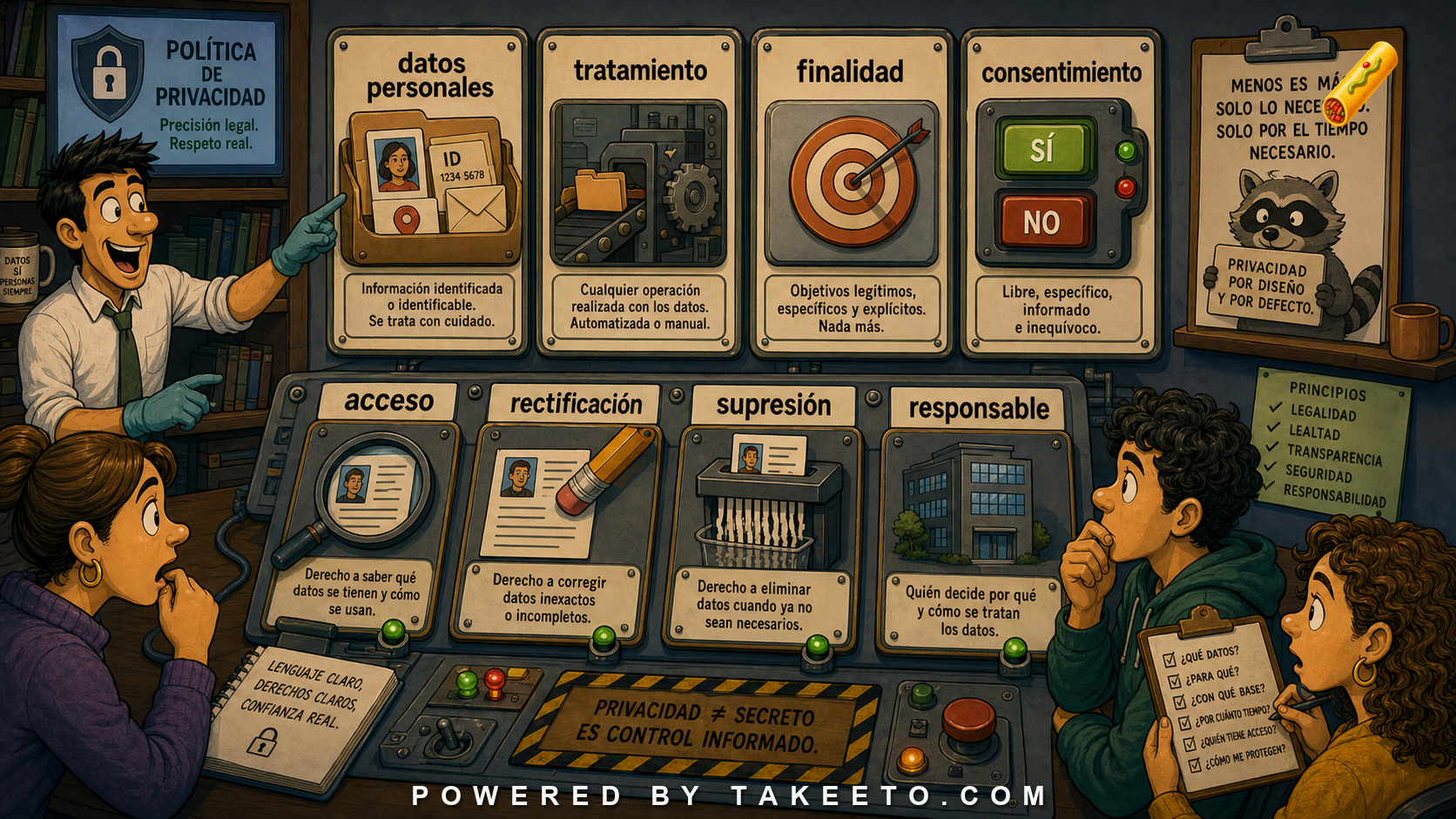
Privacy Spanish is built around roles, data, purposes, and rights
A privacy policy is not a general promise to “respect privacy.” It is a document that explains what personal data is collected, who controls it, why it is used, with whom it is shared, how long it is kept, and what rights a person may have.
Learners often stumble because privacy Spanish uses ordinary-looking words in precise ways:
responsable
encargado
tratamiento
finalidad
base legal
supresión
These words are not difficult because they are rare. They are difficult because their legal-document function is narrower than their everyday meaning.
The key principle is:
Privacy-policy Spanish describes a data relationship: subject, controller, processor, data type, purpose, legal basis, retention, sharing, and rights.
Specific privacy obligations vary by jurisdiction. Spain, the European Union, Mexico, Colombia, Argentina, Chile, Peru, and other Spanish-speaking contexts may use overlapping vocabulary but different legal frameworks. This article teaches language recognition, not compliance advice.
Datos personales: more than name and email
Datos personales means personal data. It can include obvious identifiers:
nombre — name
correo electrónico — email address
dirección — address
número de teléfono — phone number
fecha de nacimiento — date of birth
It can also include technical or behavioral data:
dirección IP — IP address
identificadores del dispositivo — device identifiers
ubicación — location
historial de navegación — browsing history
datos de uso — usage data
preferencias — preferences
Privacy policies often group data into categories:
datos identificativos — identifying data
datos de contacto — contact data
datos de pago — payment data
datos técnicos — technical data
datos de navegación — browsing data
datos de salud — health data
A reader should never assume that datos personales means only name and address. The policy usually defines what it includes.
Tratamiento: processing, not treatment
The word tratamiento causes major translation problems. In medical Spanish, tratamiento is treatment. In privacy Spanish, it usually means processing: collecting, using, storing, transmitting, deleting, analyzing, or otherwise handling data.
Example:
El tratamiento de sus datos personales se realizará conforme a la normativa aplicable.
The processing of your personal data will be carried out in accordance with applicable regulations.
Common processing verbs:
recoger / recopilar — collect
almacenar — store
conservar — retain
utilizar — use
compartir — share
comunicar — disclose/communicate
transferir — transfer
analizar — analyze
eliminar — delete
anonimizar — anonymize
In privacy texts, tratar datos does not mean “treat data kindly.” It means process data.
Responsable and encargado
Two important roles appear in many privacy policies:
responsable del tratamiento
encargado del tratamiento
A plain-language approximation:
responsable = the entity that decides why and how personal data is processed
encargado = the entity that processes data on behalf of the responsible entity
Do not translate responsable only as “responsible person” in a vague moral sense. In this domain it can be a defined legal role.
Example:
El responsable del tratamiento es Aprendizaje Digital, S.L.
The data controller/responsible entity is Aprendizaje Digital, S.L.
Determinados proveedores tecnológicos actuarán como encargados del tratamiento.
Certain technology providers will act as processors/service providers handling processing.
Spanish texts may vary by jurisdiction, but the reader should look for role definitions. The role tells you who has duties and who can answer rights requests.
Finalidad: the purpose of processing
Finalidad means purpose. In privacy policies, it answers “why is this data used?”
Examples:
gestionar la cuenta del usuario — manage the user’s account
prestar el servicio contratado — provide the contracted service
enviar comunicaciones comerciales — send marketing communications
mejorar la experiencia de usuario — improve user experience
cumplir obligaciones legales — comply with legal obligations
prevenir fraudes — prevent fraud
Example clause:
Trataremos sus datos con la finalidad de gestionar su cuenta, prestar el servicio y atender sus solicitudes.
We will process your data for the purpose of managing your account, providing the service, and responding to your requests.
A strong reader asks whether each data category has a stated purpose. Vague purposes such as mejorar nuestros servicios may need closer attention in high-stakes contexts.
Base legal: why the processing is permitted
Privacy policies may name a base legal, fundamento jurídico, or legitimación for processing.
Common phrases:
consentimiento del interesado — consent of the data subject
ejecución de un contrato — performance of a contract
cumplimiento de una obligación legal — compliance with a legal obligation
interés legítimo — legitimate interest
protección de intereses vitales — protection of vital interests
A learner does not need to become a privacy lawyer to recognize the pattern:
data + purpose + legal basis
Example:
La base legal para el envío de comunicaciones comerciales será su consentimiento.
The legal basis for sending marketing communications will be your consent.
Example:
La base legal para gestionar su suscripción es la ejecución del contrato.
The legal basis for managing your subscription is performance of the contract.
Rights language: acceso, rectificación, supresión
Many privacy policies list user rights.
Core terms:
acceso — access
rectificación — correction/rectification
supresión — deletion/erasure
oposición — objection
limitación — restriction/limitation
portabilidad — portability
revocación del consentimiento — withdrawal of consent
Example:
Usted podrá ejercer sus derechos de acceso, rectificación, supresión y oposición mediante comunicación escrita.
You may exercise your rights of access, correction, deletion, and objection by written communication.
Important verb:
ejercer un derecho — exercise a right
A rights paragraph often explains where to send requests:
Puede ejercer sus derechos escribiendo a privacidad@ejemplo.com.
You may exercise your rights by writing to privacidad@example.com.
In some texts, ARCO may refer to access, rectification, cancellation, and opposition, especially in certain Latin American contexts. Terminology may differ by country.
Retention: how long data is kept
Look for time language:
conservaremos sus datos — we will retain your data
durante el tiempo necesario — for the necessary time
mientras exista la relación contractual — while the contractual relationship exists
hasta que retire su consentimiento — until you withdraw your consent
durante los plazos legalmente exigidos — during the legally required periods
Example:
Conservaremos sus datos mientras mantenga una cuenta activa y, posteriormente, durante los plazos necesarios para atender posibles responsabilidades legales.
We will retain your data while you maintain an active account and afterward for the periods necessary to address possible legal liabilities.
The phrase durante el tiempo necesario sounds reassuring but is vague unless tied to a purpose, law, or account status.
Sharing and transfer language
Privacy policies often distinguish internal use, service providers, legal disclosures, and international transfers.
Vocabulary:
terceros — third parties
proveedores — providers/vendors
cesión — transfer/disclosure
comunicación de datos — disclosure/communication of data
transferencia internacional — international transfer
destinatarios — recipients
autoridades competentes — competent authorities
Example:
Sus datos podrán ser comunicados a proveedores de servicios tecnológicos necesarios para el funcionamiento de la plataforma.
Your data may be disclosed to technology service providers necessary for the operation of the platform.
When you see podrán ser comunicados, ask:
To whom? For what purpose? Under what safeguards or legal basis?
Cookies and tracking
Cookie policies add specialized vocabulary:
cookies necesarias — necessary cookies
cookies analíticas — analytics cookies
cookies publicitarias — advertising cookies
preferencias — preferences
consentimiento — consent
configurar — configure
rechazar — reject
aceptar todas — accept all
UI labels may be short, but the policy explains categories. A privacy-literate reader does not treat Aceptar todo as a meaningless convenience label. It may authorize tracking categories.
Annotated privacy clause
Trataremos los datos personales facilitados por el usuario con la finalidad de gestionar su cuenta, prestar el servicio solicitado y enviar comunicaciones relacionadas con la plataforma, sobre la base de la ejecución del contrato y, cuando proceda, de su consentimiento.
Plain reading:
We will process the personal data provided by the user to manage the account, provide the requested service, and send platform-related communications, based on contract performance and, where applicable, consent.
Structure:
trataremos = processing action
datos personales facilitados por el usuario = data source
con la finalidad de = purpose marker
gestionar / prestar / enviar = purposes
sobre la base de = legal-basis marker
ejecución del contrato / consentimiento = legal bases
Privacy-policy reading workflow
- Identify the responsible entity: Who controls the policy?
- List data categories: What data is collected?
- Find the source: user, device, cookies, third parties, public sources.
- Map purposes: Why is each category used?
- Find legal bases: consent, contract, legal obligation, legitimate interest, etc.
- Find recipients: providers, affiliates, authorities, third parties.
- Check transfers: especially international transfer language.
- Check retention: how long and according to what criterion?
- Find rights: access, correction, deletion, objection, portability, withdrawal.
- Find contact method: email, address, form, identity verification procedure.
Remediation: do not translate privacy Spanish through medical Spanish
The most damaging beginner mistake in privacy-policy Spanish is translating tratamiento as medical treatment. In data-protection language, tratamiento de datos personales means processing of personal data. It can include collecting, storing, organizing, using, sharing, transferring, deleting, anonymizing, or otherwise handling data.
Example:
El responsable tratará los datos personales con la finalidad de gestionar la cuenta del usuario.
Functional translation:
The controller will process personal data for the purpose of managing the user's account.
Not:
The responsible person will treat the personal data...
A second mistake is treating responsable as merely “responsible person.” In many privacy contexts, responsable del tratamiento is a defined role: the entity that determines purposes and means of processing. Encargado del tratamiento is not simply “person in charge”; it is often the processor acting on behalf of the controller.
A useful privacy-policy map is:
who decides = responsable
who processes for that decision-maker = encargado
what is processed = datos personales
why = finalidad
legal reason = base legal / fundamento jurídico
how long = plazo de conservación
who receives it = destinatarios / cesionarios
what the user can do = derechos
Rights language: recognize the action behind the noun
Privacy policies often list rights as nouns:
acceso, rectificación, supresión, oposición, limitación, portabilidad
Turn each noun into a user action:
acceso = ask to know or obtain the data held about you
rectificación = ask to correct inaccurate data
supresión = ask to delete data under applicable conditions
oposición = object to certain processing
limitación = restrict processing in certain cases
portabilidad = receive or transmit data in a portable format where applicable
Do not overgeneralize these rights across every country. Spain, the EU, Mexico, Argentina, Colombia, Chile, Peru, and other jurisdictions may use overlapping vocabulary with different procedures, authorities, deadlines, and legal bases. The article teaches reading architecture, not the legal rights of a specific jurisdiction.
Mini-workshop: unpack a privacy clause
Clause:
Conservaremos tus datos mientras mantengas una cuenta activa y, posteriormente, durante el plazo necesario para cumplir obligaciones legales o atender posibles responsabilidades.
Ask:
Who acts?
We / the service provider.
What is kept?
tus datos
How long during normal use?
mientras mantengas una cuenta activa
How long after?
durante el plazo necesario
Why after account closure?
cumplir obligaciones legales o atender posibles responsabilidades
Plain reading:
The company keeps the data while the account is active. After that, it may keep the data for as long as necessary to comply with legal obligations or handle possible liabilities.
The vague phrase plazo necesario is not automatically abusive, but it should make the reader look for a more specific retention table, legal basis, or category-by-category explanation elsewhere in the policy.
Questions a careful reader should ask
A serious privacy-policy reading should answer:
- What categories of data are collected?
- Which data is required and which is optional?
- What purpose is named for each category?
- What legal basis or permission is claimed?
- Who receives the data?
- Is data transferred internationally?
- How long is it retained?
- How can the user exercise rights?
- What happens when the account is deleted?
- Does the Spanish version look localized carefully, or does it contain calques that weaken clarity?
The remediation target is disciplined skepticism: not panic, not blind trust, but structured reading.
Suggested interactive module: privacy-policy entity map
A strong tool for this article would draw the relationships in a privacy policy.
Suggested functions:
- Entity map: user, responsible entity, processor, providers, authorities.
- Data-category tags: contact, technical, payment, usage, sensitive.
- Purpose links: connect each data type to a finalidad.
- Legal-basis labels: consent, contract, obligation, interest.
- Rights panel: access, rectification, deletion, objection, portability.
- Retention timeline: convert dense retention clauses into visual periods.
- Caution notes: jurisdiction-specific compliance requires expert review.
Final rule
Privacy-policy Spanish is precise because data relationships are precise.
Do not read tratamiento, responsable, finalidad, base legal, and supresión as ordinary loose vocabulary. They organize who handles personal data, why, under what authority, for how long, with whom, and with what rights.
A privacy policy is not a mood statement. It is a map of data power.