Manual Spanish is action under constraints
Product manuals, setup guides, app help pages, appliance instructions, safety sheets, and troubleshooting articles all use Spanish to make people do things in the right order. The language must be clear, consistent, and hard to misread. A manual is not a place to show stylistic variety if that variety creates ambiguity.
The key principle is:
Technical Spanish should make the next safe action unmistakable.
That means choosing one instruction style, using verbs consistently, marking warnings visibly, and separating prerequisites from steps.
Infinitive, imperative, and se constructions
Spanish instructions commonly use three styles.
Infinitive style:
Conectar el cable de alimentación.
Connect the power cable.
Seleccionar el idioma.
Select the language.
This style is compact and common in manuals, recipes, and checklists. It avoids choosing tú or usted.
Usted imperative style:
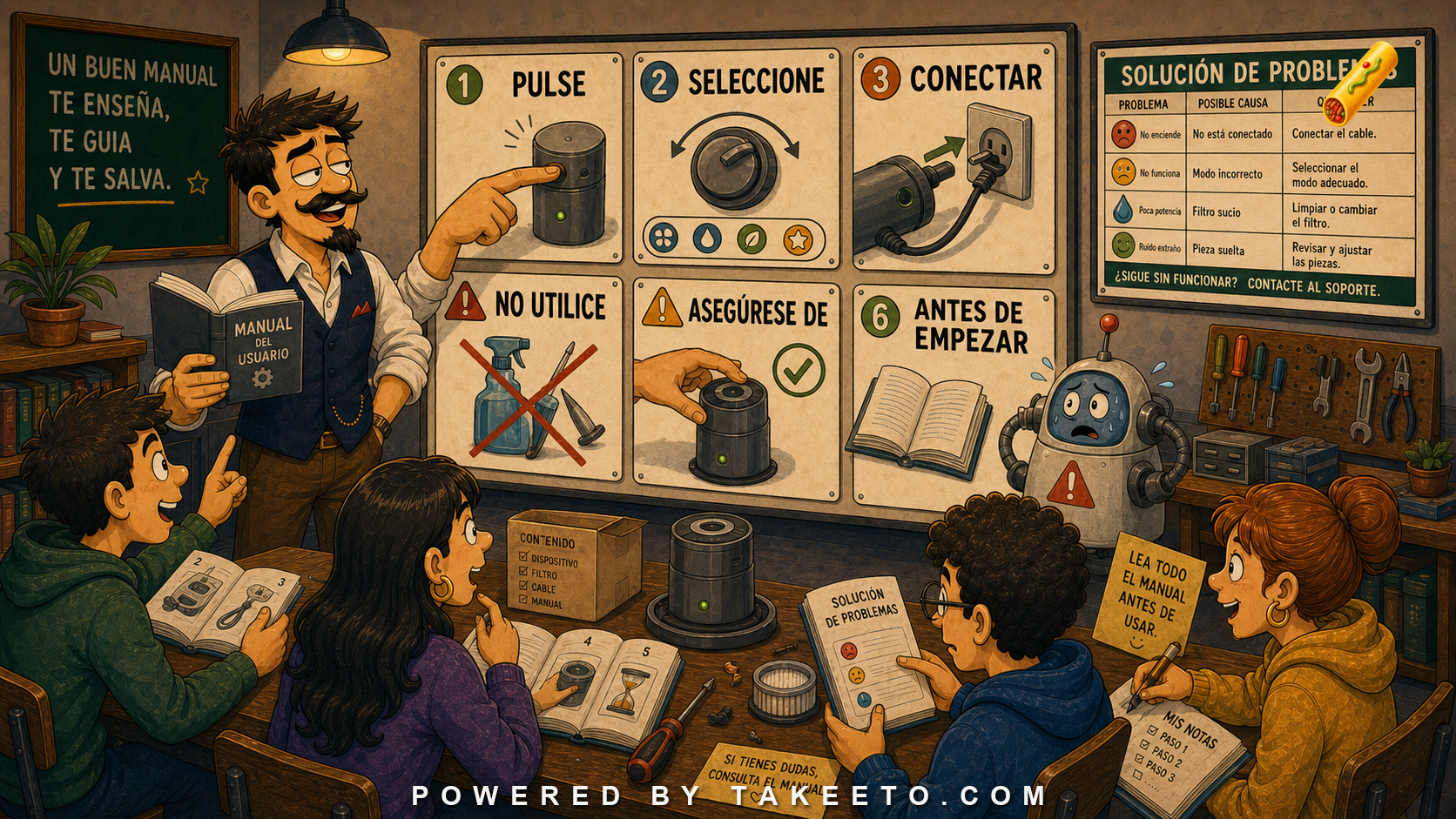
Pulse el botón de encendido.
Press the power button.
Seleccione la red Wi-Fi.
Select the Wi-Fi network.
This style is clear, formal, and user-facing. It is common in product UI and manuals.
Se construction:
Se recomienda apagar el dispositivo antes de limpiarlo.
It is recommended to turn off the device before cleaning it.
No se debe utilizar el equipo en ambientes húmedos.
The equipment should not be used in humid environments.
Se constructions are useful for general rules, safety notices, and impersonal warnings. They can become vague if overused in steps.
Consistency matters more than elegance
A bad manual mixes styles randomly:
Conecte el cable.
Seleccionar el idioma.
Ahora presiona continuar.
Se debe reiniciar.
This is not only ugly. It creates register confusion. Is the manual addressing the user as usted, tú, or no one? A good manual chooses a style and keeps it.
Better:
Conecte el cable de alimentación.
Seleccione el idioma.
Pulse Continuar.
Reinicie el dispositivo.
Or fully infinitive:
Conectar el cable de alimentación.
Seleccionar el idioma.
Pulsar Continuar.
Reiniciar el dispositivo.
Warnings, cautions, and danger language
Warnings are not normal steps. They need visual and linguistic priority.
Common labels:
Advertencia
Warning
Precaución
Caution
Atención
Attention
Importante
Important
Peligro
Danger
Prohibition:
No utilice el producto cerca del agua.
Do not use the product near water.
No abra la carcasa.
Do not open the casing.
Mantenga el dispositivo fuera del alcance de los niños.
Keep the device out of reach of children.
Warnings should say what not to do, why when necessary, and what risk exists. Vague warnings weaken safety.
Weak:
Tenga cuidado.
Be careful.
Better:
No toque la superficie metálica mientras el equipo esté encendido; puede estar caliente.
Do not touch the metal surface while the equipment is on; it may be hot.
Before starting: prerequisites
Antes de empezar is a useful heading.
Prerequisites may include:
Compruebe que la caja incluya los siguientes elementos.
Check that the box includes the following items.
Asegúrese de tener conexión a internet.
Make sure you have an internet connection.
Cargue la batería durante al menos dos horas.
Charge the battery for at least two hours.
A manual should not hide prerequisites inside later steps. If step six requires a cable, say that before step one.
Numbered steps and sequencing
Clear manuals use numbered steps when order matters.
1. Conecte el cable de alimentación.
2. Pulse el botón de encendido durante tres segundos.
3. Seleccione el idioma.
4. Siga las instrucciones en pantalla.
Sequence phrases:
antes de
before
después de
after
a continuación
next
luego
then
una vez que
once
hasta que
until
In manuals, hasta que often introduces a condition:
Mantenga pulsado el botón hasta que la luz parpadee.
Hold the button until the light blinks.
This is an action plus stopping condition. It must be precise.
Troubleshooting language
Troubleshooting sections often use:
solución de problemas
troubleshooting
problema
problem
causa posible
possible cause
solución
solution
si el problema persiste
if the problem persists
póngase en contacto con soporte técnico
contact technical support
Good troubleshooting pairs symptom and action:
Si el dispositivo no se enciende, compruebe que la batería esté cargada.
If the device does not turn on, check that the battery is charged.
Avoid vague “try again” loops without diagnostic steps.
Localization issues
Technical Spanish can be regionally sensitive. Botón is widely understood. Ordenador versus computadora varies. Enchufe, toma de corriente, contacto, and tomacorriente vary by region. Móvil and celular vary. Manual writers should decide whether they are writing for a specific region or for neutral international Spanish.
UI labels also matter. If the button on screen says Guardar, the manual should say Pulse Guardar, not Pulse Salvar unless the UI uses Salvar.
Consistency between interface and manual is more important than theoretical synonym preference.
Example bank walkthrough
pulse
Formal command from pulsar. Learner action: recognize as “press,” often for buttons.
seleccione
Formal command from seleccionar. Learner action: used for menu choices and options.
conectar
To connect. Learner action: infinitive style instruction or verb in explanatory text.
no utilice
Do not use. Learner action: safety prohibition; read conditions carefully.
asegúrese de
Make sure to. Learner action: marks prerequisite or verification.
antes de empezar
Before starting. Learner action: read prerequisites before steps.
solución de problemas
Troubleshooting. Learner action: match symptom, cause, and action.
Manual-reading and writing routine
- Identify the instruction style: infinitive, usted imperative, or se.
- Read warnings before steps.
- Locate prerequisites.
- Follow numbered steps in order.
- Watch for conditions: hasta que, una vez que, si.
- Match UI labels exactly.
- Use troubleshooting tables by symptom.
- Avoid improvising safety instructions.
- When writing, keep verbs and register consistent.
- Test instructions with a real user when possible.
Remediation: choose one instruction style and stay with it
Product manuals often fail because they mix instruction styles randomly:
Conecte el cable.
Seleccionar la red.
Se debe pulsar el botón.
Espera hasta que la luz parpadee.
Each sentence is understandable, but the style shifts between usted imperative, infinitive, impersonal construction, and tú imperative. A manual can use different styles intentionally in different contexts, but random mixing creates friction.
Common style systems:
Infinitive: Conectar el cable. Seleccionar la red. Pulsar Inicio.
Usted imperative: Conecte el cable. Seleccione la red. Pulse Inicio.
Impersonal: Se conecta el cable. Se selecciona la red.
Tú imperative: Conecta el cable. Selecciona la red. Pulsa Inicio.
For many technical manuals, infinitive or usted imperative is safer than tú because it feels neutral or formal.
Warning hierarchy
Manual Spanish should distinguish levels of risk:
Peligro
danger; serious immediate risk
Advertencia
warning
Precaución
caution
Atención / Aviso / Nota
attention/notice/note
A warning should name the hazard and the consequence:
Weak:
Tenga cuidado con el cable.
Better:
Advertencia: No utilice el cable si está dañado. Puede provocar descarga eléctrica o incendio.
Instructional Spanish must be clear enough to prevent harm, not merely grammatical.
Mini-workshop: repair unclear steps
Weak:
Conectar el equipo y se configura la red antes de usarlo.
Problems:
two actions merged; style inconsistency; unclear sequence; pronoun ambiguity
Better:
1. Conecte el equipo a la corriente.
2. Encienda el equipo.
3. Seleccione la red Wi-Fi.
4. Introduzca la contraseña.
5. Espere hasta que el indicador permanezca encendido.
Good manuals break tasks into one action per step when order matters.
Negative instructions and prohibitions
Spanish manuals use:
No utilice...
Do not use...
No conecte...
Do not connect...
No exponga...
Do not expose...
Mantenga... fuera del alcance de...
Keep... out of reach of...
Asegúrese de...
Make sure to...
Avoid vague negatives:
No hacer mal uso del equipo.
Better:
No utilice el equipo cerca del agua ni lo manipule con las manos mojadas.
The second version states observable behavior.
Upgraded manual-reading routine
When reading product instructions:
- Identify warnings before steps.
- Check prerequisites: power, tools, parts, environment, account, software version.
- Follow one numbered action at a time.
- Note whether verbs use infinitive, imperative, or se.
- Watch for antes de, después de, hasta que, mientras, and no... hasta.
- Keep troubleshooting separate from normal setup.
- Do not infer safety instructions from similar devices.
- If installation involves electricity, gas, water, structural work, medical devices, vehicles, or child safety, use professional help.
The remediation target is operational clarity: a manual is successful when the reader can act safely and in order.
Style-conversion drill for manual Spanish
A powerful practice exercise is to convert the same instruction into three acceptable styles and then choose the one that fits the product.
Base action:
connect the charger before turning on the device
Infinitive style:
Conectar el cargador antes de encender el dispositivo.
Usted imperative:
Conecte el cargador antes de encender el dispositivo.
Tú imperative:
Conecta el cargador antes de encender el dispositivo.
Impersonal se:
Se conecta el cargador antes de encender el dispositivo.
All four can be grammatical. They do not feel the same. The infinitive is compact and common in instructions. Conecte is direct and formal. Conecta is friendlier and product-brand dependent. Se conecta describes procedure more than command and may suit explanatory documentation.
Now add a warning:
No encienda el dispositivo si el cargador o el cable presentan daños visibles.
This warning should not become stylistically playful. Even in a friendly manual, safety language needs firmness.
Confirmation signals make steps testable
Good instructions often tell the user how to know the step succeeded:
hasta que la luz verde se encienda
cuando aparezca la pantalla de inicio
hasta oír un clic
cuando el indicador deje de parpadear
Without a confirmation signal, users may repeat a step, stop too early, or think the product is broken. Spanish manuals can improve clarity by pairing action and result:
Mantenga pulsado el botón durante cinco segundos, hasta que el indicador deje de parpadear.
For learners, this is also grammar practice: hasta que plus a result condition, temporal clauses with cuando, and precise verb choice for lights, sounds, screens, and mechanical parts.
Additional remediation: numbered steps must have one action each
A frequent weakness in Spanish technical writing is overloading one numbered step with several actions and conditions.
Weak:
3. Conecte el cable, abra la aplicación, confirme la configuración y reinicie el dispositivo si aparece el mensaje de error.
Better:
3. Conecte el cable al puerto USB.
4. Abra la aplicación.
5. Confirme la configuración.
6. Si aparece un mensaje de error, reinicie el dispositivo.
The second version separates normal sequence from conditional troubleshooting. This is not just prettier writing. It reduces user mistakes.
Object clarity
Manuals often use pronouns such as lo, la, los, and las. When several parts are mentioned, pronouns can become ambiguous.
Problematic:
Retire la tapa y el filtro. Límpielo con agua tibia.
What should be cleaned: the lid or the filter? A clearer version repeats the noun:
Retire la tapa y el filtro. Limpie el filtro con agua tibia.
Technical Spanish should not be afraid of repetition when repetition prevents error.
Safety grammar
Negative instructions should be explicit:
No abra la carcasa.
No exponga el equipo a la lluvia.
No utilice piezas no autorizadas.
Desconecte el dispositivo antes de limpiarlo.
Avoid softened prohibitions when safety is at stake. No se recomienda may be too weak if the action is dangerous. Use no utilice, no conecte, no abra, or queda prohibido depending on the seriousness and register.
Troubleshooting is not the same as setup
A manual should separate normal setup from troubleshooting. Setup assumes the expected path. Troubleshooting begins after something fails.
Setup:
Conecte el cable de alimentación. Encienda el equipo. Seleccione la red Wi-Fi.
Troubleshooting:
Si el indicador no se enciende, compruebe que el cable esté conectado correctamente. Si el problema continúa, reinicie el equipo.
The conditional si is central in troubleshooting Spanish:
Si aparece un mensaje de error...
If an error message appears...
Si el problema persiste...
If the problem persists...
Si no puede iniciar sesión...
If you cannot log in...
Clear troubleshooting avoids blame. It describes conditions and next steps. It also tells the reader when to stop trying and contact support:
Si el equipo emite olor a quemado, desconéctelo de inmediato y póngase en contacto con el servicio técnico.
That is not optional advice. It is a safety boundary.
Suggested interactive module: instruction-style converter
A strong tool for this article would rewrite instructions into a consistent manual style.
Suggested functions:
- Style selector: infinitive, usted imperative, tú imperative, impersonal se.
- Consistency checker: flags mixed register.
- Warning formatter: peligro, advertencia, precaución.
- Step validator: one action per step.
- Condition highlighter: si, hasta que, antes de, una vez que.
- UI-label lock: preserve exact button text.
- Troubleshooting table builder: symptom, cause, solution.
Final rule
Product-manual Spanish should not be clever. It should be safe, consistent, and executable.
Choose an instruction style. Mark warnings. Separate prerequisites from steps. Tell the user exactly what to do next.